Nomad vs Ubigi eSIM Europe is one of the most common comparisons for travelers in 2026. Nomad is built for occasional travelers who want simple, disposable plans. Ubigi is built for frequent travelers who want one rechargeable eSIM forever.
Both providers rely on eSIM technology, which allows you to activate mobile data digitally without inserting a physical SIM card. If you travel once or twice a year, Nomad wins on price and simplicity. If you travel 3+ times per year, Ubigi wins on convenience.
Why trust this comparison? I review travel eSIMs full-time and have tested both Nomad and Ubigi across multiple European trips. All prices verified on official websites in February 2026. Prices change frequently — always confirm on the provider’s site before purchasing.
The worst travel mistake in Europe isn’t overpaying €5 for data. It’s landing without internet when you need maps, Uber, or hotel check-in instructions.
You’re planning your Europe trip. You’ve narrowed it to Nomad or Ubigi. You don’t want to read 15 articles. Here’s the short version:
Traveling once this year? Get Nomad. It’s slightly cheaper per trip and you won’t need reusable infrastructure.
Traveling 3+ times per year? Get Ubigi. Install once, recharge forever. After the second trip, the convenience pays for itself.
If you want the full breakdown — pricing tables, coverage maps, app comparison, and route-specific recommendations — keep reading.
In this comparison, you’ll see a full breakdown of pricing, model differences, coverage, and real travel scenarios so you can decide in minutes.
Nomad vs Ubigi eSIM Europe Comparison Table
| Nomad | Ubigi | |
| Best For | Single trips | Frequent travelers |
| Model | Buy each trip | Install once, recharge forever |
| Europe Countries | 60+ | 35+ |
| App | ✅ Simple, minimal | ✅ Feature-rich |
| Top-Up | ✅ Buy new plan | ✅ In-app, instant |
| Hotspot | ✅ | ✅ |
| Customer Support | Email (24-48h) | Live chat + email |
| Trustpilot | 4.2/5 (4,600+) | 4.3/5 (12,000+) |
| My Rating | 4.4/5 | 4.5/5 |
At a glance: Nomad is slightly cheaper for single trips. Ubigi eliminates reinstallation on every trip. Nomad covers 60+ countries (better for Eastern Europe). Ubigi focuses on 35+ core destinations (better for Western Europe).
For a complete breakdown across all 7 providers, see my Best eSIM for Europe 2026 guide.
The Core Difference: Disposable vs Rechargeable
This is where most people choose wrong.
Nomad: Buy, Use, Done
With Nomad, every trip is separate.
You buy a plan. Install it. Use it. Delete it.
Next trip, you repeat the process.
That’s perfect if:
- You don’t travel often
- You want zero long-term commitment
- You prefer a clean slate each time
It’s simple and it works.
Ubigi: Install Once, Recharge Forever
Ubigi works differently.
You install the eSIM once. Before each trip, you open the app and top up. Same eSIM. Every trip. Every country.
That’s ideal if:
- You travel multiple times per year
- You move between countries often
- You don’t want to reinstall eSIMs constantly
After the first setup, activating data takes less than a minute.
Quick decision: If you’re traveling once this year, stop here — get Nomad. You’ll save a few dollars and you won’t use the reusable infrastructure. If you travel 3+ times per year, get Ubigi — the time savings add up fast. Still unsure? Keep reading.
Pricing Comparison
This is where the comparison gets interesting. Nomad costs slightly less per individual trip — but the gap is small.
Nomad Europe Plans (USD)
| Data | Validity | Price |
|---|---|---|
| 1 GB | 7 days | $5 |
| 3 GB | 30 days | $11 |
| 5 GB | 30 days | $16 |
| 10 GB | 30 days | $25 |
| 20 GB | 30 days | $40 |
Ubigi Europe Plans (EUR)
| Data | Validity | Price (EUR) | Price (USD) |
|---|---|---|---|
| 1 GB | 30 days | €4.50 | ~$5 |
| 3 GB | 30 days | €12 | ~$13 |
| 10 GB | 30 days | €28 | ~$31 |
| 25 GB | 30 days | €59 | ~$65 |
| 50 GB | 30 days | €99 | ~$109 |
Price Comparison
| Data | Nomad | Ubigi | Difference |
|---|---|---|---|
| 1 GB | $5 | ~$5 | About equal |
| 3 GB | $11 | ~$13 | $2 |
| 10 GB | $25 | ~$31 | $6 |
When comparing Nomad vs Ubigi eSIM Europe options, pricing differences are small but travel frequency changes the decision.
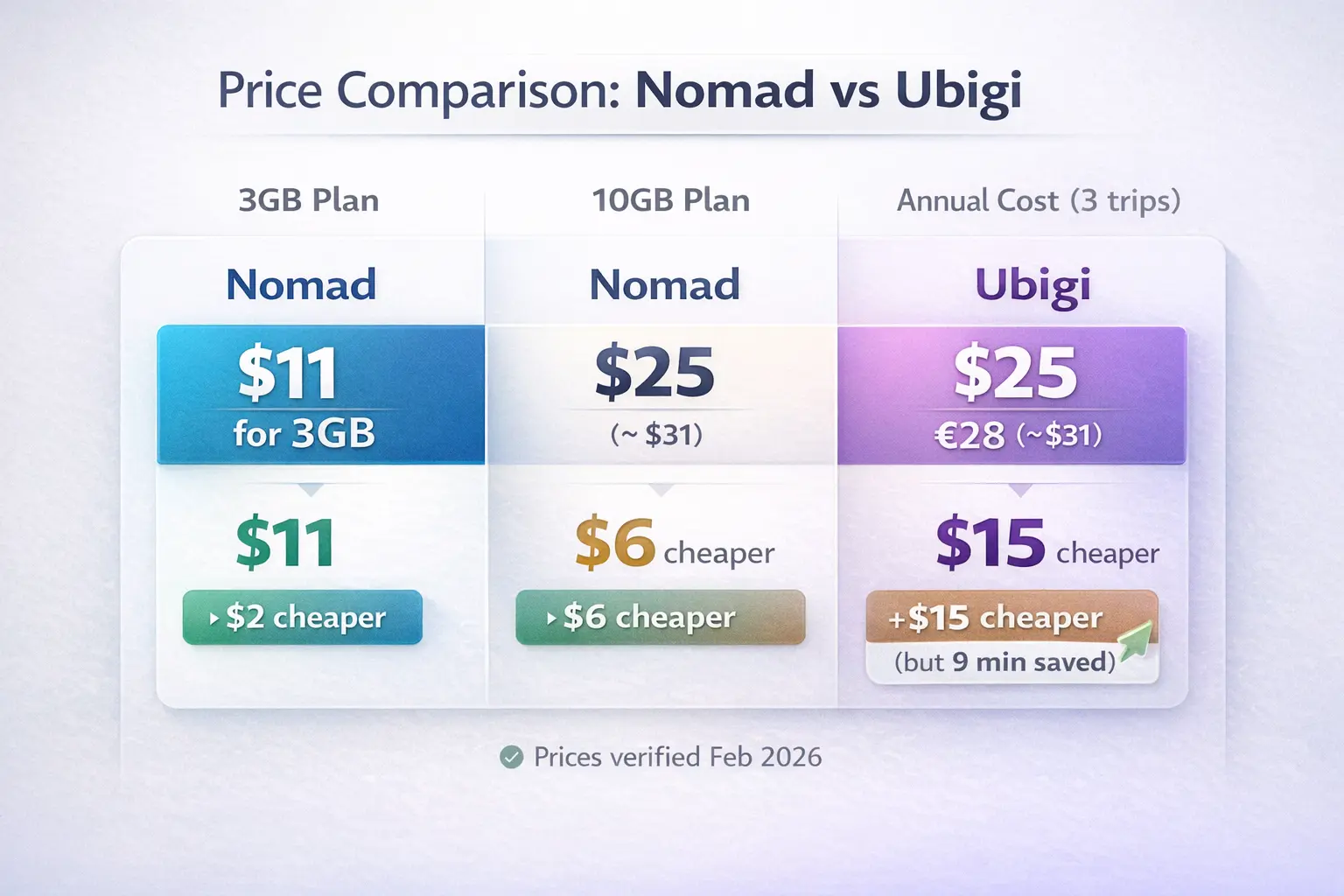
Nomad is usually slightly cheaper at every tier — $2 to $6 per trip. But here’s what the pricing table doesn’t show: time cost.
Real-World Scenario: Three Trips Per Year
Let’s say you take three 10-day European trips annually, using roughly 5GB per trip:
With Nomad:
- Trip 1: $16 (5GB plan) + 5 min setup
- Trip 2: $16 (5GB plan) + 5 min setup
- Trip 3: $16 (5GB plan) + 5 min setup
- Total: $48 + 15 minutes of repeated setup
With Ubigi:
- Initial install: 3 minutes (one-time)
- Trip 1: €19 (~$21) + 1 min top-up
- Trip 2: €19 (~$21) + 1 min top-up
- Trip 3: €19 (~$21) + 1 min top-up
- Total: ~$63 + 6 minutes total
Nomad saves $15 over the year. Ubigi saves 9 minutes and eliminates reinstallation hassle.
If you’re based in the EU: Ubigi’s euro pricing eliminates currency conversion fees (saves 2-3% per transaction).
For a complete breakdown across all 7 providers, see my Cheapest eSIM for Europe 2026 guide.
Coverage in Europe
Nomad
| Countries Covered | 60+ |
|---|---|
| Includes | All EU countries, UK, Switzerland, Norway, Iceland, Romania, Bulgaria, Serbia, Albania, Montenegro, North Macedonia, Bosnia and Herzegovina, Turkey |
| Best For | Eastern Europe, Balkans, less common destinations |
Strong choice if your route goes beyond typical tourist circuits or includes Eastern Europe extensively.
Ubigi
| Countries Covered | 35+ |
|---|---|
| Includes | All EU countries, UK, Switzerland, Norway, Iceland |
| Best For | France, Germany, Italy, Spain, Portugal, Netherlands, Belgium, Austria, Czech Republic |
Focuses on high-traffic destinations and business routes.
Bottom line: If your trip is Western/Central Europe, both work equally well. If you’re going deeper into Eastern Europe or Balkans, Nomad usually makes more sense.
Performance & Speed
Both use the same local carrier networks (Vodafone, Orange, T-Mobile), so speeds are nearly identical in major cities.
The difference shows up more in rural areas and specific countries:
- Ubigi tends to be more reliable in Switzerland and France
- Nomad has better coverage in Greek islands and rural Southern Europe
For typical routes (capitals and main cities), you won’t notice a difference.
Data Plans & Flexibility: Ubigi Wins
While Nomad is cheaper per trip, Ubigi offers more long-term flexibility.
Nomad: Simple regional plans. One Europe plan covers 60+ countries. Buy what you need for each trip, then delete.
Ubigi: Install once, top up as needed. The same eSIM works across 190+ countries globally. You build account credit that works anywhere.
Top-Up Capability
This is a real differentiator. If you run out of data mid-trip:
Ubigi: Tap “top up” in the app. Instant. You keep the same eSIM. Takes 30 seconds.
Nomad: Top-up available but requires buying a new plan and potentially installing a new eSIM.
If you’re the type of traveler who might underestimate data needs and want the safety net of instant top-ups, Ubigi’s flexibility is worth paying for.
App & User Experience
Both apps work well, but they’re designed for different priorities.
Nomad App: Minimalist Efficiency
Nomad’s app is stripped down to essentials.
What works:
- Browse plans by region in under 10 seconds
- Purchase flow is 3 taps: select → pay → install
- No account required (guest checkout available)
- Perfect for occasional travelers
What’s missing:
- No saved payment methods
- Limited in-app support
- Can’t manage multiple eSIMs simultaneously
Based on 4,600+ Trustpilot reviews at 4.2/5, users praise the simplicity but note limited features.
Ubigi App: Feature-Rich Command Center
Ubigi’s app has more capabilities.
What works:
- Single eSIM manages 190+ countries
- Account credit system (load once, use anywhere)
- Saved payment methods
- In-app live chat support
- Detailed usage tracking across trips
What’s clunky:
- Initial setup takes 5-7 minutes with account creation
- More screens to navigate
- Occasional display bugs
Based on 12,000+ Trustpilot reviews at 4.3/5, users appreciate the features but note the learning curve.
Verdict: Nomad wins for simplicity. Ubigi wins for repeat-use convenience.
Real Travel Scenarios
1 European Trip Per Year
Nomad wins.
You’ll save a few dollars and you won’t need reusable infrastructure.
3–5 Trips Per Year
Ubigi starts making more sense.
The time saved by not reinstalling eSIMs adds up. You just open the app and activate.
Western Europe Business Circuit (London → Paris → Amsterdam → Frankfurt)
Ubigi fits better.
Permanent eSIM. Quick top-up. Seamless across countries. If you run this circuit quarterly, Ubigi saves time and hassle.
Eastern Europe Route (Prague → Budapest → Bucharest → Balkans)
Nomad is safer.
Broader regional coverage (60+ countries) in one plan. Ubigi may require separate country plans for some destinations.
Weekend City Break (3-4 days, light use)
Either works.
The price difference is small. Choose based on whether you already have Ubigi installed.
Month-Long Digital Nomad Stay
Ubigi makes more sense.
Install once, top up as needed, move between countries seamlessly without thinking about eSIM logistics.
What Both Are Missing
Before choosing between Nomad and Ubigi, know what neither offers:
❌ Phone number — both are data-only. No calls, no SMS. If you need a phone number for 2FA codes or calling, see my SimOptions Review ($29 for 30GB with calls).
❌ Unlimited data — neither offers unlimited plans. If you need unlimited, see my Holafly Review (€45.95/month).
❌ Long-stay auto-renew — both cap at 30 days. For stays over a month, check providers with longer validity periods.
These aren’t dealbreakers for most short trips. But if you need any of these features, a different provider is the better choice.
Who Should Skip Both
If you need:
- A local phone number for calls
- Unlimited data for heavy streaming
- Validity longer than 30 days
Neither Nomad nor Ubigi is ideal. Check my Best eSIM for Europe 2026 comparison for alternatives.
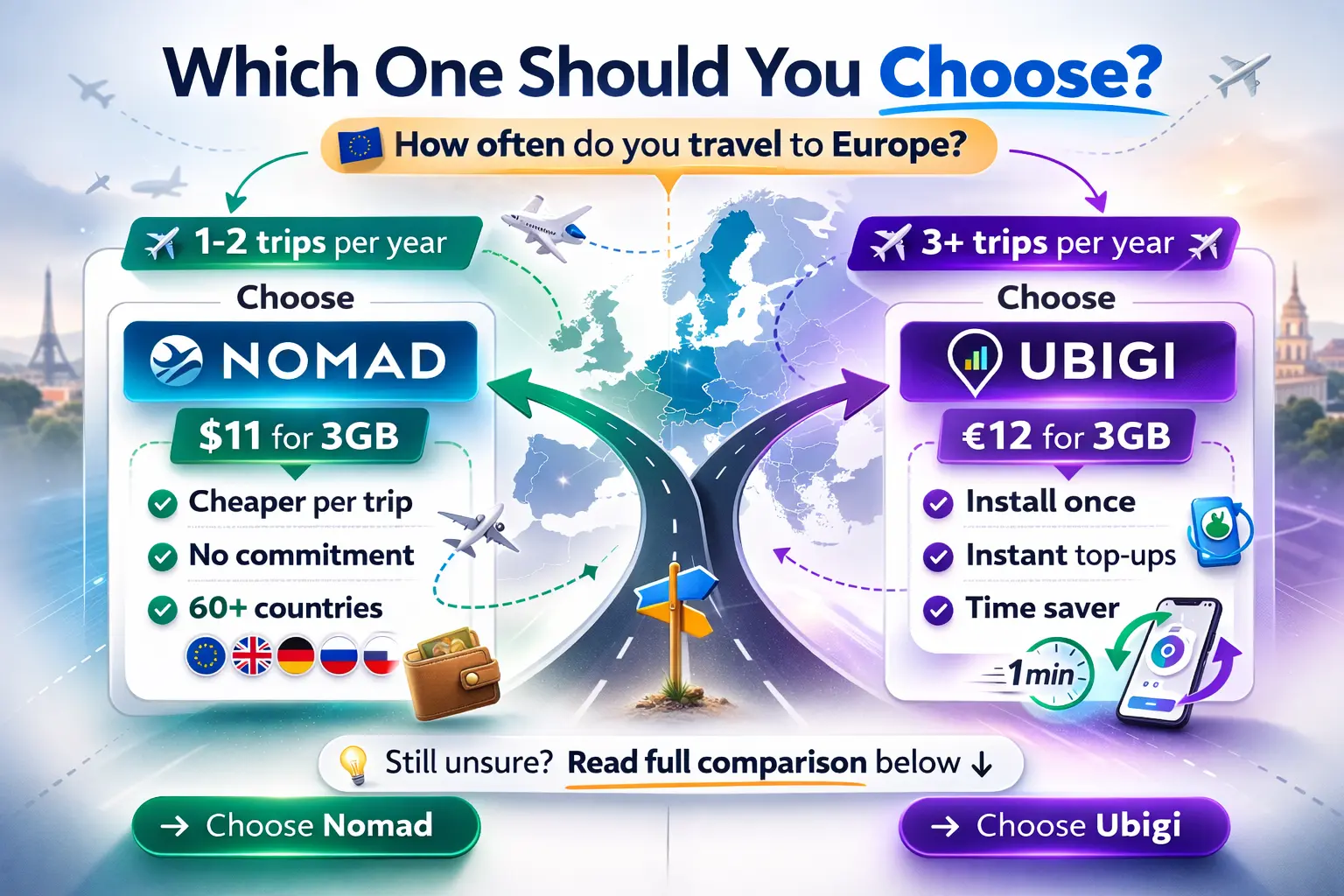
Choose Nomad If…
✔ You travel once or twice per year
✔ Your route includes Eastern Europe or Balkans
✔ You want the cheapest single-trip option
✔ You prefer not keeping a permanent eSIM installed
✔ You’ve used eSIMs before and don’t need hand-holding
✔ Budget is your top priority — period
Nomad is the budget airline of eSIMs — no frills, no extras, just cheap data that works.
Read my Nomad Review 2026
Choose Ubigi If…
✔ You travel internationally 3+ times per year
✔ You want one eSIM for multiple trips
✔ You’re based in the EU and prefer euro billing
✔ Convenience matters more than saving a few dollars per trip
✔ You need instant in-app top-ups as a safety net
✔ You travel beyond Europe and want global coverage
Ubigi is the premium option — smoother experience, slightly higher price, everything just works.
Read my Ubigi Review 2026
Frequently Asked Questions
Is Nomad cheaper than Ubigi for Europe?
Yes, at almost every data tier. The difference is $2-6 per trip. For 10 GB, Nomad charges $25 while Ubigi charges €28 (~$31) — a $6 difference. The gap is consistent across all plan sizes, but it’s not huge.
Is Ubigi better than Nomad?
It depends on your priority. Ubigi has the better model for frequent travelers (install once, recharge forever), live chat support, and instant top-ups. Nomad has lower prices per trip and broader country coverage (60+ vs 35+). If you travel 3+ times per year, choose Ubigi. If you travel once or twice, choose Nomad
Do Nomad and Ubigi include phone numbers?
No. Both are data-only eSIMs — no calls, no SMS, no phone number. If you need a working phone number for calls or SMS verification codes, see my SimOptions Review for eSIMs that include voice capabilities.
Can I use Nomad and Ubigi for hotspot?
Yes. Both Nomad and Ubigi support hotspot/tethering, so you can share your phone’s data connection with your laptop, tablet, or travel companion’s phone. No extra cost.
Which has better coverage in Europe — Nomad or Ubigi?
Nomad covers 60+ European countries including Eastern Europe and Balkans. Ubigi covers 35+ core destinations focusing on Western and Central Europe. For typical Western Europe trips (France, Spain, Italy, Germany), both work equally well. Nomad has an advantage for less common destinations.
What if I run out of data with Nomad or Ubigi?
Ubigi lets you top up instantly through its app — you keep the same eSIM profile and add more data in seconds. Nomad requires purchasing a new plan, which may involve installing a new eSIM. If running out of data worries you, Ubigi’s instant top-up is a meaningful advantage.
Can I use both Nomad and Ubigi at the same time?
Yes, if your phone supports multiple eSIMs (most iPhones from XS/XR onwards and Android phones from 2020+ support 5-8 eSIM profiles simultaneously). You could keep Ubigi installed permanently and still buy Nomad for specific trips if you find a better deal.
Nomad vs Ubigi 2026: Final Verdict
In this Nomad or Ubigi comparison, the final decision comes down to one simple question: what matters more to you — saving a few dollars per trip or eliminating setup hassle?
If you want the cheapest option for single trips, buy Nomad. At $11 for 3GB or $25 for 10GB, it’s consistently cheaper than Ubigi per trip. The app works, the coverage is excellent (60+ countries), and you’ll save money every time.
If you want long-term convenience for multiple trips, buy Ubigi. You’ll pay slightly more per trip, but you’ll install once and recharge forever. After your second or third trip, the time savings become meaningful — especially for frequent travelers.
Both are excellent providers. You won’t regret either choice. But one will fit your travel pattern better than the other.
If you’re overthinking it, you’re already ahead of 90% of travelers. Pick the one that matches your travel frequency and move on. Both will work.
In this Nomad vs Ubigi eSIM Europe comparison, the decision depends on your travel frequency.
My picks:
Single trip on a budget → Nomad ($11/3GB)
3+ trips per year → Ubigi (€28/10GB, install once)
Eastern Europe route → Nomad (60+ countries covered)
Western Europe business circuit → Ubigi (instant top-ups, seamless)
This article contains affiliate links. I may earn a commission at no extra cost to you. All prices verified on official websites in February 2026.
Last verified: February 2026.