


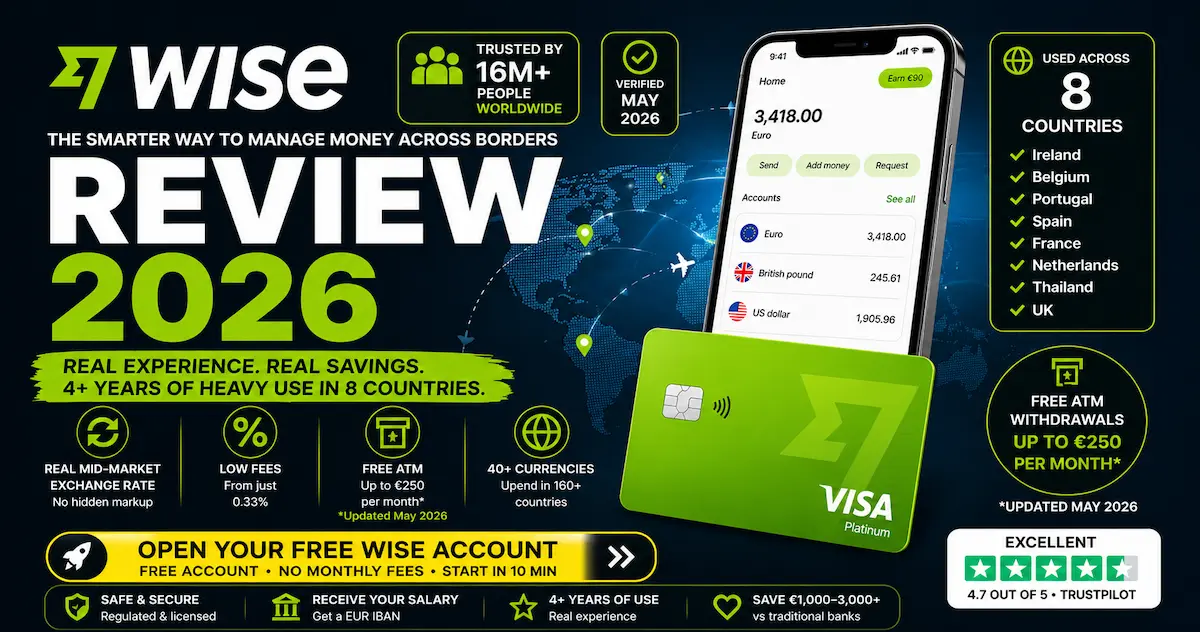
⚡ Quick Answer — Is Wise Worth It in Europe in 2026?
Yes — for travelers, expats, and digital nomads spending across multiple European currencies, Wise remains the most transparent and cost-efficient multi-currency account available in 2026. It uses the real mid-market exchange rate with no hidden markup, charges conversion fees from 0.33–0.57% (vs 2–4% at banks), offers free ATM withdrawals up to €250/month (updated May 2026), and has zero monthly subscription fee. Wise now serves over 16 million customers globally, processing $12 billion per month.
Wise Review Europe 2026 — after 4 years of real use across 8 countries, here’s what actually matters if you’re living or traveling in Europe.
My personal verdict after 4 years: I used Wise to receive my salary while living in Ireland and Belgium, send money to Brazil, pay for everything from groceries in Dublin to restaurants in Bangkok, and manage money across 8 countries. The fees I paid in four years of heavy use were a fraction of what any traditional bank would have charged. It’s not perfect — customer support has slowed and it’s not a full bank — but for international money management in Europe, nothing competes at this price point.
8 countries. 4 years. Here’s where Wise actually works — and saves you money.
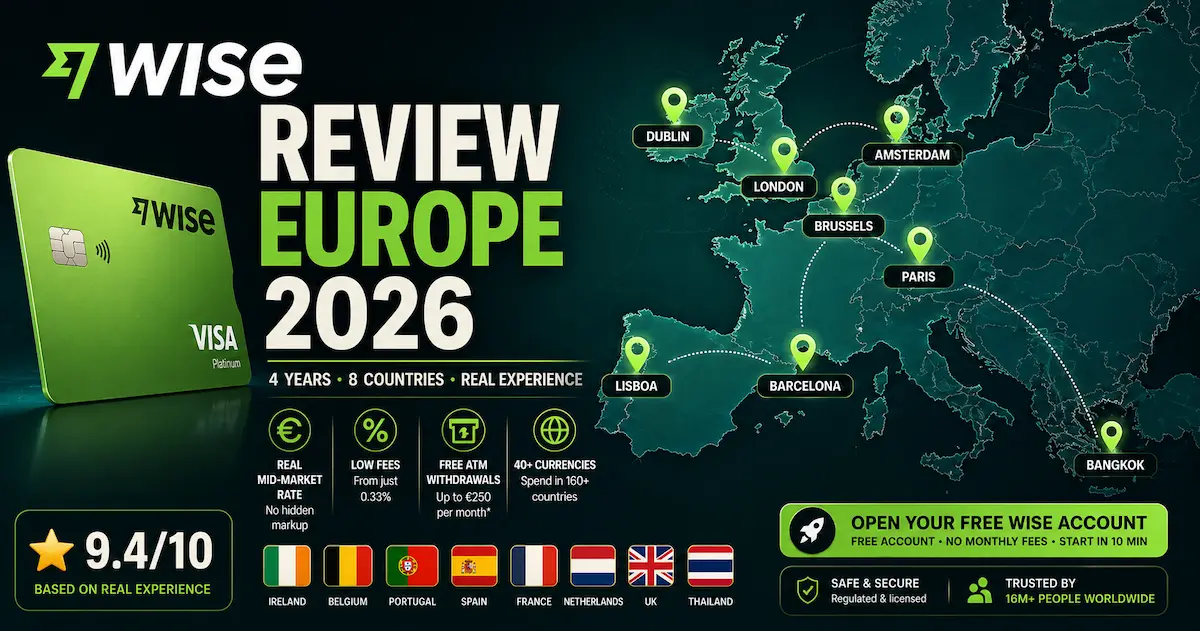
Best for: Expats · travelers · digital nomads · anyone paid in one currency and spending in another. Not ideal for: People who only spend domestically, need cash deposits, or want a credit card. Verified May 2026.
This Wise Review Europe 2026 is based on real usage — not theory.
🔥 Get Started with Wise — Free Account → 10 min sign-up · no monthly fee · card delivery in 5–10 days
Why My Wise Review Europe 2026 Is Different From Most
I left Brazil in 2022 to live in Ireland. Wise wasn’t just a travel card for me — it was how I received my salary from Irish and Belgian employers, paid my rent, sent money home to family, and managed money across 8 countries over 4 years. I’ve used it in Ireland, Belgium, Portugal, Spain, France, Thailand, the Netherlands, and the UK (London). My wife uses Revolut. I’ve contracted N26 myself. I know these products from the inside out — not from a press release.
⭐ My Rating: 9.4/10 — Based on 4 years of real use across 8 countries
| Category | Score |
|---|---|
| Fees & Value | 9.8/10 |
| Ease of Use | 9.5/10 |
| Coverage | 9.5/10 |
| Customer Support | 7.5/10 |
| Salary Receipt | 9.0/10 |
| International Transfers | 9.8/10 |
Quick stats: 8 countries · 4+ years · 0.33% lowest conversion fee · €0 monthly fee
What Is Wise and How Does It Work in Europe?
Wise (formerly TransferWise) is a multi-currency account with a debit card that lets you hold, convert, send, and spend money in 40+ currencies at the real mid-market exchange rate — the same rate you see on Google — with a small transparent fee and no hidden markup.
For anyone living in, traveling through, or earning money across multiple European countries, this is genuinely transformative. The difference between Wise and a traditional bank isn’t a technicality. It’s the difference between paying 0.4% to convert your salary from EUR to GBP and paying your bank’s 3.5% markup on the same transaction — invisibly embedded in an “unfavorable” exchange rate you never questioned.
When I moved from Brazil to Ireland in 2022, Wise was the first account I opened. My Irish employer paid my salary directly into my Wise EUR IBAN. I used the same account to send money to my family in Brazil, pay my Dublin landlord, and buy groceries in Tesco — all without a single hidden fee. When I moved to Belgium, the same account received my Belgian salary. When my wife and I traveled to Thailand, the Wise card connected to the local Mastercard network seamlessly. It’s been four years of the same account, the same app, and consistently the lowest fees available.
| Feature | Wise | Traditional Bank |
|---|---|---|
| Exchange rate | Real mid-market rate (no markup) | 2–4% hidden markup |
| Conversion fee | 0.33–0.57% (shown upfront) | Hidden in exchange rate |
| ATM withdrawals | Free up to €250/month (May 2026), then 1.75% | €2–5 per withdrawal + % |
| Monthly fee | €0 | €5–15/month |
| Receive salary | ✅ EUR IBAN included | Depends on country |
| Multi-currency | 40+ currencies | Single currency |
| Setup time | 10 min + 2–3 days verification | Branch visit, 1–2 weeks |
Wise Fees Europe 2026: Complete Breakdown
In this Wise Review Europe 2026, fees are one of the biggest advantages compared to traditional banks.
Wise publishes every fee publicly on its official pricing page. There are no surprises. Here’s what you actually pay in Europe in 2026:
Currency Conversion Fees
| Currency Pair | Wise Fee | Typical Bank (hidden) |
|---|---|---|
| EUR → USD | ~0.47% | 2.5–4% |
| EUR → GBP | ~0.33% | 2–3.5% |
| EUR → BRL | ~1.5% | 4–6% |
| USD → EUR | ~0.47% | 2.5–4% |
| GBP → EUR | ~0.33% | 2–3.5% |
| EUR → CHF | ~0.57% | 2.5–4% |
This is where most people lose money — here’s the real difference between Wise and banks.
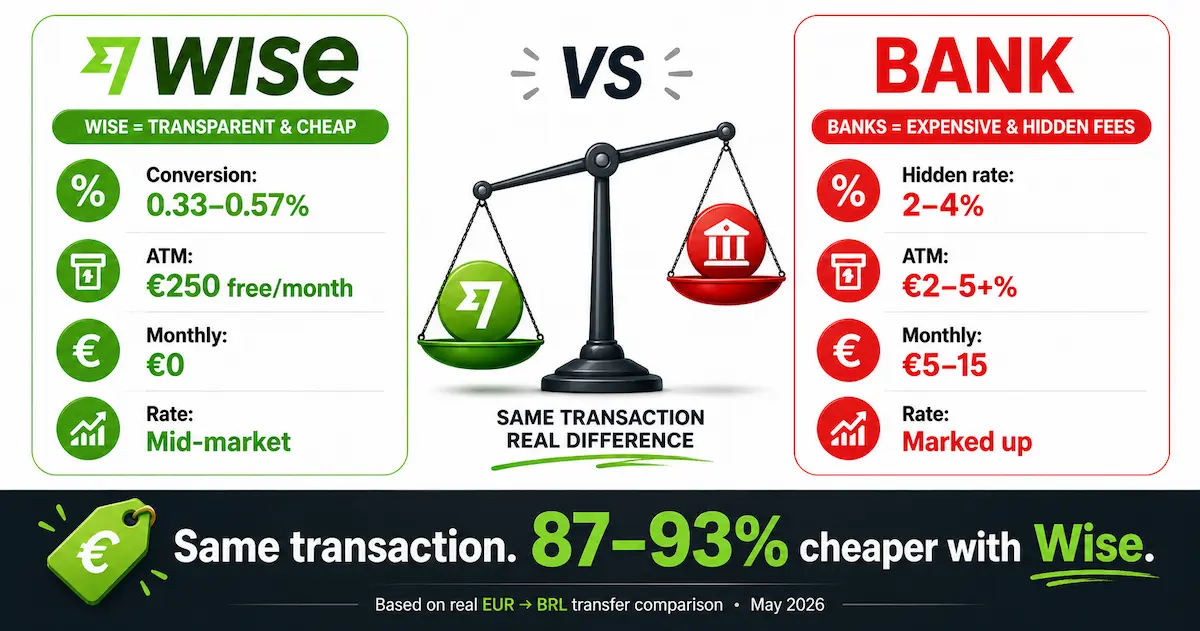
Rates verified via wise.com/pricing — May 2026.
ATM Withdrawals
- Free: Up to €250 per month (updated May 2026 — Wise removed the previous 2-withdrawal limit and the €0.50 fixed fee)
- After free limit: 1.75% on amounts over €250 per month
- Real example: Withdraw €400 in one month = first €250 free, 1.75% (€2.63) on the remaining €150 = total cost €2.63
- Bank comparison: Most banks charge €2–5 per international ATM withdrawal + 2–3% foreign transaction fee
Before you use your Wise card, watch this — it shows the two easiest ways to withdraw money without extra fees.
In practice, this means you can get paid in Europe without opening a traditional bank account first.
Other Fees
| Fee Type | Wise | Traditional Bank |
|---|---|---|
| Monthly account fee | €0 | €5–15 |
| Card fee (first card) | €7 one-time (physical) | €20–50/year |
| Card replacement | €7 | €10–20 |
| Receive EUR (SEPA) | Free | Free (varies) |
| Receive USD wire | $6.11 per wire | $10–25 |
| Inactivity fee | €0 | €5–10/month |
| Top-up via bank transfer | Free | N/A |
💡 Key rule for zero conversion fees: If you hold EUR in your Wise account and spend in EUR (across all Eurozone countries), you pay zero conversion fee. For anyone living in Portugal, Ireland, Belgium, Spain, France, Italy, Germany, or any Eurozone country — your day-to-day spending costs nothing beyond the €7 card fee, paid once.
Wise Assets: Interest on Your Balance
Wise now offers interest on EUR and USD balances through Wise Assets — a feature many users don’t know about. For EUR balances in Europe, you can earn approximately 1.76% p.a. (variable, not guaranteed). This isn’t a savings account in the traditional sense, and it involves investment funds, but for idle money sitting in your Wise account, it’s meaningfully better than €0. For heavy users who hold €5,000–10,000 in their Wise balance for spending, this adds up to €88–176 per year in passive interest. Compared to Revolut, which offers ~2.25% p.a. but only on paid plans — the gap narrows significantly when you factor in Revolut’s subscription cost.
💰 Real savings calculation: Wise vs traditional bank On a €500 EUR→BRL transfer: Wise charges ~€7.50 (1.5%). A traditional bank charges €15–25 wire fee plus a 4–6% rate markup = €35–55 total. Difference: €27–47 saved on one transfer. Over 4 years of regular transfers, Wise has saved me conservatively €1,000–2,000 compared to my old bank. For full-time expats in Europe, annual savings of €1,000–3,000 vs traditional banking are common. The math compounds fast.
This part of the Wise Review Europe 2026 shows how it performs in real life across different countries.
My Personal Experience: 4 Years Across 8 Countries
This isn’t a theoretical review. Everything below is based on direct personal use — not testing, not simulations.
Ireland (2022–2023) — Receiving Salary Through Wise
When I arrived in Ireland, I opened a Wise account before I had an Irish bank account. Crucially, Wise gave me an Irish IBAN and account details immediately — and my employer was able to pay my salary directly into it. This is something most people don’t realize Wise can do. You don’t need a traditional bank account to receive your salary in Europe. You need a Wise account with local currency details.
I used the Wise card for groceries at Tesco, bills in Dublin, and train tickets across Ireland. I sent money back to Brazil regularly using the EUR→BRL conversion — always at the mid-market rate, always with the fee shown upfront. I also made Wise-to-Wise transfers to colleagues and friends, which were instant and free.
Belgium (2025–2026) — Second Salary, Cross-Border Use
When I relocated to Belgium for work, the same Wise account received my Belgian salary — no new setup needed. My EUR balance transferred seamlessly. I was also frequently crossing to the Netherlands, France, and Luxembourg for work — all Eurozone, all €0 conversion fees from my EUR balance. The Wise card worked identically across every border.
Portugal (2026–present) — Settled Base, Ongoing Use
Now based in Portugal, I use Wise as my primary international account. I still use it for transfers to Brazil, for online purchases in non-EUR currencies, and whenever I travel. My wife and I also connected our accounts for shared expense management on trips — the Wise-to-Wise transfer is instant and costs nothing.
Spain, France, Thailand, Netherlands, UK
Every Eurozone country worked identically — no friction, no surprises. Thailand was smooth via Mastercard. The UK (London) worked well, though I noticed slightly slower contactless in a couple of older terminals. The ATM network (any Mastercard-accepting ATM) was universally available across all 8 countries I tested.
⚠️ Honest note on support: Customer support has declined noticeably since 2022. Response times that used to be under 10 minutes now sometimes take hours. The chat-only model is a limitation, and there’s no phone support. For me personally this was never a critical issue — I’ve needed support maybe 5 times in 4 years and it was resolved each time — but it’s a real weakness for users who encounter urgent problems.
If you’re planning to travel across Europe and want to stay connected without roaming fees while also keeping your money costs down, combining Wise with a reliable eSIM for Europe is the combination that covers both problems. The Wise card handles money. The eSIM handles data. Both work without touching your home carrier.
Open Your Free Wise Account → Free account · No monthly fees · Your EUR IBAN included · Receive salary · 40+ currencies
A key part of this Wise Review Europe 2026 is understanding how it compares to Revolut and N26.
Wise vs Revolut vs N26: Honest Comparison from Real Use
I’ve used all three. My wife uses Revolut daily. I contracted N26 for a period in Ireland. Here’s the actual picture — not a table built from press releases.
Wise vs Revolut
My wife started using Revolut while I was on Wise. We’ve compared them side by side on hundreds of transactions. The honest verdict: they serve different purposes and both have real strengths.
Revolut is more of a full financial app — she’s done crypto investments, received salary, and used the stock trading features directly in the app. The interface is more feature-rich. But we found the Revolut app more complex than it needed to be, the weekend markup on currency conversion (0.5–1% extra on Saturdays and Sundays) caught us off-guard a couple of times, and the €1,000/month free conversion limit on the standard plan means heavy users eventually pay more than they expect.
Wise is simpler. Every conversion shows the exact fee upfront. There’s no weekend markup — the rate is identical at 2am on Sunday as it is at 9am on Monday. For pure money management and international transfers, I’ve consistently found Wise cheaper and more predictable.
| Feature | Wise | Revolut (Standard) |
|---|---|---|
| Exchange rate | Mid-market, always | Mid-market up to €1,000/month, then 0.5% |
| Weekend markup | None | 0.5–1% on Sat/Sun |
| Monthly fee | €0 | €0 standard / €3.99–€45 paid |
| Free ATM/month | €250 free (May 2026) | €200 free (Standard) |
| Receive salary (IBAN) | ✅ | ✅ |
| Crypto/investing | ❌ | ✅ Built-in |
| App complexity | Simple, focused | Feature-rich, can feel cluttered |
| Interest on EUR | ~1.76% p.a. (Wise Assets) | ~2.25% p.a. (paid plans only) |
My verdict: If you want the cheapest and most transparent option for spending money in Europe and sending internationally, Wise wins. If you want an all-in-one financial app with crypto, investments, and premium travel perks, Revolut’s paid tiers are worth considering. We use both in our household — Wise for transfers and international spending, Revolut for investment features.
Wise vs N26
I contracted N26 in Ireland to compare it with Wise. N26 is a proper bank — licensed, deposit-insured under EU scheme (up to €100,000), with a German IBAN. That’s its main advantage over Wise. Interesting detail: N26 actually uses Wise under the hood for its international transfer feature. When you make an international transfer through N26, the rates and fees are Wise’s — N26 has integrated Wise directly into its app. This means using Wise directly is more transparent and often gives you a clearer fee breakdown than going through N26’s interface.
For international spending, N26 is noticeably more expensive than Wise. Free plan gives 3 free ATM withdrawals per month (then €2 each), uses Mastercard’s exchange rate (not the mid-market rate), and charges a foreign transaction fee on non-EUR purchases.
| Feature | Wise | N26 (Standard) |
|---|---|---|
| Bank license | ❌ Payment institution | ✅ Full bank (EU licensed) |
| Deposit insurance | No (safeguarded accounts) | Yes (up to €100,000) |
| Exchange rate | Mid-market rate | Mastercard rate (~1–2% markup) |
| Foreign transaction fee | €0 (same currency) | €1.70/transaction (free tier) |
| Multi-currency | 40+ currencies | EUR primary |
| ATM fees | €250 free/month | 3 free/month, then €2 |
| Monthly fee | €0 | €0 Standard / €4.90–€16.90 paid |
| Best for | International spending | Living in EU, domestic banking |
My verdict: Use N26 if you’re settled in Germany or another EU country and want a proper bank account with deposit insurance. Use Wise if you travel frequently, earn in multiple currencies, or send money internationally.
Not all fintech apps are built for the same purpose — here’s the real difference.
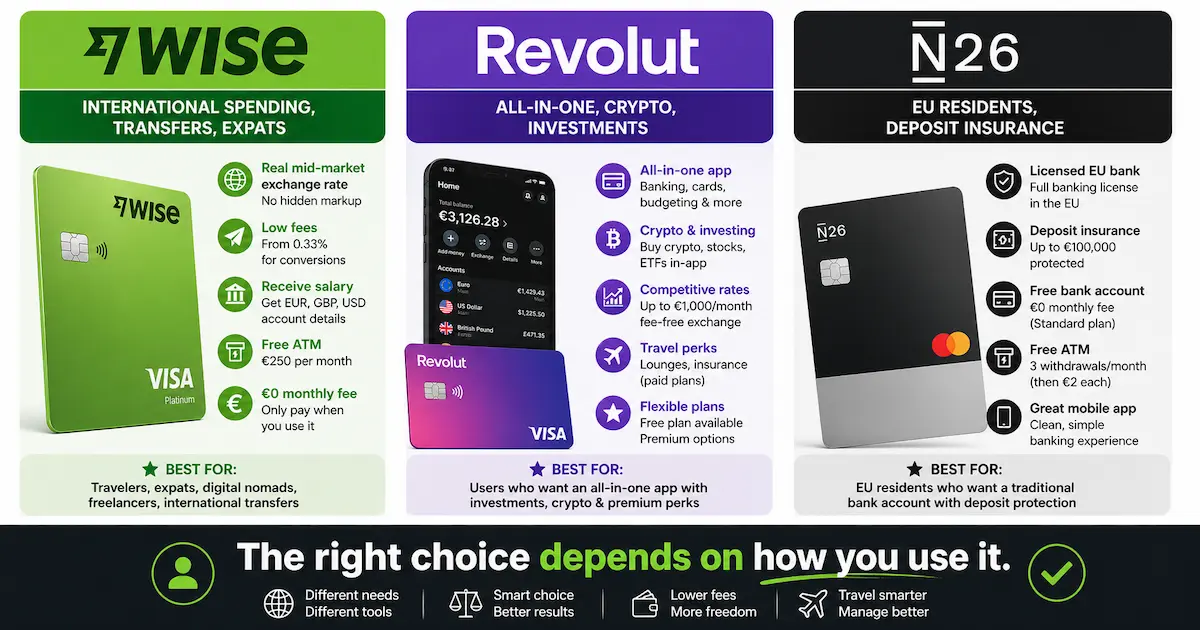
🏦 The 3-app setup most European expats actually use Based on expat communities in Ireland, Belgium, and Portugal: Wise as the financial backbone (receiving payments, international transfers, multi-currency holding), Revolut as the daily wallet (card spending, budgeting, crypto if needed), and a local bank or N26 as the anchor account (salary for employers who require a local IBAN, direct debits, deposit insurance). Total cost: €0–10/month. Annual savings vs traditional banking: €1,000–3,000+.
Can You Receive Your Salary Through Wise in Europe?
Yes — and this is one of Wise’s most underused features for expats and immigrants in Europe.
When you open a Wise account in Europe, you receive a real EUR IBAN (European bank account number) that works identically to any other bank account for receiving SEPA transfers. My Irish employer and my Belgian employer both paid my salary directly into my Wise EUR IBAN with no issues.
This is genuinely useful for anyone who:
- Just arrived in a new European country and hasn’t opened a local bank account yet
- Works remotely or freelances and wants to receive payments from multiple countries
- Wants to avoid the €5–15/month fee of a full bank account
- Needs to receive payment in multiple currencies (EUR + GBP + USD simultaneously)
Once your salary is in Wise, you can spend it directly with the card at zero conversion fee (EUR spending from EUR balance), send portions to family abroad at the mid-market rate, or hold it across multiple currency balances.
Most people don’t know this — you can receive your salary in Europe without a traditional bank.
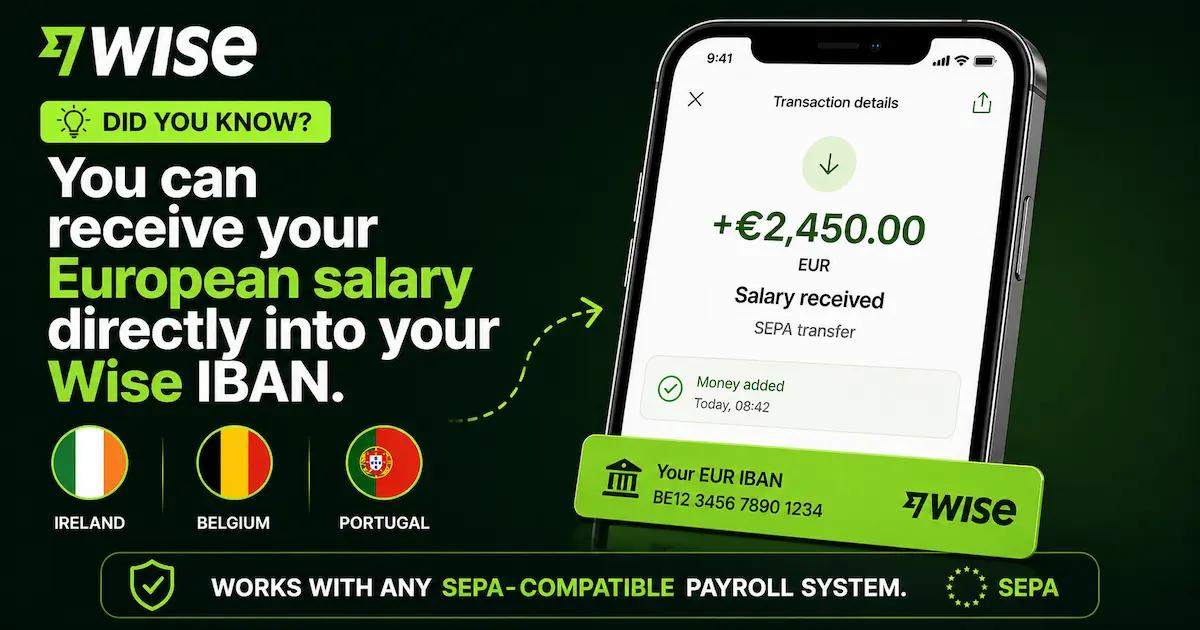
✅ Salary receipt: what works Wise EUR IBAN works for SEPA transfers (standard payroll in the Eurozone). Wise also provides GBP account details (UK sort code + account number) and USD routing details, making it usable for salary receipt in the UK and the US. Some employers require a local bank account specifically — always confirm with your payroll team before relying on Wise exclusively for salary.
If you’re looking for comprehensive travel coverage while managing your European finances, also check out our guide on the best eSIM for 30 days in Europe — combining low-fee banking with low-cost mobile data is the complete solution for extended European stays.
Wise for International Money Transfers: What I Actually Paid
One of the most consistent uses of Wise over four years has been sending money from Europe to Brazil. Whether I was in Ireland, Belgium, or Portugal, the process was identical: open the app, enter the amount, confirm the mid-market rate and the transparent fee, confirm the transfer. Money arrived in 1–2 business days at a cost that made my bank’s international wire fee look like a scam.
A typical EUR to BRL transfer of €500: Wise charges approximately €7.50 (1.5% of the amount). A traditional bank wire for the same transfer typically involves a flat €15–25 wire fee plus a 4–6% hidden spread on the exchange rate. On a €500 transfer, the real cost difference is €50–75 vs €7.50. Every time. For four years.
Wise-to-Wise transfers in the same currency are free and instant. This became particularly useful for splitting bills and shared expenses with friends and colleagues across Europe who also use Wise — an increasingly common situation.
⚠️ Note on large transfers: For transfers over €10,000, Wise may require additional identity verification. This is a regulatory requirement (anti-money-laundering), not unique to Wise. The process is straightforward but adds 1–2 business days. Plan accordingly for large transfers.
Wise Review Europe 2026: Honest Pros and Cons
✅ What Wise Does Well
- Mid-market rate, always — no hidden markup
- €0 monthly fee, €7 one-time card fee
- Receive salary via EUR IBAN
- Free €250 ATM per month (updated May 2026)
- Transparent fees shown before every transaction
- Works in 160+ countries
- Instant Wise-to-Wise transfers (free)
- No weekend markup (unlike Revolut Standard)
- 40+ currencies in one account
- Interest on balances (~1.76% EUR via Wise Assets)
- Freeze/unfreeze card in one tap
❌ Wise Weaknesses
- Not a bank — no deposit insurance
- Chat-only support (no phone)
- Support response times have slowed since 2022
- No credit card option
- No cash deposits
- No overdraft facility
- Some local payment systems not supported (Germany’s Girocard)
- Doesn’t integrate with some EU direct debit systems
🌍 Planning to stay connected across Europe? Wise handles your money. An eSIM handles your data. Combine both and travel Europe without hidden fees on either side. → Best eSIM for Europe 2026
Who Should Use Wise in Europe — and Who Shouldn’t
✅ Use Wise if you are…
- An expat or immigrant who has moved to Europe and needs a bank account quickly
- A digital nomad spending across multiple European countries
- Anyone receiving salary in one currency and spending in another
- Someone sending money internationally regularly (especially to non-EU countries)
- A traveler spending more than 2–3 weeks in Europe across multiple countries
- A freelancer or remote worker receiving payments in multiple currencies
❌ Consider alternatives if you need…
- Full deposit insurance: Use N26 or a licensed local bank
- Cash deposits: Wise has no physical locations
- Credit facility: Wise is debit-only
- Domestic-only use in one country: A local bank or N26 may be simpler
- Crypto and investments: Revolut has built-in crypto and stock trading
For travelers who are also protecting their devices and data abroad, our VPN guide covers the best options for secure browsing. Also consider travel insurance as the third pillar of smart European travel alongside banking and connectivity.
How to Set Up Wise for Europe: Step-by-Step
- Sign up online or in the app (5 min) — wise.com or iOS/Android app. Choose Personal account.
- Verify your identity (5 min + 2–3 days) — photo ID (passport or national ID) + selfie. Usually approved within a few hours.
- Order your card (free, arrives in 5–10 days) — physical debit card, €7 one-time fee. Virtual card available instantly in the app.
- Add money — bank transfer (free, 1–3 days) is the recommended method.
- Activate your card — scan QR code in app when physical card arrives. First transaction must be chip-and-PIN.
- Convert if needed — if you loaded non-EUR funds and you’re in the Eurozone, convert once and spend for free.
Recommended timeline: Start the process at least 2 weeks before your trip or relocation.
Before you add money to your Wise account, watch this — it shows the fastest and cheapest way to do it step by step.
Now that you know how to add money to Wise, you’re ready to use it anywhere in Europe without worrying about hidden fees.
FAQ — Wise Review Europe 2026
Is Wise safe to use in Europe?
Yes. Wise is regulated by the National Bank of Belgium for EU operations and holds licenses in all major markets. Your money is held in safeguarded accounts at regulated banks — separate from Wise’s operating funds. This means your funds are protected if Wise faces financial difficulty. Note: this is not the same as deposit insurance (like EU DGS up to €100,000). For full deposit protection, use a licensed bank alongside Wise. Verified May 2026.
Can I receive my salary through Wise in Ireland, Belgium, or Portugal?
Yes. Wise provides a real EUR IBAN that accepts SEPA transfers — the standard payroll method across all Eurozone countries including Ireland, Belgium, and Portugal. I personally received salary from Irish and Belgian employers directly into my Wise account. Confirm with your employer’s payroll team, as some systems require a specifically bank-issued IBAN. Verified May 2026.
Is Wise better than Revolut for Europe in 2026?
For pure money transfers and international spending, Wise is more transparent and has no weekend markup on exchange rates. Revolut’s standard plan adds 0.5–1% on weekends and has a €1,000/month free conversion limit. For an all-in-one financial app with crypto, investing, and premium travel perks, Revolut’s paid tiers offer more. My household uses both: Wise for transfers and international spending, Revolut for investment features. Verified May 2026.
What is the Wise card fee in Europe?
The Wise debit card costs €7 (or equivalent) as a one-time delivery fee — there is no annual fee and no monthly fee. Replacement cards cost €7. The virtual card is free and available immediately in the app. If you hold EUR and spend EUR in Europe, there is no per-transaction fee. Verified May 2026.
Does Wise work in non-EU countries like the UK or Switzerland?
Yes. Wise works in 160+ countries including the UK, Switzerland, Norway, and Turkey — all non-EU European destinations. The card connects via Mastercard’s global network. When spending in a non-EUR currency, a small conversion fee applies (0.33–0.57% for major pairs). Verified May 2026.
How does Wise compare to N26 for expats in Europe?
N26 is a licensed bank with full EU deposit insurance (up to €100,000) and is better for anyone settled in Germany or another EU country who wants a traditional banking relationship. Wise is significantly cheaper for international transactions, multi-currency management, and sending money abroad. For most expats, having both makes sense: N26 (or a local bank) for domestic requirements, Wise for cross-border everything. Verified May 2026.
After everything covered in this Wise Review Europe 2026, the conclusion becomes very clear.
Final Verdict: Is Wise Worth It in Europe in 2026?
Yes. Without hesitation.
I’ve been using Wise since I left Brazil in 2022. In four years across Ireland, Belgium, Portugal, Spain, France, Thailand, the Netherlands, and the UK, it has been the most consistently reliable and cost-efficient financial tool I’ve used. The fees I’ve paid — for hundreds of transactions, salary receipts, international transfers, and ATM withdrawals — represent a fraction of what any traditional bank would have charged for the same activity.
It’s not perfect. The support is slower than it was three years ago. It’s not a bank, so it doesn’t replace N26 or a local account if you need full deposit insurance. And the app, while clean, doesn’t have the investment and crypto features that Revolut offers.
But for what it does — transparent international money management, real mid-market rates, salary receipt, zero monthly fees — nothing at this price point comes close. If you’re moving to Europe, traveling for more than a week, or managing money across borders in any capacity, Wise is the account you open first and keep forever.
Keep Reading
Travel & Connectivity in Europe
- Best eSIM for Europe 2026 — Full Guide
- Best eSIM for 30 Days in Europe
- Best eSIM for International Travel
Security & Insurance
Disclosure: This article contains affiliate links. If you open a Wise account through our links, we may earn a small commission at no extra cost to you. All fee information verified against wise.com/pricing — May 2026. This review reflects personal experience and is not financial advice.
Last verified: May 2026.