The best eSIM for Canada in 2026 is Nomad — the best price per GB among all providers reviewed here, starting at $5 for 1GB and $18 for 10GB/30 days.
Canada is the second-largest country in the world. Most eSIM coverage stops 100km from any major city.
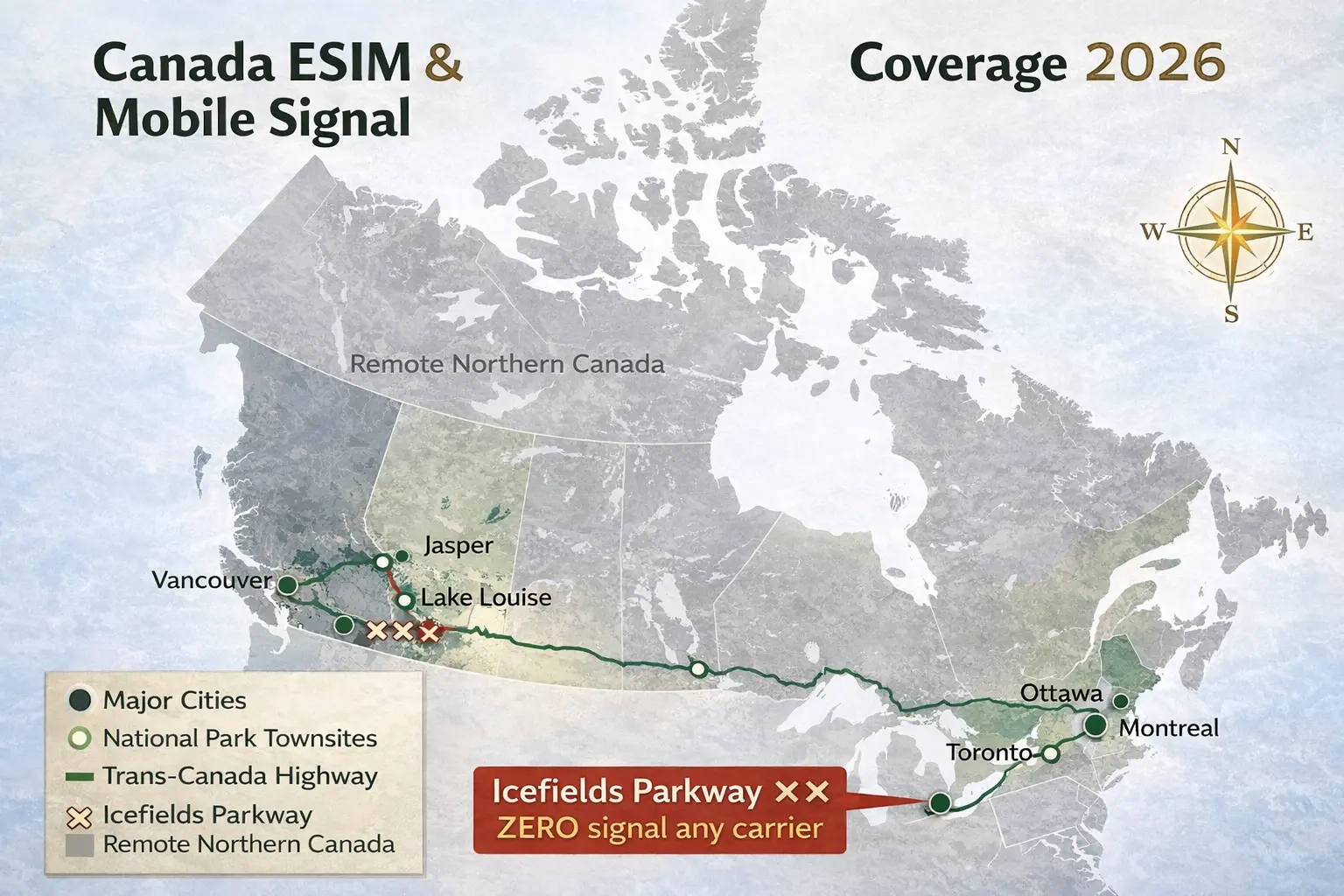
This is the critical fact about Canadian mobile coverage that most eSIM guides gloss over. Toronto, Vancouver, Montreal, Calgary, and Ottawa have excellent 4G/5G on all carriers. The Trans-Canada Highway has reasonable coverage between major cities. But Canada’s wilderness — the Rocky Mountain national parks, the Icefields Parkway, Northern Ontario, the Yukon, and most of the country beyond the urban corridor — operates under very different rules. The Icefields Parkway between Lake Louise and Jasper, one of the world’s most scenic drives, has zero cell signal from any carrier for most of its 232km length.
Canada has three main carriers: Rogers (strongest in Ontario and Eastern Canada), Bell and Telus (who share a network, with Bell stronger in the East and Telus stronger in the West and Rockies). For national park travel, Bell/Telus has better coverage in Alberta’s mountain parks than Rogers. For the Trans-Canada highway in BC, Rogers loses signal where Bell/Telus maintains it.
Best eSIM for Canada — Quick Pick:
| Use Case | Best Provider | Price | Why |
|---|---|---|---|
| 🏆 Best overall | Nomad | from $5 | Best price/GB, unlimited options |
| ♾️ Best unlimited | Holafly | $7.90/day | Unlimited, no data counting |
| 💰 Best budget | Nomad | $18/10GB | $1.80/GB — cheapest fixed data |
| 🔒 Best security | Saily | $5.29/1GB | NordVPN security built-in |
Canada eSIM Plans and Prices 2026
| Provider | Plan | Price (USD) | Hotspot | Best For |
|---|---|---|---|---|
| Nomad | 1GB / 7d | $5.00 | ✅ | Budget short stay |
| Nomad | 3GB / 30d | $9.00 | ✅ | Light trip |
| Nomad | 10GB / 30d | $18.00 | ✅ | Standard visit |
| Nomad | 20GB / 30d | $28.00 | ✅ | Heavy use |
| Nomad | 50GB / 30d | $49.00 | ✅ | Long stay / nomads |
| Nomad | Unlimited / 3d | $21.00 | ✅ | Short unlimited |
| Nomad | Unlimited / 7d | $41.00 | ✅ | Week unlimited |
| Nomad | Unlimited / 10d | $49.00 | ✅ | 10-day unlimited |
| Holafly | 1 day unlimited | $7.90 | ✅ 1GB/d | Layover / 1 day |
| Holafly | 7 days unlimited | ~$35–40 | ✅ 1GB/d | Standard week |
| Holafly Plans | Unlimited/month | $64.90/mo | ✅ Unlimited | Long stay subscription |
| Holafly Plans | 25GB/month | $49.90/mo | ✅ | Light subscription |
| Saily | 1GB / 7d | $5.29 | ✅ | Budget entry |
| Saily | 5GB / 30d | $17.99 | ✅ | Standard trip |
| Saily | 10GB / 30d | $30.99 | ✅ | Heavy use |
| Saily | Unlimited / 30d | $48.99 | ✅ | Month unlimited |
| Airalo | 1GB / 3d | $7.00 | ✅ | Very short stay |
| Airalo | 10GB / 7d | $18.00 | ✅ | Heavy week |
| Airalo | 10GB / 30d | $23.00 | ✅ | Standard trip |
All prices in USD. Verified at official provider sites — March 2026. Always confirm at checkout.
For most Canada visitors (7–14 days): Nomad 10GB at $18 covers a standard Canada trip comfortably — city navigation, social media, video calls, and Trans-Canada road trip navigation. At $1.80/GB it’s the best fixed-data price among providers reviewed here.
Best eSIM for Canada Travel in 2026
🥇 Nomad — Best Overall for Canada
Nomad is the best eSIM for Canada in 2026 on price. The 10GB/30-day plan at $18 is $5 cheaper than Airalo’s equivalent and significantly cheaper than Saily’s $30.99 for the same data. The 50GB plan at $49 works out to $0.98/GB — the best per-GB rate available for Canada from any major travel eSIM provider.
For Canadian road trips specifically, Nomad’s unlimited plans offer excellent value: $21 for 3 days, $41 for 7 days, $49 for 10 days. For a Rockies road trip including Banff and Jasper, the unlimited/7d plan at $41 removes all data anxiety — use navigation heavily in the parks, stream at the lodge each evening, without monitoring usage.
Nomad Canada plans:
- 1GB / 7 days: $5.00
- 10GB / 30 days: $18.00 — standard visit recommended
- 20GB / 30 days: $28.00 — heavy use
- 50GB / 30 days: $49.00 — long stay / digital nomads
- Unlimited / 7 days: $41.00 — road trips
Full hotspot on all plans — no daily cap. See the full Nomad eSIM Review 2026 for detailed testing and analysis.
🥈 Holafly — Best Unlimited
Holafly’s Canada plan charges per day — $7.90/day decreasing with longer plans. For travelers who use 2GB+ per day — content creators uploading Banff photos, remote workers on video calls, families with multiple devices — Holafly’s unlimited model removes data anxiety entirely.
For longer Canada stays: Holafly’s monthly subscription plans offer strong value for extended visitors. The Unlimited Plan at $64.90/month covers Canada with truly unlimited data, unlimited hotspot, and a phone number. The Light Plan at $49.90/month includes 25GB. Both are cancel-anytime subscriptions.
Holafly Canada hotspot: 1GB/day for connected devices on standard day plans. The monthly subscription includes unlimited hotspot. See the full Holafly Review 2026 for detailed plan comparison.
If it’s your first time using an eSIM, don’t worry. This quick video shows exactly how to install it on an iPhone in less than a minute.
🥉 Saily — Best Security Option
Saily’s Canada plans include NordVPN’s built-in ad blocker and web protection — genuinely useful in Canada, where airport Wi-Fi in YYZ, YVR, and YYC is commonly used and not always secure. The ad blocker saves approximately 28% of data usage, partially offsetting Saily’s higher per-GB price vs Nomad.
Saily Canada pricing:
- 1GB / 7 days: $5.29
- 5GB / 30 days: $17.99
- 10GB / 30 days: $30.99
- Unlimited / 30 days: $48.99 (5GB/day high-speed cap)
Note: Saily’s unlimited plan caps high-speed data at 5GB/day — more generous than most, but not truly unlimited. See the full Saily eSIM Review 2026.
Also worth mentioning: Airalo
Airalo’s Canada plans run on Bell — one of Canada’s strongest networks, sharing towers with Telus. Bell/Telus is the better network for Alberta’s Rocky Mountain parks. Plans start at $7/1GB. Available at airalo.com
Nomad vs Holafly vs Saily vs Airalo: Canada Comparison
| Nomad | Holafly | Saily | Airalo | |
| 10GB price | $18 | N/A | $30.99 | $23 |
| Unlimited option | ✅ From $21/3d | ✅ $7.90/day | ✅ $48.99/30d | ❌ |
| Best plan | 10GB/$18 | Unlim/$7.90/d | 5GB/$17.99 | 10GB/$23 |
| Hotspot | ✅ Full | ✅ 1GB/day | ✅ Full | ✅ |
| Security | ❌ | ❌ | ✅ NordVPN | ❌ |
| Network | — | — | — | Bell |
| Free trial | ✅ 1GB | ❌ | ❌ | ❌ |
| Rating | 🥇 Best value | 🥈 Best unlimited | 🥉 Best security | Solid option |
For a full comparison see the Best eSIM for International Travel 2026 and Nomad eSIM Review 2026.
Canada Carrier Coverage: Rogers vs Bell/Telus
Understanding the carrier difference is critical for Canada travel — especially national parks.
| Carrier | Strength | Best Region | Travel eSIM |
|---|---|---|---|
| Rogers | ✅ Best Ontario + East | Toronto, Ottawa, East Canada, Trans-Canada East | — |
| Bell + Telus (shared network) | ✅ Best West + Rockies | Vancouver, Calgary, BC highways, Banff/Jasper | Nomad + Airalo |
| Bell | ✅ Strong East | Montreal, Maritime provinces | Airalo |
Key fact: Bell and Telus share a national tower network in Canada. A Bell eSIM gives you Telus coverage in Western Canada, and vice versa. This shared infrastructure makes Bell/Telus effectively one network — the strongest option for BC and Alberta travel.
For the Rocky Mountain parks: Bell/Telus consistently outperforms Rogers in Banff, Jasper, and along BC mountain highways. Rogers loses signal entirely in several stretches where Bell/Telus maintains 4G.
Toronto vs Vancouver: Urban Coverage
Toronto — All Carriers Excellent
Toronto (YYZ) has dense 4G/5G infrastructure on all carriers. Downtown, the Entertainment District, CN Tower area, Yorkville, and suburban Toronto are all well covered. Speeds of 100+ Mbps are standard in central Toronto. Any provider works reliably for the standard Toronto tourist experience.
Vancouver — All Carriers Good
Vancouver city and the immediate North Shore have excellent coverage. Stanley Park — entirely within the city — has good signal. The Sea-to-Sky Highway (Hwy 99) north to Whistler has coverage in most sections with some gaps in canyon areas. Whistler itself is well covered.
Trans-Canada Highway
The Trans-Canada (Hwy 1) between major cities has functional 4G coverage in most sections. Notable gaps occur in remote stretches through northern Ontario (between Sudbury and Thunder Bay) and in BC mountain passes west of Calgary. Download offline maps for any multi-hour highway drives through unpopulated areas.
Banff & Jasper: Coverage Reality
This is the section that matters most for travelers heading to Canada’s most famous national parks.
Banff townsite: All carriers — Rogers, Bell, Telus — provide 4G coverage in and around the Banff townsite. The main street, hotel areas, and visitor centre are well covered. Signal reaches Sunshine Village ski area and the Banff Gondola.
Lake Louise: Coverage in the Lake Louise village. At the lake itself — limited. Hiking trails above Lake Louise: no signal.
Between Banff and Lake Louise (Trans-Canada): Mostly covered with a couple of brief dead spots on curves.
Between Lake Louise and Jasper — Icefields Parkway (Hwy 93N): This is Canada’s most scenic drive and has essentially zero cell signal for the majority of its 232km length. Every carrier drops out. The Columbia Icefield Visitor Centre area has no coverage. Athabasca Glacier: no coverage. The famous viewpoints along the Parkway: no coverage.
⚠️ The Icefields Parkway rule: Download Google Maps offline for the entire Icefields Parkway route — both directions, plus Jasper townsite and Banff — before leaving Lake Louise or Jasper. This is not optional for safe navigation on this road.
Jasper townsite: Coverage from all carriers in and around the townsite. Signal disappears a few kilometres outside town in any direction.
For up-to-date visitor information on Banff National Park, check the Parks Canada official Banff National Park page before your trip.
Canada eSIM Travel Tips
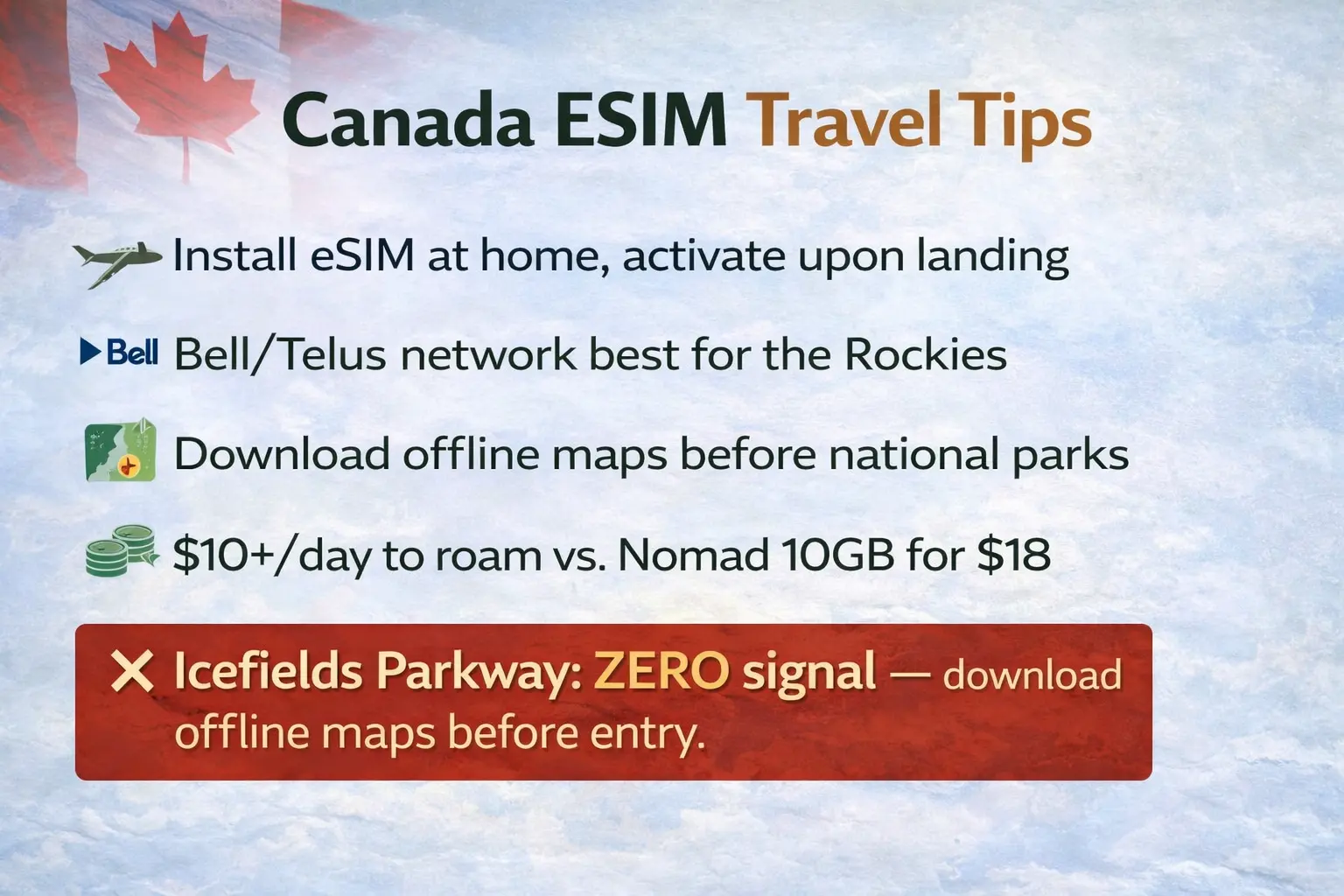
Activate before landing at YYZ or YVR. Install your eSIM at home on Wi-Fi. When your plane lands at Toronto Pearson or Vancouver International, your eSIM connects automatically. Order an Uber or Lyft from the arrivals hall without hunting for airport Wi-Fi.
Download offline maps before every national park. Banff, Jasper, Yoho, Kootenay, Pacific Rim, Gwaii Haanas — all have significant coverage gaps. Download Google Maps offline for each park at your last hotel before entry. For the Icefields Parkway specifically, download the entire route (Banff → Lake Louise → Jasper) as one offline region.
Icefields Parkway — offline is mandatory. There is no cell signal for most of the 232km drive between Lake Louise and Jasper. Not “limited signal.” Not “patchy signal.” No signal from any carrier. Your offline map is your only navigation tool for this drive.
Bell/Telus for the Rockies. If you’re spending significant time in Banff, Jasper, and BC mountain parks, Bell/Telus provides better coverage than Rogers in this region. Airalo’s Bell network has an edge here. Nomad’s carrier for Canada — verify at getnomad.app before purchasing if park coverage is critical.
Canada roaming charges are among the world’s highest. Canadian carriers charge some of the highest roaming rates in the world — $10–15+/day from most international plans. An eSIM is not optional for Canada travel on a budget: Nomad’s 10GB for $18 vs $10/day roaming for the same trip.
Combining Canada with USA or Mexico? See Best eSIM for North America 2026 — regional plans vs per-country. USA next? See Best eSIM for USA 2026. Full international trip? See Best eSIM for International Travel 2026.
FAQ
What is the best eSIM for Canada travel in 2026?
The best eSIM for Canada travel in 2026 is Nomad — 10GB for $18 ($1.80/GB), the best fixed-data price among major providers, with unlimited options from $21/3 days. For unlimited data: Holafly from $7.90/day. For security features: Saily from $5.29 with NordVPN built-in. All prices in USD, verified at official provider sites — March 2026.
Does eSIM work in Banff and Jasper National Parks?
Yes, in the townsites. Banff townsite, Lake Louise village, and Jasper townsite have functional 4G coverage from Bell, Telus, and Rogers. Coverage disappears on most hiking trails and backcountry areas. The Icefields Parkway (Hwy 93N) between Lake Louise and Jasper has essentially no cell signal from any carrier for most of its 232km length. Download offline maps before entering any national park area.
Which carrier is best for Canada’s national parks?
Bell and Telus — who share a tower network — provide the best coverage in Alberta’s Rocky Mountain parks. For Banff and Jasper, Bell/Telus maintains signal in more areas than Rogers, particularly in BC mountain highway sections. Rogers is stronger in Ontario and Eastern Canada. For a Rockies-focused trip, choose a Bell/Telus-connected eSIM (Airalo uses Bell for Canada).
Is eSIM worth it for Canada travel?
Very much so. Canadian carriers charge some of the world’s highest international roaming rates — typically $10–15+ per day from international plans. A Nomad 10GB plan for a 14-day Canada visit costs $18 total. A Holafly unlimited 7-day plan costs approximately $40. Even the most expensive eSIM option saves 50–80% compared to roaming charges for any trip longer than 2 days.
How much data do I need for a Canada trip?
For a standard 7–14 day Canada trip in cities: 5–10GB covers navigation, social media, messaging, and video calls. Nomad 10GB at $18 covers most visitors comfortably. For a Rocky Mountain road trip with heavy navigation: 10–20GB, plus offline maps for national parks. For content creators or remote workers: Holafly unlimited or Nomad unlimited/7d at $41. For a quick Toronto or Vancouver city break: Saily or Nomad 1–3GB from $5–$9.
Can I use eSIM on the Trans-Canada Highway?
Yes for most of the Trans-Canada. The highway has 4G coverage in most populated sections. Significant gaps occur in remote northern Ontario (between Sudbury and Thunder Bay), in BC mountain passes between Calgary and Vancouver, and anywhere more than 100km from a major city in the northern sections. Download offline maps for any multi-hour stretch through unpopulated areas. The Icefields Parkway is not part of the Trans-Canada but is a popular side route — it has no coverage and requires mandatory offline maps.
Final Verdict: Best eSIM for Canada 2026
Canada’s mobile coverage is excellent in cities and along major populated corridors — and genuinely absent in the wilderness that makes Canada one of the world’s top travel destinations.
For most Canada visitors (cities + Trans-Canada): Nomad 10GB at $18 — best price/GB, unlimited options available, full hotspot.
For Rocky Mountain road trips (Banff + Jasper + Icefields Parkway): Download offline maps regardless of provider. Any eSIM works in the townsites. No eSIM works on the Icefields Parkway itself.
For unlimited data (heavy users, content creators): Holafly from $7.90/day — unlimited primary data, no counting.
For long stays or frequent Canada visitors: Holafly Plans $64.90/month — unlimited, monthly subscription, cancel anytime.
For security-conscious travelers: Saily from $5.29 — NordVPN built-in, solid coverage.
This article contains affiliate links. I may earn a commission at no extra cost to you. All prices in USD. Verified at official provider sites — March 2026. May change without notice — always confirm at checkout.
Last verified: March 2026.