The best eSIM for Japan travel in 2026 is Holafly — unlimited data from $3.90/day across Tokyo, Kyoto, Osaka, and rural Japan with no gigabyte counting.
Japan has world-class 5G in Tokyo — and zero signal on the Shinkansen through mountain tunnels. Here’s what actually works.
Japan’s mobile infrastructure is genuinely exceptional. Tokyo consistently ranks among the world’s top cities for 5G speed and reliability. NTT Docomo, SoftBank, KDDI (au), and Rakuten cover the urban corridor from Tokyo to Osaka with dense 5G networks. But Japan also has a unique connectivity quirk that surprises most first-time visitors: the Shinkansen bullet train passes through hundreds of mountain tunnels where signal disappears completely — even on Japan’s best networks. For a traveler, this means understanding not just which eSIM to buy, but what to expect when you’re hurtling at 300 km/h through the Japanese Alps.
Travelers visiting Japan need reliable data for Google Maps navigation (Japan’s street addresses are notoriously complex), Google Translate’s camera feature for reading Japanese menus and signs, and booking restaurants or transport on the go. An eSIM that works consistently across cities, countryside, and transit routes is not optional for Japan travel — it’s essential.
Not sure which eSIM to use in Japan? This quick 2-minute video explains why Holafly is a popular choice for travelers across Japan and Asia
If you want the fastest answer:
- Nomad → best price/GB, unlimited from $23/7 days
- Airalo → SoftBank network, competitive fixed data
- Saily → budget fixed data from $3.99
Best eSIM for Japan — Quick Pick
| Use Case | Best Provider | Price | Why |
|---|---|---|---|
| 🏆 Best overall | Holafly | $3.90/day | Unlimited, no counting, 5G/4G Japan |
| 📊 Best price/GB | Nomad | $17/10GB | $1.70/GB, unlimited from $23/7d |
| 🌐 Best network | Airalo | $18/10GB | SoftBank — Japan’s best tourist network |
| 💰 Best budget | Saily | $3.99/1GB | NordVPN security included |
Japan eSIM Plans and Prices 2026
Typical eSIM prices for Japan range from $3.90/day unlimited to $4/1GB fixed data depending on the provider and plan.
| Provider | Plan | Price (USD) | Hotspot | Best For |
|---|---|---|---|---|
| Holafly | 1 day unlimited | $3.90 | ✅ 1GB/d | Day trip / layover |
| Holafly | 7 days unlimited | $27.30 | ✅ 1GB/d | Standard visit |
| Holafly | 15 days unlimited | $58.50 | ✅ 1GB/d | Extended trip |
| Holafly | 30 days unlimited | $117.00 | ✅ 1GB/d | Long stay |
| Holafly Plans | Unlimited/month | $64.90/mo | ✅ Unlimited | Subscription |
| Holafly Plans | 25GB/month | $49.90/mo | ✅ | Light subscription |
| Nomad | 1GB / 7d | $4.00 | ✅ | Budget short stay |
| Nomad | 10GB / 30d | $17.00 | ✅ | Standard visit |
| Nomad | 20GB / 45d | $24.00 | ✅ | Extended heavy use |
| Nomad | 50GB / 45d | $39.00 | ✅ | Long stay |
| Nomad | Unlimited / 7d | $23.00 | ✅ | Week unlimited |
| Nomad | Unlimited / 14d | $41.00 | ✅ | 2-week unlimited |
| Nomad | Unlimited / 21d | $49.00 | ✅ | 3-week unlimited |
| Airalo | 1GB / 3d | $4.00 | ✅ | Short stay |
| Airalo | 5GB / 7d | $10.00 | ✅ | Standard week |
| Airalo | 10GB / 30d | $18.00 | ✅ | Standard visit |
| Airalo | 20GB / 30d | $25.00 | ✅ | Heavy use |
| Saily | 1GB / 7d | $3.99 | ✅ | Budget entry |
| Saily | 10GB / 30d | $17.99 | ✅ | Standard visit |
| Saily | 20GB / 30d | $24.99 | ✅ | Heavy use |
| Saily | Unlimited / 30d | $48.99 | ✅ | Month unlimited |
All prices in USD. Verified at official provider sites — March 2026. Always confirm at checkout.
Most Japan visitors traveling 7–14 days choose Holafly’s unlimited plan — Google Translate camera, Maps navigation, and social media add up quickly without a data counter.
Best eSIM for Japan Travel in 2026
🥇 Holafly — Best Overall for Japan
Holafly is the top pick for Japan in 2026. Japan is one of the world’s most data-intensive destinations for tourists — you will use Google Translate’s camera constantly (menus, signs, ticket machines), run Google Maps non-stop through complex city navigation, and upload photos and videos throughout the day. Counting gigabytes in this environment creates stress. Holafly’s unlimited model removes that entirely.
At $3.90/day, a 7-day Japan trip costs $27.30 — comparable to or cheaper than fixed-data alternatives once you account for actual Japan usage patterns. The hotspot feature (1GB/day shareable) is practical for tablet navigation or keeping a travel companion connected.
Holafly Japan network: Connects to Japan’s major carriers for 4G/5G coverage across the country. Excellent in Tokyo, Osaka, Kyoto, and the urban Shinkansen corridor. Coverage weakens in mountainous rural areas and Hokkaido’s remote north — consistent with all carrier performance in these regions.
Holafly Japan pricing:
- 1 day: $3.90
- 7 days: $27.30
- 15 days: $58.50
- 30 days: $117.00
- Global Plans: $64.90/month unlimited · $49.90/month 25GB
Wondering how to install an eSIM on your iPhone? This quick video shows how to activate Holafly in seconds using a QR code.
🥈 Nomad — Best Price Per GB
Nomad offers the best fixed-data price per GB for Japan. The 10GB/30-day plan at $17 is $0.70 below Airalo’s equivalent, and the unlimited plans are genuinely competitive — 7 days unlimited at $23 is actually cheaper than Holafly’s 7-day plan ($27.30). For budget travelers who want unlimited without paying Holafly’s per-day rate, Nomad’s unlimited/7d at $23 is the best value in this comparison.
Nomad Japan pricing:
- 10GB / 30 days: $17.00
- 20GB / 45 days: $24.00
- Unlimited / 7 days: $23.00
- Unlimited / 14 days: $41.00
- Unlimited / 21 days: $49.00
🥉 Airalo — Best Network for Japan
Airalo’s Japan plan runs on SoftBank — one of Japan’s top two networks alongside NTT Docomo. SoftBank has strong 4G/5G coverage in all major cities and along the main Shinkansen corridors. For travelers specifically concerned about network quality over price, Airalo’s explicit SoftBank connection provides clarity on carrier performance.
Airalo Japan pricing:
- 5GB / 7 days: $10.00
- 10GB / 30 days: $18.00
- 20GB / 30 days: $25.00
Saily — Best Budget Fixed Data
Saily’s Japan plans are competitive on fixed data — 1GB at $3.99 is the lowest entry price in this comparison, and 20GB at $24.99 matches Airalo’s equivalent. The NordVPN ad blocker saves data passively, practical in Japan where news and entertainment apps consume background data.
Saily Japan pricing:
- 1GB / 7 days: $3.99
- 10GB / 30 days: $17.99
- 20GB / 30 days: $24.99
- Unlimited / 30 days: $48.99
Japan Carrier Coverage: NTT Docomo vs SoftBank
Japan has four major carriers: NTT Docomo (largest, best rural coverage), SoftBank (strong urban, good tourist infrastructure), KDDI/au (strong regional coverage), and Rakuten (budget carrier, more limited rural reach).
For travel eSIMs, the relevant carriers are NTT Docomo and SoftBank — both provide excellent coverage across Japan’s main tourist circuit. Airalo explicitly connects to SoftBank. Holafly, Nomad, and Saily connect to their respective Japan carrier partners — check at purchase for the specific network.
| Area | Coverage | Notes |
|---|---|---|
| Tokyo (23 wards) | ✅ 5G excellent | All providers |
| Osaka / Kyoto | ✅ 5G excellent | All providers |
| Nagoya | ✅ 5G very good | All providers |
| Hiroshima / Fukuoka | ✅ 4G/5G good | All providers |
| Hokkaido (Sapporo) | ✅ 4G good | All providers |
| Hokkaido (remote north) | 🟠 Variable | Thinner coverage |
| Okinawa | ✅ 4G good | All providers |
| Mountain rural areas | ⚠️ Limited | Docomo best |
| Shinkansen (open sections) | ✅ Good | Coverage between tunnels |
| Shinkansen (tunnels) | ❌ Zero | All carriers drop — normal |
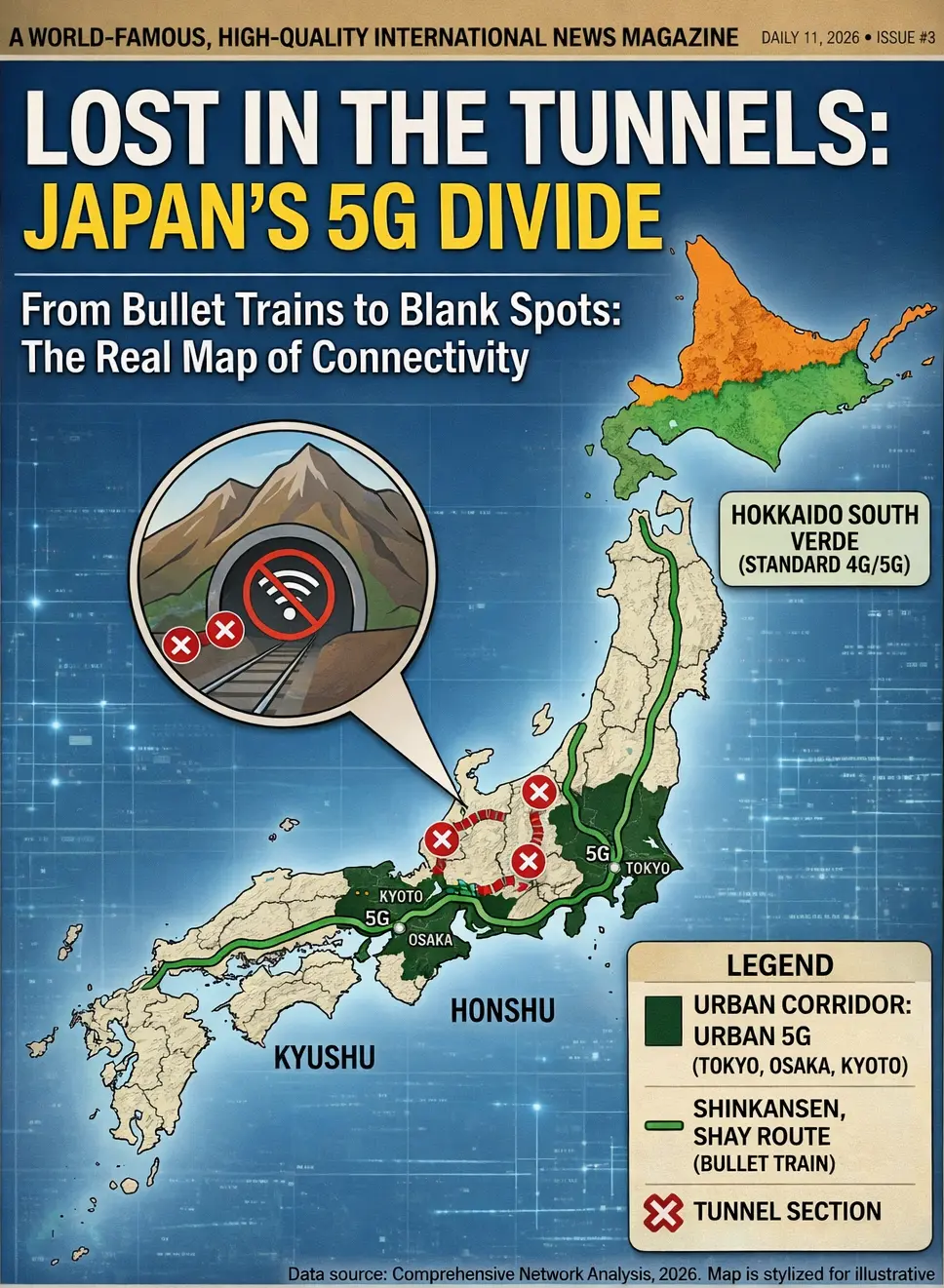
Shinkansen & Rural Japan Coverage
The Shinkansen is Japan’s high-speed rail network connecting Tokyo, Kyoto, Osaka, Hiroshima, and beyond. It is the primary transport method for most Japan tourists — and it has a specific connectivity characteristic that surprises first-time riders.
Shinkansen tunnels = zero signal. The Tokaido Shinkansen (Tokyo–Osaka) passes through multiple mountain tunnels where all carrier signals drop completely. These blackouts last from 30 seconds to several minutes depending on the tunnel. This is not an eSIM problem — it is a physical limitation of underground travel through mountain rock. Every carrier experiences this. Every provider’s eSIM experiences this.
Between tunnels: signal is good. The open sections of the Shinkansen route have functional 4G coverage. You can use your phone normally between tunnel sections.
What to do:
- Download Google Maps offline for every city on your itinerary before boarding
- Download any content you want to watch offline before the journey
- Use tunnel time for offline tasks — translation lookups, itinerary review, photo editing
Rural Japan coverage: Japan’s rural areas — the Japanese Alps, rural Shikoku, northern Hokkaido, and remote coastal areas — have progressively thinner coverage as you move from the Shinkansen corridor. NTT Docomo has the best rural reach of Japan’s carriers. Most tourist-accessible rural destinations (Hakone, Nikko, Nara, rural Kyoto, Shirakawa-go) have functional coverage.
For detailed Shinkansen route information, see the Japan-Guide Shinkansen coverage guide.
Tokyo vs Kyoto vs Rural Japan
Tokyo: World-class 5G across all 23 wards. Subway stations have Wi-Fi but your eSIM will work in most underground stations too — Tokyo’s subway system has good in-tunnel coverage. Download Google Maps offline as backup for deep station navigation.
Kyoto: Excellent 4G/5G in central Kyoto, Gion, Arashiyama, and Fushimi Inari. The temple and shrine circuits are well covered. The mountain areas above Arashiyama (Sagano bamboo grove vicinity) have good coverage at tourist areas. Remote hiking trails above the city may drop to 3G.
Osaka: Strong 5G throughout Dotonbori, Namba, Umeda, and the Universal Studios Japan area. Osaka is a tech-forward city with dense urban coverage.
Rural and mountain Japan: Hakone has variable coverage — good in the town and around Hakone Open Air Museum, weaker on Mount Hakone trails. Nikko has coverage in the shrine complex. The Japanese Alps (Kamikochi, Tateyama) have very limited coverage in the valleys and none above the tree line. Shirakawa-go has limited but functional coverage in the village.
Japan eSIM Travel Tips
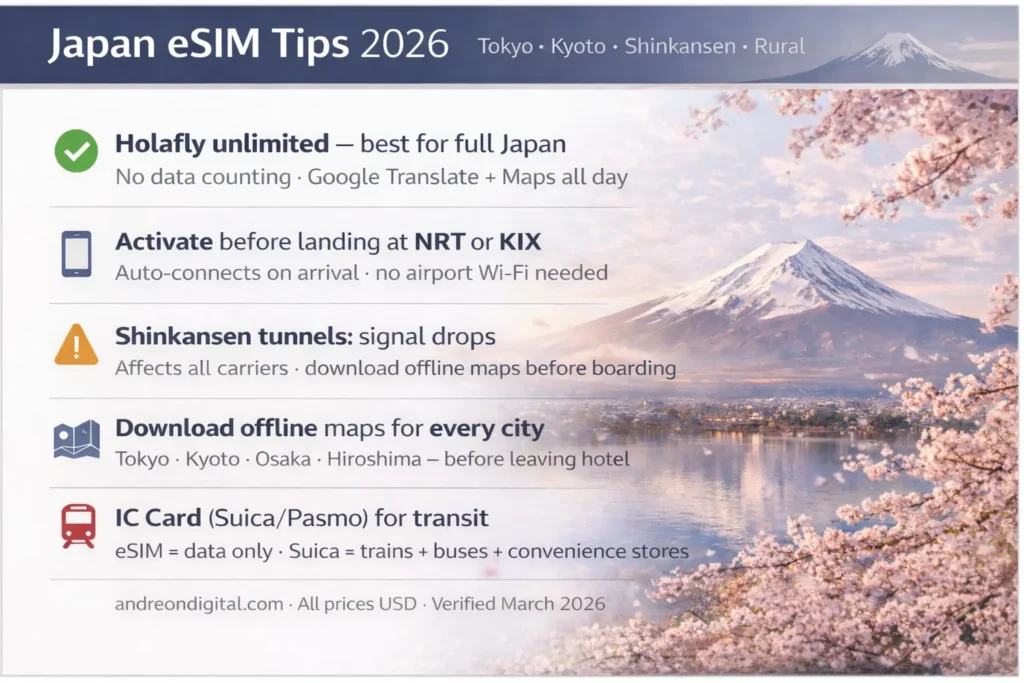
Activate before landing at Narita (NRT) or Kansai (KIX). Install your eSIM at home on Wi-Fi. When you land in Japan, your phone connects automatically. Order your airport limousine bus or book an IC card top-up without hunting for airport Wi-Fi.
Use Google Translate camera — it needs data. Japan’s camera translate feature in Google Translate (point camera at Japanese text → instant translation) is one of the most useful tools for Japan travel. It works over data, not just Wi-Fi. An unlimited plan means you can use this constantly without monitoring usage.
Shinkansen tunnels: prepare before boarding. Download Google Maps offline for your destination city before getting on any Shinkansen. The signal will drop in tunnels. This is normal, expected, and affects every carrier equally.
IC Card (Suica/Pasmo) for transit, eSIM for data. Japan’s transit system runs on IC cards — Suica (Tokyo) or Pasmo — not mobile data. Your eSIM is for internet. Your IC card is for trains, buses, and convenience store payments. Both are essential. iPhone users can add Suica to Apple Wallet. Android users need a physical card.
7-Eleven and convenience stores. 7-Eleven, Lawson, and FamilyMart have free Wi-Fi throughout Japan — practical for large downloads (offline maps) when you want to save eSIM data. But your eSIM handles all daily navigation, translation, and social needs without needing to find Wi-Fi.
Download offline maps for every region before leaving your hotel. Tokyo, Kyoto, Osaka, Hiroshima, Hakone — download each as a separate offline region in Google Maps before your travel day begins. Japan’s offline maps are particularly important for temple districts and areas where phone signal may be weaker.
FAQ
What is the best eSIM for Japan travel in 2026?
The best eSIM for Japan travel in 2026 is Holafly — unlimited data from $3.90/day covering Tokyo, Kyoto, Osaka, and rural Japan. Japan is one of the most data-intensive destinations for tourists (Google Translate camera, Maps navigation, social media) making unlimited data especially valuable. For budget fixed data: Nomad 10GB at $17. For SoftBank network: Airalo from $10. All prices USD, verified March 2026.
Does eSIM work on the Shinkansen in Japan?
Yes — between tunnels. The Shinkansen passes through mountain tunnels where all carrier signals drop completely. This affects every carrier and every eSIM provider equally — it is a physical limitation of underground travel through mountain rock. Between tunnel sections, 4G coverage is functional. Download Google Maps offline for your destination before boarding any Shinkansen.
Which carrier is best for Japan travel eSIM?
NTT Docomo has the best overall coverage in Japan, particularly in rural areas. SoftBank has excellent urban coverage and good tourist-circuit reach — Airalo’s Japan plan runs on SoftBank. For most tourists on the Tokyo–Kyoto–Osaka–Hiroshima circuit, any major carrier (Docomo or SoftBank) provides excellent coverage. The carrier difference matters most in remote rural Japan and Hokkaido’s north.
How much data do I need for a Japan trip?
Japan is a high data-use destination. Google Translate camera, Google Maps in complex cities, social media uploads, and restaurant booking apps add up quickly. For a 7-day Japan trip: 10–15GB minimum for moderate use, 20GB+ for heavy use. Most experienced Japan travelers recommend unlimited plans specifically because translation and navigation apps consume more data than expected. Holafly’s unlimited 7-day plan at $27.30 removes all data monitoring.
Does eSIM work in Kyoto temples and rural areas?
Yes in most tourist areas. Fushimi Inari, Kinkaku-ji, Gion, and Arashiyama all have good 4G coverage. Remote hiking trails above Arashiyama or in the Kurama area may drop to 3G. Rural destinations like Shirakawa-go and Hakone have coverage in the main tourist zones with gaps on remote trails. Download offline maps for any rural hiking day.
Can I use eSIM for navigation in Japan without knowing Japanese?
Yes — and this is one of the strongest use cases for a Japan eSIM. Google Maps works seamlessly in Japan including transit directions (train lines, bus routes, walking). Google Translate’s camera feature translates menus, signs, and ticket machines in real time. Both apps require data. An eSIM that works consistently across Japan’s cities and transit network makes Google Maps and Google Translate your most important travel tools.
Final Verdict: Best eSIM for Japan 2026
Japan rewards travelers who stay connected — from navigating Tokyo’s subway system to translating a ramen shop’s daily special. An eSIM is the most practical connectivity solution for Japan travel in 2026.
For most Japan visitors (7–14 days, full circuit): Holafly unlimited from $3.90/day — unlimited data for Google Translate, Maps, and social media across Tokyo, Kyoto, Osaka, and beyond. No data counting on one of the world’s most data-intensive destinations.
For budget travelers (fixed data): Nomad 10GB at $17 — $1.70/GB, best fixed-data price in this comparison. Unlimited options from $23/7 days if you want unlimited at a lower daily rate than Holafly.
For network-priority travelers: Airalo SoftBank — explicit carrier connection, 5GB/7d at $10 for short stays.
For budget entry / short stays: Saily 1GB at $3.99 — lowest entry price, NordVPN security included.
This article contains affiliate links. I may earn a commission at no extra cost to you. All prices in USD. Verified at official provider sites — March 2026. May change without notice — always confirm at checkout.
Last verified: March 2026.
Keep Reading
Asia eSIM Guides
- Best eSIM for South Korea 2026
- Best eSIM for Thailand 2026
- Best eSIM for Vietnam 2026
- Best eSIM for Bali 2026
- Best eSIM for Philippines 2026
- Best eSIM for Singapore 2026