The best eSIM for USA travel in 2026 is Nomad, connecting via both T-Mobile and AT&T — the only dual-network travel eSIM for the US at this price point, starting at $5 for 1GB.
T-Mobile covers the coasts. AT&T owns the rural South. Choosing wrong means no signal between San Francisco and Yosemite.
The United States is the third-largest country in the world by area — 9.8 million km², 50 states, and one of the most uneven mobile coverage maps you’ll encounter anywhere. If you’re looking for an eSIM for visiting the USA, the carrier your plan connects to matters more than the provider name. In New York City, Los Angeles, Chicago, and Miami, every carrier delivers blazing 5G. On a road trip through rural Montana, the Wyoming plains, or the Utah canyon country, the network you connect to determines whether you have signal or silence.
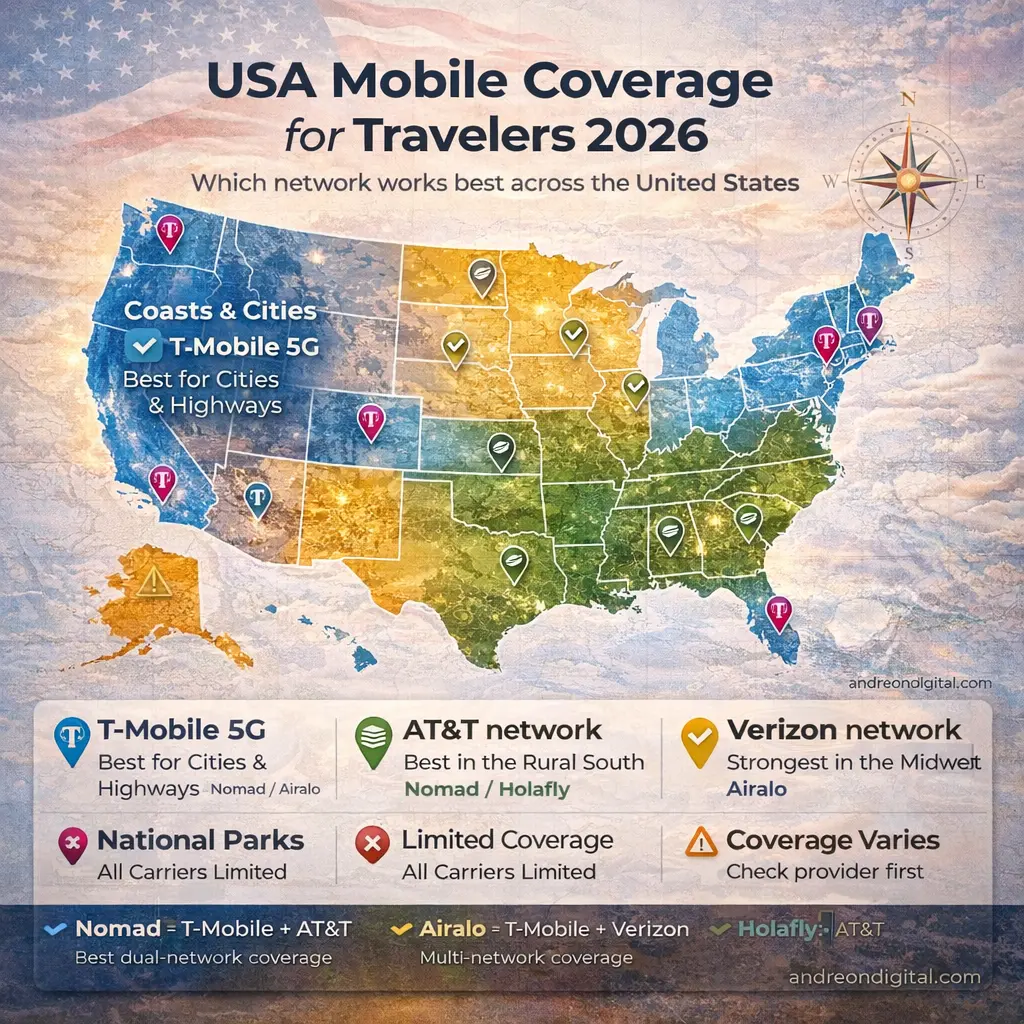
Three carriers dominate US mobile coverage: T-Mobile, AT&T, and Verizon. T-Mobile has the widest 5G footprint and strongest urban performance. AT&T has better rural reach in the South and Southeast — it’s the network of choice in Texas, Louisiana, Alabama, and rural Appalachia. Verizon has the most consistent overall rural coverage, particularly in the Midwest and Mountain West. Most travel eSIMs connect to T-Mobile. A few connect to AT&T. Fewer still offer multi-network access.
Best eSIM for USA — Quick Pick:
| Use Case | Winner | Why |
|---|---|---|
| Best overall (all states) | ✅ Nomad | T-Mobile + AT&T multi-network, $20/10GB |
| Best budget (light use) | ✅ Saily | $3.99/1GB, NordVPN security included |
| Best unlimited | ✅ Holafly | AT&T network, ~$3.90/day, 1GB/day hotspot |
| Best with calls + SMS | ✅ Airalo | Discover+ plan includes US phone number |
USA eSIM Plans and Prices 2026
| Provider | Plan | Price (USD) | Network | Hotspot | Best For |
|---|---|---|---|---|---|
| Nomad | 1GB / 7d | $5 | T-Mobile + AT&T | ✅ Full | Weekend NYC/LA |
| Nomad | 3GB / 7d | $11 | T-Mobile + AT&T | ✅ Full | Short trip |
| Nomad | 5GB / 30d | $14 | T-Mobile + AT&T | ✅ Full | 1–2 week trip |
| Nomad | 10GB / 30d | $20 | T-Mobile + AT&T | ✅ Full | Standard visit |
| Airalo | 1GB / 7d | $6 | T-Mobile/Verizon/US Cellular | ✅ | Budget short stay |
| Airalo | 10GB / 30d | ~$23 | T-Mobile/Verizon/US Cellular | ✅ | Standard visit |
| Airalo | Unlimited / 3d | $11.50 | T-Mobile/Verizon/US Cellular | ✅ | Short heavy use |
| Holafly | 7 days unlimited | ~$27 | AT&T | 1GB/day | Week trip, heavy use |
| Holafly | 30 days unlimited | ~$75 | AT&T | 1GB/day | Month, content creators |
| Saily | 1GB / 7d | $3.99 | local network | ✅ | Light use, security |
| Saily | 10GB / 30d | $22.99 | local network | ✅ | Standard visit |
| Saily | Unlimited / 15d | $39.19 | local network | ✅ | 5GB/day cap |
All prices in USD. Verified at official provider sites — March 2026. Always confirm at checkout.
⚠️ Coverage exceptions: Saily does not cover Alaska. Holafly does not cover Baja California. Grand Canyon, Yosemite, and Yellowstone have limited coverage on all providers — verified at official sites.
For most USA visitors (7–14 days): Nomad 10GB at $20 covers a standard US trip — city sightseeing, navigation, social media, video calls, and road trip navigation across most major routes.
Best eSIM for USA Travel in 2026
🥇 Nomad — Best Overall for USA
Nomad is currently the best eSIM for USA travel in 2026 for the majority of visitors, and the reason is specific: it connects to both T-Mobile and AT&T, giving dual-network fallback across the country. When T-Mobile drops in rural Alabama or the Texas Panhandle, AT&T picks up. When AT&T is congested in Times Square, T-Mobile takes over. No other major travel eSIM in this price range offers this dual-network coverage for the US.
T-Mobile has the widest 5G network in the US — covering over 330 million people with mid-band 5G as of 2026. In cities, airports, and along major interstate highways, Nomad’s T-Mobile connection delivers download speeds of 150–300 Mbps. AT&T backs up in rural and Southern states where T-Mobile’s rural reach is thinner.
Nomad USA plans:
- 1GB / 7 days: $5 — weekend city break
- 3GB / 7 days: $11 — short trip with moderate use
- 5GB / 30 days: $14 — light 2-week trip
- 10GB / 30 days: $20 — standard US visit recommended
Full hotspot on all plans — no daily cap. Useful for tethering a laptop or sharing data with a travel companion in a rental car.
Caveat: No unlimited plan on Nomad USA. For travelers who want unlimited data without tracking gigabytes — content creators, daily streamers, heavy navigators — Holafly’s unlimited plan removes that constraint.
If you’re visiting the United States, installing your eSIM before departure is the easiest way to stay connected. This video shows how to activate the Nomad eSIM on iPhone step by step.
🥈 Airalo — Best for Flexibility and Calls Option
Airalo’s USA plans connect to T-Mobile, US Cellular, and Verizon — a three-network setup that provides the widest coverage footprint of any provider reviewed here. For travelers venturing into Verizon-dominant areas (rural Midwest, Mountain West, New England countryside), Airalo’s Verizon fallback is a genuine advantage over single-network alternatives.
The unique Airalo differentiator for USA: The Discover+ plan includes a US phone number with calls and SMS. No other travel eSIM reviewed here offers traditional voice calls in the US. For travelers who need to call US businesses, make reservations, or receive verification codes via SMS — things that don’t work on VoIP apps — Airalo’s Discover+ plan is the only data-only alternative that solves this.
Airalo USA pricing:
- 1GB / 7 days: $6
- 5GB / 30 days: $16
- 10GB / 30 days: ~$23
- 50GB / 30 days: $59
- Unlimited / 3 days: $11.50 (3GB/day high-speed cap)
🥉 Holafly — Best for Unlimited Data
Holafly’s USA plan runs on AT&T — the second-largest US carrier with strong coverage across the South, Southeast, rural Texas, and the Gulf Coast. For travelers who want unlimited data without counting gigabytes — uploading daily content from Miami, streaming throughout a New York week, or navigating 8-hour road trip days in a rental car — Holafly removes data anxiety entirely.
Pricing: Holafly USA charges per day, which scales competitively for longer stays. A 7-day plan costs approximately $27 ($3.90/day). A 30-day plan costs approximately $75 ($2.50/day). For heavy data users, these rates are competitive with Airalo and Saily’s capped plans.
Holafly USA hotspot: Capped at 1GB/day for connected devices. The primary phone gets unlimited data; connected tablets, laptops, or a partner’s phone share 1GB/day. For solo travelers, this is adequate. For road trips where one phone runs navigation for the car: download offline maps before departure to preserve the 1GB hotspot allowance for other use.
Coverage note: Holafly USA does not cover Baja California. AT&T coverage has gaps in the most remote parts of Montana, Wyoming, and the Four Corners region — download offline maps before entering these areas.
Installing an eSIM on Android is quick and simple. This video shows how to activate your eSIM step by step before traveling to the United States.
+ Saily — Best Budget Entry and Security
Saily’s USA plans start at $3.99/1GB — the cheapest entry point among providers reviewed here. For a 2–3 day New York or Los Angeles city break with light data use, Saily’s 1GB or 3GB plans ($8.99) are the most economical option. The built-in ad blocker (saves ~28% data), NordVPN web protection, and virtual location features make Saily particularly useful for travelers using public Wi-Fi in airports, hotels, and coffee shops across the US.
⚠️ Saily does not cover Alaska. For all 48 contiguous states and Hawaii, coverage is confirmed. For Alaska, use a local carrier SIM or Airalo (which covers Alaska on some plans).
Saily unlimited USA: The unlimited plan ($39.19/15 days or $71.99/30 days) is capped at 5GB/day of high-speed data — more generous than Holafly’s 1GB/day hotspot cap but more expensive than Holafly’s per-day pricing for heavy users.
US Carrier Coverage: T-Mobile vs AT&T vs Verizon
Understanding which network your eSIM connects to is the single most important factor for US road trips and rural travel.
USA Mobile Networks — Quick Reference
| Carrier | Strength | Best Region | Travel eSIM |
|---|---|---|---|
| T-Mobile | ✅ Best 5G, best urban | Coasts, major cities, interstates | Nomad + Airalo |
| AT&T | ✅ Best rural South | Texas, Southeast, South | Nomad + Holafly |
| Verizon | ✅ Best rural Midwest | Mountain West, New England, rural | Airalo |
| US Cellular | ⚠️ Regional only | Midwest rural pockets | Airalo |
Which eSIM Works Best for USA Road Trips?
For road trips specifically, carrier coverage along highways and in rural states is the deciding factor — not urban performance. Nomad’s T-Mobile + AT&T dual-network is the clearest advantage: on a drive from Los Angeles to New Orleans via I-10, the carrier switches automatically between networks as coverage shifts. No manual intervention, no dead stretches on major routes.
Urban Areas — All Carriers Excellent
New York City, Los Angeles, Chicago, Miami, San Francisco, Houston, Phoenix, and all major US cities have dense 4G/5G coverage from every carrier. In these areas, any provider delivers fast, consistent connectivity. 5G speeds of 200–500 Mbps are common in Midtown Manhattan, downtown LA, and Chicago’s Loop.
Interstate Highways — Generally Good
The major Interstate corridors (I-95, I-10, I-40, I-80, I-90) have reliable 4G coverage from T-Mobile and AT&T for most of their length. Gaps occur in remote mountain passes (Rocky Mountains, Sierra Nevada), desert stretches (Mojave, Sonoran), and the most isolated rural sections. Download offline maps before multi-hour highway drives through sparsely populated states.
National Parks — Significant Coverage Gaps
This is the most important coverage warning for USA travel. America’s National Parks are intentionally preserved — cell towers are limited or absent in many of these areas.
Coverage reality by major park:
- Yosemite Valley: Limited coverage, spotty in the valley, none on backcountry trails
- Grand Canyon: Coverage at the South Rim visitor area; little to none inside the canyon
- Yellowstone: Coverage in gateway towns (Jackson, West Yellowstone); patchy inside the park
- Zion National Park: Coverage in Springdale (gateway town); limited in canyon
- Death Valley: Essentially no coverage — download all offline maps before entering
- Great Smoky Mountains: Partial coverage in gateway towns; limited on park roads
The offline maps rule: For any National Park visit, download Google Maps offline for the entire park region before leaving the last major town with Wi-Fi. This single step eliminates navigation dependency on live signal inside the parks.
Rural South and Appalachia — AT&T Advantage
In rural Alabama, Mississippi, Louisiana, and West Virginia, AT&T has historically stronger rural infrastructure than T-Mobile. Nomad’s dual T-Mobile + AT&T access is the clearest advantage here — when T-Mobile’s rural coverage thins, AT&T maintains the connection. Single-network T-Mobile eSIMs can drop in these areas.
Alaska — Special Consideration
Alaska has limited eSIM coverage. Saily explicitly excludes Alaska. For Alaska travel, verify your specific provider’s Alaska coverage before purchase — not all plans include it. GCI (a local Alaska carrier) dominates the market; few travel eSIMs partner with GCI. For Anchorage, Fairbanks, and main highway corridors: check provider coverage maps specifically. For remote Alaska (Denali backcountry, Southeast island communities): plan for no coverage from any travel eSIM.
USA eSIM Travel Tips
Activate before you land. Install your eSIM at home on Wi-Fi and set it as the active data line. When your plane lands at JFK, LAX, O’Hare, or Miami International, your eSIM connects automatically. You’ll have Google Maps, Uber, and your hotel confirmation before you leave the arrivals hall.
Download offline maps state by state. Before any road trip, download Google Maps offline for every state you’ll drive through. A full state like Texas is 200–400MB offline. Download at your hotel or Airbnb each evening for the next day’s route.
National Parks — offline is non-negotiable. Every National Park visit should start with a full offline map download of the surrounding region. Do it at your last hotel before the park. Apple Maps and Google Maps both support offline downloads. Alltrails also has offline trail maps for hiking. For up-to-date visitor information on specific parks, check the National Park Service official website before your trip.
Rideshares need data. Uber and Lyft are the primary transport options in US cities without public transit. Both require live data to request rides and track drivers. Make sure your eSIM is active before leaving the airport.
US airport Wi-Fi for activation. If you need to activate an eSIM on arrival, every major US airport has free Wi-Fi. JFK, LAX, O’Hare, and Miami International all have reliable airport Wi-Fi in the arrivals area — adequate for eSIM QR code scanning and activation.
The 2026 FIFA World Cup. Sixteen host cities across the USA (plus Canada and Mexico) will see significant network congestion on match days: New York/New Jersey, Los Angeles, San Francisco, Seattle, Kansas City, Dallas, Atlanta, Boston, Miami, Philadelphia, and Houston. On game days, have key information downloaded offline before arriving at stadiums — live data will be strained.
Combining USA with Canada or Mexico? See Best eSIM for North America 2026 — regional plans vs per-country. Planning the full international trip? See Best eSIM for International Travel 2026 — global plan vs per-country strategy.

FAQ
What is the best eSIM for USA travel in 2026?
The best eSIM for USA travel in 2026 is Nomad — connecting via T-Mobile and AT&T with multi-network fallback, 10GB for $20, full hotspot, and no daily data cap. For unlimited data: Holafly AT&T unlimited at approximately $3.90/day. For budget light use: Saily 1GB at $3.99. For calls and SMS capability: Airalo Discover+ plan with US phone number. All prices in USD, verified at official provider sites — March 2026.
Which carrier has the best coverage across all 50 US states?
No single carrier covers all 50 states equally. T-Mobile has the widest 5G footprint and best urban coverage. AT&T has stronger rural coverage in the South and Southeast. Verizon has the most consistent overall rural coverage, particularly in the Midwest and Mountain West. Nomad’s dual T-Mobile + AT&T access provides the widest travel eSIM coverage. For Alaska specifically, most travel eSIMs have limited or no coverage — verify before purchase.
Does eSIM work in US National Parks?
Coverage inside National Parks is limited on all carriers and all eSIM providers. The South Rim of the Grand Canyon, Yosemite Valley, and Yellowstone gateway towns have partial coverage. Backcountry trails, canyon floors, and remote park areas typically have no signal. The solution is consistent and straightforward: download Google Maps or Apple Maps offline for the entire park region before leaving the last town with Wi-Fi. No eSIM provides reliable signal inside the most remote National Park areas.
Is eSIM cheaper than roaming in the USA?
Significantly cheaper. US carrier international roaming charges $10–15/day for visitors using their home plan in the US. A Nomad 10GB eSIM for a 14-day visit costs $20 total. Holafly unlimited for 7 days costs approximately $27. Even the most expensive eSIM option saves 50–80% compared to home carrier roaming for any trip longer than 2–3 days.
Does Saily eSIM work in Alaska?
No — Saily explicitly excludes Alaska from its USA plans. For Alaska travel, use Airalo (which covers Alaska on select plans — verify at checkout), or purchase a local GCI SIM card on arrival in Anchorage or Fairbanks. For the main Anchorage and Fairbanks urban areas, Airalo’s T-Mobile/Verizon coverage reaches. For remote Alaska, plan for no travel eSIM coverage.
How much data do I need for a USA trip?
For a standard 7–14 day US city trip: 5–10GB covers navigation (Google Maps), daily social media, messaging, and occasional video calls. Nomad’s 10GB plan at $20 covers most standard visitors comfortably. For a cross-country road trip with heavy navigation and daily uploads: 15–25GB. For content creators filming and uploading daily: Holafly unlimited. For a quick 3–5 day city break (New York, LA, Miami): Saily 3GB at $8.99 or Nomad 3GB at $11.
Final Verdict: Best eSIM for USA 2026
USA coverage is excellent in cities and on major highways. It becomes carrier-dependent as you move into rural areas, the Mountain West, and the South — and it largely disappears inside National Parks.
For most USA visitors (cities + major routes): Nomad 10GB at $20 — T-Mobile + AT&T dual network, best value, full hotspot, real-time usage in-app.
For unlimited data (content creators, road trips, heavy users): Holafly unlimited at ~$3.90/day — AT&T network, no data counting, 1GB/day hotspot.
For budget city breaks (3–7 days, light use): Saily 1GB–3GB starting at $3.99 — NordVPN security included, cheapest entry point.
For travelers needing calls and SMS: Airalo Discover+ — T-Mobile/Verizon/US Cellular, US phone number included.
This article contains affiliate links. I may earn a commission at no extra cost to you. All prices in USD. Prices verified at official provider sites — March 2026. May change without notice — always confirm at checkout.
Last verified: March 2026.
Keep Reading
USA & North America
- Best eSIM for North America 2026: USA, Canada & Mexico
- Best eSIM for Mexico 2026
- Best eSIM for Canada 2026
- Best eSIM for International Travel 2026
- Heading to the World Cup? See Best eSIM for FIFA World Cup 2026