
The transition from physical SIM to eSIM is reshaping how we connect abroad — and smart travelers are already saving hundreds of dollars per trip.
The sim card is dying trend is no longer a prediction — it’s already happening.
If you opened your phone’s SIM tray today, that may be one of the last times you ever do it.
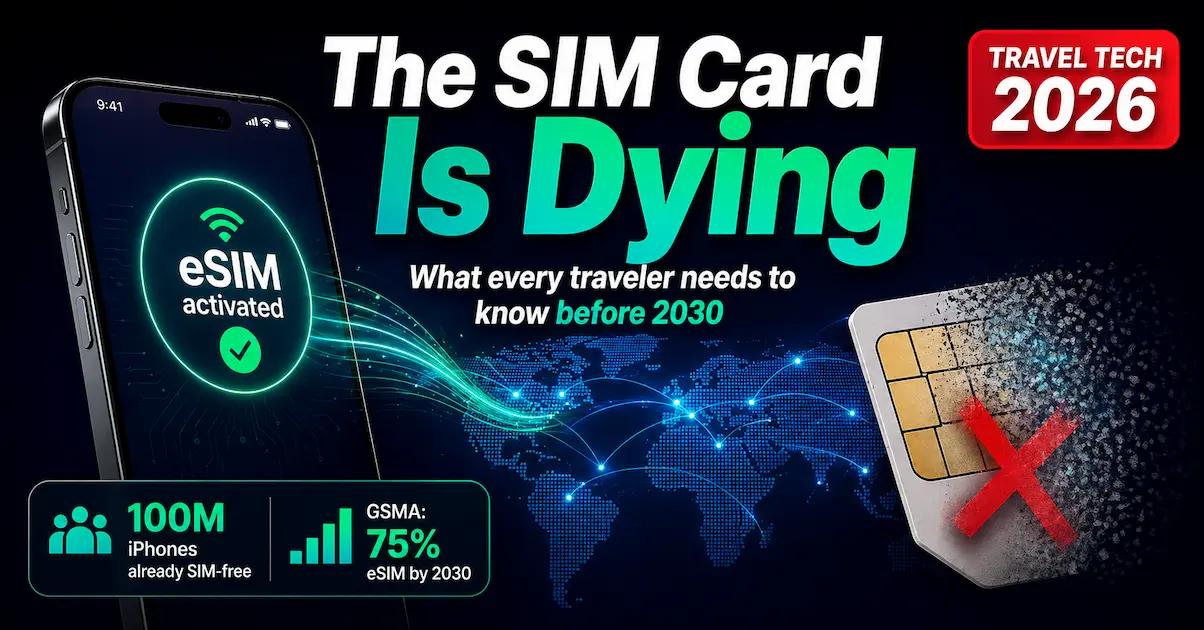
The GSMA — the global body that regulates the mobile industry — projects that physical SIM cards will be virtually obsolete by 2030. And the transition is already happening at full speed: Apple has sold more than 100 million iPhones with no SIM tray at all in the United States over the past two years, and Google, Samsung and the rest of the Android ecosystem are quietly following.
For travelers, this isn’t just a technical curiosity. It’s the biggest shift in mobile connectivity since 4G — and it’s already saving smart travelers hundreds of dollars per trip on roaming. Here’s what’s happening, why it matters, and how to get ahead of the curve before everyone else does.
Why the SIM Card is Dying (and What Replaces It)
If you’ve been hearing about the sim card is dying shift, this is what it actually means in practice.
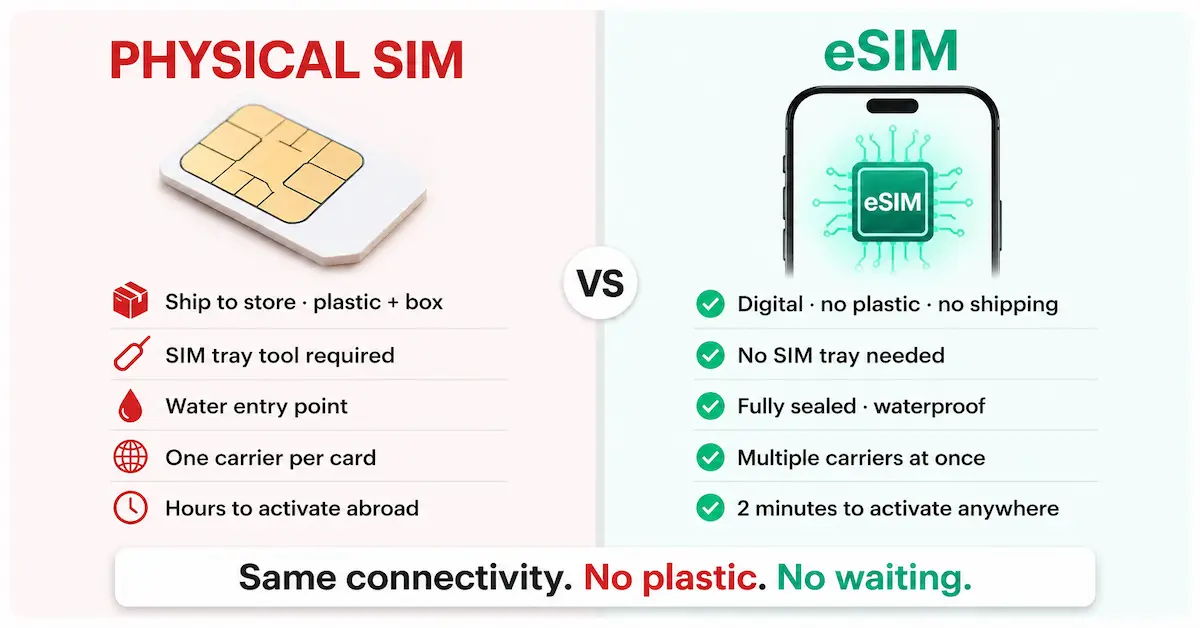
An eSIM (“embedded SIM”) is a tiny chip soldered directly onto your phone’s motherboard. Unlike the plastic SIM card you’ve been popping in and out for fifteen years, you can’t see it, touch it or lose it. Instead of swapping a physical chip when you change carriers, you scan a QR code or tap a button — and your phone is connected to a new network in under two minutes.
Every iPhone since the XS, every recent Pixel, every flagship Samsung Galaxy from the S20 onward, and most mid-range phones from 2023 forward already support eSIM. You probably own an eSIM-ready phone right now and don’t even know it.
The real superpower? You can store multiple eSIMs at once and switch between them instantly. Your home carrier in São Paulo, a data plan for your week in Rome, a backup line for emergencies — all on one device, no plastic involved.
Why the SIM Card Is Living on Borrowed Time
The sim card is dying shift became real the moment. Apple removed the SIM tray to take the leap. In late 2022, the iPhone 14 launched in the United States without a SIM tray at all — eSIM only. The decision was so bold the industry assumed Apple would walk it back. They didn’t. The iPhone 15, 16 and 17 all kept the same design in the US, and rumors point to Apple expanding eSIM-only models to Europe in the next iPhone cycle.
Why kill the SIM tray? Three reasons, all of them about money and physics. The tray takes up precious internal space that could be used for a bigger battery or new components. It’s a point of water and dust intrusion. And eliminating it lets carriers onboard customers digitally — no shipping, no plastic, no retail visit.
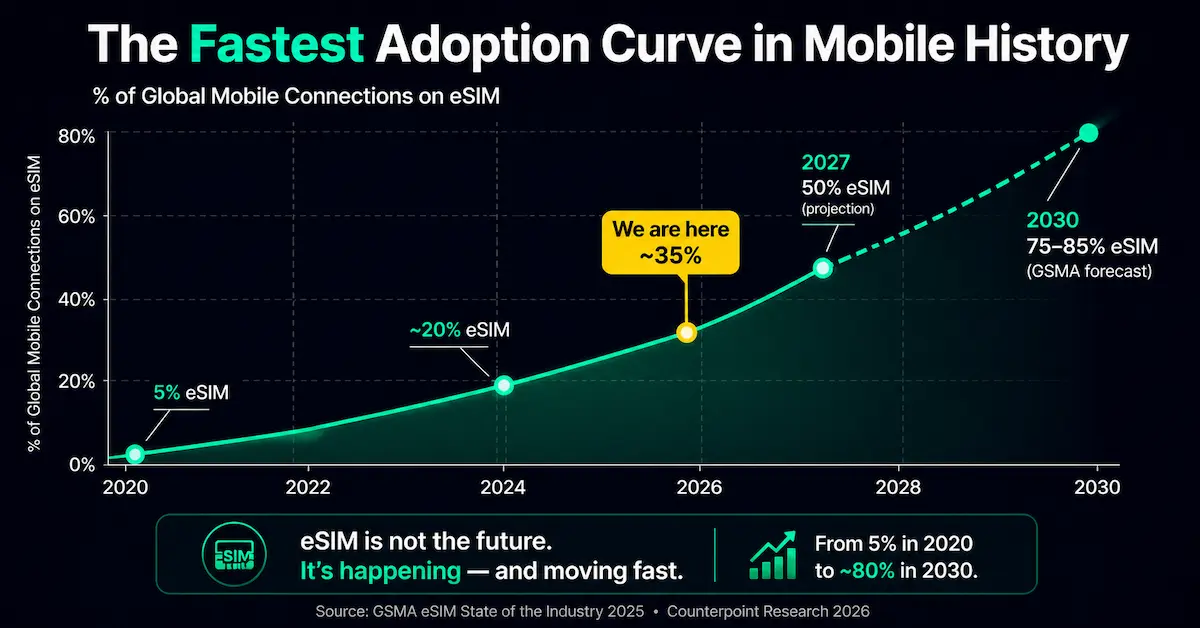
The GSMA’s eSIM State of the Industry report projects that by 2030, over 75% of all smartphone connections globally will run on eSIM. Counterpoint Research is even more aggressive, expecting eSIM-only devices to become the default in major markets by 2027–2028. The European Union is pushing standardization rules that will make switching carriers via eSIM as simple as changing your Wi-Fi network.
In other words: this isn’t a maybe. The SIM card is following the path of the floppy disk, the headphone jack, and the physical SIM tray on iPhones in the US — gone before most people noticed.
The Roaming Revolution: How Much Travelers Actually Save
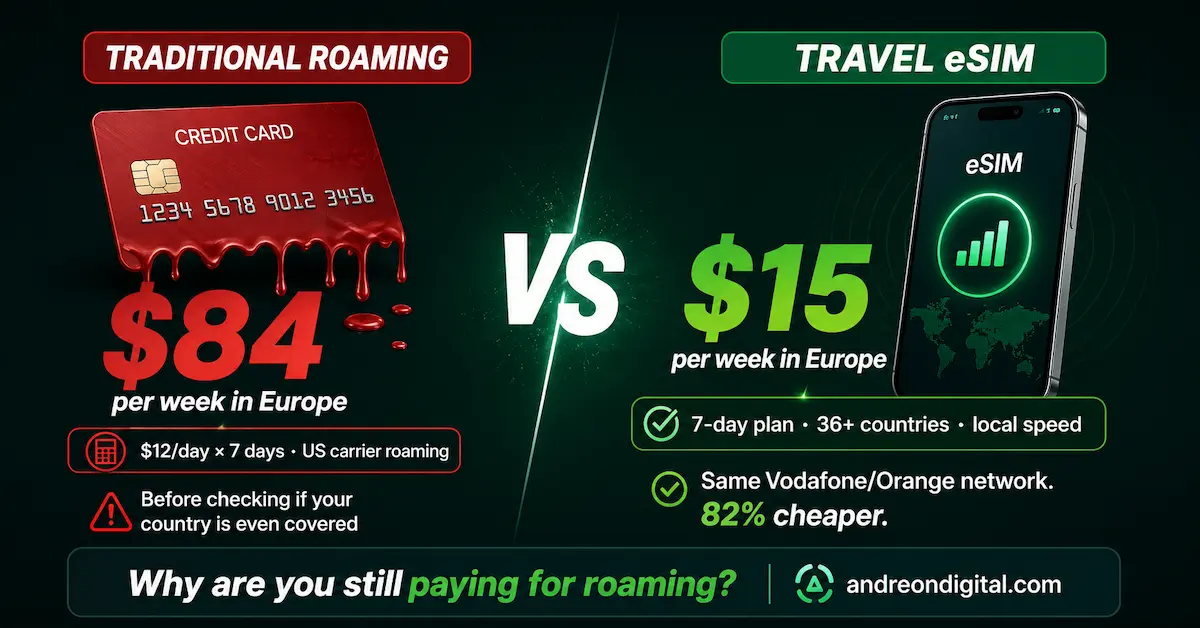
Here’s where the sim card is dying shift starts saving you real money. Traditional roaming has always been a quiet form of highway robbery. A typical US carrier charges $10 to $12 per day for international roaming. A week in Italy and Spain? That’s $84 just to keep your phone working. Two weeks in a multi-country European trip? Easily $150–$200, and that’s before you check whether your plan even covers the country you’re visiting.
eSIM travel plans break that model entirely. A 7-day, 5GB data plan covering 36 European countries typically costs between $10 and $18. A 30-day plan with 20GB is usually under $40. The math isn’t subtle — you’re paying somewhere between 70% and 90% less than your home carrier would charge for roaming, and you get faster speeds because you’re connecting to local networks directly, not bouncing through a roaming agreement.
Travel eSIMs are usually sold in three formats:
- Daily packages — great for short trips and city breaks
- Weekly packages — the sweet spot for most vacations
- Monthly packages — for longer journeys, digital nomads, and business travelers
Most reputable providers also offer regional plans — “Europe,” “Asia,” “Latin America” — so you don’t need a separate eSIM for each border crossing.
📱 Planning a European trip soon? Our complete eSIM Europe guide compares daily, weekly, and monthly plans across 36+ countries — including which providers actually deliver the speeds they advertise.
How It Actually Works When You Travel
If you’ve never used an eSIM, the process feels almost suspiciously simple. Here’s what actually happens when you buy a travel eSIM:
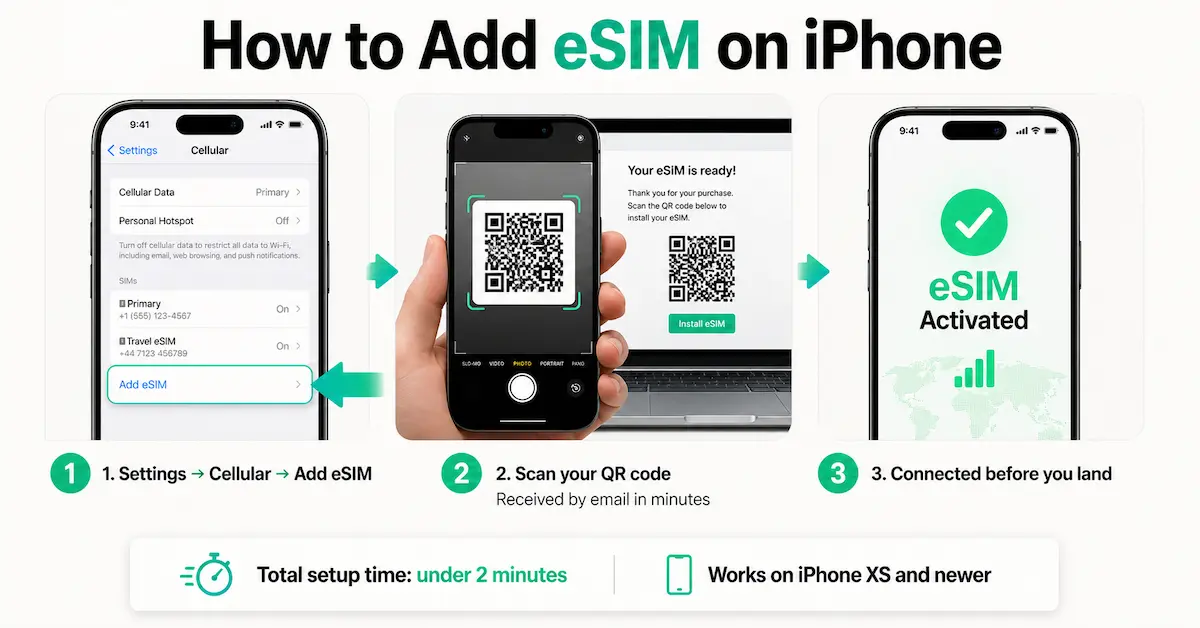
Step 1. Buy the plan online — usually 30 seconds. Pick the country or region, choose the data package, pay.
Step 2. Receive a QR code by email — within minutes, not days.
Step 3. Scan the QR code with your phone before you fly. iPhone: Settings → Cellular → Add eSIM. Android: Settings → Network → Add Mobile Plan.
Step 4. Land and turn on data roaming for the travel eSIM line. Your home line stays active for calls and SMS — no number changes, no missed messages.
Step 5. Connected to a local network within seconds of landing. No SIM swapping at the airport, no plastic in your pocket.
⚠️ The only catch worth knowing: activate the eSIM before you leave home, while you have stable Wi-Fi. Some travelers learn this the hard way at airport gates with weak signal. Set it up the night before.
The Numbers: What Happens Between Now and 2030
The forecasts coming out of the major mobile industry analysts are remarkably aligned. Here’s where things are heading:
| Year | What Changes |
|---|---|
| End of 2026 | eSIM-only flagship phones expand from the US to Canada, Australia, and parts of Europe |
| 2027 | Counterpoint Research expects eSIM connections to surpass 4 billion globally — roughly half of all mobile lines on Earth |
| 2028 | Most mid-range Android phones drop SIM trays entirely in developed markets |
| 2029 | EU regulators expected to mandate eSIM portability across all member states — ending carrier lock-in |
| 2030 | GSMA projects 75–85% of smartphone connections will be eSIM-based |
To put that in perspective: in 2020, eSIM accounted for less than 5% of global connections. The growth curve over the next four years is steeper than the move from 3G to 4G. Travel eSIM providers — companies that didn’t exist five years ago — are already serving tens of millions of users a year.
What This Means for Travelers Around the World
If you travel internationally even once a year, the practical consequences are immediate. You no longer need to hunt for a kiosk at the airport, hope it’s open, struggle through a language barrier, and trust a stranger with your phone. You don’t need to keep a tiny SIM ejector tool in your wallet. You don’t need to risk losing your home country’s SIM card in a hostel drawer somewhere in Lisbon.
More importantly, you stop being held hostage by your home carrier’s roaming fees. The economic case is simple enough that we expect — within the next two years — most travel insurance and airline loyalty programs to start bundling eSIM plans the way they bundle lounge access today.
For frequent travelers, the bigger question becomes which destinations have the best eSIM ecosystems right now. The countries with the most developed travel eSIM markets — and where you’ll save the most money — include the United States, Portugal, Spain, Italy, the United Kingdom, and Japan. Each market has different speeds, coverage quirks, and price sweet spots — and that’s exactly what our country guides break down.
The Bottom Line
The SIM card had a good run. For nearly three decades, that little plastic rectangle defined how we connected our phones to the world. By 2030, it will mostly be a museum piece — a curiosity your kids ask you about when they find an old phone in a drawer.
The transition is already underway, and the travelers who adopt eSIM first are the ones saving the most money and avoiding the most headaches. You don’t need to wait for the industry to finish the job — your phone is almost certainly ready right now, and a working travel plan is two minutes and a QR code away.
Ready to make the switch before your next trip? Browse our eSIM guides by destination and find the plan that fits where you’re going next. Because the future of mobile connectivity isn’t coming — it’s already in your pocket.
Frequently Asked Questions
Will my old phone still work with a SIM card after 2030?
Yes. Existing SIM cards and phones with SIM trays will keep working for years — carriers won’t switch off SIM provisioning overnight. The shift is about new devices and new activations, not about disabling old ones.
Does my phone support eSIM?
Most flagship phones from 2018 onward and most mid-range phones from 2022 onward do. iPhone XS and newer, Google Pixel 3 and newer, and Samsung Galaxy S20 and newer all support eSIM. To check: Settings → About Phone → look for an EID number.
Can I keep my home phone number while using a travel eSIM?
Yes — that’s the whole point. Your home line stays active for calls and SMS, and the travel eSIM handles your data. You receive WhatsApp, iMessage and emails normally.
Are travel eSIMs reliable?
The major travel eSIM providers connect to the same Tier-1 networks (Vodafone, Orange, T-Mobile, Verizon partners, etc.) that local carriers use. Speed and coverage are equivalent. Reliability comes down to the provider — stick with established names.
What happens to my eSIM data when the plan ends?
The plan stops, but the eSIM profile usually stays on your phone — you can top it up or delete it. Many providers let you reactivate the same eSIM on your next trip without buying a new one.
Last updated: April 2026 · andreondigital.com