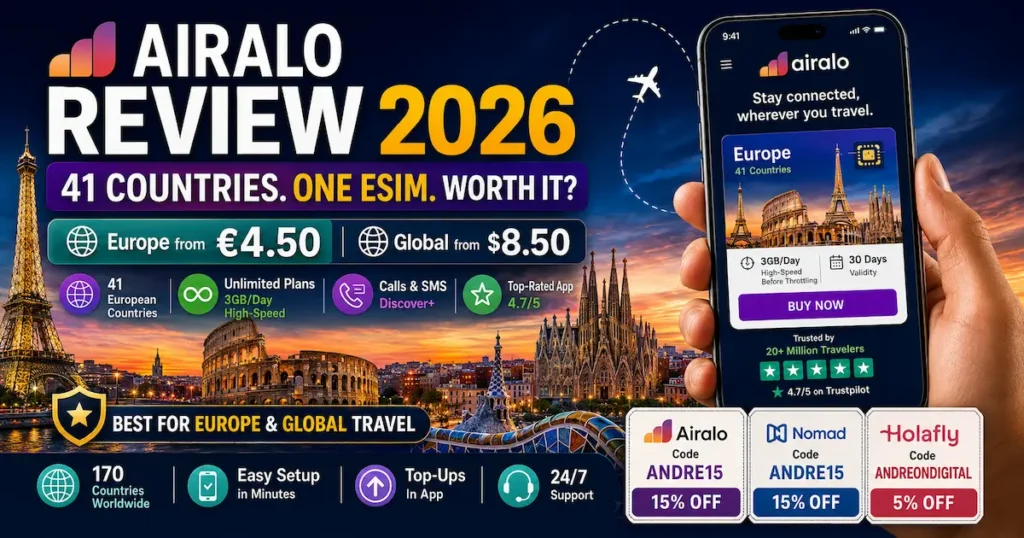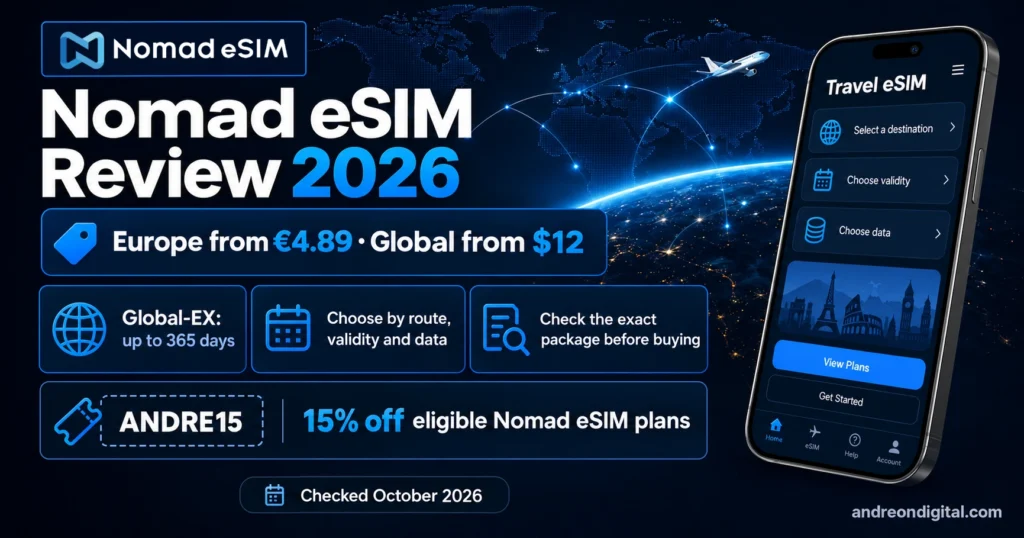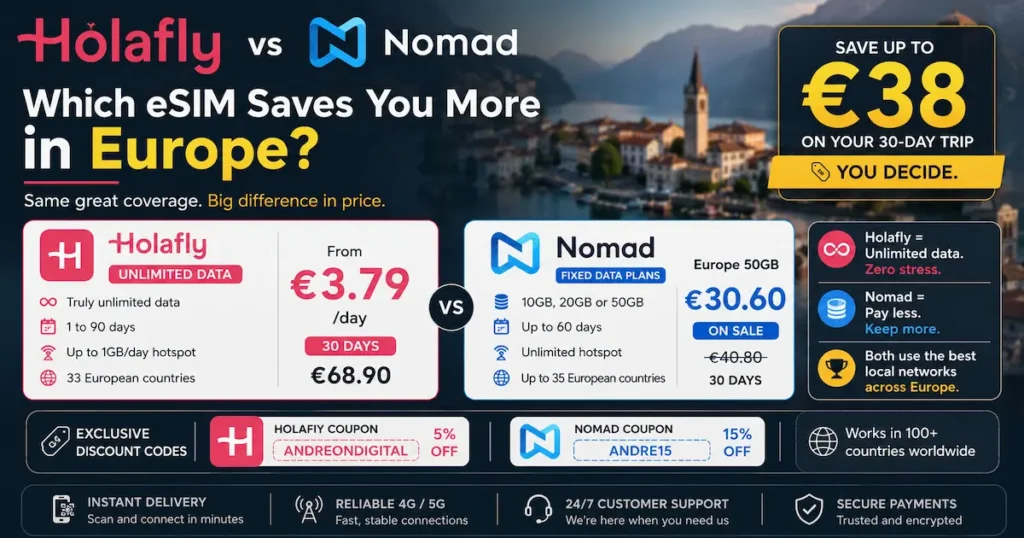

Best eSIM for train travel in Europe right now: Nomad Europe regional plan for most travelers — Telekom in Germany, multi-carrier in France, full hotspot. Holafly for unlimited data on long journeys — no data counting across ICE, TGV, and Frecciarossa.
High-speed trains are great until your eSIM drops signal in a tunnel between Paris and Lyon. Here’s how to avoid that.
Europe has the world’s most connected high-speed rail network — ICE in Germany, TGV in France, Frecciarossa in Italy, AVE in Spain, Eurostar between London and Paris. Traveling at 250–300km/h creates a specific set of mobile connectivity challenges that a standard city-break eSIM guide doesn’t cover. Signal handover between towers happens faster than your phone can negotiate. Tunnels on high-speed lines can be 5–10km long. Onboard Wi-Fi on ICE, TGV, and Frecciarossa trains exists — but it aggregates the same mobile networks your eSIM uses, and it’s consistently slower and less reliable than a direct eSIM connection.
After months of testing travel eSIMs while traveling by ICE, TGV, and Frecciarossa across Europe, here is what actually works on trains — and what doesn’t.
Choosing the best eSIM for train travel in Europe depends on carrier coverage along rail corridors, multi-country support, and enough data for long journeys.
Best eSIM for train travel right now:
Nomad — Europe regional, Telekom in Germany, best for multi-country rail trips
Holafly — unlimited, no data tracking on long journeys
How eSIM Works on High-Speed Trains
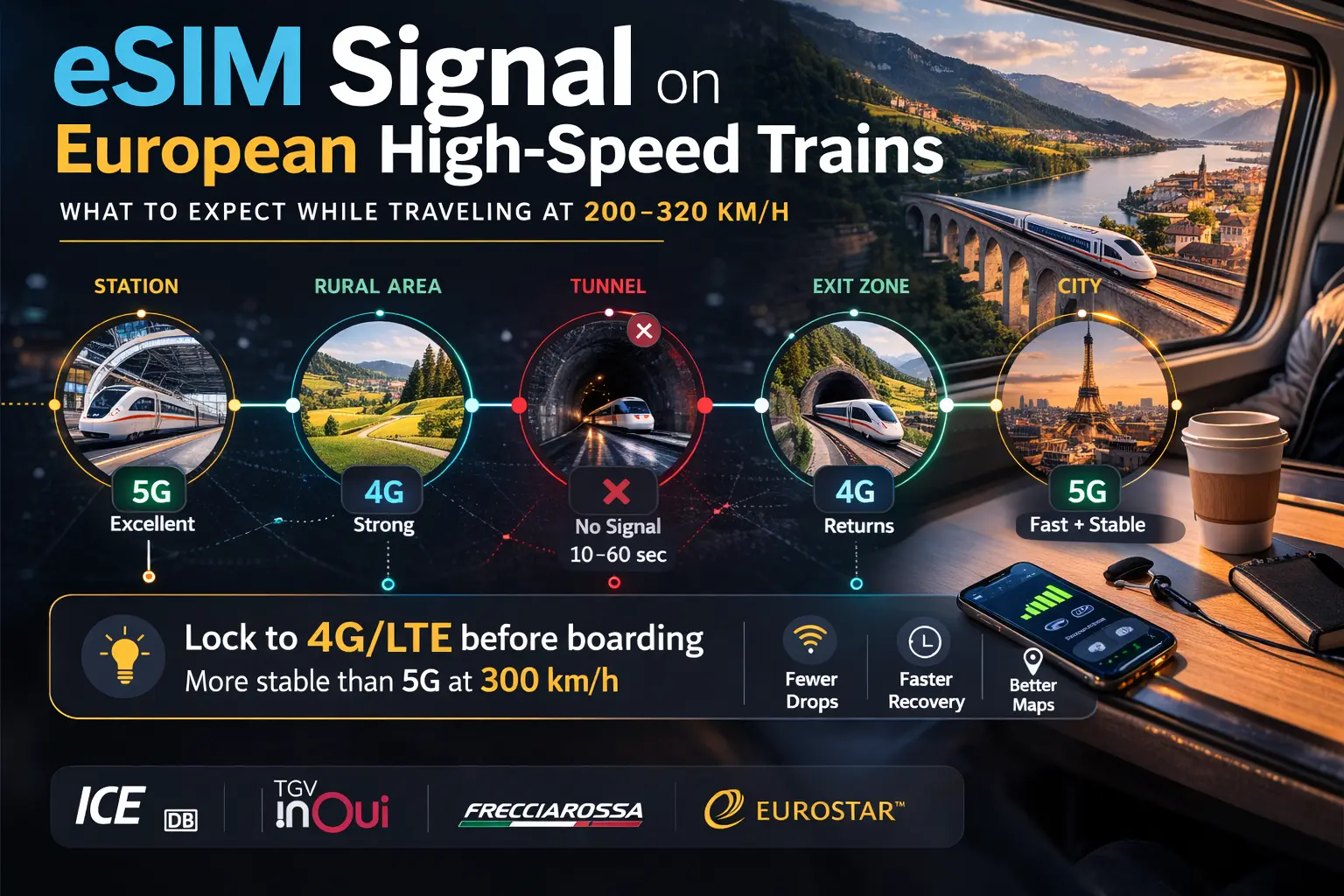
A travel eSIM works exactly like a local SIM inside a train — your phone connects to the nearest cell tower and maintains that connection as the train moves. The challenge at high speed is handover: as you pass one tower and approach the next, your device has milliseconds to negotiate the switch. At 300km/h, you pass a tower every 1–3 minutes on rural stretches.
What causes signal drops on trains:
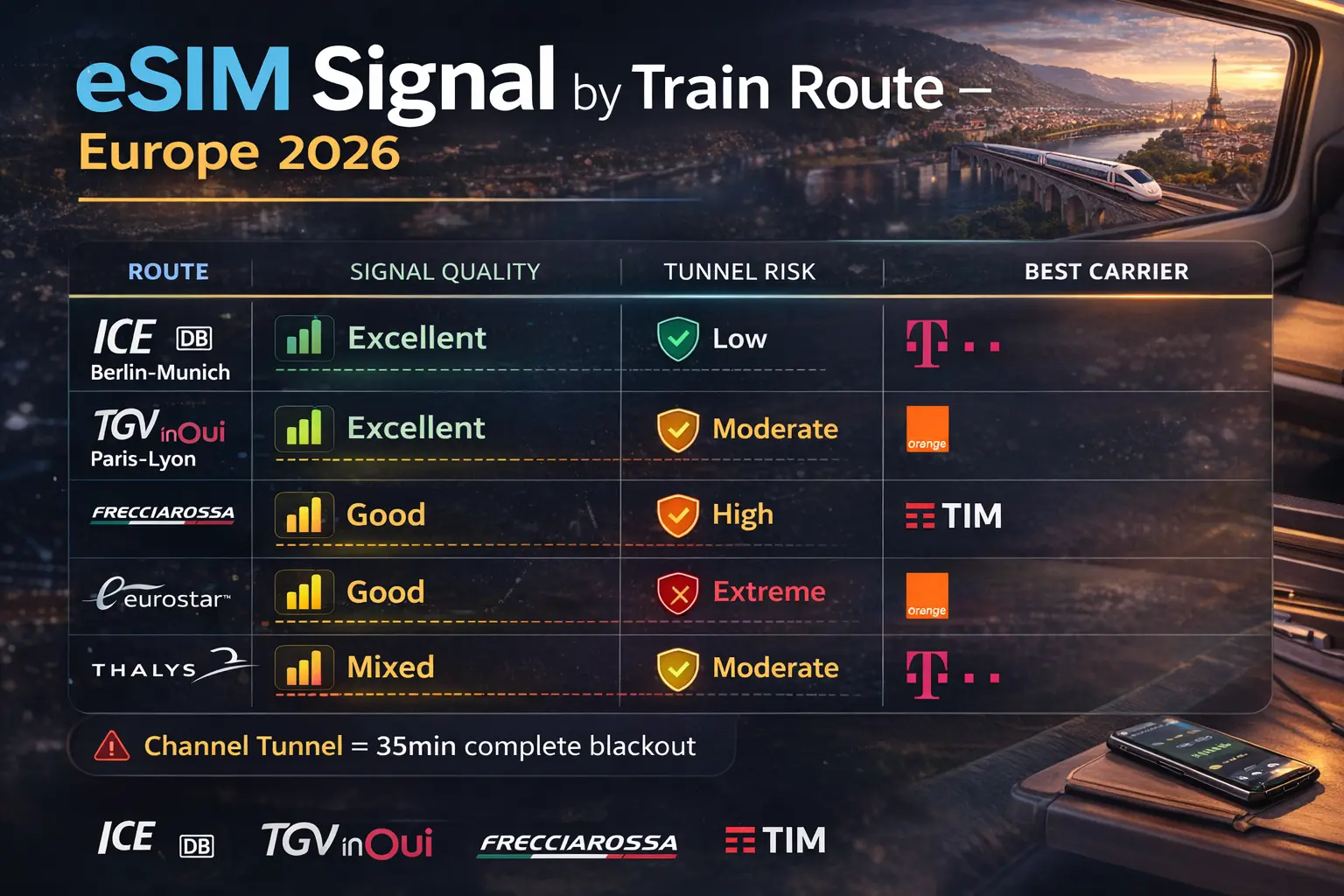
Tunnels — the most common cause of complete signal loss. High-speed lines use tunnels extensively to maintain gradient and avoid urban disruption. The Berlin–Munich ICE line passes through the Thuringian Forest tunnel complex. The Frankfurt–Cologne route has a significant tunnel section near Siegburg/Montabaur. The Channel Tunnel is 50km of complete blackout. Most TGV tunnels in France are shorter (1–3km) with quick signal return.
Speed-induced handover failures — at 250–300km/h, your phone sometimes fails to complete a 5G handover before leaving the tower’s coverage zone. The result is a momentary drop to 4G or LTE, followed by reconnection. This is more pronounced with 5G than 4G — 5G towers have a smaller coverage radius.
Rural stretches — the ICE network covers 7,800km of main routes in Germany. Signal along main corridors is good, but rural Bavaria, Brandenburg, and Mecklenburg have weaker infrastructure.
The single most useful tip for train travel: Lock your phone to 4G/LTE only before boarding any high-speed train. Go to Settings → Mobile Data → Network Selection → 4G/LTE only. This prevents your phone from constantly attempting and failing 5G handovers at speed, resulting in a stable 4G connection for the entire journey. Re-enable 5G when you arrive at your destination city.
Best Carriers by Train Route
ICE Germany: Use Telekom
Germany’s ICE network is the most data-demanding rail environment in Europe for eSIM users — fast trains, long rural stretches, and historically patchy rural mobile coverage.
Telekom is the correct carrier for ICE train travel. Deutsche Bahn and Deutsche Telekom have a formal partnership to cover all main ICE routes with 200Mbit+ by end of 2026 — 800 new mobile towers being installed along the rail network. Telekom already leads O2/Telefónica and Vodafone on rural and inter-city rail corridors.
Nomad and Holafly both connect to Telekom in Germany. Airalo connects to O2 — strong in Berlin, Munich, and Frankfurt, but weaker on rural ICE stretches through Thuringia, Bavaria, and the Rhineland.
| ICE Route | Journey Time | Telekom Signal | Tunnel Risk | Notes |
|---|---|---|---|---|
| Berlin → Munich | 4h | Good overall | ⚠️ Thuringia | Lock 4G before boarding |
| Frankfurt → Cologne | 1h10m | Good | ⚠️ Siegburg section | Short tunnels, quick return |
| Hamburg → Berlin | 1h45m | Excellent | Low | Flat terrain, strong signal |
| Frankfurt → Munich | 3h10m | Good | Low | Some rural Bavaria patches |
| Cologne → Brussels | 1h50m | Good → Excellent | Low | Transitions to Belgian network |
Download DB Navigator offline before boarding. The app works without signal for ticket display and timetables — essential for tunnel sections and ticket inspections.
TGV France: Use Orange or Bouygues
France’s TGV network is the most extensive high-speed rail system in Europe by route length. Signal on most TGV routes is good — France has strong 4G/5G infrastructure along main corridors.
The tunnel reality on TGV: TGV lines use tunnels frequently in mountainous and urban sections. The Paris–Lyon route has several shorter tunnels (1–3km) where signal drops momentarily and returns quickly. Longer tunnel sections exist on the Paris–Bordeaux and Paris–Marseille routes in Alpine approaches.
Multi-carrier access is the advantage on TGV. France has four carriers: Orange, SFR, Bouygues, and Free Mobile. An eSIM that accesses only Orange will drop signal where Orange is weak but Bouygues is strong — common in valleys and some tunnel exit zones. Nomad accesses Bouygues, Free Mobile, and Orange in France.
TGV onboard Wi-Fi exists on most trains but is notoriously unreliable. It aggregates the same mobile networks your eSIM uses, adds latency, and is shared with the entire train. Your eSIM is faster and more reliable on every TGV route.
| TGV Route | Journey Time | Signal Quality | Tunnel Risk | Notes |
|---|---|---|---|---|
| Paris → Lyon | 2h | Good | ⚠️ Several short | Drops momentary, returns fast |
| Paris → Marseille | 3h | Good | ⚠️ Alpine approach | Signal returns after tunnels |
| Paris → Bordeaux | 2h10m | Excellent | Low | Flat corridor, strong coverage |
| Paris → Brussels | 1h20m | Good → Excellent | Low | Transitions to Belgian network |
| Paris → London (Eurostar) | 2h15m | ⚠️ Channel Tunnel | Complete 50km blackout | No signal in Channel Tunnel |
Eurostar / Channel Tunnel: The Channel Tunnel is 50km of complete signal blackout — approximately 35 minutes with no mobile connection. This is normal and unavoidable with any carrier or eSIM. Signal resumes immediately on exit in France or the UK. Download everything you need before boarding at St Pancras or Gare du Nord.
Frecciarossa Italy: Use TIM or Vodafone IT
Italy’s Frecciarossa high-speed trains connect Milan, Florence, Rome, and Naples on a dedicated high-speed line. The route is well-covered by TIM (Telecom Italia) and Vodafone IT on the main north-south corridor.
The Apennine tunnels are the main signal challenge on Italian high-speed routes. The Florence–Rome section of the Direttissima and the AV/AC line both pass through significant Apennine mountain tunnels — up to 18km in some sections. Signal is lost in tunnels and returns on exit.
For Frecciarossa travel: A Europe regional eSIM on TIM provides the most consistent coverage on the main corridor. Signal quality in major stations (Milano Centrale, Roma Termini, Napoli Centrale) is excellent.
| Frecciarossa Route | Journey Time | Signal Quality | Tunnel Risk | Notes |
|---|---|---|---|---|
| Milan → Rome | 3h | Good | ⚠️ Apennine tunnels | Drops in mountain sections |
| Rome → Naples | 1h10m | Good | Low | Flat coastal approach |
| Milan → Florence | 1h40m | Good | ⚠️ Some Apennine | Short sections |
| Milan → Venice | 2h30m | Excellent | Low | Flat Po Valley |
Thalys / Eurostar (Brussels–Amsterdam–Paris)
The Brussels–Amsterdam route (now operated by Eurostar) is one of Europe’s most-used cross-border high-speed corridors. Belgium, Netherlands, and France are all EU member states — a Europe regional eSIM covers the full route seamlessly without any configuration change.
Signal is consistently strong on this route. The only notable drop is in the short Antwerp tunnel section and the Channel Tunnel for London-bound services.
Tips for Staying Connected on European Trains
Lock to 4G/LTE before boarding any high-speed train. This is the single most effective action you can take. 5G handover at 300km/h causes more drops than 4G does. Every major eSIM guide confirms this — lock 4G in Settings before you board, re-enable 5G at your destination.
Download offline maps before every long journey. Google Maps offline works without any signal — covers navigation at stations, connections, and emergency situations in tunnels. Download by city and by route before boarding.
Cache your train tickets offline. DB Navigator (Germany), SNCF Connect (France), Trenitalia (Italy) — all support offline ticket display. Download your ticket to Apple Wallet or Google Wallet as a backup. Ticket inspectors board in tunnels too.
Use Telekom-based eSIMs for multi-country ICE routes. If your journey crosses from Germany into France, Belgium, or the Netherlands on the same train (Frankfurt → Paris via ICE, Cologne → Brussels via Thalys), your Europe regional eSIM switches networks automatically at the border. No action needed.
Holafly for long-distance unlimited travel. On a week-long Eurail/Interrail trip covering multiple countries, Holafly’s unlimited plan removes the need to track data across long train days. Navigation, streaming, video calls, and map downloads on a 6-hour train journey can easily hit 3–5GB. Unlimited removes the calculation entirely.
Sit near carriage doors or under the repeater symbol (marked on ICE train ceilings) for stronger signal on rural stretches. Modern ICE sets use signal-permeable windows, but older rolling stock attenuates signal noticeably — doors have better exposure.
For eSIM setup before your trip, see my step-by-step eSIM activation guide. Traveling by Interrail or Eurail? A Europe regional eSIM pairs perfectly — the official Eurail pass guide covers all 33 countries included in the pass, the same countries your Europe eSIM covers.
FAQ
What is the best eSIM for train travel across Europe?
Nomad’s Europe regional plan is the best overall eSIM for European train travel — Telekom in Germany (the strongest carrier for ICE routes), multi-carrier in France (Bouygues/Orange/Free Mobile), full hotspot, and 5G in major cities. For unlimited data on long rail journeys: Holafly Europe, no data counting. Both work seamlessly across borders on a single eSIM. Prices verified March 2026.
Does eSIM signal drop in train tunnels?
Yes — signal drops completely in tunnels, regardless of eSIM provider or carrier. This is a physics limitation, not an eSIM issue. Short TGV tunnels (1–3km) cause momentary drops of 10–30 seconds. The Channel Tunnel causes a complete blackout for approximately 35 minutes. Download offline maps and cache train tickets before boarding any route with significant tunnel sections.
Should I use 4G or 5G on high-speed trains?
4G/LTE only — always. Lock your phone to 4G before boarding any high-speed train. At 250–300km/h, your phone constantly attempts and fails 5G handovers because 5G towers have a smaller coverage radius. This causes more frequent drops than 4G does. A stable 4G connection is faster and more reliable on a train than an unstable 5G connection. Re-enable 5G when you arrive at your destination.
Which carrier is best for ICE trains in Germany?
Deutsche Telekom. DB and Telekom have a formal infrastructure partnership to cover all main ICE routes with 200Mbit+ by end of 2026 — 800 new towers being installed along the rail network. Telekom outperforms O2 and Vodafone on rural ICE stretches through Thuringia, Bavaria, and the Rhineland. Nomad and Holafly both connect to Telekom in Germany. Airalo connects to O2 — adequate in cities, weaker on rural rail corridors.
Does the eSIM work on the Eurostar through the Channel Tunnel?
The Channel Tunnel itself (approximately 50km) is a complete signal blackout for all carriers and all eSIMs — this is unavoidable. Signal resumes immediately on exit in France (from UK) or the UK (from France). A Europe regional eSIM automatically switches from UK to French carrier (or vice versa) as soon as signal returns after the tunnel. No action needed. Download offline content before boarding at St Pancras or Gare du Nord.
Do I need a separate eSIM for each country on a Eurail trip?
No. A Europe regional eSIM covers all Eurail countries on one plan — Nomad’s Europe plan covers 35+ countries, Holafly’s Europe plan covers all EU members plus Norway and Switzerland. One eSIM, one activation, all borders seamless. Country-specific eSIMs are cheaper for single-country visits but require buying and activating multiple plans for multi-country rail travel. For Interrail or Eurail trips: always use a Europe regional plan.
Best eSIM for Eurail and Interrail Travelers
For multi-country rail trips, choosing the best eSIM for train travel in Europe is essential for staying connected across borders.
Eurail and Interrail passes cover 33 European countries. A Europe regional eSIM covers the same territory — one eSIM, one activation, all borders seamless.
Best eSIM for Eurail travel: Nomad Europe regional — Telekom in Germany, multi-carrier in France, full hotspot. At $20/20GB per 30 days, it covers a standard 2-week Eurail trip with headroom for navigation, maps, and social media across multiple countries.
Best eSIM for Interrail unlimited: Holafly Europe — no data counting across the full Interrail zone. On a week-long Interrail trip crossing Germany, Austria, and Italy, data usage on long train days can easily hit 3–5GB (navigation, streaming, downloads). Unlimited removes the calculation entirely.
Practical tip for Eurail travelers: Download the Eurail/Interrail app offline before each journey. The app shows real-time schedules, connections, and seat reservations — essential for multi-country routing. A stable 4G connection via eSIM is more reliable than train Wi-Fi for live timetable lookups at intermediate stations.
Final Verdict: Best eSIM for Train Travel in Europe
Overall, the best eSIM for train travel in Europe is Nomad for most travelers, with Holafly as the best unlimited option for long-distance rail journeys.
European train travel demands a specific approach to mobile data — the right carrier in each country, 4G locked during high-speed sections, offline maps cached, and enough data for long journey days.
For multi-country Eurail / Interrail trips: Nomad Europe regional — Telekom in Germany, multi-carrier in France, full hotspot, seamless border transitions. The single best eSIM for a train-focused Europe trip.
For unlimited data on long rail days: Holafly Europe — no data counting, no anxiety about 6-hour train journeys with navigation and streaming. The 500MB hotspot cap is the only limitation.
The 4G rule applies everywhere: Lock to 4G/LTE before every high-speed train, regardless of provider. Re-enable 5G at destination. This one change makes the biggest difference on train signal quality.
This article contains affiliate links. I may earn a commission at no extra cost to you. Prices verified March 2026. May change without notice — always confirm at checkout.
Last verified: March 2026.
Keep Reading
Train Travel & Europe
- Best eSIM for Europe 2026: 7 providers compared
- Best eSIM for Germany 2026
- Best eSIM for France 2026
- Best eSIM for Italy 2026
- Can I Use One eSIM in Multiple European Countries?
- Best eSIM for Long Stays in Europe
- Best eSIM for Backpacking Europe
- Best eSIM for Couples in Europe
- Mixing trains and driving? See Best eSIM for Road Trips in Europe
- Multi-country Interrail route? See Best eSIM for 10+ Countries in Europe