eSIM vs pocket WiFi for Europe is one of the most common questions travelers ask before planning a trip to Europe. I carried a pocket WiFi across Japan once. Never again. The device needed charging every 4 hours, it took up bag space, the daily rental added up fast, and I still had to return it at the airport or get charged a late fee. When I switched to eSIM, the difference was immediate — no extra device, no battery stress, no returning anything. Just data on my phone from the moment I landed.
For European travel in 2026, eSIM wins for the vast majority of travelers. But pocket WiFi still makes sense in a few specific situations — and being honest about those matters more than pretending one option is perfect.
Why trust this comparison? I’m based in Portugal, I’ve personally used Holafly and Nomad across Europe, and I compare connectivity options for European travelers full-time. Every price in this guide is verified against official sources and updated weekly.
eSIM vs Pocket WiFi: Quick Answer
eSIM wins for 90% of European travelers. It’s 3-5× cheaper, requires no extra device, has no deposit or return, and covers 30-42 countries automatically. Pocket WiFi only makes sense for groups of 3+ people on phones that don’t support eSIM. Today, eSIM is the best pocket WiFi Europe alternative — and it’s not close.
How Each Works
eSIM is a digital SIM card built into your phone — an embedded SIM standard that lets you download carrier profiles without a physical chip. You buy a data plan online from a provider like Nomad, Holafly, or Airalo, scan a QR code, and your phone connects to local European carriers — Orange in France, Deutsche Telekom in Germany, Cosmote in Greece. No extra device. No pickup. No return.
Pocket WiFi is a small portable router you rent or buy. It creates a personal WiFi hotspot that multiple devices connect to. For Europe, you typically rent from companies like Solis, Skyroam, GlocalMe, or TravelWiFi — either online for airport pickup or shipped to your hotel.
The fundamental difference: eSIM lives in your phone. Pocket WiFi is another thing you carry, charge, and eventually return.
Price Comparison: eSIM vs Pocket WiFi for Europe
When comparing eSIM vs pocket WiFi for Europe, the biggest difference travelers notice first is the price.
| eSIM | Pocket WiFi | |
| 7-day trip | $5-27 | $50-80 |
| 14-day trip | $12-45 | $90-150 |
| 30-day trip | $29-75 | $150-300 |
| Setup cost | $0 | $0-15 (shipping/pickup) |
| Deposit | None | $50-150 (refundable) |
| Late return fee | N/A | $10-20/day |
| Lost device fee | N/A | $100-200 |
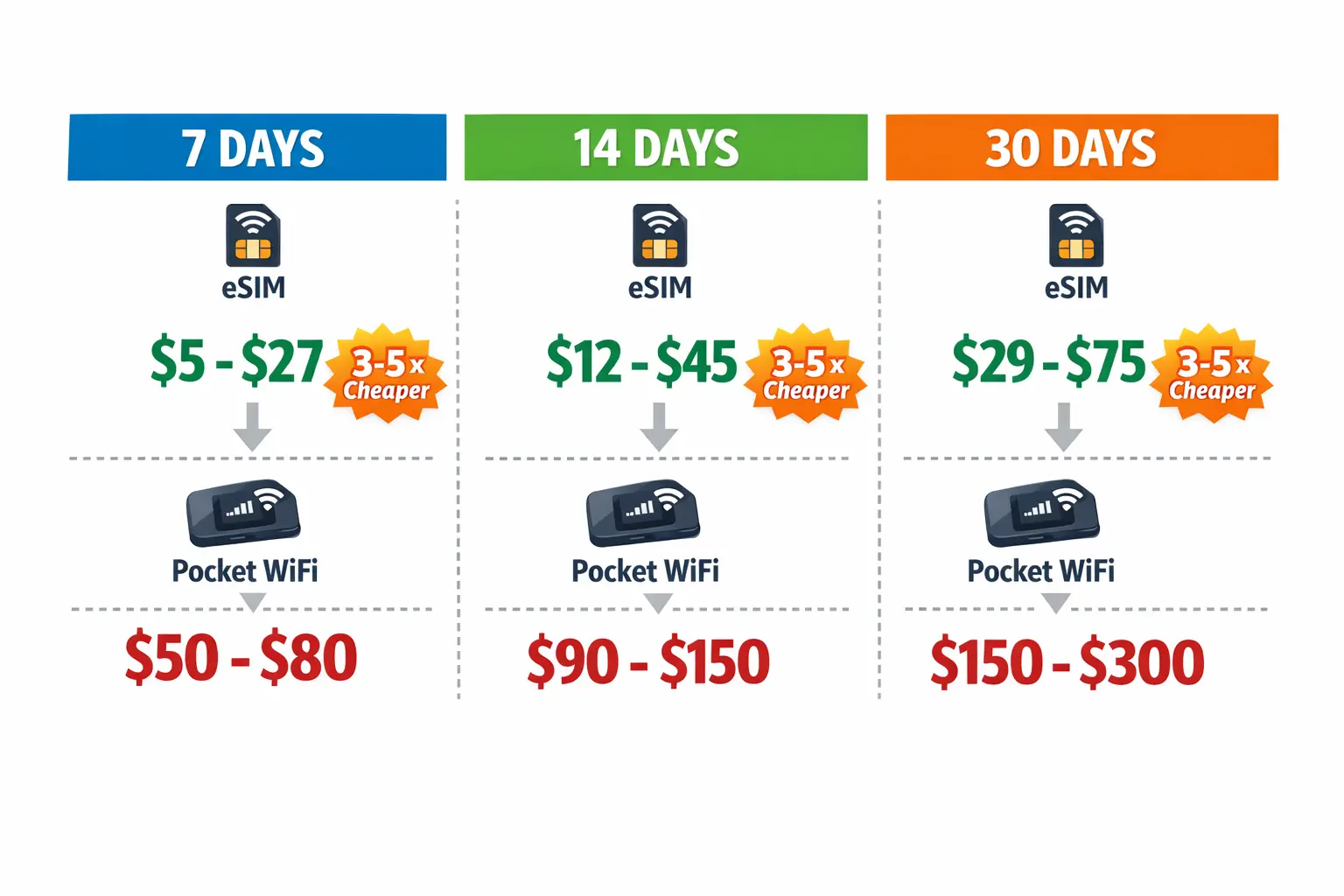
The math is clear. A Nomad eSIM costs $22 for 20GB over 30 days. A Holafly eSIM costs ~$27 for 7 days unlimited. A typical European pocket WiFi rental runs $8-15/day — that’s $56-105 for a single week, or $240-450 for a month.
Even the cheapest pocket WiFi costs 3-5× more than an eSIM for the same trip. And that’s before the deposit, the pickup logistics, and the risk of a lost-device fee that can hit $200.
Convenience: No Contest
| Factor | eSIM | Pocket WiFi |
|---|---|---|
| Setup time | 3 minutes (at home) | 15-30 min (airport pickup) |
| Extra device to carry | No | Yes (~150g, pocket-sized) |
| Battery | Uses phone battery | Separate battery (4-8 hours) |
| Charging | Phone charges normally | Extra cable + power bank needed |
| Works immediately on landing | ✅ Yes | ⚠️ After pickup/power on |
| Return required | No | Yes (airport/mail) |
| Multi-country | ✅ Automatic switching | ✅ If plan covers Europe |
| Lost/stolen | Just your phone | Phone + WiFi device |
| Sharing with others | Via hotspot (if plan allows) | ✅ Built-in (5-10 devices) |
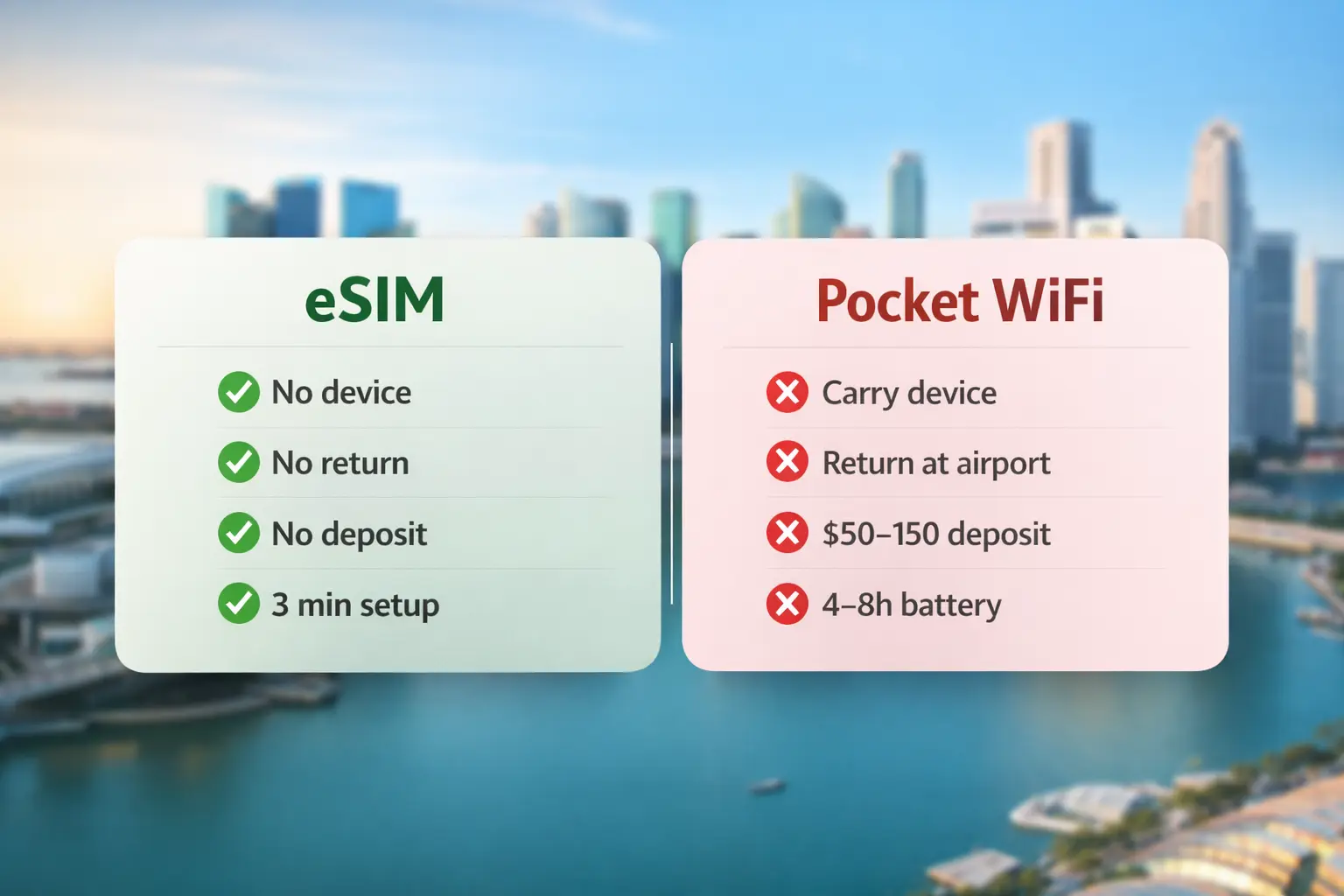
eSIM is invisible — it’s in your phone, uses your phone’s battery, requires zero logistics. Pocket WiFi adds friction to every part of your trip: one more device to charge, one more thing to lose, one more item to pack, and a return process at the end.
The only convenience advantage of pocket WiFi is built-in sharing. But most eSIM providers now include hotspot — Nomad and Maya Mobile offer full tethering, and even Holafly includes 500MB-1GB/day of hotspot on destination plans.
eSIM vs Pocket WiFi: Coverage in Europe
Both eSIM and pocket WiFi use the same local European carrier networks — the difference is how they connect to them.
eSIM providers partner with specific carriers in each country. Nomad connects to Orange in France, Deutsche Telekom in Germany, and Cosmote in Greece. Holafly uses Telekom, Orange, TIM, and Movistar depending on the country. You get direct carrier access at full 4G/5G speed — the same signal a local would get.
Pocket WiFi devices also connect to local carriers, but typically through roaming agreements that may prioritize different networks. Coverage is comparable in major cities like Paris, Rome, Berlin, Barcelona, and Athens. The real difference shows in rural areas or on trains — where eSIM providers on Telekom or Cosmote often hold signal better than pocket WiFi devices on lower-priority roaming connections.
For mainstream European travel across France, Italy, Spain, Germany, Greece, and Portugal, both options cover you. But eSIM gives you more control over which carrier you’re on — and that matters when you’re on an ICE train through Bavaria or a ferry between Greek islands.
When Pocket WiFi Still Wins
Being fair — pocket WiFi is better in three specific scenarios:
Groups of 3+ people with no eSIM-compatible phones. If you’re traveling with family members on older phones that don’t support eSIM, a single pocket WiFi device connecting 5-10 people makes sense. But if even one person has an eSIM-compatible phone, that person’s hotspot does the same job cheaper.
You need to connect a laptop and tablet all day. Digital nomads who tether 8+ hours daily may hit eSIM hotspot limits. Pocket WiFi with a dedicated battery handles sustained multi-device use better. That said, Holafly Plans at $64.90/mo includes unlimited hotspot — check my Digital Nomads eSIM guide first.
Destinations with very limited eSIM carrier coverage. In remote parts of Eastern Europe or rural Balkans, pocket WiFi with multi-carrier SIMs may find signal where a single-carrier eSIM doesn’t. For mainstream European travel — France, Italy, Spain, Germany, Greece, Portugal — this isn’t an issue.
When eSIM Wins (Most Travelers)
Solo travelers. No extra device, no extra battery, no extra weight. eSIM is the obvious choice.
Couples. One person gets an eSIM with hotspot, shares with the other. Nomad at $22/20GB with full tethering costs less than one day of pocket WiFi rental.
Multi-country European trips. Paris to Amsterdam to Berlin to Prague — an eSIM switches carriers automatically at every border. Pocket WiFi works too, but at 5× the price while you carry an extra device.
Anyone who values simplicity. No pickup at Schiphol or CDG. No returning at Fiumicino while rushing to catch your flight. No deposit holds on your credit card. No “where did I put the WiFi device?” panic.
Short trips (under 14 days). The cost gap is enormous. A week in Italy: Nomad eSIM $5.50-$22 vs pocket WiFi $70-100. For anyone considering a portable WiFi vs eSIM for travel, the numbers speak for themselves on short European trips.
Budget pick: Nomad from $0.58/GB — hotspot included, nothing to return.
FAQ
Is eSIM better than pocket WiFi for Europe?
For most travelers, yes. eSIM is cheaper (from $5 vs $50+/week), requires no extra device, has no return logistics, and covers 30-42 European countries automatically. Pocket WiFi only wins for large groups where nobody has an eSIM-compatible phone.
Can I share my eSIM data with others?
Yes, via your phone’s hotspot. Nomad, Maya Mobile, and Breezy include full tethering. Holafly limits hotspot to 500MB-1GB/day on destination plans. For sharing with 1-2 people, eSIM hotspot works fine. For 5+ devices all day, pocket WiFi handles it better.
How much does pocket WiFi cost in Europe?
Typically $8-15 per day, plus a refundable deposit of $50-150. A 7-day trip costs $56-105 in rental alone. A 30-day trip runs $240-450. Compare that to a pocket WiFi Europe alternative like eSIM at $22-75 for the same duration.
Does pocket WiFi work across multiple European countries?
Yes, most rentals cover the EU. But an eSIM covers the same countries at a fraction of the cost without carrying a second device. The multi-country advantage pocket WiFi once had no longer exists with regional eSIM plans.
What if my phone doesn’t support eSIM?
If your phone is older than 2018 or lacks eSIM hardware, pocket WiFi is your best portable option. Check Settings → About Phone for “EID” — if it’s there, you’re good. Most phones made after 2020 support eSIM.
Can I use pocket WiFi and eSIM together?
Yes. Some travelers use eSIM as primary data and pocket WiFi as backup for group situations. But for most European trips, this is overkill — an eSIM with hotspot handles both scenarios.
The Verdict: eSIM for 90% of European Travelers
After comparing eSIM vs pocket WiFi for Europe, the conclusion is clear for most travelers.
If your phone supports eSIM, there’s no reason to rent a pocket WiFi for Europe in 2026. eSIM is the pocket WiFi Europe alternative that’s cheaper, simpler, requires no extra device, no deposit, no return, and covers 30-42 countries on a single plan.
The only real exception: large groups on old phones. Everyone else should get an eSIM.
Best value: → Nomad $22/20GB — full hotspot, 35+ countries, nothing to carry.
Best unlimited: → Holafly ~$27/7 days — no data limits, no devices, no stress.
This article contains affiliate links. I may earn a commission at no extra cost to you. All prices verified on official websites in March 2026. Prices may change without notice — always confirm at checkout.
Last verified: March 2026.
Keep Reading
eSIM Guides
- Best eSIM for Europe 2026: 7 providers compared
- Cheapest eSIM for Europe 2026
- Best eSIM for 30 Days in Europe
- Best Unlimited Data eSIM for Europe
- How Much Data Do You Need for Europe?
- eSIM vs Physical SIM for Europe
- Best eSIM for Digital Nomads in Europe
- Going on a cruise? See Best eSIM for European Cruises
- Family connectivity comparison — see Best eSIM for Families in Europe
eSIM by Country
- Portugal | Spain | Italy | France| Germany | Greece | Netherlands | UK
- Croatia | Turkey | Austria | Switzerland | Czech Republic