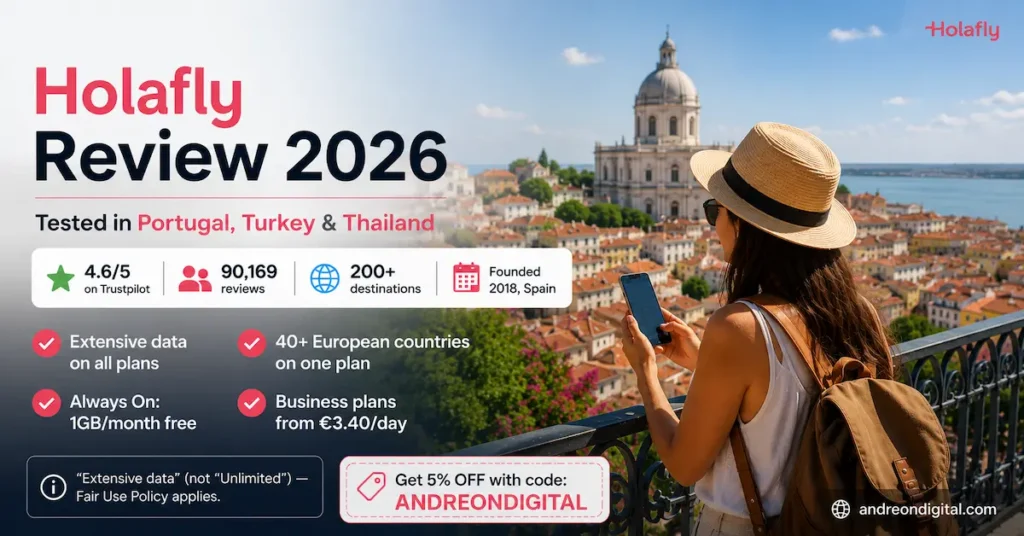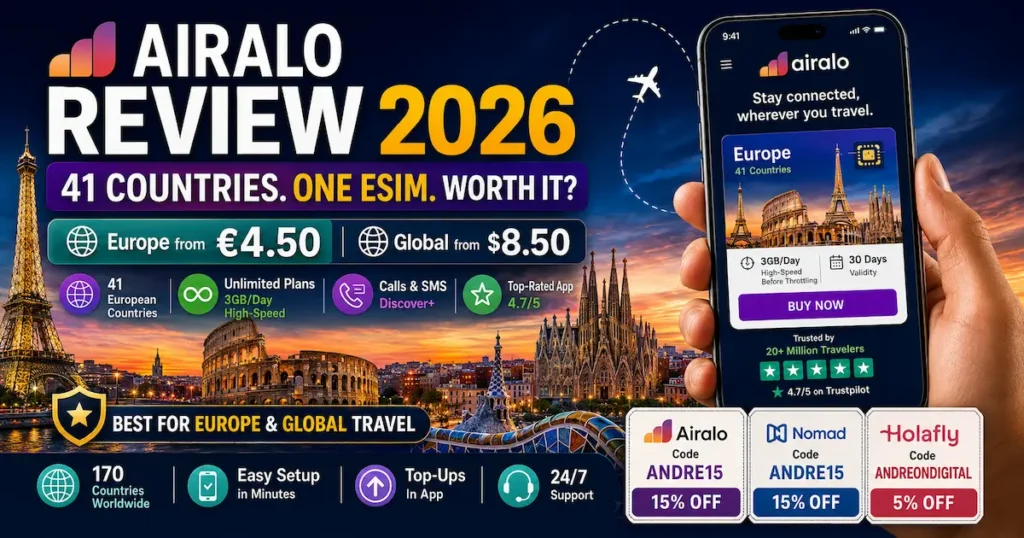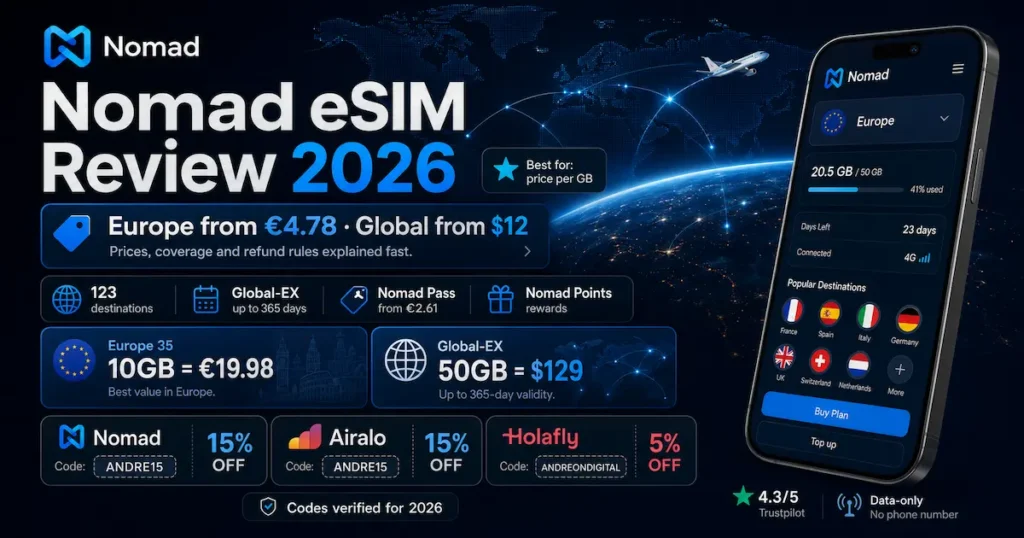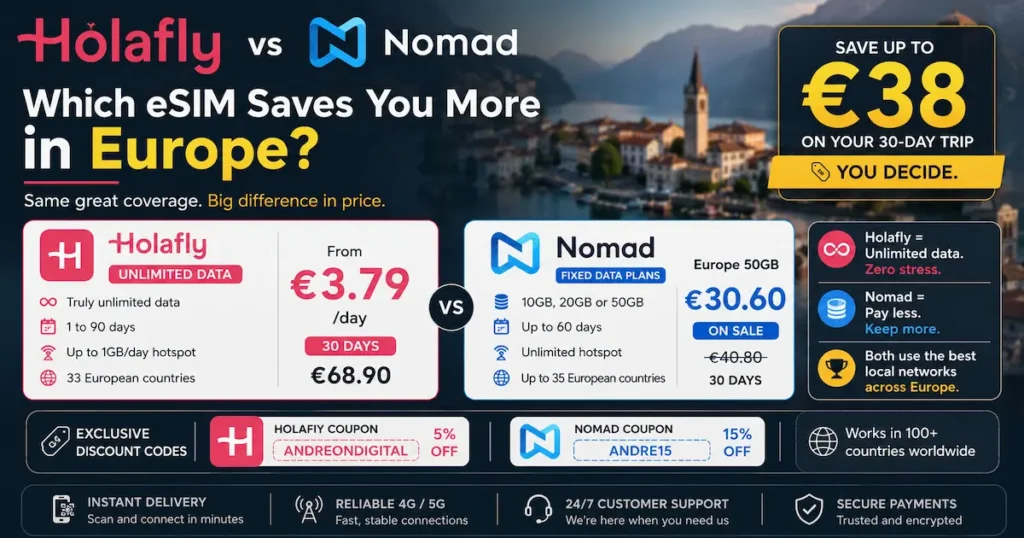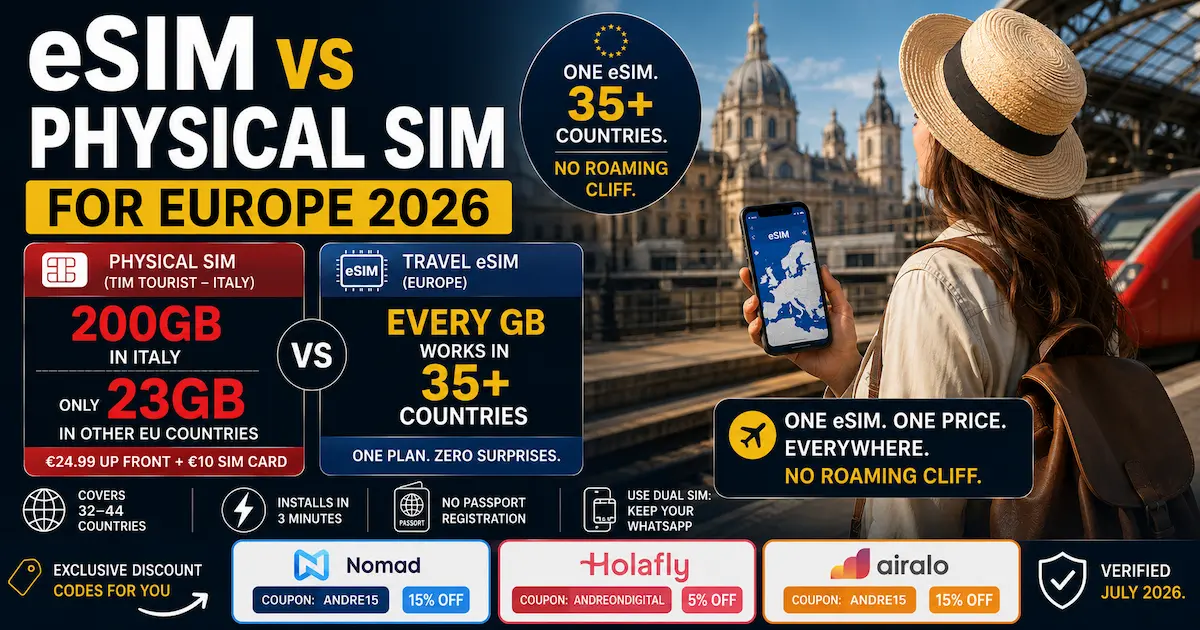

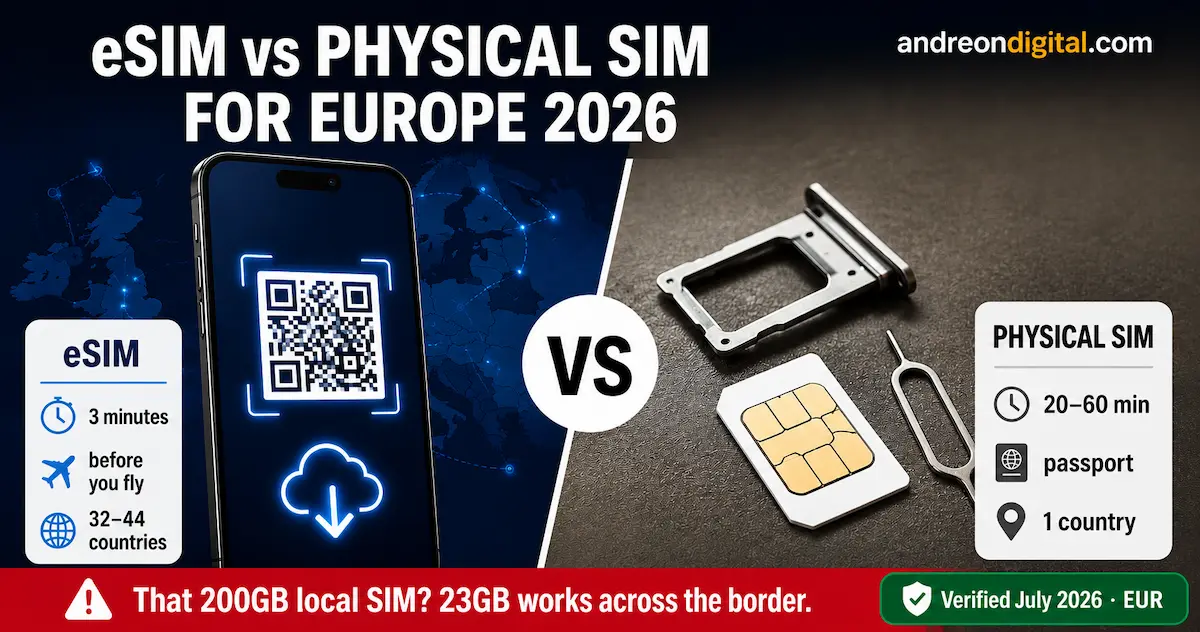
This visual introduces the central question behind eSIM vs Physical SIM for Europe: whether convenience, cross-border data or a local number matters most for your itinerary.
eSIM vs physical SIM for Europe is one of the most common questions travelers ask before booking their trip. Choosing the right option comes down to how you travel, how long you’re staying, and whether you need a local number. For most visitors in 2026, an eSIM is the better option — you buy it before your flight, install it in under 3 minutes, and land already connected. No airport kiosks, no passport registration, no tiny plastic cards to lose.
But the argument people usually have — “the local SIM has way more data for the money” — falls apart on one official number. TIM’s tourist package in Italy advertises 200GB and costs €24.99 with the SIM card. Only 23GB of it works once you leave Italy. Vodafone Spain’s €10 prepaid lists 90GB in Spain and 15GB of EU roaming.
That gap isn’t a trick — it’s how EU roaming rules let operators cap roaming data — and it’s the single most important fact in this comparison, because a regional eSIM simply doesn’t have it: every gigabyte works in every country on the plan.
⚡ The 30-second answer
✈️ Visiting 2+ European countries, 1–30 days → eSIM. One plan across 32–44 countries, no roaming cliff, installed before you fly.
🏠 Staying 3+ months in one country → local physical SIM. Better long-term rates, local number, network priority.
📵 Phone with no eSIM support → physical SIM, no debate.
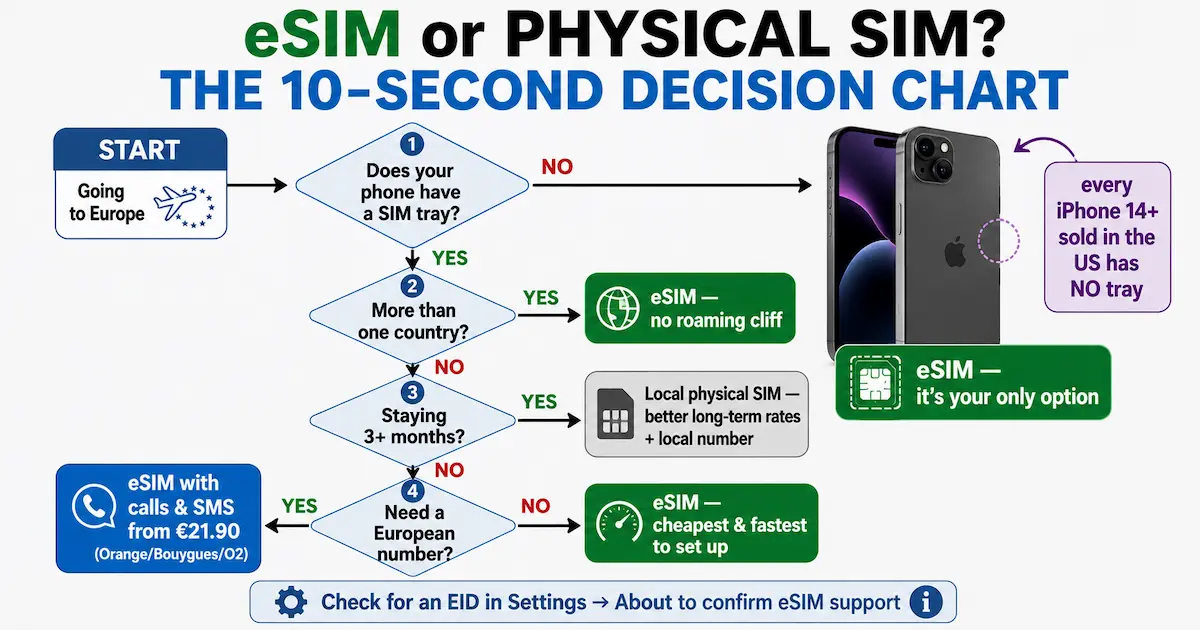
📱 iPhone 14 or later bought in the US → eSIM only — your phone has no SIM tray at all.
☎️ Need a European number with calls & SMS → you no longer need plastic: operator eSIMs (Orange, Bouygues, O2) include one from €21.90.
💶 Typical 10-day cost: eSIM €15–€34 · local SIM €10–€25 (plus the roaming cliff) · home-carrier day passes often €90–€180.
How Does an eSIM Actually Work?
An eSIM (embedded SIM) is a digital SIM built into your phone. You scan a QR code — or tap install in a provider app — and a carrier profile downloads directly to your device. No plastic chip needed.
For European travel, you buy a regional plan from Nomad, Airalo, Holafly or SimOptions before leaving home. When you land at Charles de Gaulle, Fiumicino or Barajas, your phone usually connects to a local carrier within seconds. No shop visits, no forms, no waiting. Most travel eSIMs are data-only — you use WhatsApp and FaceTime for calls, while your home SIM stays active for texts and bank codes.
Compatible devices: iPhone XS (2018)+, Samsung Galaxy S20+, Google Pixel 3a+. Many phones made after 2020 support eSIM, but compatibility depends on model and region — some units sold in certain markets ship without it. Check Settings → About → look for an EID number before buying. Check if your phone supports eSIM: full list here.
For the full setup walkthrough, see my eSIM Activation Guide.
eSIM vs Physical SIM Explained Before You Choose
This short explanation shows the practical difference between installing a digital eSIM and buying a physical SIM after arrival. Watch it before choosing, especially if this is your first time using dual SIM in Europe.
The key point is simple: both formats connect to mobile networks, but the buying process, setup time, roaming allowance and ability to keep your home number active are different.
How Does a Physical SIM Work in Europe?
A physical SIM is the traditional plastic chip you insert into your phone’s tray. You buy one at an airport shop or carrier store after landing — Orange or SFR in France, TIM or Vodafone in Italy, Movistar or Vodafone in Spain.
Each country has its own plans and registration requirements: identity verification is standard practice for prepaid SIMs in markets including Germany, Italy and Spain, which is why the purchase happens at a staffed counter and typically eats 20–60 minutes of your first day.
EU roaming rules mean a SIM bought in one EU country works across the bloc — but with a catch that deserves its own section, because it is the whole ballgame.
Comparing eSIM to pocket WiFi instead? See my full comparison here.
The Roaming Cliff: Official Local SIM Prices vs What You Actually Get Abroad
The roaming figures make eSIM vs Physical SIM for Europe easier to judge because they separate the headline domestic allowance from the data travelers can actually use abroad.
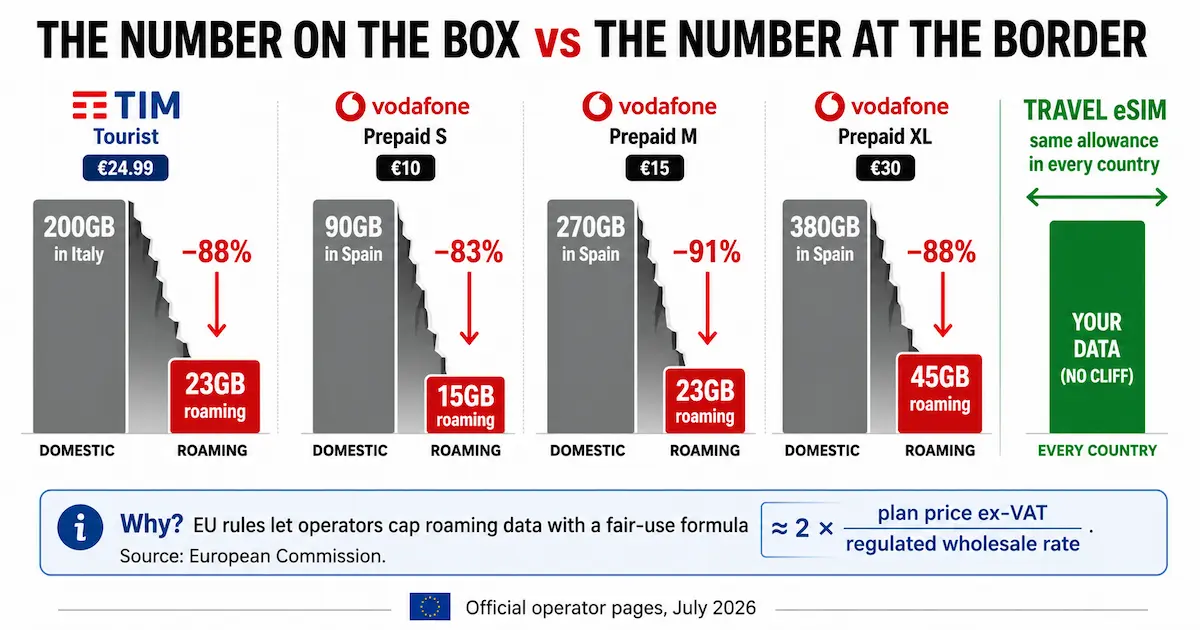
Official local SIM prices — France, Italy, Spain (July 2026)
| Country / plan | Real up-front cost | Domestic data | Data when roaming in the EU | Calls & SMS |
|---|---|---|---|---|
| Italy — TIM Tourist | €24.99 (€14.99 package + €10 SIM card) | 200GB with 5G Ultra | 23GB ⚠️ | Unlimited to Italian numbers · 100 international minutes |
| Spain — Vodafone Prepaid S | €10 (SIM free) | 90GB | 15GB ⚠️ | Unlimited national calls · 500 international minutes |
| Spain — Vodafone Prepaid M | €15 | 270GB | 23GB | Unlimited national · 2,000 international minutes |
| Spain — Vodafone Prepaid XL | €30 | 380GB | 45GB | Unlimited national · 3,000 international minutes |
| France — Orange Holiday Europe | Starter price not published online ⚠️ recharges from €19.99 / 12GB / 14d | 20GB / 50GB / 100GB 5G / 500GB tiers | Works across Europe (that’s the product) | Unlimited calls & SMS in Europe + international minutes |
For short multi-country travel, eSIM vs Physical SIM for Europe is mainly a comparison between one regional allowance and a domestic plan governed by roaming limits.
What the eSIM Companies Themselves Admit About Physical SIM
Provider documentation adds balance to eSIM vs Physical SIM for Europe by showing that plastic still wins for device transfers, local numbers and some troubleshooting situations.
Every eSIM comparison online is written by someone selling eSIMs. So instead of adding another opinion, here’s something more useful: what six eSIM providers publish on their own websites about where physical SIM still beats them. These are their concessions, not mine.
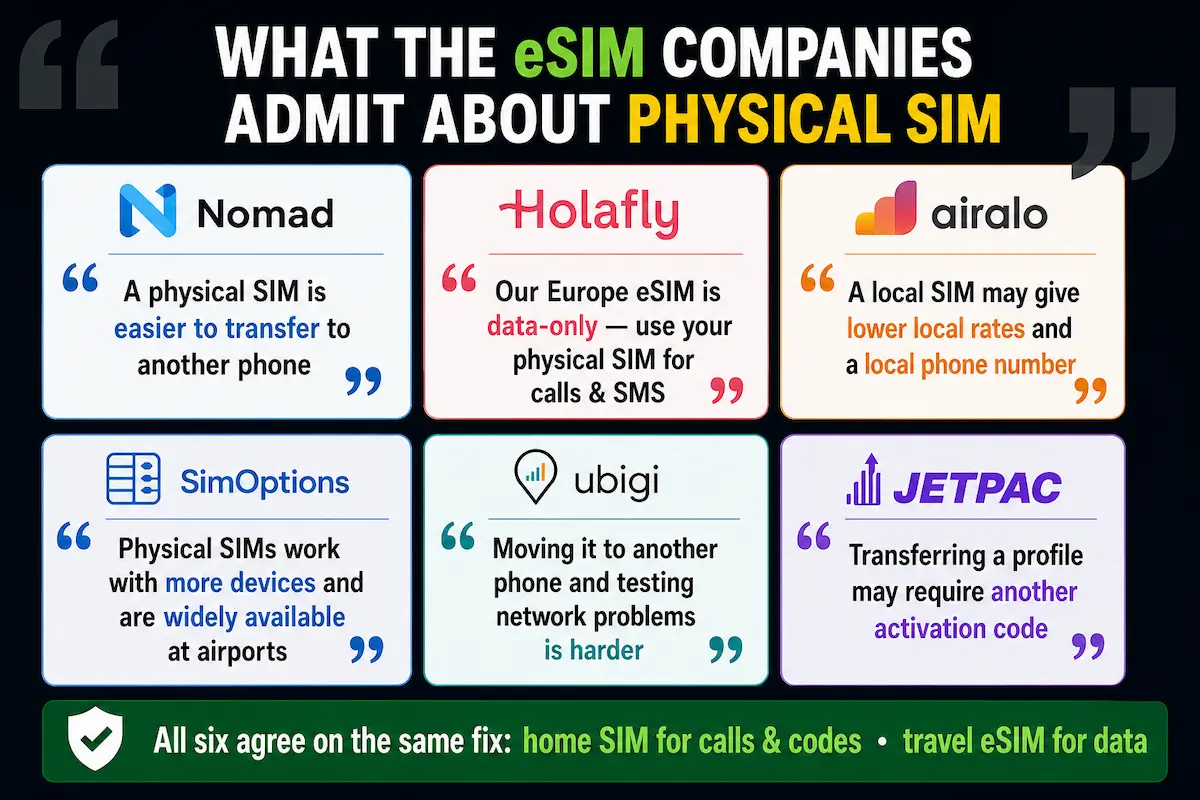
| Provider | What they say eSIM does better | What they admit physical SIM does better |
|---|---|---|
| Nomad | Digital activation, remote carrier switching, multiple stored profiles, keep the home SIM active | A physical SIM is easier to transfer to another phone. eSIM availability depends on device, carrier and regional compatibility |
| Holafly | Instant digital delivery, nothing to lose or damage, less plastic waste, one plan across destinations | The phone must support eSIM and normally needs internet to install. Its Europe eSIM is data-only — it recommends using your physical SIM for calls and SMS |
| Airalo | Remote activation, multiple profiles, regional plans across several countries | A local physical SIM may give lower local rates and a local phone number — at the cost of finding a seller, registering and swapping cards |
| SimOptions | Digital carrier switching, QR activation, better resistance to loss or physical theft, easier remote plan changes | Physical SIMs work with more devices, move easily between phones and are widely available at airports; not every carrier or older phone supports eSIM |
| Ubigi | Multiple cellular profiles, no physical damage or loss, remote management, works alongside a physical SIM | Limited to newer compatible devices and selected carriers; moving it to another phone and diagnosing network problems is harder than popping a SIM into another handset |
| Jetpac | Digital setup, no airport queues, secure embedded profile, keep your primary SIM active | Phone and carrier must support eSIM; installation usually needs internet; some regional networks still rely on physical SIMs; transferring a profile may require another activation code |
Reading the table: notice how consistent the concessions are. Every single provider agrees on two points — your phone has to support eSIM, and plastic is easier to move between handsets. Three of them (Holafly, Airalo, SimOptions) also flag the local phone number as physical SIM territory, though as you’ll see below that’s no longer strictly true. And all six converge on the same recommended setup: home SIM for calls and codes, travel eSIM for data.
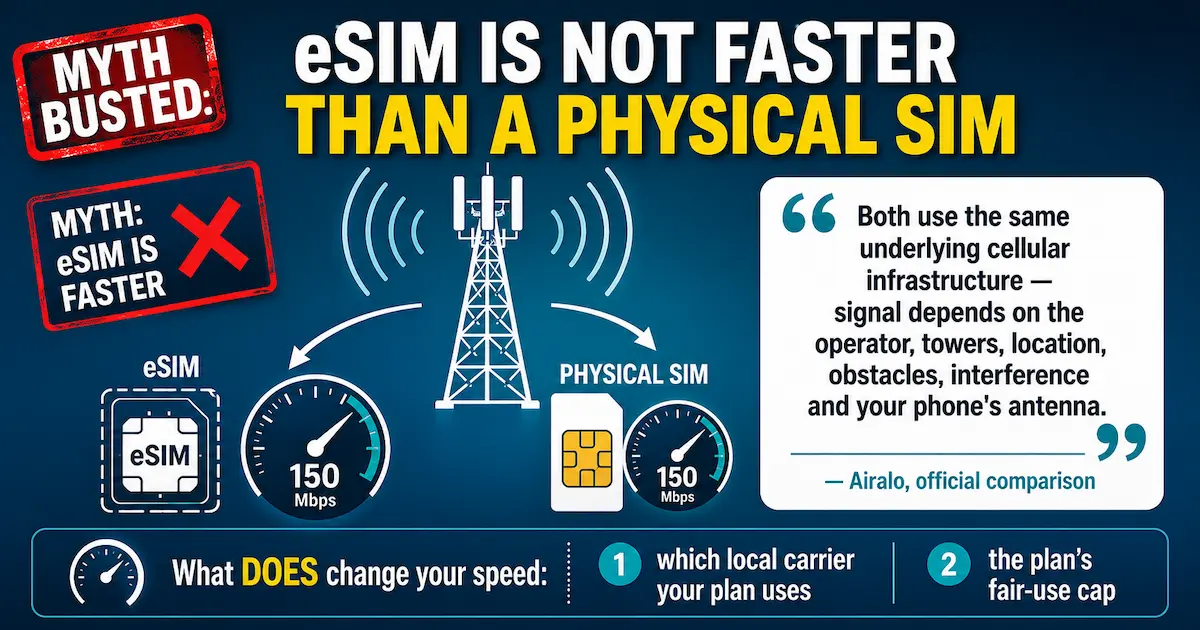
Speed should not decide eSIM vs Physical SIM for Europe: when both plans use the same local network, the SIM format itself does not create a faster connection.
eSIM vs Physical SIM for Europe: Side-by-Side Comparison
The table below turns eSIM vs Physical SIM for Europe into a feature-by-feature decision rather than a marketing claim.
| Feature | eSIM | Physical SIM |
|---|---|---|
| Setup time | ~3 minutes, before your flight | 20–60 minutes, after landing |
| Where to buy | Online or in-app, anywhere, 24/7 | Airport shop or carrier store, during opening hours |
| Countries on one plan | 32–44 on a regional plan | 1 country + EU roaming with a reduced allowance |
| Data that works abroad | 100% of what you bought | TIM: 23 of 200GB · Vodafone S: 15 of 90GB ⚠️ |
| Typical cost (10 days) | €15–€34 | €10–€25 up front (single country) |
| Registration needed? | No — just an email | Often yes (ID/passport standard in DE, IT, ES) |
| Keep your home number? | ✅ Yes (dual SIM) | ❌ Must swap SIMs, or use a second tray |
| Multi-country trips | ✅ Automatic carrier switching | ⚠️ Roaming cap applies |
| Hotspot / tethering | ✅ Most providers | ✅ Most carriers |
| Phone number included? | ⚠️ Usually data-only — but operator eSIMs with calls & SMS exist from €21.90 | ✅ Local number included |
| Moving service to another phone | ⚠️ May need a new activation code | ✅ Pop it in, done |
| If your phone is lost or stolen | ✅ Profile is embedded — can’t be pulled out and reused | ⚠️ Card can be removed and reused |
| Works without internet? | ❌ Needs Wi-Fi to install | ✅ Buy and insert anywhere |
| Device compatibility | iPhone XS+ / Galaxy S20+ / Pixel 3a+ | Any unlocked phone with a tray |
| Speed | Identical — same networks, same towers (Airalo’s own words) | |
Use this decision chart when eSIM vs Physical SIM for Europe still feels unclear after comparing price, compatibility and trip length.
Real Cost: A 10-Day European Trip, Three Ways (July 2026, EUR)
The real cost of eSIM vs Physical SIM for Europe includes more than the purchase price: roaming caps, registration time and cross-border usability all matter.
Most comparisons pit eSIM against local SIM and forget the option most travelers actually default to: their own carrier’s roaming. Here are all three, with July 2026 prices.
| Option | Cost | Data you can use across Europe | Coverage |
|---|---|---|---|
| Ubigi eSIM | €15.00 | 10GB, all countries | Europe regional |
| SimOptions — Travel Basic (Bouygues) | €15.90 | 15GB, all countries · 5G | 44 countries |
| Nomad eSIM | €20.11 | 10GB, all countries | 35 countries |
| Jetpac eSIM | €21.00 | 10GB, all countries | Europe regional |
| Airalo Eurolink eSIM | €28.00 | 10GB, all countries | 42 countries |
| Holafly eSIM (unlimited) | €33.90 | Unlimited, all countries | 33 countries |
| Vodafone Spain Prepaid S (physical) | €10.00 | 90GB in Spain — but 15GB elsewhere | 1 country + capped roaming |
| TIM Tourist Italy (physical) | €24.99 | 200GB in Italy — but 23GB elsewhere | 1 country + capped roaming |
| Home-carrier roaming day pass | ≈€90–€180 | Depends on your domestic plan | Wherever your carrier roams |
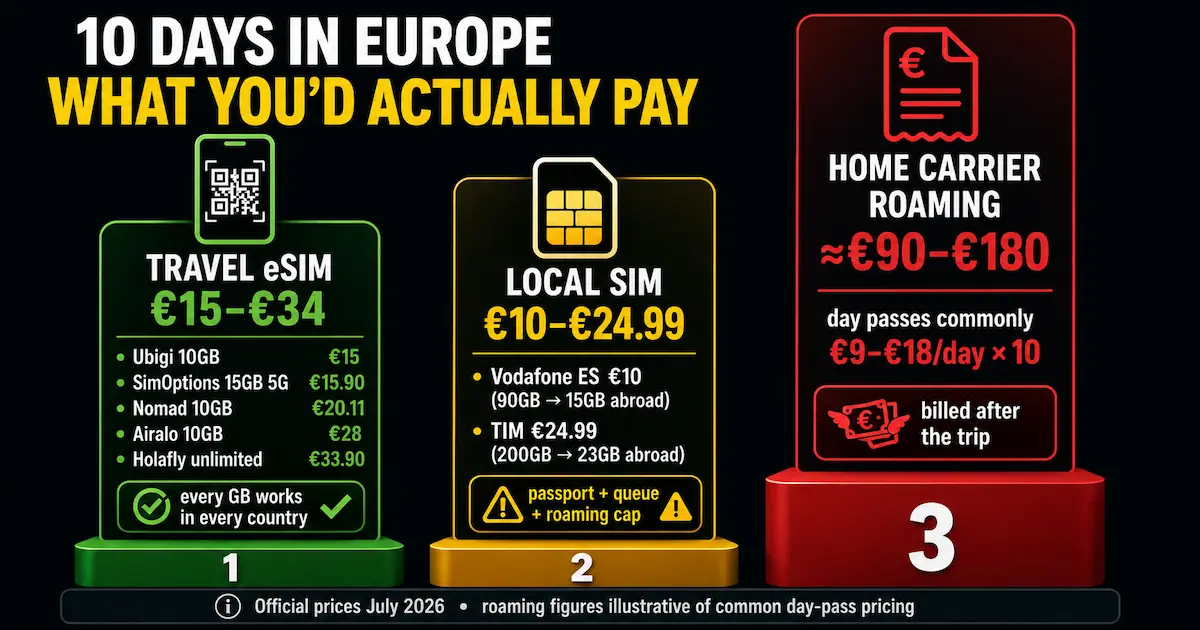
Reading the table: for a single-country trip, the local SIM wins on raw volume — nothing here touches 200GB in Italy for €24.99. For a multi-country trip, the picture inverts completely: TIM’s usable cross-border allowance (23GB) costs more than Ubigi’s 10GB at €15 or SimOptions’ 15GB in 5G at €15.90, and it required a passport and a queue.
And carrier day passes — commonly sold in the €9–€18 per day range — turn a ten-day trip into a €90–€180 line item for data you already could have bought for €15. That’s the entire argument in one table.
When eSIM Wins (Most Travelers)
Multi-country European trips. Taking the train from Paris to Amsterdam, flying Rome to Barcelona, or doing a 3-week Interrail route — an eSIM is the only practical option. One plan, one payment, automatic carrier switching at every border, and no roaming cliff at any of them. A physical SIM means living inside that reduced roaming allowance or buying a new SIM in each country. Especially true for backpackers crossing 10+ countries.
Short vacations (5–14 days). You don’t want to spend the first hour in Rome standing in a TIM shop queue, passport in hand. An eSIM is installed before you board. When you step off at Fiumicino, your phone is already connected — that first taxi, that Maps route to the hotel, it just works.
Arrivals when the shops are shut. A 23:40 landing at a secondary airport, a Sunday arrival, a late train into a small city — the SIM counter is closed and the vending machine doesn’t exist. An eSIM is bought and installed at any hour, from anywhere, including from the plane’s Wi-Fi if you forgot.
First-time visitors. Finding a SIM shop at BER or navigating a Vodafone store in Milan where staff may not speak English adds friction to a trip you’re already navigating. eSIM removes that entirely — and there’s no ID registration step at all.
Keeping your home number active. With dual SIM, your eSIM handles European data while your original SIM keeps receiving calls, texts and — critically — bank verification codes from home.
For 1–6 month stays, eSIM still usually wins — see the Long Stay guide. For students crossing borders on weekends, eSIM wins for study abroad.
How Holafly Unlimited eSIM Works in Europe
Holafly is aimed at travelers who prefer unlimited data instead of tracking a fixed allowance. The video below helps explain the installation process and what to expect from the plan during a European trip.
After watching, compare the convenience of unlimited data with the plan terms, hotspot rules and fair-use conditions that may apply during heavier use.
What the Saily eSIM Setup Looks Like
Saily is another app-based option for Europe. This video is useful for travelers who want to see the purchase and installation flow before deciding between a digital plan and a local physical SIM.
As with the other travel eSIMs in this comparison, check the included countries, data allowance, activation timing and hotspot policy before paying.
When a Physical SIM Still Wins
Your phone doesn’t support eSIM. Older phones, budget Android models and some region-specific devices lack the hardware. Check Settings → About Phone → look for “EID” — if it’s there, you’re good. If it isn’t, the comparison ends here and plastic wins by default.
Long-term stays (3+ months). Living in Berlin for a semester or working remotely from Lisbon — a local contract gives better long-run rates, a local number, and full domestic allowances instead of a roaming cap. Travel eSIMs are designed for travel, not residency, and every provider in the table above says so in one way or another.
Very heavy data in a single country. This is where the local SIM’s headline numbers finally pay off: 200GB in Italy for €24.99, or 380GB in Spain for €30, with unlimited national calls. If you’re spending a month in one country and streaming, no travel eSIM comes close on raw data per euro.
You’ll swap the service between phones. Nomad, Ubigi and Jetpac all concede this: moving a physical SIM to a spare handset takes five seconds, while an eSIM profile may need a fresh activation code — and many QR codes are single-use.
Non-EU corners with thinner eSIM partnerships. Coverage is excellent across the EU, but smaller Balkan markets have fewer eSIM carrier deals. A local SIM in Tirana or Sarajevo can give stronger rural coverage than a regional plan. Turkey airport SIMs, meanwhile, cost several times more than an eSIM — see Best eSIM for Turkey.
“But I need a European phone number” — this is no longer plastic-only
This used to be the physical SIM’s unbeatable argument. It isn’t anymore. Through SimOptions you can buy operator eSIMs that include a real European number with calls and SMS — the same Orange, Bouygues Telecom and O2 products sold as physical cards, delivered digitally:
| eSIM with a European number | Price | Data | Coverage | Calls & SMS |
|---|---|---|---|---|
| O2 Go Card eSIM 10GB | €21.90 | 10GB / 30 days | 38 countries | ✅ Yes |
| Bouygues Travel Basic+ 20GB | €21.90 | 20GB / 15 days · 5G | 44 countries | ✅ Yes |
| Orange Holiday Zen eSIM | €28.90 | 20GB / 31 days | 40 countries | ✅ Yes |
| Bouygues My European eSIM 30GB | €32.90 | 30GB / 30 days · 5G | 44 countries | ✅ Yes |
| Bouygues My European eSIM 120GB | €45.90 | 120GB / 30 days · 5G | 44 countries | ✅ Yes · €0.38/GB |
| Orange Holiday Europe 100GB | €55.90 | 100GB / 31 days · 5G | 40 countries | ✅ Yes |
The Setup Every Provider Actually Recommends: Use Both
Read the six providers’ official guidance side by side and they converge on the same answer — not eSIM or physical SIM, but both, doing different jobs. Nomad, Holafly, Ubigi and Jetpac all describe the same hybrid: your home physical SIM stays in the phone for calls, SMS and verification codes, and the travel eSIM carries the data.
Three rules make it work, and all three come from the providers themselves:
- Only one line provides mobile data at a time, even with both enabled — so explicitly select the travel eSIM as your data line.
- Keep data roaming switched off on your home SIM. Holafly says it plainly: leaving the home line active with roaming on may generate roaming charges even while the eSIM does the work. Also disable automatic data switching, so the phone can’t quietly fall back.
- Install before departure, activate on arrival — Jetpac’s official advice, and good practice for every provider. Full walkthrough: How to Activate an eSIM for Europe.
Holafly Europe eSIM: A Second Practical Walkthrough
This second Holafly video gives another practical look at using an unlimited travel eSIM. It is especially relevant for longer trips where daily data use is harder to predict.
Use it alongside the price tables above. Unlimited data can remove the stress of counting gigabytes, while a fixed plan may still offer better value for lighter use.
The Verdict: eSIM for Travel, Physical SIM for Living
In the final analysis, eSIM vs Physical SIM for Europe depends on how many countries you visit, how long you stay and whether your phone supports both formats.
For the 90% of travelers reading this — visiting Europe for 1 to 30 days across more than one country — get an eSIM. It’s cheaper than carrier roaming by an order of magnitude, it covers 32–44 countries on one purchase with no roaming cliff, it needs no passport or queue, and it works at 3am when the airport counter is closed.
If you’re relocating, staying three months in one place, or your phone has no eSIM support, get a local physical SIM once you arrive — and enjoy that 200GB.
🏁 Picks for July 2026 (EUR)
🥇 Best overall Europe eSIM → Nomad: 20GB €23.61 · 50GB €30.60 on sale · 35 countries · full hotspot → code ANDRE15 (15% off)
♾️ Best unlimited → Holafly: from €3.79/day · 33 countries · no data counting → code ANDREONDIGITAL (5% off)
📱 Best for beginners → Airalo: from €5 · 42 countries · the most guided app → code ANDRE15 (15% off)
☎️ Need a European number → SimOptions: Orange, Bouygues & O2 eSIMs with calls & SMS from €21.90 · 120GB in 5G for €45.90
🇮🇹 One country, one month, heavy use → local SIM: TIM €24.99 (200GB in Italy) · Vodafone Spain from €10
For the full breakdown of every provider, see my Best eSIM for Europe 2026 guide. If budget matters most, my Cheapest eSIM for Europe comparison has the numbers, and if you want a strictly one-time purchase with no subscription attached, see Best Prepaid eSIM for Europe.
FAQ — eSIM vs Physical SIM for Europe
This article contains affiliate links — if you buy through them I may earn a commission at no extra cost to you; it keeps this guide updated and never changes the conclusions, which the numbers above decide. All prices in euros (€). Travel eSIM prices were read from each provider’s official Europe page in July 2026, including promotional pricing where displayed (Nomad’s 20GB and 50GB sale prices apply automatically).
Local operator figures come from the official TIM, Vodafone Spain and Orange websites the same month: TIM Tourist €14.99 plus a €10 physical SIM, 200GB in Italy with 23GB usable in EU roaming; Vodafone Spain prepaid from €10 with 90GB in Spain and 15GB EU/UK roaming; Orange Holiday Europe packages include unlimited European calls and SMS, and Orange does not currently publish an online price for the physical starter SIM, so its in-store price must be confirmed at the point of sale.
Provider statements about eSIM versus physical SIM are summarised from those companies’ own published comparison pages and are not an independent network test — including Airalo’s statement that both formats use the same cellular infrastructure. Roaming day-pass costs are illustrative of common market pricing, not a quote from any specific carrier; check your own operator’s rates.
Country counts, allowances and terms change without notice — always confirm at checkout or in store. I have personally used Holafly, Nomad and Airalo eSIMs across Europe and Southeast Asia; SimOptions, Ubigi and Jetpac are assessed from their official documentation.
Last verified: July 2026
Keep Reading
eSIM Guides
- Best eSIM for Europe 2026: 7 providers compared
- Cheapest eSIM for Europe 2026
- Best Prepaid eSIM for Europe 2026
- Best Unlimited Data eSIM for Europe
- How Much Data Do You Need for Europe?
- Airalo vs Nomad 2026
- Maya Mobile vs Airalo 2026
- eSIM vs Pocket WiFi for Europe 2026
- Best eSIM for 30 Days in Europe
- Best eSIM for Students in Europe
- Best eSIM Providers for Europe
Setup & Troubleshooting
- How to Activate an eSIM for Europe
- eSIM Compatible Phones 2026
- Slow eSIM Internet in Europe? 8 Fixes
- eSIM Not Working in Europe? 9 Fixes
eSIM by Country
Portugal | Spain | Italy | France | Germany | Greece | Netherlands | UK
Croatia | Turkey | Austria | Switzerland | Czech Republic | Ireland