
Google Maps rerouting on the Autobahn at 180 km/h needs a connection that doesn’t drop. What it does not need is a big data plan — and that single misunderstanding is why most people choose the wrong plan for a European road trip.
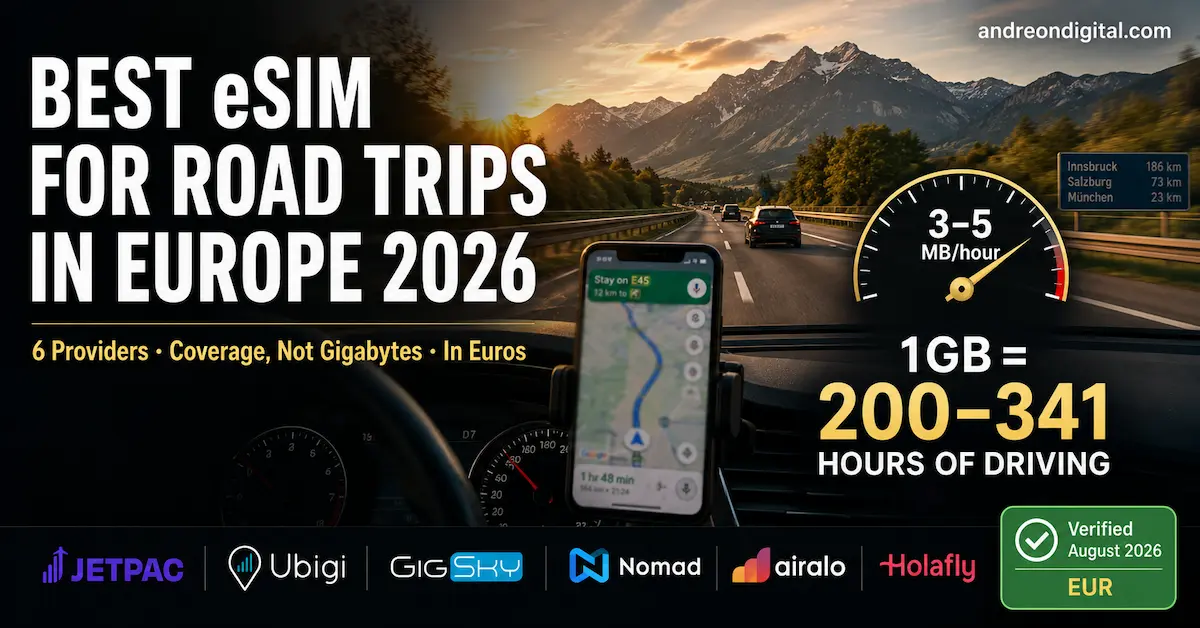
Standard navigation uses roughly 3 to 5MB an hour. One gigabyte covers between 200 and 341 hours of driving. A ten-day road trip with six hours behind the wheel each day burns under 600MB on maps.
So the question that decides the best eSIM for road trips isn’t how many gigabytes you buy. It is whether the signal holds across borders, mountain passes and rural corridors, and what happens to your navigation when a fair-use cap lands mid-drive. This guide answers those questions, with six providers priced in euros for August 2026.
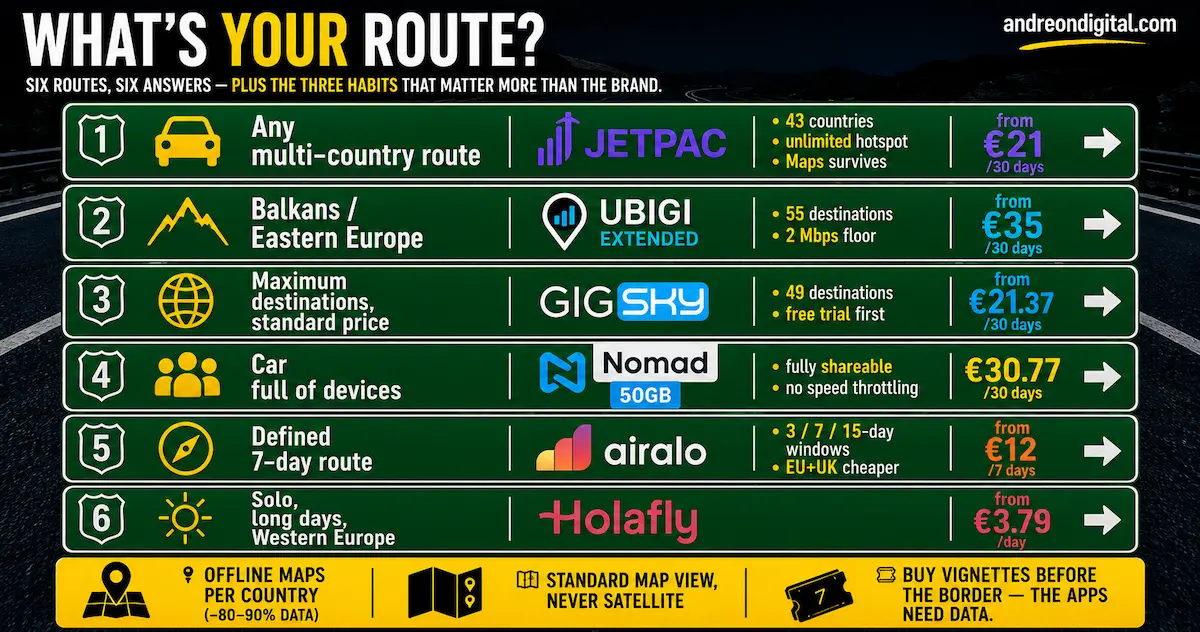
⚡ Quick answer — road trips, August 2026
🥇 Best all-round → Jetpac: 43 countries · unlimited hotspot · Google Maps keeps working even after your data runs out
🗺️ Route crosses into the Balkans → Ubigi: 38 standard, 55 on Europe Extended · drops to 2 Mbps, not 1
🌍 Widest standard coverage → GigSky: 49 destinations · 3.5GB/day · free 500MB trial
💰 Best value with full hotspot → Nomad: 20GB €23.73 · 50GB €30.77 · no separate hotspot cap
♾️ Long driving days, unlimited → Holafly: from €3.79/day — but only 33 countries and ~1GB/day hotspot
🧭 The number that changes everything: 1GB = 200–341 hours of standard navigation. Satellite view burns the same 1GB in under 10 hours.
⚠️ And the one check nobody does: open your plan’s country list before you plan the route, not after.
The Number That Should Decide Your Plan
Most guides to the best eSIM for road trips start with data volume. Here’s why that’s backwards.
| What you’re doing | Data per hour | How far 1GB goes |
|---|---|---|
| Standard navigation (map view, basic traffic) | 3–5 MB | 205–341 hours of driving |
| Navigation + live traffic overlay | ~10 MB | ~102 hours |
| Rerouting + heavy zooming | ~25 MB | ~41 hours |
| Satellite view while driving | 100–180 MB | 5.7–10 hours ⚠️ |
| AR / Immersive view | up to 10 MB/minute | ~1.7 hours — never use while driving |
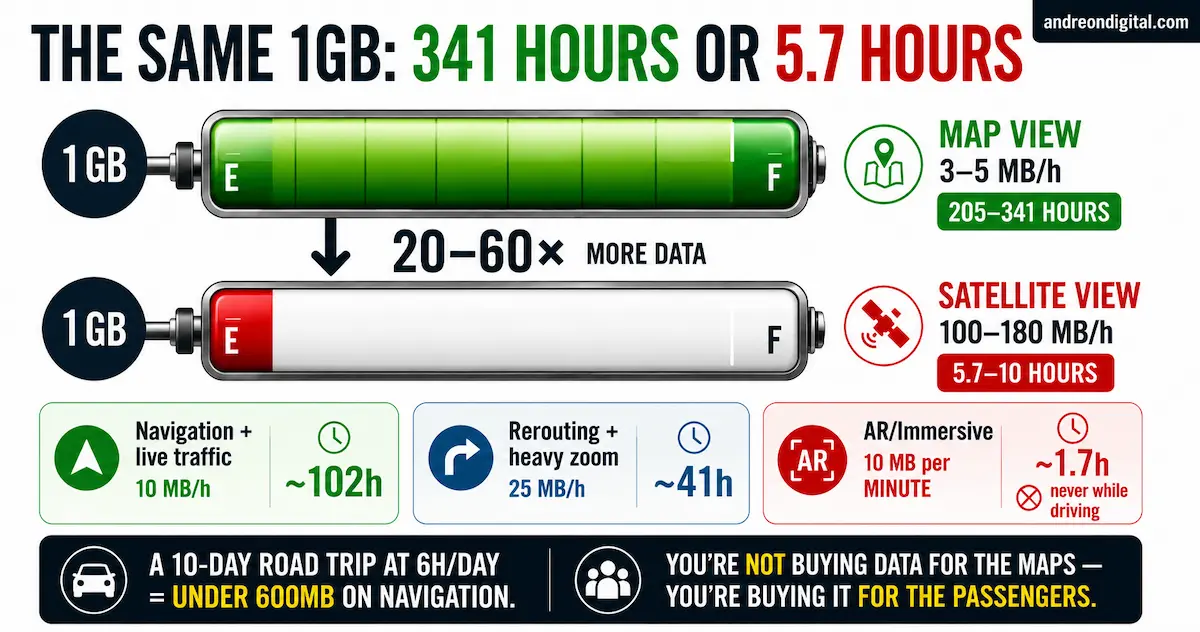
📉 What that means in practice: a ten-day road trip with six driving hours a day uses roughly 0.2 to 0.6GB on navigation. A fortnight of driving still comes in under a gigabyte. You are not buying data for the maps — you’re buying it for the passengers, the stops, the photo uploads and whoever is streaming in the back seat.
✅ So the buying rule for a road trip inverts: pick on coverage and fair-use behaviour first, then buy the smallest plan that covers your non-navigation use. Not sure what that is? How Much Data Do You Need for Europe? breaks it down by activity.
What a real road trip actually consumes
| Trip | Navigation only | Realistic total | Plan that fits |
|---|---|---|---|
| Weekend (2 days, 5h/day) | ~30–100 MB | ≈1.5–2GB | Ubigi 3GB €7 · Jetpac 1GB/4d €4 |
| One week (7 days, 5h/day) | ~100–340 MB | ≈3–4GB | Jetpac 5GB/7d €12.50 · Airalo EU+UK 5GB/7d €11 |
| Ten days (6h/day) — solo driver | ~180–590 MB | ≈5GB | Ubigi 10GB €15 · Nomad 5GB €15.38 |
| Ten days with passengers streaming | same ~0.6GB | 15–25GB | Nomad 20GB €23.73 · Ubigi 25GB €29 |
| Two weeks, family, heavy hotspot | same ~0.7GB | 25–40GB | Nomad 50GB €30.77 · Jetpac 40GB €33.50 |
Notice what stays constant down the navigation column and what explodes in the total. The maps cost you almost nothing across every row; the passengers multiply the bill. That’s why the honest advice for a solo driver is to buy small — and why a family road trip should buy for the back seat, not the dashboard. If you’re travelling two-up, Best eSIM for Couples in Europe covers the sharing maths, and for a car full of children, Best eSIM for Families in Europe.
Coverage: The Criterion That Matters Most on a Road Trip
No other kind of travel crosses as many borders as driving does. A route that looks entirely European on a map can leave your plan’s country list without warning — and unlike a flight, you won’t be sitting still with airport Wi-Fi when you find out. This is the first table to read when choosing the best eSIM for road trips.
| Plan | European countries | What it means for a driving route |
|---|---|---|
| Ubigi Europe Extended | 55 | The widest list available — the safest single plan for a Balkan or Eastern European route |
| GigSky Europe | 49 | Widest standard plan, no premium tier needed |
| Jetpac Europe | 43 | Wide, plus essential apps survive running out of data |
| Airalo Eurolink | 42 | Includes the Balkans, Turkey and Iceland |
| Ubigi Europe (standard) | 38 | Includes the UK, Switzerland, Ukraine and Moldova |
| Nomad Europe 36 | 36 | ⚠️ Adds Turkey and Northern Cyprus but drops Gibraltar and San Marino |
| Nomad Europe 35 | 35 | Includes Gibraltar, San Marino and Vatican City |
| Holafly Europe | 33 | ⚠️ The narrowest of the major providers — fine for a Western European loop, risky beyond it |
| Airalo EU+UK | 28 | EU member states plus the UK only — cheaper, but no non-EU stops |
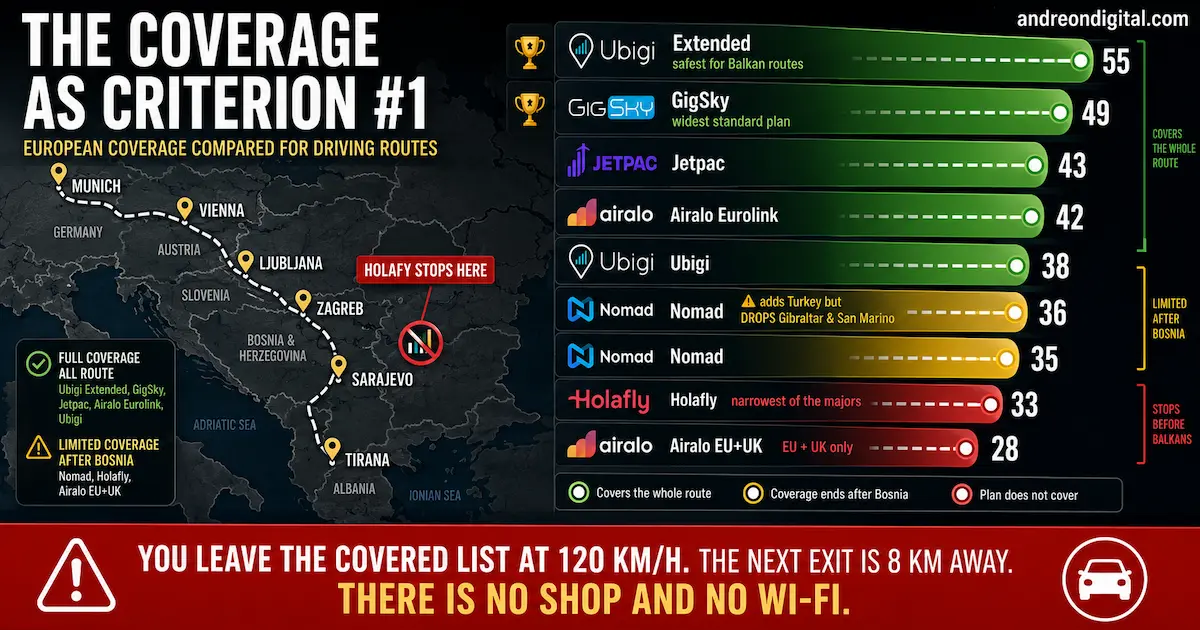
🗺️ Two routes where this bites hardest. The Balkans loop — Croatia, Bosnia, Montenegro, Albania, North Macedonia, Serbia — sits outside several providers’ standard lists, which is why Ubigi’s Europe Extended (55) or Airalo’s Eurolink (42) are the safe answers there. And the microstates: Nomad’s two Europe plans aren’t nested, so the 36-country version drops Gibraltar and San Marino to add Turkey. If your route includes them, check which plan you’re buying.
✅ The 30-second check before you plan the route: open the plan’s country list, and search it for every country you’ll drive through, not just the ones you’ll sleep in. Transit countries are the ones people forget. If you’re heading somewhere specific, our country guides list the local networks: Germany · France · Italy · Spain · Croatia · Austria.
What Happens to Your Navigation When the Cap Hits
Every unlimited plan slows down eventually. On a beach holiday that’s an inconvenience; at 130 km/h with a junction approaching, it’s the difference between rerouting and missing your exit. Here’s the floor each provider drops to.
| Provider | Full-speed allowance | Speed after | Effect on navigation |
|---|---|---|---|
| Ubigi | 60GB on the 30-day plan | 2 Mbps | ✅ Reroutes normally — the highest floor here |
| Jetpac | 3GB every 24h | up to 1 Mbps | ✅ Slow but works — and Google Maps keeps running free even after the data ends |
| Airalo | 3GB/day | ~1 Mbps | ⚠️ Map tiles load slowly; rerouting usually still works |
| GigSky | 3.5GB/day | Reduced (floor not published) | ⚠️ Most generous daily allowance, unspecified floor |
| Nomad (unlimited plans) | ~2GB/day | ~512 kbps–2 Mbps | ❌ At the low end, rerouting starts to stall |
| Holafly | No fixed number published | Not specified | ❓ Unknown — may never throttle you, but you can’t plan around it |
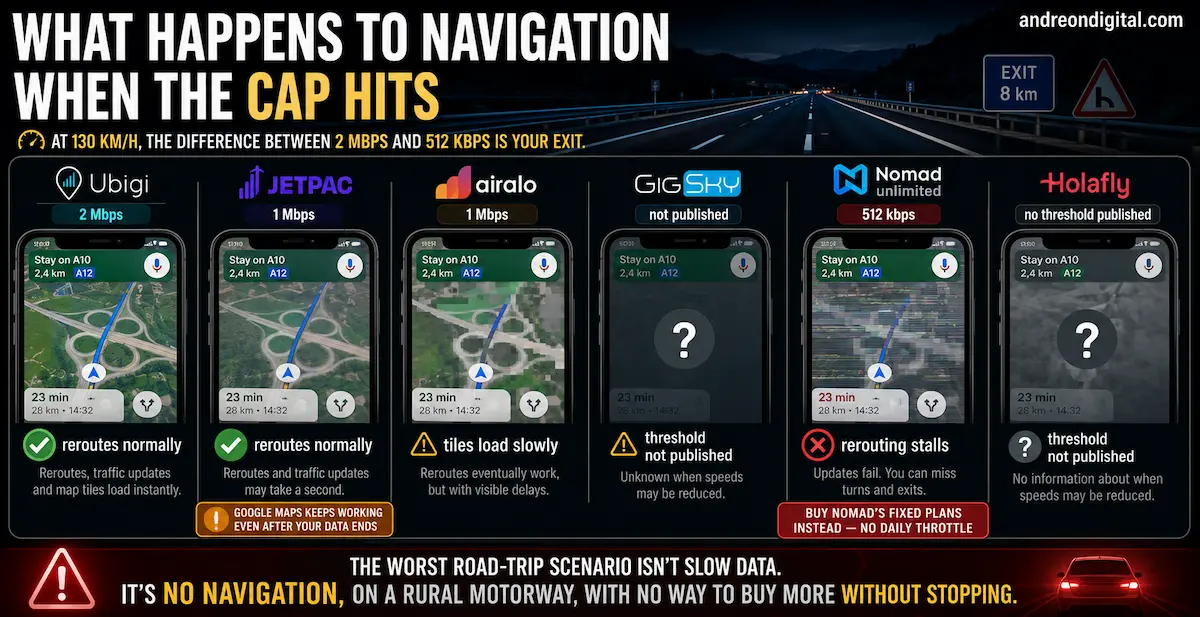
🚗 Think about what that means on a drive. The worst-case scenario on a European road trip isn’t slow data — it’s running out of data on a rural motorway in inland Spain or eastern Poland with no navigation and no way to buy more without stopping. Jetpac removes that scenario entirely. Your maps keep working; you keep driving.
⚖️ The honest counterweight: Nomad’s fixed plans avoid the problem differently — they have no daily throttle at all, so 50GB at €30.77 is 50GB at full speed whenever you want it. The trap is Nomad’s unlimited plans, which throttle at around 2GB a day. For a road trip, buy Nomad’s fixed data, not its unlimited.
Hotspot: A Car Is the Hardest Test There Is
A car is the most demanding hotspot scenario in travel — one phone feeding a passenger’s tablet, children’s devices, sometimes the car’s own system, for eight hours straight. Hotspot rules matter more here than in any hotel room, and they’re the third thing to check when picking the best eSIM for road trips, after coverage and fair-use behaviour.
| Provider | Hotspot rule | Verdict for a full car |
|---|---|---|
| Jetpac | Unlimited hotspot (official) | ✅ Best in class |
| Nomad (fixed plans) | No separate hotspot allowance — tethering uses the plan’s data | ✅ Whole plan is shareable, no daily ceiling |
| Airalo | No separate tethering cap, no limit on connected devices | ✅ Within the 3GB daily allowance |
| Ubigi | Data sharing permitted | ✅ Fine |
| GigSky | Included | ✅ Fine |
| Holafly | ~1GB per day on destination plans | ❌ One passenger streaming will finish it before lunch |
Motorway Coverage by Country
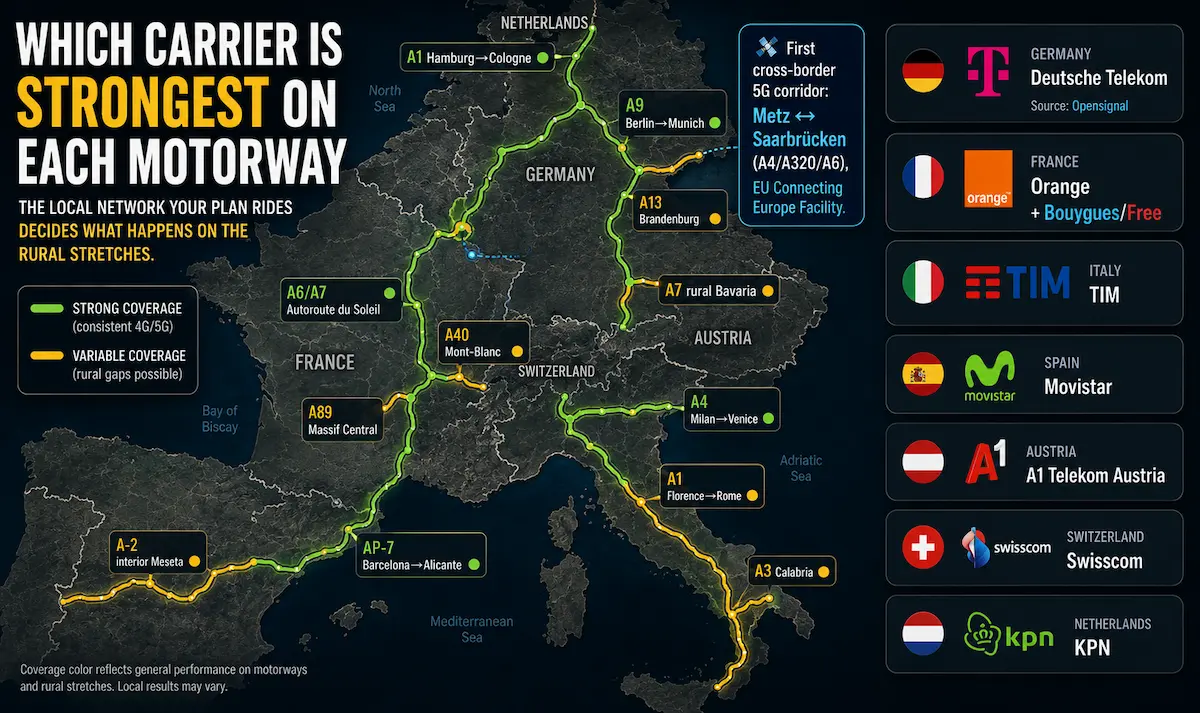
Which local carrier your plan rides matters on rural motorway sections, where coverage between operators diverges most — and it’s the layer beneath every recommendation for the best eSIM for road trips. These are the strongest highway networks in the countries most European road trips pass through.
| Country | Strongest motorway carrier | Where it matters most |
|---|---|---|
| 🇩🇪 Germany | Deutsche Telekom | Rural Autobahn through eastern Germany, Bavaria and the Rhine-Moselle region — per Opensignal’s Mobile Network Experience Report for Germany |
| 🇫🇷 France | Orange (main corridors) + Bouygues and Free (gaps) | Multi-carrier access matters: valleys, Alpine approaches and secondary exits |
| 🇮🇹 Italy | TIM | The A1 and A4 arteries; the Apennine section between Florence and Rome is the weak point |
| 🇪🇸 Spain | Movistar | Interior Castile, Extremadura and rural Aragón, where main-corridor coverage ends |
| 🇦🇹 Austria | A1 Telekom Austria | The A1 Vienna–Salzburg–Innsbruck axis and Alpine passes |
| 🇨🇭 Switzerland | Swisscom | Alpine passes and tunnel approaches |
| 🇳🇱 Netherlands | KPN | The A1 and A2 corridors |
Where the gaps actually are
| Route | Coverage | Note |
|---|---|---|
| A1 Hamburg → Cologne · A9 Berlin → Munich · A2 Berlin → Dortmund | ✅ Strong | Main German corridors, well covered |
| A7 Hamburg → Füssen · A13 Berlin → Dresden | ⚠️ Variable | Rural Bavaria and Brandenburg: gaps between operators |
| A6/A7 Paris → Lyon → Marseille (Autoroute du Soleil) | ✅ Excellent | Busiest holiday route in France |
| A40 Geneva → Chamonix · A89 Bordeaux → Lyon | ⚠️ Variable | Mont-Blanc approaches and the Massif Central |
| A4 Milan → Venice · A14 Bologna → Bari | ✅ Strong | Flat Po Valley and the Adriatic coast |
| A1 Florence → Rome · A3 Naples → Reggio Calabria | ⚠️ Variable | Apennine tunnels and southern Italy |
| AP-7 Barcelona → Alicante · A-4 Madrid → Seville | ✅ Strong | Main Spanish corridors |
| A-2 interior Meseta · N-340 coastal secondary | ⚠️ Variable | Where Movistar’s rural lead matters most |
The Six Providers, Judged as Road Trip Tools
Same six providers you’d see in any Europe comparison — but ranked here on what a drive actually demands: border coverage, hotspot for the car, and what happens when the cap lands.
Jetpac wins this comparison on the two things a road trip punishes hardest. Unlimited hotspot, officially advertised — which no other provider here matches for a car full of devices. And the failure mode: on packs of 3GB and above, WhatsApp, Uber, Grab and Google Maps keep working free after your data runs out. On a motorway that’s not a nice-to-have, it’s the difference between a delay and a problem.
Coverage is 43 European countries — third-widest here — and unactivated packs stay valid 3 months, which suits a road trip booked well in advance. Its unlimited plans give 3GB every 24 hours at full speed, then up to 1 Mbps.
Prices: 1 day: 3GB €8.50 · 5GB €9.50 · 10GB €12 | 4 days: 1GB €4 · 5GB €11 · 10GB €15 | 7 days: 5GB €12.50 · 10GB €17.50 · 15GB €19.50 | 30 days: 10GB €21 · 20GB €38 · 30GB €28.50 · 40GB €33.50 | unlimited 3d €12.50 · 7d €26 · 30d €63.
Jetpac eSIM for European Road Trips: Setup and Real-World Use
Jetpac stands out for drivers because its plans combine broad European coverage with unlimited hotspot and continued access to Google Maps after eligible data packs run out. The video below shows the provider in a more practical format before you decide whether it fits your route.
After watching, compare the plan size with the number of passengers and devices in the car. For most road trips, the strongest reason to choose Jetpac is not unlimited data, but the safety net that keeps essential travel apps available when the main allowance ends.
Two things make Ubigi the driver’s pick when the route leaves the obvious. Europe Extended reaches 55 destinations — the widest list anyone sells — which is why it’s the safest single plan for a Balkan loop or an Eastern European run. And when its fair-use threshold lands, it drops to 2 Mbps rather than the 1 Mbps most competitors use. On a motorway that’s the difference between the map redrawing and the map freezing.
Its standard 38-destination Europe plan already includes the UK, Switzerland, Ukraine and Moldova. Pricing is excellent for a defined driving window: 10GB valid 7 days at €12, or 10GB over 30 days at €15.
Prices: 500MB/2d €2 · 3GB/30d €7 · 10GB/7d €12 · 10GB/30d €15 · 25GB/30d €29 · 50GB/30d €54 | unlimited 7d €23 · 15d €38 · 30d €62 (60GB full speed, then 2 Mbps) | monthly 20GB €19 | Europe Extended: 10GB/30d €35 · unlimited 30d €77.
Ubigi eSIM for Europe: Coverage, Installation and Road-Trip Value
Ubigi is especially useful when a route includes the Balkans, Eastern Europe or several transit countries. This video gives you a closer look at how the service works, while the written comparison above explains the difference between the standard Europe plan and Europe Extended.
The key decision is whether your itinerary truly needs the 55-destination Extended plan. Western European routes usually fit the cheaper standard plan, while more complex cross-border drives can justify the wider country list and its higher price.
GigSky lists 49 European destinations on its standard Europe plan — the widest coverage available without paying for a premium tier, which on a road trip is exactly the right shape. It also publishes the most generous daily full-speed allowance among unlimited plans here, at 3.5GB, and offers a free 500MB trial with no card required, so you can verify it installs and connects before committing to a two-week drive.
Prices: 500MB/7d free trial · 1GB/7d €3.99 · 3GB/15d €7.59 · 5GB/30d €15.67 · 10GB/30d €21.37 · 20GB/60d €41.32 · 50GB/90d €64.59 | unlimited 1d €3.49 · 5d €17.57 · 7d €24.69 · 14d €43.22 · 30d €63.64.
GigSky eSIM for Europe: Wide Coverage and Free Trial Explained
GigSky has the widest standard European coverage in this comparison and lets new users test the service with a free 500MB plan. The video below helps you see the installation and travel experience before committing to a larger package.
For a road trip, use the free trial before departure to confirm that the eSIM installs correctly. Then choose a paid plan based on the full route, especially if you will cross countries that are missing from smaller regional packages.
For a car where several people are using the connection, Nomad’s fixed plans are the strongest value here: 50GB at €30.77 and 20GB at €23.73, both on sale, with no separate hotspot allowance — the entire plan is shareable with everyone in the vehicle, at full speed, with no daily ceiling. That last detail matters: unlike an unlimited plan, a fixed plan can’t throttle you halfway through a driving day.
Nomad also runs a dedicated Balkans plan covering 12 countries (10GB at €34.10), which is worth comparing against Ubigi Extended if that’s your route.
Prices (Europe 35): 1GB/7d €4.83 · 3GB €10.55 · 5GB €15.38 · 10GB €20.22 · 20GB €23.73 · 50GB €30.77 | unlimited 5d €16.70 · 10d €29.89 | Nomad Pass €2.64/30 days.
Nomad eSIM for Europe: Fixed Data, Hotspot and Road-Trip Savings
Nomad is strongest here when you choose a fixed-data plan and share it with the whole car. The video below gives a practical overview of the service, while the figures above show why 20GB or 50GB can cost less than many unlimited alternatives.
For driving, fixed data is usually the safer Nomad choice because it avoids a daily full-speed ceiling. Check whether your route needs the 35-country, 36-country or dedicated Balkans plan before buying, since their country lists are not identical.
Airalo’s Eurolink covers 42 European countries including the Balkans, Turkey and Iceland, and it applies no separate tethering cap and no limit on connected devices — good for a car — within its 3GB daily full-speed allowance. Its other road-trip advantage is validity: Airalo sells 3, 7 and 15-day windows, so a defined driving route doesn’t have to buy a month.
Eurolink prices: 1GB/3d €5 · 3GB/7d €10 · 5GB/7d €17 · 10GB/7d €23.50 · 10GB/30d €28 · 20GB/30d €43.50 · 50GB/30d €63.50 | unlimited 3d €10.50 · 7d €24.50 · 30d €64. EU+UK: 1GB/3d €4 · 5GB/7d €11 · 10GB/7d €19 · 10GB/30d €22 · unlimited 7d €21.50 · 30d €52.50.
Airalo eSIM for Europe: Eurolink, EU+UK and Cross-Border Setup
Airalo offers two useful regional choices for drivers: the broader Eurolink plan and the cheaper EU+UK option. This video shows how Airalo works in practice and helps clarify the setup before a multi-country journey.
After the video, match the plan to every country you will drive through, including short transit stops. The cheaper EU+UK package is enough for many routes, but Eurolink is the safer choice when the itinerary includes the Balkans, Turkey or Iceland.
On a twelve-hour driving day with three stops and a hotel at the end, there’s real value in never thinking about data — and that’s what Holafly sells. Unlimited from €3.79 a day, configurable from 1 to 90 days, plus Always On, which leaves 1GB of free backup data on your account every month for life. It’s the provider I’ve used most myself, across Portugal, Turkey and Thailand.
Prices (unlimited): 1 day €3.79 · 3d €11.37 · 5d €18.50 · 7d €25.50 · 10d €33.90 · 15d €46.90 · 30d €68.90.
Holafly eSIM for Europe: Unlimited Data on Long Driving Days
Holafly is built for travelers who prefer unlimited data and do not want to monitor usage during long days on the road. The video below gives a clearer view of the setup and everyday experience before you compare its coverage and hotspot limits.
Holafly makes the most sense for a solo driver staying within its covered countries. Families and groups should pay close attention to the daily hotspot allowance, because unlimited data on the main phone does not mean unlimited sharing with passengers.
Practical Rules for Driving With an eSIM
Whichever provider you land on, these six habits do more for a drive than the choice itself.
Use a regional plan, never a country plan. Crossing from France into Spain on the AP-7 takes seconds. A France-only eSIM stops working at that moment, and buying a replacement at 120 km/h isn’t an option. A regional plan switches partner networks automatically with no configuration — your phone shows no service for a few seconds, then reconnects. The only exception is a road trip that genuinely stays inside one country for its whole duration.
Download offline maps as your primary layer, not a backup. A country-level offline map cuts navigation data by roughly 80–90% for the whole drive, because tiles come from local storage instead of the network. You keep live traffic, rerouting and search over data. Crucially, it also covers the gaps that exist regardless of provider: motorway tunnels, Alpine passes, and the seconds around every border crossing. Download one per country while you’re on Wi-Fi, before you leave.
Keep standard map view. Never satellite while driving. This is the highest-leverage setting on this page: satellite view uses 20 to 60 times more data than standard view. At 3–5MB an hour, 1GB covers over 200 driving hours; in satellite view the same gigabyte is gone in under ten. Switch to satellite when you’ve parked, if you want to explore.
Set up the hotspot before the first driving day, not during it. Connect the phone mount, tablet or car system once and leave it connected for the whole day. Reconnecting mid-drive is a distraction you don’t need. Check your provider’s hotspot rule first — Jetpac and Nomad’s fixed plans are the most permissive here, Holafly the most restrictive.
Buy your vignettes before the border, while you still have signal. Austria, Switzerland, Czechia, Hungary and Slovenia all require a motorway vignette. Austria’s is around €9.90 for ten days, while Switzerland’s is around CHF 40 for a year.
The official apps for buying digital vignettes need a live connection. The same applies to cashless toll apps in France, Italy and Spain. Set them up on Wi-Fi the night before, not on the approach road. Route planners such as ViaMichelin can show which tolls and vignettes your route requires.
Install and test the eSIM before departure — and check when the clock starts. Most plans begin on first connection at the destination, so installing days ahead is free. Jetpac asks you to keep the line switched off until arrival, some Airalo packages start at installation, and Holafly advises installing regional plans no earlier than a day before travel.
For setup, use How to Activate an eSIM for Europe. If it connects but crawls on the road, Slow eSIM Internet in Europe? 8 Fixes covers the settings to check. If it does not connect at all, follow eSIM Not Working in Europe? 9 Fixes.
FAQ — eSIMs for European Road Trips
Final Verdict
European road trips are the use case where the choice of eSIM makes the biggest real-world difference — but the best eSIM for road trips isn’t decided by the reason most guides give. It isn’t about data volume, because navigation barely uses any. It’s about whether the plan still works after you cross a border you didn’t think about, and what happens to your maps when a cap lands 40 kilometres from the next junction.
🏁 The picks for driving, August 2026
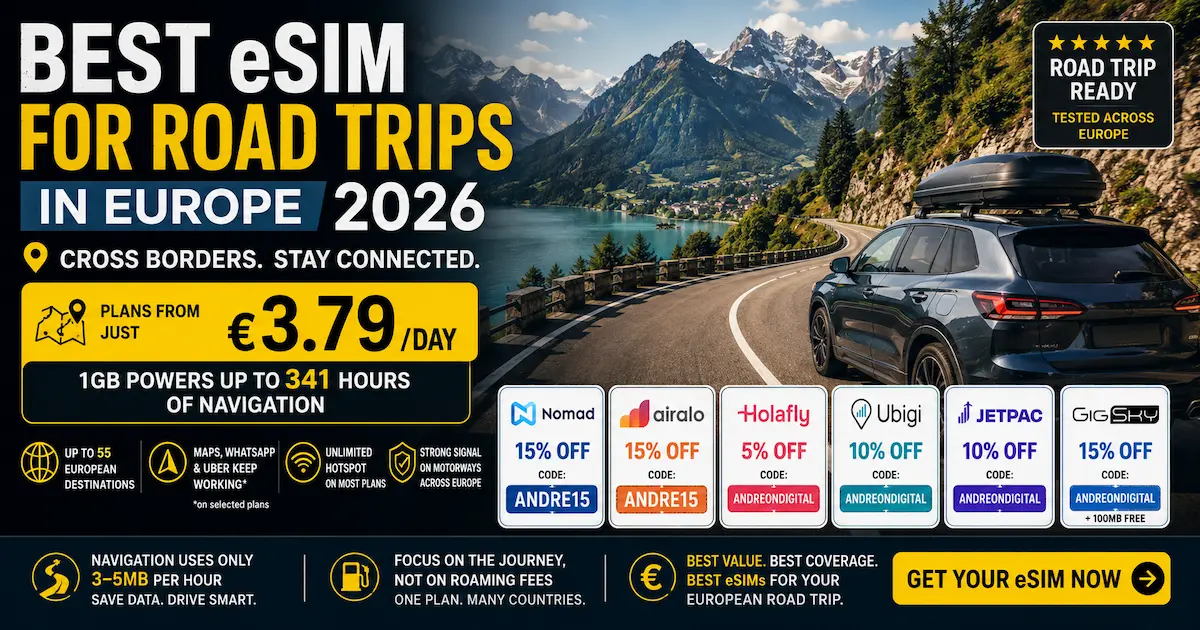
🥇 Best all-round → Jetpac: 43 countries · unlimited hotspot · Maps keeps working after your data ends → ANDREONDIGITAL −10%
🗺️ Balkans or Eastern Europe → Ubigi: Extended 55 destinations · 2 Mbps floor · 10GB/7d €12 → ANDREONDIGITAL −10%
🌍 Most destinations, standard plan → GigSky: 49 · 3.5GB/day · free trial first
💰 Car full of people → Nomad fixed 50GB €30.77: fully shareable, no daily throttle → ANDRE15 −15%
🧭 Short defined route → Airalo: 3, 7 and 15-day windows · EU+UK plan cheaper if you stay in the bloc → ANDRE15 −15%
♾️ Long driving days, solo, Western Europe → Holafly: from €3.79/day → ANDREONDIGITAL −5%
🧭 And before you buy anything: download offline maps per country, keep standard map view, and read your plan’s country list against every country you’ll drive through.
If a friend told me tonight they were driving Munich → Vienna → Ljubljana → Zagreb next month with two kids in the back, I’d send them Jetpac — 43 countries covers that route, the hotspot is unlimited for the tablets, and if the data runs out somewhere in Slovenia the navigation keeps working anyway. If the route continued into Bosnia and Albania, I’d switch them to Ubigi Europe Extended without hesitating.
This article contains affiliate links — if you buy through them I may earn a commission at no extra cost to you. It hasn’t shaped the conclusions: this guide’s central argument is that navigation barely uses data, which points most readers towards smaller and cheaper plans. It also says plainly that Holafly — the provider I’ve used most personally — is the weakest fit for a road trip because of its 33-country coverage and 1GB-a-day hotspot cap.
All prices in euros (€) were read from each provider’s official Europe pages in August 2026, including promotional prices where displayed. Nomad’s 20GB and 50GB prices are sale prices and may revert. Coverage counts, fair-use thresholds, throttled speeds and hotspot rules come from each provider’s own published documentation.
Motorway carrier strength is drawn from published network measurement reporting — including Opensignal’s Mobile Network Experience Report for Germany — and operator coverage information. It is not based on personal drive testing, and this guide makes no claim to have drive-tested these providers. Navigation data figures are published estimates for Google Maps and vary with settings, traffic conditions and rerouting frequency.
Vignette prices and toll requirements change and should be confirmed with the national operator before travel. Carrier roaming rates are indicative market ranges, not a quote from any specific operator. I have personally used Holafly in Portugal, Turkey and Thailand, Nomad in Portugal and Airalo in Portugal; Jetpac, Ubigi and GigSky are assessed from official documentation. Always confirm prices and country lists at checkout.
Last verified: August 2026
Keep Reading
Driving & multi-country
- Can I Use One eSIM in Multiple European Countries?
- Best eSIM for Couples in Europe
- Best eSIM for Families in Europe
- Best eSIM for Backpacking Europe
- Best eSIM for Short Trips to Europe
- Best eSIM for 30 Days in Europe
Prices & rankings
- Best eSIM for Europe 2026
- Best eSIM Providers for Europe — 11 scored
- eSIM Europe Price Comparison
- Cheapest eSIM for Europe 2026
- How Much Data Do You Need for Europe?
Setup & troubleshooting
- How to Activate an eSIM for Europe
- eSIM Not Working in Europe? 9 Fixes
- Slow eSIM Internet in Europe? 8 Fixes
- eSIM Compatible Phones 2026
Reviews
Countries on the main driving routes
Germany | France | Italy | Spain | Portugal | Austria | Switzerland | Netherlands
Croatia | Czech Republic | Poland | Greece