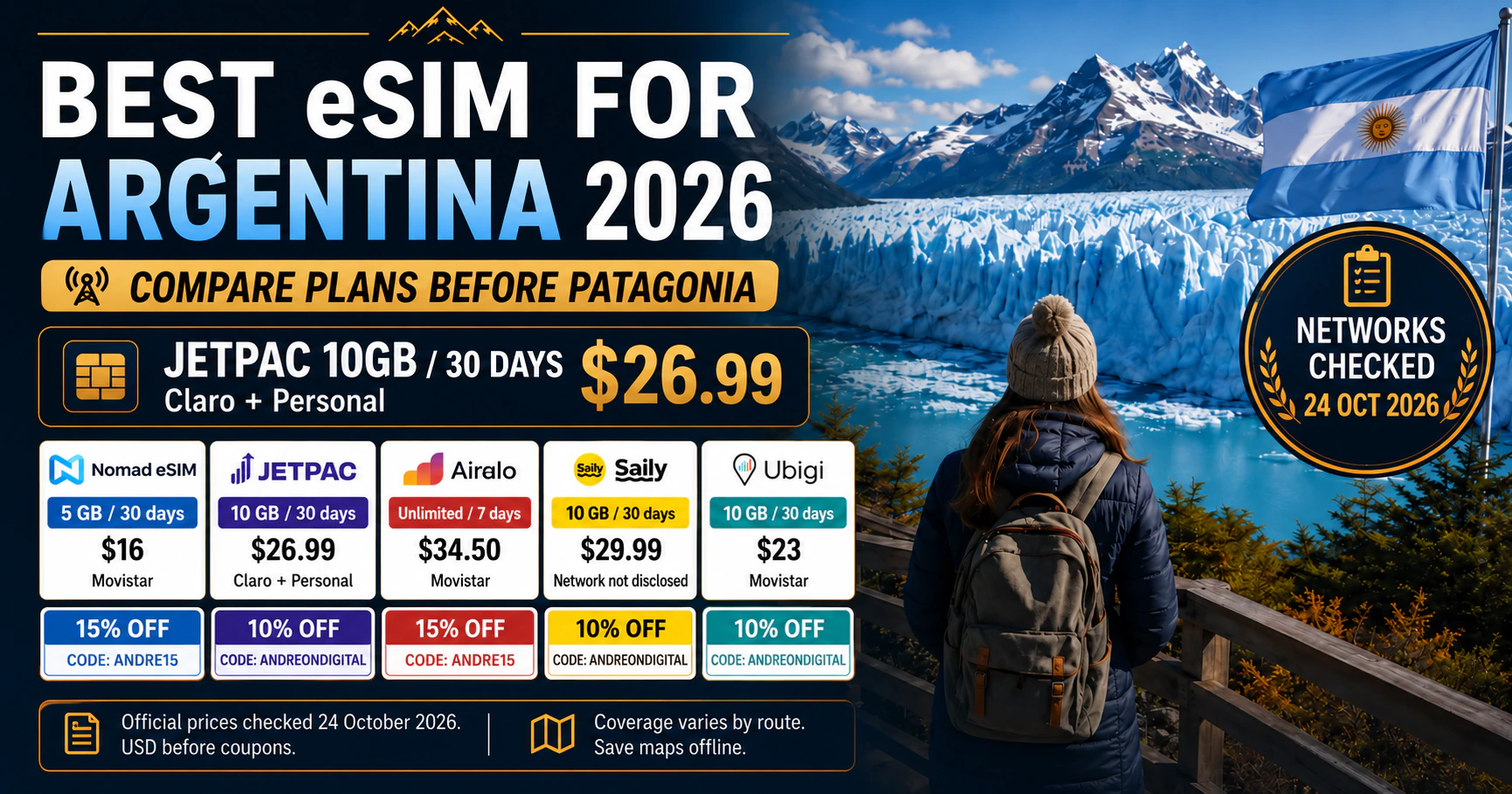

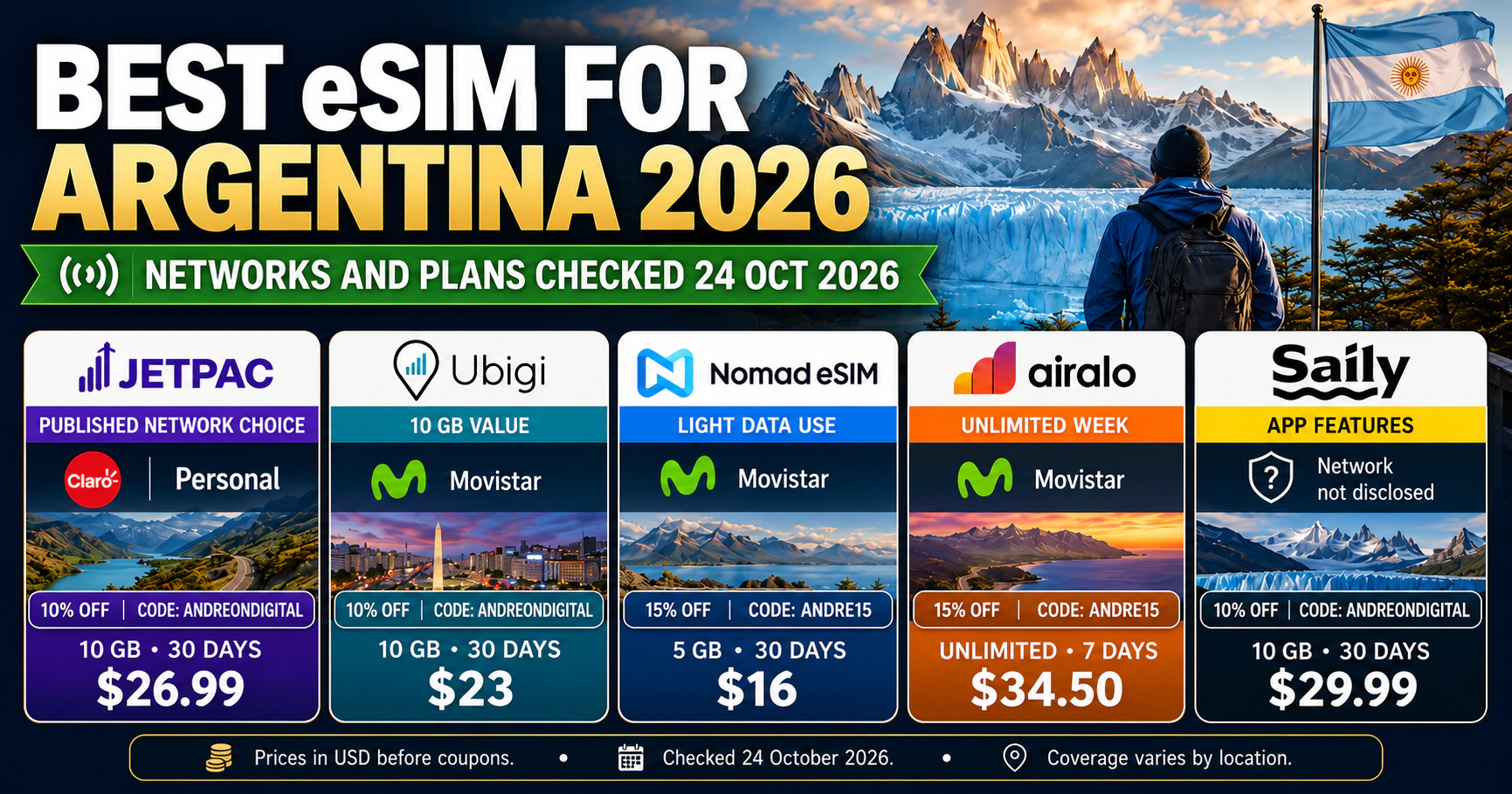
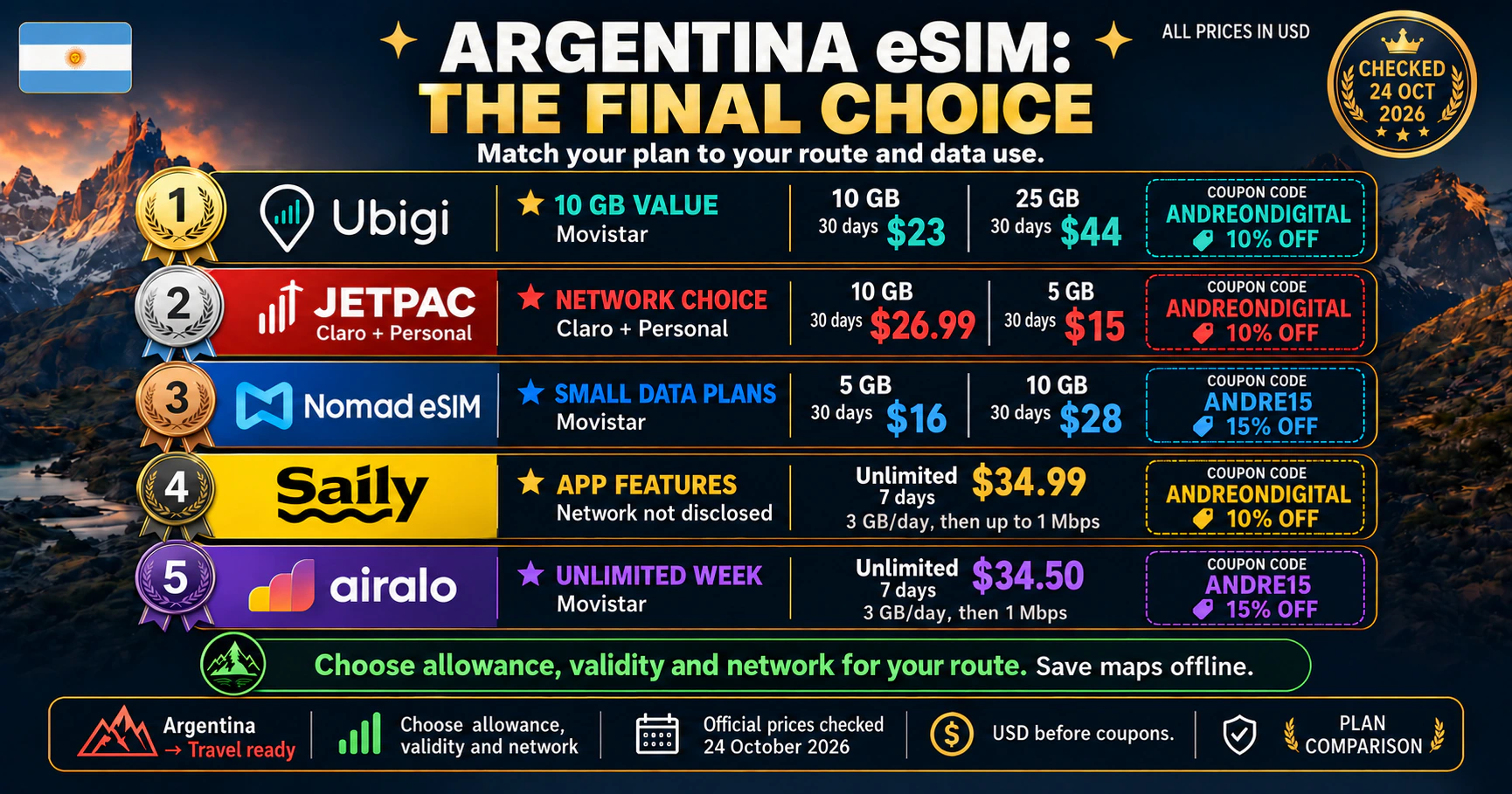
If I were buying an eSIM for a two-week Argentina trip today, I would start with Ubigi’s 10GB, 30-day plan at $23, then compare it with Jetpac’s 10GB at $26.99 if I wanted a plan that publishes both Claro Argentina and Personal. For a data-heavy week, Airalo’s $34.50 unlimited package deserves a look, but its speed drops after 3GB each day.
That choice changes with your route. A few days in Buenos Aires, a wine trip around Mendoza and a drive through Patagonia do not create the same demands. The useful questions are how long your data lasts, which network your particular package can use, and what happens when its high-speed allowance runs out. If your trip crosses borders, start with Best eSIM for South America 2026 and the separate guides to Chile and Brazil.
Which Argentina eSIM would I choose?
10GB for a longer trip: Ubigi, $23 for 30 days, on Movistar.
Published Claro and Personal access: Jetpac, 10GB for 30 days at $26.99.
A light-use month: Nomad eSIM, 3GB for $9.50 or 5GB for $16, on Movistar.
A busy seven-day trip: Airalo unlimited at $34.50, on Movistar, with 3GB daily before reduced speed.
App features and an unrestricted hotspot policy: Saily, 10GB for $29.99 or seven-day unlimited for $34.99; its local partner is not named.
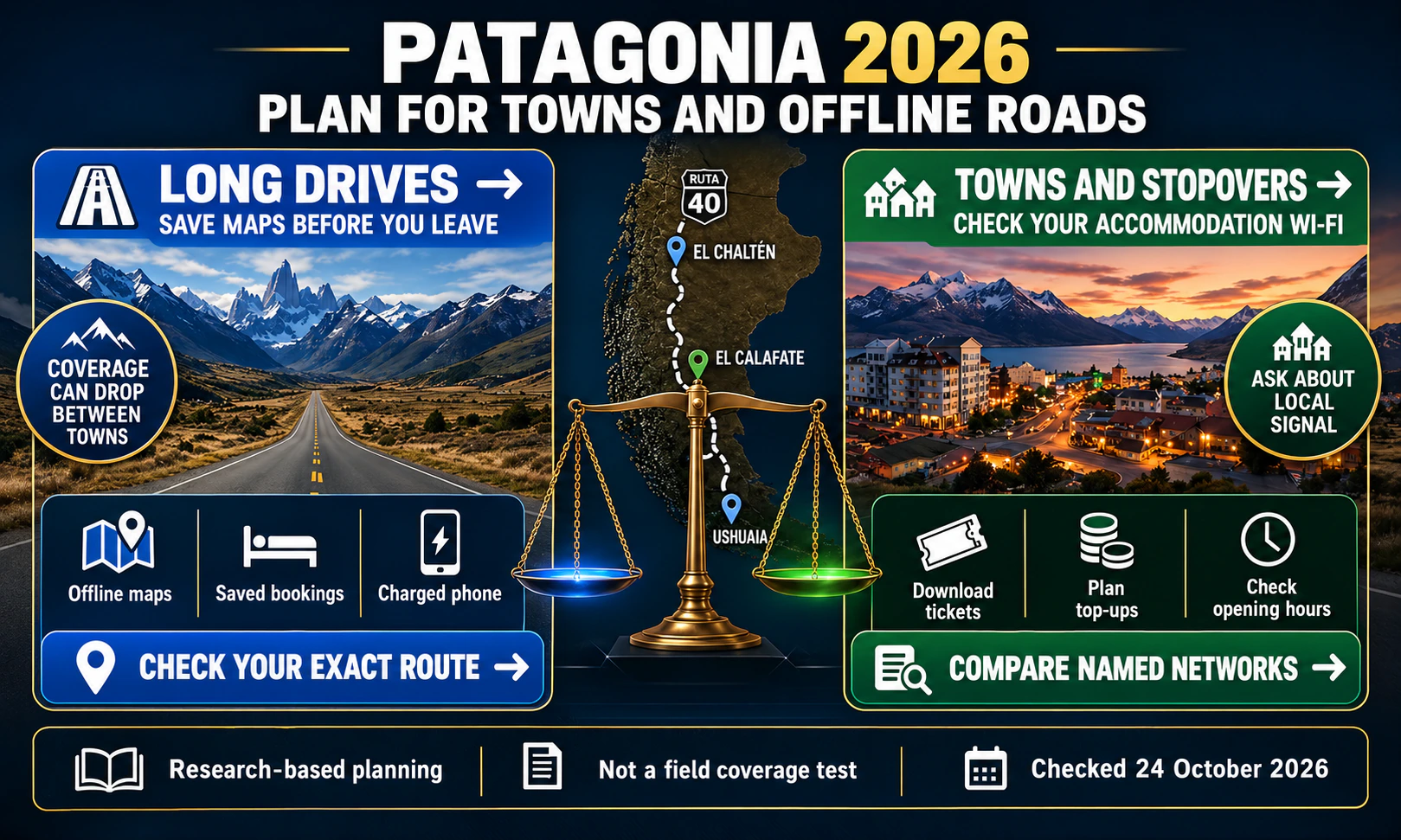
For Patagonia, I would not buy on the promise that one brand works everywhere. A published network list is useful, but it does not tell you whether your phone will connect on a particular trail, inside a lodge or between towns. Save the route, tickets and accommodation details before leaving Wi-Fi.
Argentina eSIM networks: what the providers actually list
The three local names to look for are Claro, Personal and Movistar. Travel providers buy access to local networks, so the provider name on your receipt is not necessarily the name that appears on your phone.
| Provider | Published network on checked plans | What this means when choosing |
|---|---|---|
| Jetpac | Claro Argentina + Personal | Two named partners. Check the network list on the exact package you buy. |
| Ubigi | Movistar | The current 10GB, 25GB and unlimited product pages list Movistar. |
| Nomad eSIM | Movistar, 4G | The 10GB plan details identify Movistar and allow hotspot use. |
| Airalo | Movistar | Shown as the primary network on the Argentina store. |
| Saily | Not disclosed on the Argentina product page | Do not assume that it uses a particular Argentine carrier. |
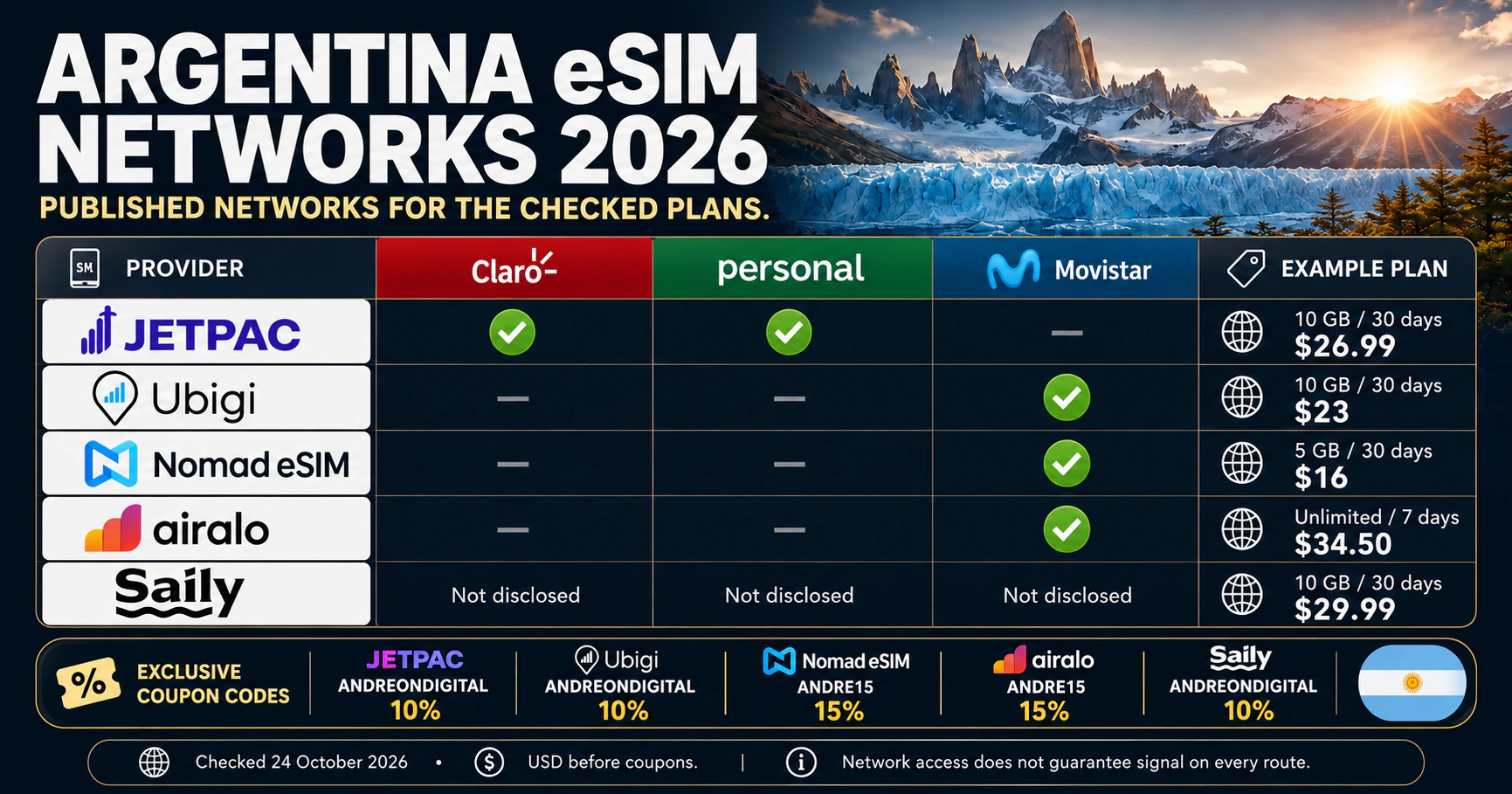
The current listings matter more than an older screenshot. Jetpac’s 10GB and seven-day unlimited package details both list Claro Argentina and Personal. Ubigi’s current pages list Movistar. That is why I no longer describe Ubigi as the Personal option or Jetpac as Claro-only. Saily’s page describes available network generations but does not identify its host carrier.
These are roaming partners, not a nationwide performance ranking. A dual-network listing can offer options, but it does not guarantee instant switching, simultaneous connections or reception on every road. Keep the provider’s installation instructions available and contact its support if network selection fails.
Argentina eSIM prices: compare the same amount of data
A low headline price can hide a very short validity period. Nomad’s 1GB lasts seven days; Airalo’s $5 1GB package lasts three. If your trip is two weeks long, a three-day plan is not a substitute for a month-long allowance.
| 30-day fixed plan | Jetpac | Ubigi | Nomad eSIM | Airalo | Saily |
|---|---|---|---|---|---|
| 5GB | $15 | Not included in this comparison | $16 | $17 | $16.99 |
| 10GB | $26.99 | $23 | $28 | $30 | $29.99 |
| Larger checked package | 15GB $29.99; 30GB $49.99 | 25GB $44 | 20GB $47 | 20GB $47 | 20GB $46.99 |
Ubigi is the lowest-priced 10GB for 30 days option among these five at the checked base prices. Jetpac has the lowest 5GB price here. Nomad’s 3GB for 30 days at $9.50 suits lighter use. Those are comparisons within this shortlist, not claims that no cheaper eSIM exists anywhere.
Unlimited plans have different high-speed limits
| Plan | Base price | High-speed allowance | After the allowance |
|---|---|---|---|
| Airalo unlimited, 7 days | $34.50 | 3GB each day | 1 Mbps for the remaining daily period |
| Saily unlimited, 7 days | $34.99 | 3GB each day | Up to 1 Mbps |
| Ubigi unlimited, 7 days | $35 | 20GB total for the package | 2 Mbps for the remainder |
| Jetpac unlimited, 7 days | $63 | 3GB per 24-hour period | Up to 1 Mbps until the next cycle |
| Ubigi unlimited, 30 days | $78 | 60GB total for the package | 2 Mbps for the remainder |
| Saily unlimited, 30 days | $98.99 | 3GB each day | Up to 1 Mbps |
| Jetpac unlimited, 30 days | $270 | 3GB per 24-hour period | Up to 1 Mbps until the next cycle |
A daily cap and a total allowance suit different habits. Ubigi lets a seven-day traveler use more of the 20GB on one busy day. Airalo and Saily reset their high-speed allowance daily. Once speed is reduced, basic messaging may still be practical, but I would not plan important video meetings or large uploads around it.
A fixed 10GB Jetpac plan is 10GB in total. It does not include an extra 3GB every day. The daily rule above belongs to its unlimited packages.
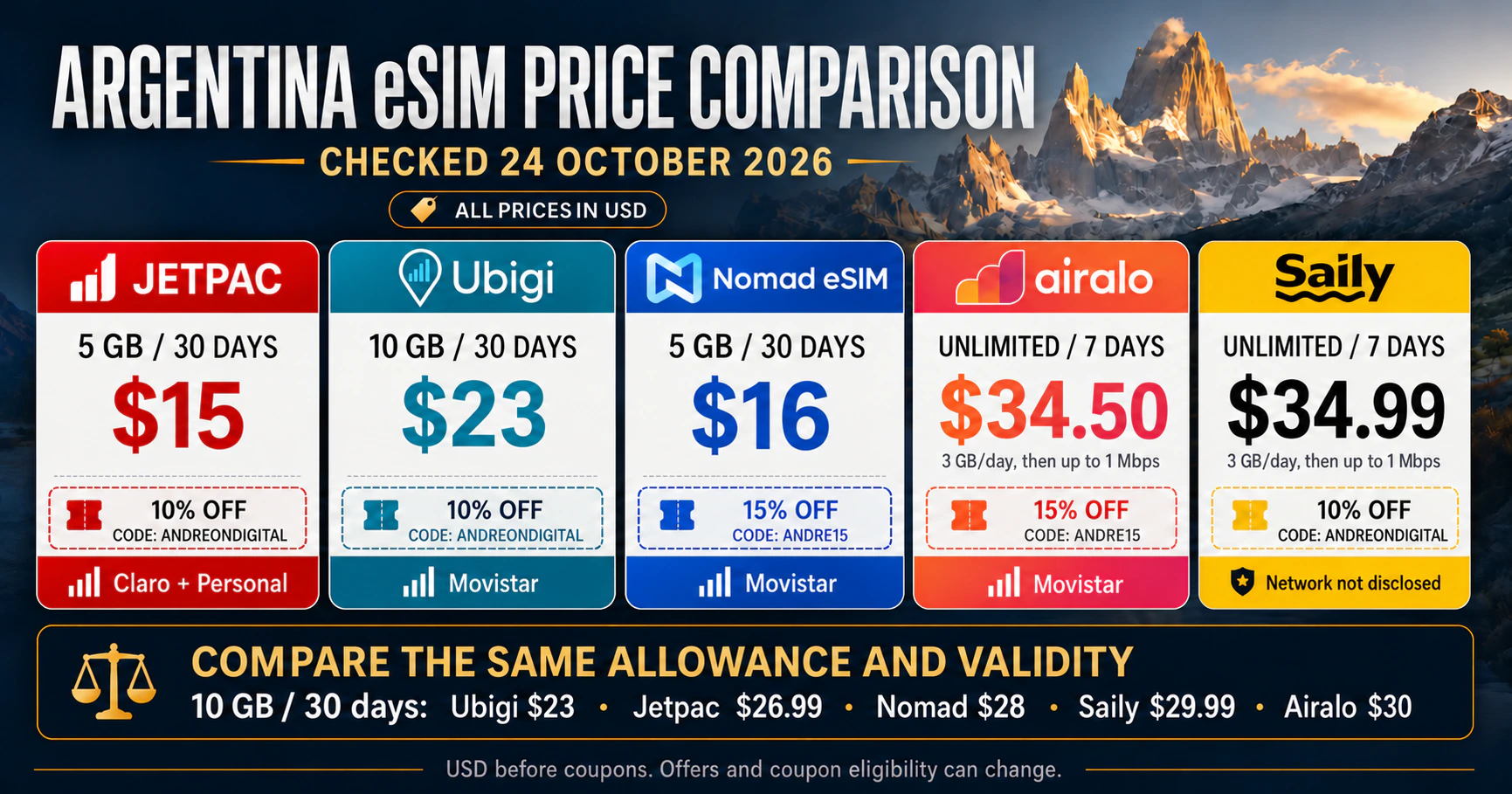
Airalo also lists unlimited packages at $19.50 for three days, $27.50 for five days and $38.50 for ten days. Its seven-day $34.50 price is slightly below Saily’s $34.99 and Ubigi’s $35, but the different speed limits matter more than a few cents.
The five providers in detail
Jetpac is the first one I would compare if a named local network matters to the itinerary. The current package details show Claro Argentina and Personal. That is useful information for planning, although it cannot establish which network will work best at your accommodation or along a remote drive.
| Fixed plan | USD | Validity |
|---|---|---|
| 3GB | $10 | 7 days |
| 5GB | $15 | 30 days |
| 10GB | $26.99 | 30 days |
| 15GB | $29.99 | 30 days |
| 20GB | $60 | 30 days |
| 30GB | $49.99 | 30 days |
On eligible packages of 3GB and above, Jetpac lists access to WhatsApp chat, Uber, Grab and Google Maps after the main allowance runs out. Those apps still need a mobile signal; this is not offline connectivity. Hotspot use shares your package allowance. Optional in-app calling packs are separate from the data plan and do not give you an Argentine mobile number.
For a wider itinerary, compare the covered-country list with my Best eSIM for South America 2026. Jetpac’s $26.99 10GB package costs $3.99 more than Ubigi’s equivalent allowance and duration. I would pay that difference only if its listed networks or included features were useful for my trip.
My Jetpac eSIM Review 2026 explains the app and broader pricing patterns. For Argentina, the current 20GB versus 30GB price inversion is worth checking in the store. The $270 monthly unlimited plan is much more expensive than the other monthly packages shown here, so it would need a clear benefit to justify that cost.
How to set up Jetpac before Argentina
Install the eSIM on a reliable connection before departure. Follow the instructions for the exact package, select it as the travel data line and enable data roaming for that line when required. Jetpac’s page says the plan must be activated within three months of purchase.
This video is a setup walkthrough, not an Argentina coverage test. Keep the installation instructions saved so you can check them if airport Wi-Fi is unreliable.
Nomad makes sense when you know roughly how much data you use and prefer a straightforward fixed allowance. I’ve used it in Portugal, and my Nomad eSIM Review 2026 separates that experience from the current plan specifications. I am not treating my Portuguese tests as proof of Argentine performance.
| Plan | USD | Validity |
|---|---|---|
| 1GB | $5 | 7 days |
| 3GB | $9.50 | 30 days |
| 5GB | $16 | 30 days |
| 10GB | $28 | 30 days |
| 20GB | $47 | 30 days |
The checked 10GB details list Movistar, 4G, hotspot support and add-ons. This is data only, with no local phone number. Nomad did not list an unlimited Argentina plan when I checked.
The 3GB package is a reasonable starting point for light navigation and messaging with regular Wi-Fi access. For daily photo uploads or laptop use, compare a larger allowance. Nomad is not the cheapest at every tier: Jetpac’s 5GB is $1 less and Ubigi’s 10GB is $5 less before coupons.
How to install Nomad eSIM before Argentina
Use Wi-Fi to install the profile and save the instructions. The plan details say service starts when it connects to the destination network, or after 60 days if it has not been used. Keep that purchase window in mind when booking far ahead.
At arrival, select Nomad for mobile data and follow the roaming instructions. If it does not connect, check the app’s troubleshooting steps rather than deleting the eSIM profile.
Airalo’s seven-day unlimited package is the least expensive unlimited week in this five-provider comparison at the checked base prices. It costs $34.50 and lists Movistar as its primary network. I’ve used Airalo in Portugal, including Figueira da Foz; the Airalo Review 2026 covers that experience.
| Fixed data | USD | Unlimited | USD |
|---|---|---|---|
| 1GB / 3 days | $5 | 3 days | $19.50 |
| 3GB / 7 days | $10 | 5 days | $27.50 |
| 5GB / 30 days | $17 | 7 days | $34.50 |
| 10GB / 30 days | $30 | 10 days | $38.50 |
| 20GB / 30 days | $47 | Not applicable | Not applicable |
For unlimited, Airalo explicitly states a speed reduction to 1 Mbps after 3GB per day. That is a limit to plan around if you share data with a laptop. I would check a typical workday’s usage before relying on it for video calls.
Airalo offers regional packages too, but the country list and validity belong to the selected regional plan. A local Argentina package is not automatically the right product for Chile or Brazil.
How to install Airalo for Argentina
Install before departure and select the eSIM for mobile data at arrival. The checked package starts its validity when it connects to a supported network in the coverage area, and allows up to 365 days after purchase to start use. Top-ups are available after installation. Check whether renewals are enabled so the account behaves as you expect.
The current written prices and package details above take precedence over any older offer mentioned in the walkthrough.
Saily includes an ad blocker, web protection and virtual-location features. Its Argentina page also says there are no hotspot restrictions. Those are useful features to compare, but hotspot traffic still consumes the plan’s data or high-speed allowance. I have not personally tested Saily; my Saily Review 2026 explains the service and its limitations.
| Plan | USD | Validity |
|---|---|---|
| 1GB | $5.29 | 7 days |
| 3GB | $9.99 | 30 days |
| 5GB | $16.99 | 30 days |
| 10GB | $29.99 | 30 days |
| 20GB | $46.99 | 30 days |
| Unlimited | $34.99 | 7 days |
| Unlimited | $98.99 | 30 days |
The unlimited packages provide 3GB per day without a speed limit, then data at up to 1 Mbps. Saily does not name its Argentine host carrier on the product page, so I would ask support before buying if a particular local network is essential.
The quoted prices are for data. Saily now advertises a separate US phone-number service with calling and text plans. That does not mean this Argentina data package includes an Argentine number or bundled calling credit. Its security features also should not be presented as a blanket guarantee for every public Wi-Fi connection.
How to install Saily for Argentina
Install through the app before the trip. Saily says the plan activates automatically at the destination when the eSIM is enabled and roaming is on. A purchased plan activates automatically after 180 days if you have not started it, so buying too early can waste part of its validity.
Use the app to monitor your allowance and check the daily limit before sharing data with another device.
Ubigi earns its place through the arithmetic. Its 10GB plan lasts 30 days and costs $23, while 25GB costs $44 for the same duration. Both are worth considering for an itinerary with several stops and regular Wi-Fi access. The Ubigi Review 2026 covers the app in more detail.
| Plan | USD | Important condition |
|---|---|---|
| 10GB / 30 days | $23 | Fixed total allowance |
| 25GB / 30 days | $44 | Fixed total allowance |
| Unlimited / 7 days | $35 | 20GB total at high speed, then 2 Mbps |
| Unlimited / 30 days | $78 | 60GB total at high speed, then 2 Mbps |
The four current product pages I checked list Movistar. I would not buy on the assumption that a previous Personal listing still applies. Data sharing is allowed, and Ubigi says you can recharge through its app even without remaining data or Wi-Fi.
Its unlimited structure differs from a daily allowance. A seven-day traveler gets a 20GB high-speed pool; the 30-day plan gets 60GB. After that, the listed speed is 2 Mbps for the rest of the package. A higher reduced-speed figure does not guarantee a particular real-world download speed.
How to install Ubigi before Argentina
Install the QR profile on an unlocked compatible device and create the account before departure. Ubigi’s Smartstart policy starts the data plan on arrival at the destination. Keep the installation instructions available and check the balance before a long day away from Wi-Fi.
This is a setup video, not a test of Argentine network coverage. The package conditions above were checked separately on the current official product pages.
What to plan for in Buenos Aires and Patagonia
In Buenos Aires, the practical priority is getting connected after landing, then keeping enough data for maps, messages and transport. Save your accommodation address and airport transfer details before flying. Indoor reception, congestion and underground travel can still interrupt a connection.
For Patagonia, split the itinerary into towns and the journeys between them. Ask your accommodation about its Wi-Fi and the mobile networks that currently work there. Download detailed maps for the roads or trails you will actually use. A local report about one lodge is more useful than a promise that an entire region has excellent signal.
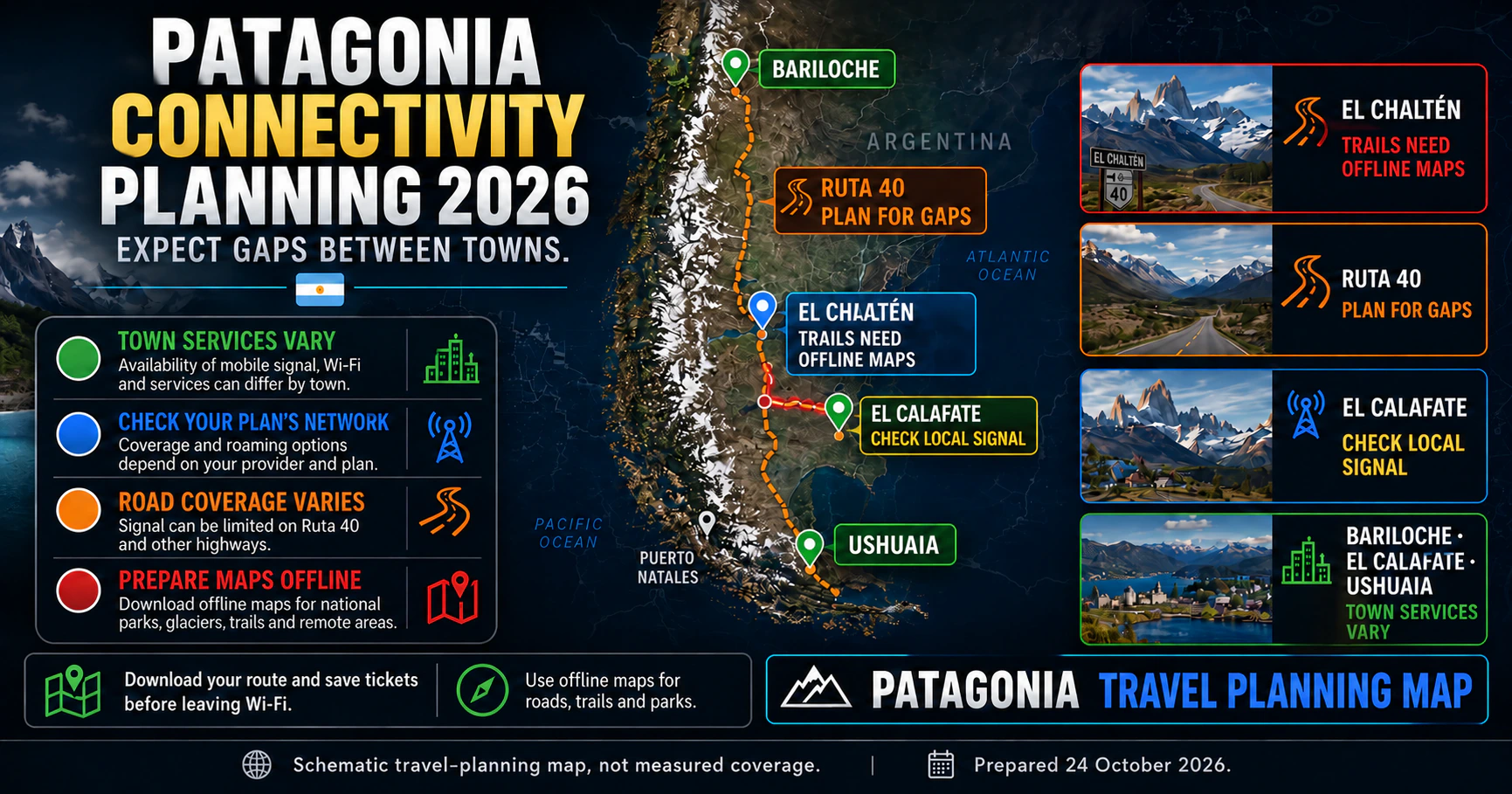
El Calafate, El Chaltén, Bariloche and Ushuaia are different destinations, not interchangeable coverage test points. I would prepare for gaps on long drives and hikes with any provider, keep the phone charged and avoid making essential travel arrangements dependent on a live connection.
The Argentina Tourism official site is a useful starting point for destination information. For an extended South American itinerary, the Peru eSIM guide and Colombia eSIM guide cover separate country choices.
Can a tourist buy a local eSIM?
Yes, local options exist. Personal’s current tourist page says an unlocked phone can obtain an eSIM through its commercial offices or WhatsApp. Its tourist registration instructions mention a DNI or passport. Check the process with the carrier before going to a store; a local eSIM can involve identity checks and a different purchase flow from a travel eSIM.
A travel package bought before departure can be convenient, but it is not the only possible eSIM route. I have not reused old Argentine-peso tourist prices because they would give a misleading comparison with today’s offers.
Crossing into Chile, Brazil or Uruguay
Check the complete covered-country list on the package you actually buy. A country-labelled offer may have broader coverage, but that cannot be assumed for every provider. For the Chilean side of Patagonia, use the Chile guide and compare a regional package against separate local plans. Do the same before visiting the Brazilian side of Iguazú or taking a ferry to Uruguay.
How much data should you buy?
As a planning estimate, 3GB to 5GB can be enough for a light-use week with Wi-Fi, while 10GB is a sensible starting point for a longer holiday using maps, messaging and some photo sharing. These are estimates, not measured averages from my Argentina travels. Video streaming, cloud backups and laptop updates can change the calculation quickly.
Check your phone’s data usage from a similar trip. Download media over Wi-Fi, restrict automatic backups and choose validity that covers the entire stay. If you need dependable internet for work, ask about the accommodation connection and have a backup rather than relying on an unlimited label alone.
FAQ: choosing an eSIM for Argentina
Which eSIM uses Personal in Argentina?
Is Claro the best carrier for Patagonia?
Which Argentina eSIM is cheapest in this comparison?
Can I buy a local eSIM in Argentina as a tourist?
Where might I lose signal in Patagonia?
What is the best eSIM for Argentina in 2026?
Are unlimited Argentina eSIMs unlimited at full speed?
Does a travel eSIM work in Patagonia?
Can I keep my WhatsApp number?
How much data do I need for Argentina?
Can I use my Argentina eSIM in Chile?
Will my Argentina eSIM get 5G?
Final verdict: what I would buy for an Argentina trip
For a typical trip with Buenos Aires, another city and a few days in Patagonia, Ubigi’s 10GB for $23 over 30 days is my starting point. It offers a useful allowance without paying for a large daily cap that may go unused. If your phone history suggests 10GB is too little, its 25GB package at $44 is the next one I would compare.
Jetpac is the alternative when its published Claro and Personal access matters to your route. Its 10GB package costs $3.99 more than Ubigi’s before coupons. That is a small difference if a local accommodation confirms that one of those networks is the better fit, but I would not treat it as a guarantee for the whole of Patagonia. Check the 15GB and 30GB offers too, because the current 20GB price is poor value beside them.
For lighter use, Nomad’s 3GB at $9.50 or 5GB at $16 keeps the decision simple. For a busy week, Airalo’s $34.50 unlimited package is worth comparing with Ubigi’s $35 package: one has a daily 3GB allowance, the other a 20GB pool. Saily’s $34.99 week is close in price and adds app features, although the unpublished host network makes it harder to choose on coverage grounds.
The decision I would make before paying is quite ordinary: count the travel days, look at my real data use, and check the networks for the places I will sleep and work. Then I would save maps and bookings offline. A sensible package can make arrival and everyday travel easier. It cannot promise a connection on every stretch of road or every trail.
This article contains affiliate links. I may receive a commission at no extra cost to you. Reader codes are ANDREONDIGITAL for Jetpac, Ubigi and Saily (10%), and ANDRE15 for Nomad and Airalo (15%). Eligibility and promotion stacking depend on the provider and order. Prices and plan details were checked on 24 October 2026. My hands-on experience described above was outside Argentina; local coverage recommendations here are research-based.
Official sources checked
Prices, validity and network details come from the current provider pages, including their package selectors. I used USD displays throughout.
- Jetpac Argentina packages and network details
- Nomad eSIM Argentina plans
- Airalo Argentina fixed and unlimited packages
- Saily Argentina plans and technical details
- Ubigi Argentina 10GB for 30 days
- Ubigi Argentina 25GB for 30 days
- Ubigi seven-day unlimited and fair-use policy
- Ubigi 30-day unlimited and fair-use policy
- Personal tourist SIM and eSIM guidance
Keep Reading
South America
- Best eSIM for South America 2026
- Best eSIM for Brazil 2026
- Best eSIM for Chile 2026
- Best eSIM for Peru 2026
- Best eSIM for Colombia 2026