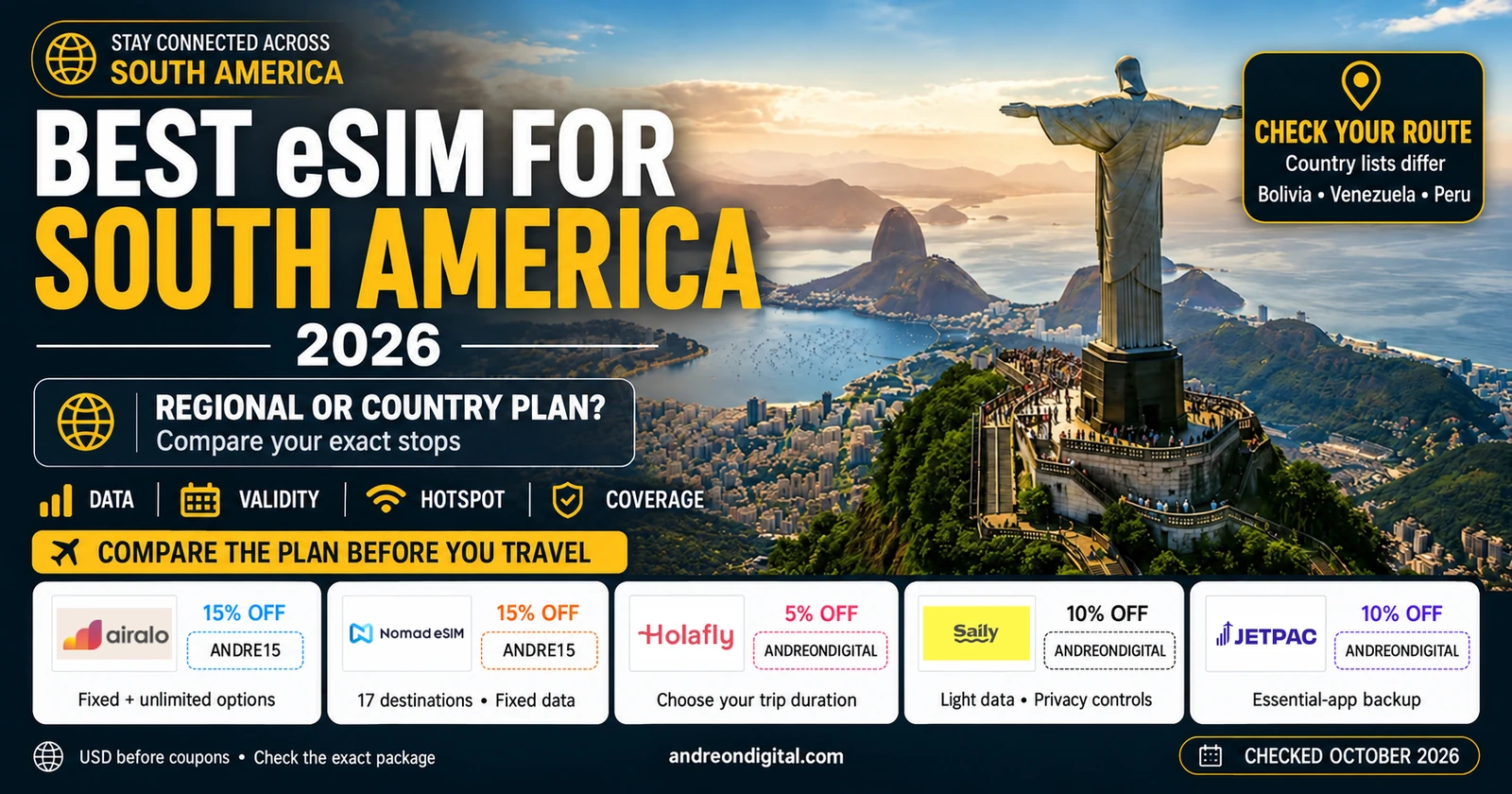

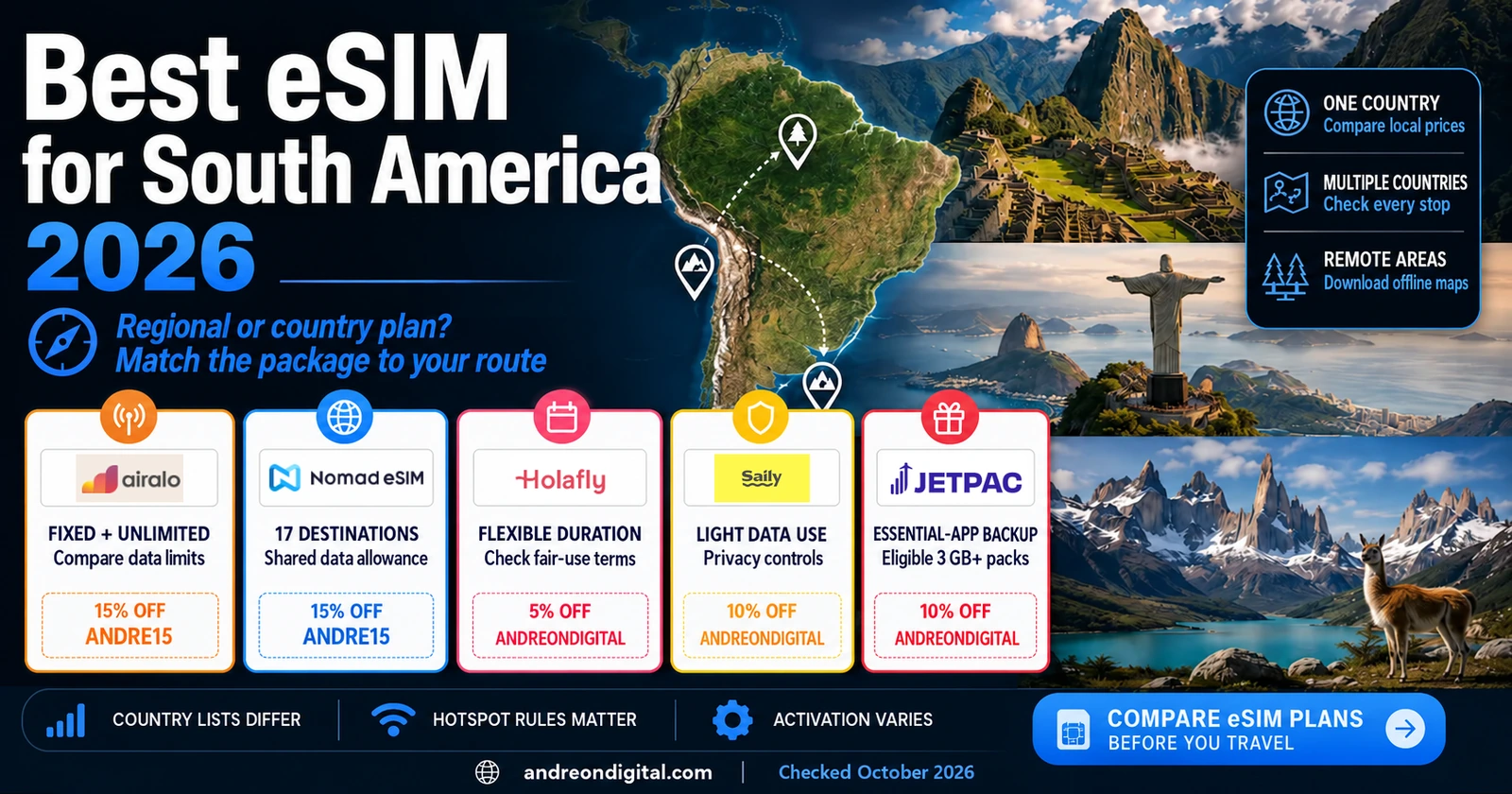
The best eSIM for South America is the one that covers your actual route with enough data for the whole trip. A plan advertised for 17 Latin American destinations does not cover 17 South American countries, and crossing a border does not refill your allowance.
For a typical multi-country itinerary, Airalo is my first comparison point: its Latin America plan includes ten South American countries, with 10 GB for 30 days at $36 and a choice of fixed or unlimited data. Nomad eSIM is a close alternative at $39 for the same allowance and duration, with a useful country-by-country network list. Holafly suits travelers who want to choose the number of unlimited-data days, while Saily and Jetpac have different strengths worth checking against your route.
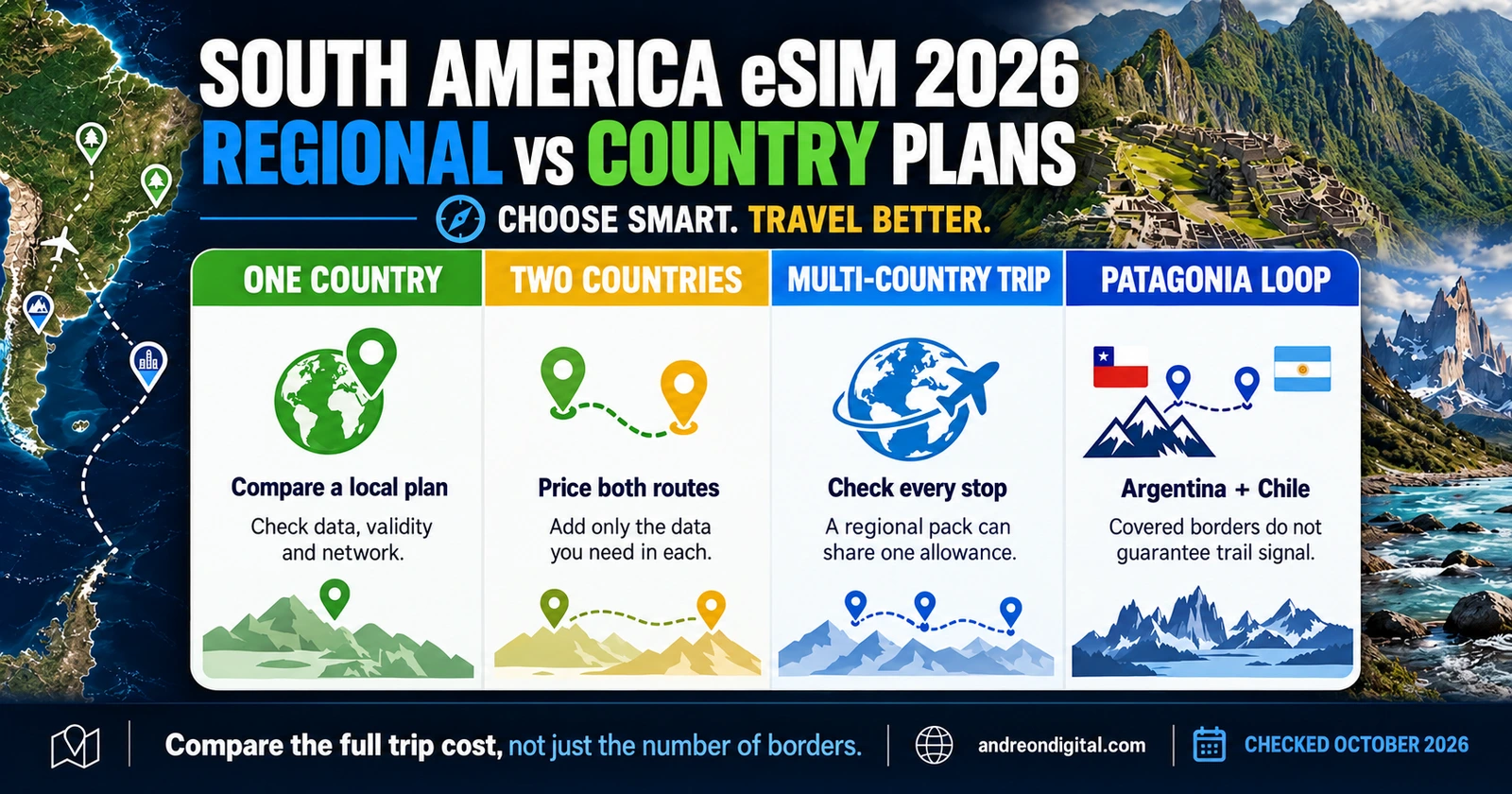
The decision is still regional versus country plans. A week in Brazil is a different purchase from six weeks between Colombia, Peru, Bolivia, Chile and Argentina. Below, I compare the five providers already in this guide, show where their packages actually work, and put the price of one shared allowance next to separate country allowances. For a single stop, start with our Brazil, Argentina, Chile, Peru or Colombia guide.
Best eSIM for South America 2026: quick answer
2. Nomad eSIM: straightforward fixed data and published regional networks; ten South American countries, 10 GB/30 days for $39.
3. Holafly: flexible trip-length unlimited data; nine South American countries, 30 days for $99.90, with a 1 GB/day hotspot limit.
4. Saily: light-use plans and app security controls; nine South American countries, 1 GB/7 days for $7.99.
5. Jetpac: fixed-data plans with qualified essential-app benefits; eight South American countries, 10 GB/30 days for $38.
All five have route gaps. Bolivia, Venezuela and the Guianas deserve particular attention. This order reflects the regional packages checked, not a measured speed ranking or a partnership placement.
How to Install Your South America eSIM (Before You Land)
Before buying anything, check whether your home mobile plan already includes the countries and roaming allowance you need. A travel eSIM is useful when its coverage, data budget and total cost improve on what you already have; it is not automatically necessary for every traveler.
Check that your exact phone model supports eSIM and is carrier-unlocked before buying. The GSMA eSIM overview explains the underlying technology. Installation and activation are separate steps: you can often install over reliable Wi-Fi before flying, while the package starts when it first connects or uses data in an included destination. The product’s own activation instructions take priority.
- Read the country list before checkout. Include stopovers where you intend to use data. Landing in an included country can start a regional plan before your main trip begins.
- Install through the app, QR code or manual details supplied. Save the order and support instructions somewhere accessible without mobile data.
- Name the line clearly. Set the travel eSIM as your mobile-data line and follow its data-roaming instructions. Disable roaming on your home line if you do not want it to use roaming data.
- Check automatic data switching. Make sure your phone cannot silently fall back to the home SIM when travel data is unavailable. Keeping your usual number active does not make calls or SMS free.
- Test before leaving the arrival area. Open a webpage and a map, check your remaining allowance, and save the provider’s troubleshooting steps.
For the phone menus, our eSIM installation guide and eSIM troubleshooting guide show the general process. They are written for Europe, so use your South America package instructions for operators, APN, activation and coverage. Do not delete an installed profile as a first troubleshooting step: reinstalling it may not be permitted.
Regional or Country Plans? The Price Math
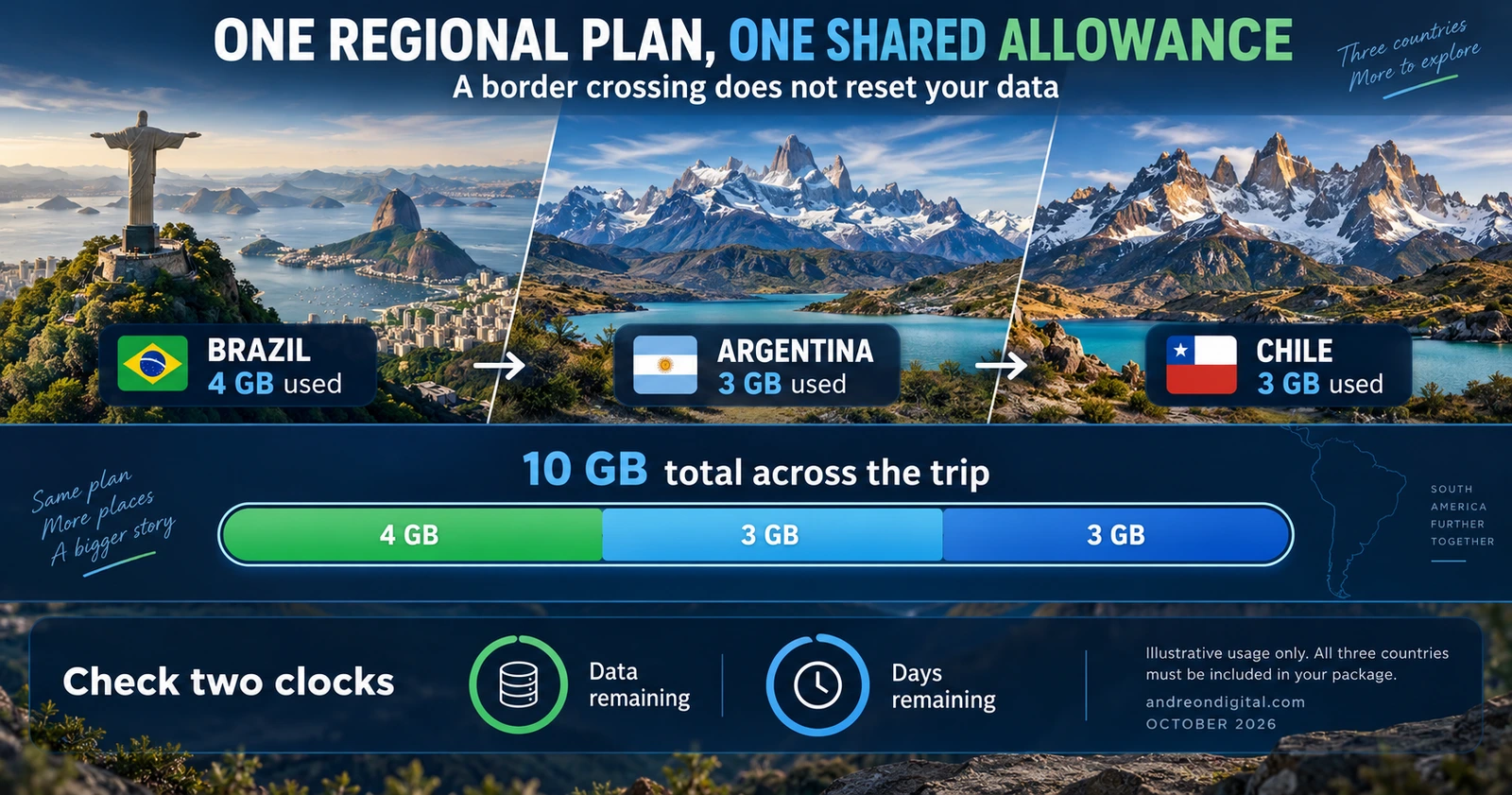
Counting countries alone is too crude. Two country plans may be cheaper than a regional package, but only if the data assigned to each country fits the way you travel. A 10 GB regional allowance can follow you across the included itinerary. Two 5 GB country packages cannot usually lend unused data to each other.
One country: compare the local package first
In the official Nomad eSIM catalog checked for this update, 10 GB for 30 days costs $19 for Brazil, $28 for Argentina, $25 for Chile and $25 for Peru. Its Latin America regional package costs $39 for 10 GB/30 days. If you remain in one country, paying for regional coverage may add nothing useful.
Even within the same provider, the country and regional products can use different networks. Nomad eSIM’s Brazil country package lists TIM, while its regional package lists Claro in Brazil. Its Argentina country package lists Movistar, while the regional one lists Claro. Compare the package you will buy, rather than assuming the brand has one network everywhere.
Two countries: compare equal total data, then flexibility
| Option | Data and validity | USD | How the allowance works |
|---|---|---|---|
| Brazil country plan | 5 GB / 30 days | $12 | Only in Brazil |
| Argentina country plan | 5 GB / 30 days | $16 | Only in Argentina |
| Two country packages together | 10 GB total across two packages | $28 | 5 GB assigned to each country |
| Latin America regional package | 10 GB / 30 days | $39 | Shared across included countries |
Our calculation: 5 GB in Brazil plus 5 GB in Argentina costs $28 ($12 + $16), which is $11 less than the $39 regional 10 GB plan. Both options give you 10 GB in total and each package has 30-day validity, but their activation clocks and usable locations differ. If you end up using 7 GB in Brazil and 3 GB in Argentina, the regional allowance can accommodate that split. The two country packages cannot do so without more data for Brazil.
These are examples from the official Brazil, Argentina, Chile, Peru and regional catalogs. They demonstrate the trade-off, not a promise that country plans always save a fixed percentage.
Several countries or a Patagonia loop: value the shared allowance
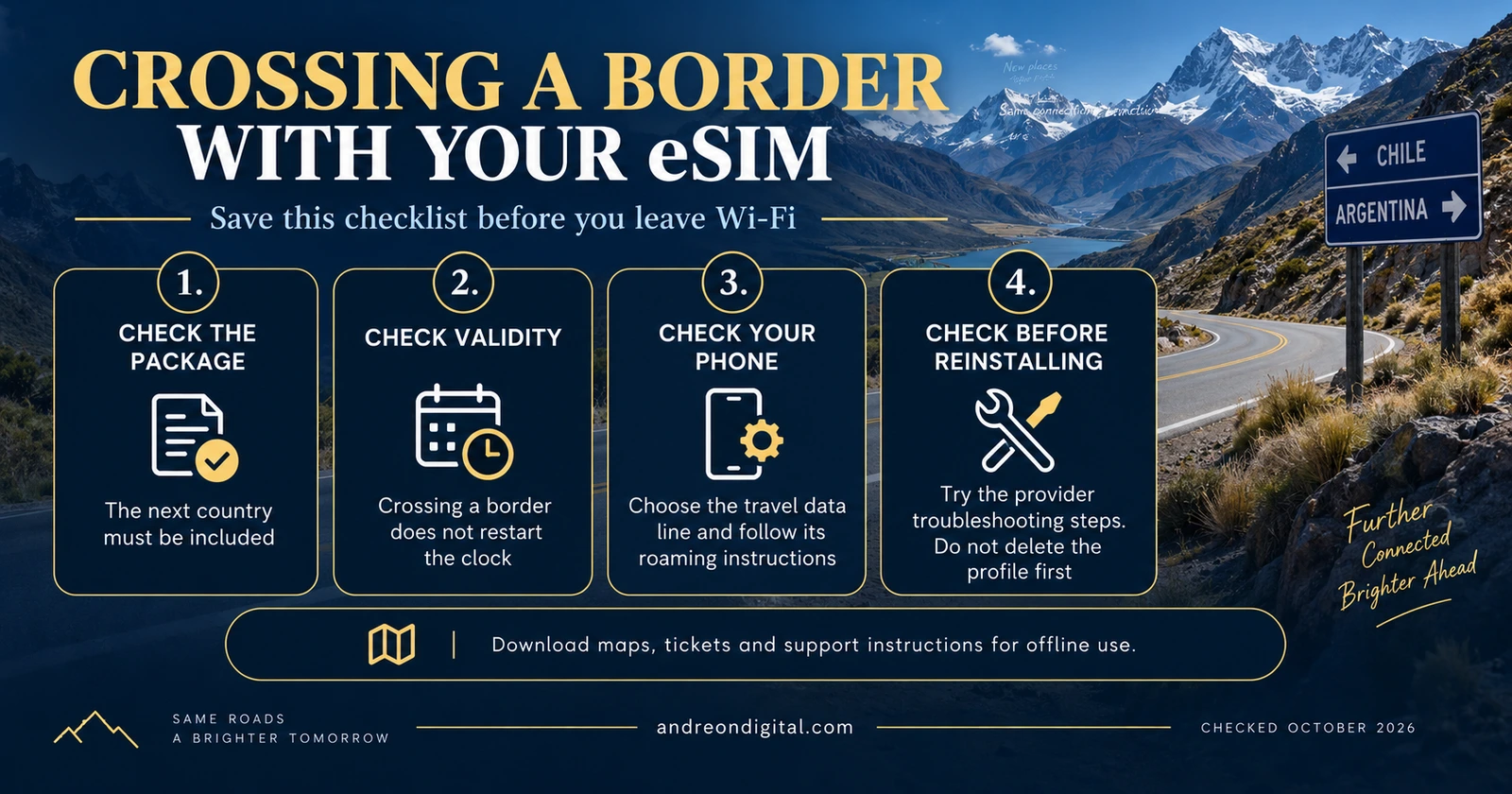
For a route through several covered countries, a regional plan reduces the number of packages you need to manage. The same is true when a Patagonia itinerary goes back and forth between Chile and Argentina. A border crossing does not restart the validity period or reset the data balance, and a new network connection can take time.
For a trip longer than 30 days, budget for the next package or an eligible add-on. A large 30-day allowance is not a 60-day plan. A hybrid can make sense too: use one regional package for short stops, then a country plan for a longer stay. Check add-on timing before running completely out; Nomad eSIM’s current Neon terms require an active, undepleted original plan for an add-on.
South America eSIM Plans: Prices in October 2026
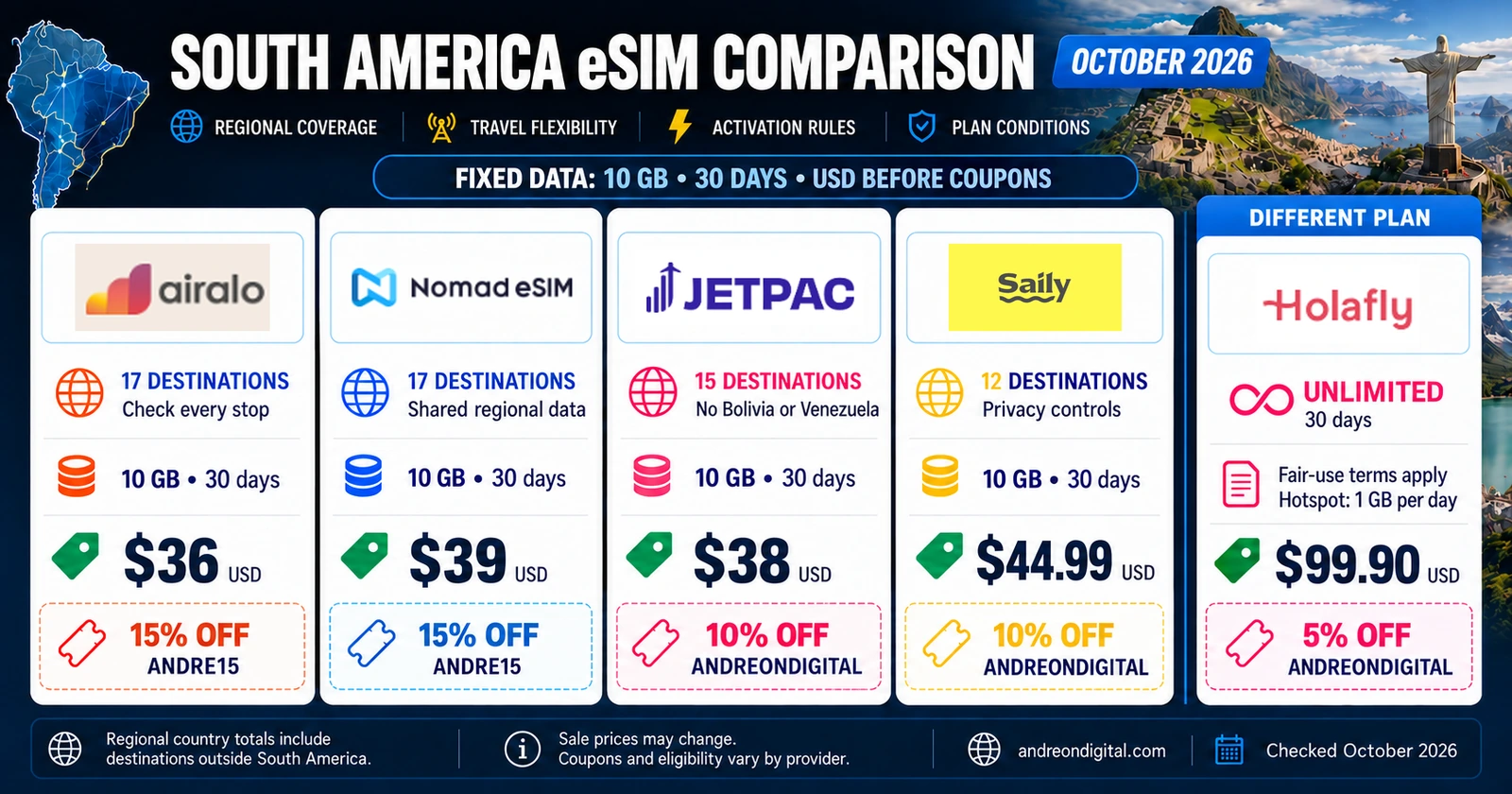
These are selected official USD packages before the site’s coupons. The clearest fixed-data comparison is 10 GB/30 days: Airalo $36, Jetpac $38, Nomad eSIM $39 and Saily $44.99. Those are different footprints, not identical services. Holafly’s $99.90/30-day unlimited package is shown separately because its pricing model and hotspot limit differ.
Airalo fixed data
| Data | Validity | USD before coupon |
|---|---|---|
| 1 GB | 3 days | $7 |
| 3 GB | 7 days | $14 |
| 5 GB | 7 days | $18 |
| 10 GB | 7 days | $29 |
| 5 GB | 15 days | $20 |
| 10 GB | 15 days | $32 |
| 20 GB | 15 days | $47 |
| 5 GB | 30 days | $22 |
| 10 GB | 30 days | $36 |
| 20 GB | 30 days | $49 |
Nomad eSIM fixed data
| Data | Validity | USD before coupon |
|---|---|---|
| 1 GB | 7 days | $9 |
| 3 GB | 30 days | $19 |
| 5 GB | 30 days | $29 |
| 10 GB | 30 days | $39 |
| 20 GB | 30 days | $65 |
Holafly unlimited phone data
| Data | Validity | USD before coupon |
|---|---|---|
| Unlimited | 1 day | $9.50 |
| Unlimited | 3 days | $19.90 |
| Unlimited | 5 days | $31.90 |
| Unlimited | 7 days | $40.90 |
| Unlimited | 10 days | $51.90 |
| Unlimited | 15 days | $62.90 |
| Unlimited | 30 days | $99.90 |
Saily fixed data
| Data | Validity | USD before coupon |
|---|---|---|
| 1 GB | 7 days | $7.99 |
| 2 GB | 15 days | $13.99 |
| 3 GB | 30 days | $20.99 |
| 5 GB | 30 days | $31.99 |
| 10 GB | 30 days | $44.99 |
Jetpac fixed data
| Data | Validity | USD before coupon |
|---|---|---|
| 1 GB | 4 days | $7 |
| 3 GB | 7 days | $19.99 |
| 5 GB | 30 days | $29.99 |
| 10 GB | 30 days | $38 |
| 15 GB | 30 days | $90 |
| 20 GB | 30 days | $59.99 |
Best eSIM for South America 2026: The 5 Providers in Detail
I ranked these regional products by itinerary fit, comparable data pricing, disclosed conditions and practical features. I have not run a simultaneous South America speed test across the five. A provider lower in the list may be the right choice for your exact trip, especially when duration, hotspot use or a specific country matters more than the headline price.
Airalo takes first place because its Latamlink range gives you a useful choice: a fixed allowance for predictable use, or unlimited data with a published daily speed threshold. Both options include Bolivia, Paraguay and Venezuela, alongside the usual Brazil, Argentina, Chile and Peru circuit. That combination is more useful than a headline country count alone.
The 10 GB, 30-day plan is $36, compared with $39 for the same allowance and duration from Nomad eSIM. At 20 GB for 30 days, Airalo is $49. Those are package comparisons, not proof that the networks or real-world performance are identical. We could confirm Airalo’s regional country list but not its current operator assignments, so I would check the package details before choosing it for a particular rural stop.
| Data | Validity | Price |
|---|---|---|
| 5 GB | 30 days | $22 |
| 10 GB | 30 days | $36 |
| 20 GB | 30 days | $49 |
| Unlimited | 7 days | $39 |
On unlimited plans, you get 3 GB of high-speed data per 24-hour period, then 1 Mbps until the next reset. The period runs from activation, rather than necessarily resetting at midnight. Hotspot is supported within the plan’s conditions. These regional packages are data-only, so do not expect a local number for ordinary calls or SMS.
I have used Airalo in Portugal. That experience helps me explain setup, but it is not a South American network test. You can read the context in my Airalo review.
Plan details checked against Airalo’s official Latin America catalog.
Airalo setup video
Official setup tutorial. This video explains installation; it is not a South America field test.
Nomad eSIM earns its place through a straightforward fixed-data range and a published regional network list. It covers the same ten South American countries as Airalo, including Bolivia, Paraguay and Venezuela. It suits a trip where you know roughly how much data you need and want the allowance to follow you across borders.
Its appeal is not that it always costs less. Airalo currently undercuts its comparable 10 GB and 20 GB regional packages. What you get here is a clearly specified Neon product: Claro in Brazil, Argentina, Chile, Ecuador, Peru and Uruguay; Tigo in Colombia and Paraguay; Digitel in Venezuela. Bolivia is listed on Tigo with 3G in the package catalog. That last detail deserves checking before making it the only connection for a Bolivia-heavy route.
| Data | Validity | Price |
|---|---|---|
| 1 GB | 7 days | $9 |
| 5 GB | 30 days | $29 |
| 10 GB | 30 days | $39 |
| 20 GB | 30 days | $65 |
Hotspot is supported, and the regional packages are data-only. First data use starts validity; an unused purchase automatically activates after 60 days. For these Neon packages, buy an add-on before the original allowance expires or runs out completely. Keep the installed profile rather than deleting it during troubleshooting.
I have used Nomad eSIM in Portugal and in Dessel, Belgium, where we live. These are my own experiences, not evidence of tested performance across South America. More detail is in my Nomad eSIM review.
Plan details checked against Nomad eSIM’s official Latin America catalog.
Nomad eSIM setup video
Official setup tutorial. This video explains installation; it is not a South America field test.
Holafly is worth considering when you would rather buy the number of days you need than estimate a total data allowance. Its Latin America plan covers 18 destinations, including Bolivia and Paraguay. However, Venezuela is absent. More destinations overall therefore does not mean a better fit for every South American itinerary.
The package lists Movistar or Telefónica in several countries, Tigo in Bolivia, and Claro, TIM and Vivo in Brazil. Available operators vary by country. As with the other options, a listed network is a starting point for checking your route, not a promise of reception on every road.
| Data | Validity | Price |
|---|---|---|
| Unlimited | 5 days | $31.90 |
| Unlimited | 7 days | $40.90 |
| Unlimited | 15 days | $62.90 |
| Unlimited | 30 days | $99.90 |
The distinction to remember is phone use versus sharing. Hotspot is limited to 1 GB per day. Phone data is subject to the local operator’s fair-use policy, and the product does not publish a numerical high-speed threshold. Temporary speed reductions are possible. Install before departure; validity begins when the eSIM connects in a covered destination.
I have used Holafly in Portugal, Turkey and Thailand. My Holafly review preserves that experience; this regional recommendation is based on the current plan details.
Plan details checked against Holafly’s official Latin America product page.
Holafly setup video
Official setup tutorial. This video explains installation; it is not a South America field test.
Saily is a sensible option for lighter use: maps, messages, booking confirmations and occasional browsing between Wi-Fi connections. Its 1 GB regional package lasts seven days, longer than Airalo’s three-day entry plan. The $7.99 starting price is useful, but it does not make Saily the cheapest provider for every allowance.
The regional list includes nine South American countries, with Bolivia and Paraguay among them. Venezuela is excluded. Saily does not name the local operators on this product page, so I would not choose it on an assumed Claro or Movistar connection. Check with support if a particular carrier is essential for your itinerary.
| Data | Validity | Price |
|---|---|---|
| 1 GB | 7 days | $7.99 |
| 3 GB | 30 days | $20.99 |
| 5 GB | 30 days | $31.99 |
| 10 GB | 30 days | $44.99 |
Ad blocking, web protection and virtual-location controls are included for the Saily data connection. A separate NordVPN subscription is not included, and these features do not protect every Wi-Fi connection. Hotspot draws from your purchased data without a separate sharing allowance. You can reuse the eSIM for later plans; arrival in a covered country starts validity, or the plan activates automatically 180 days after purchase.
I have not personally tested Saily. The recommendation uses published product details, as explained in my Saily review. The prices here cover data; its optional paid phone-number service is separate.
Plan details checked against Saily’s official Latin America catalog.
Saily setup video
Official setup tutorial. This video explains installation; it is not a South America field test.
Jetpac’s strongest reason for making this shortlist is its combination of competitive fixed-data offers and essential-app access on eligible packages after the main allowance runs out. That could help when you need to check a map or arrange transport. It is not a promise of unrestricted free internet, or unlimited WhatsApp voice and video calls.
Check the route first: the regional product includes Paraguay but leaves out Bolivia and Venezuela. Its published operators include Claro across much of the South American list, with Tigo also listed in Colombia and Paraguay. For a Brazil, Argentina, Chile and Peru itinerary, it deserves a price comparison; for a route through Bolivia, this particular package does not fit.
| Data | Validity | Price |
|---|---|---|
| 1 GB | 4 days | $7 |
| 5 GB | 30 days | $29.99 |
| 10 GB | 30 days | $38 |
| 20 GB | 30 days | $59.99 |
These are the current displayed offers, so compare the final checkout price. The catalog’s 15 GB tier was more expensive than 20 GB when checked. Hotspot is supported. Unlimited packages also exist, but their 3 GB daily high-speed allowance followed by up to 1 Mbps should be compared separately from these fixed plans.
I have not personally tested Jetpac. This assessment uses official package details. The essential-app offer applies to new purchases of 3 GB or more and covers WhatsApp chat, Uber, Grab and Google Maps navigation after the main allowance runs out, subject to its terms. The 1 GB entry plan is not an eligible substitute. Flight-delay lounge benefits require registration and qualifying conditions. Neither perk replaces checking the connection you will actually use.
Plan details checked against Jetpac’s official Latin America product page.
Jetpac setup video
Official setup tutorial. This video explains installation; it is not a South America field test.
Unlimited Data: Read the High-Speed and Hotspot Limits
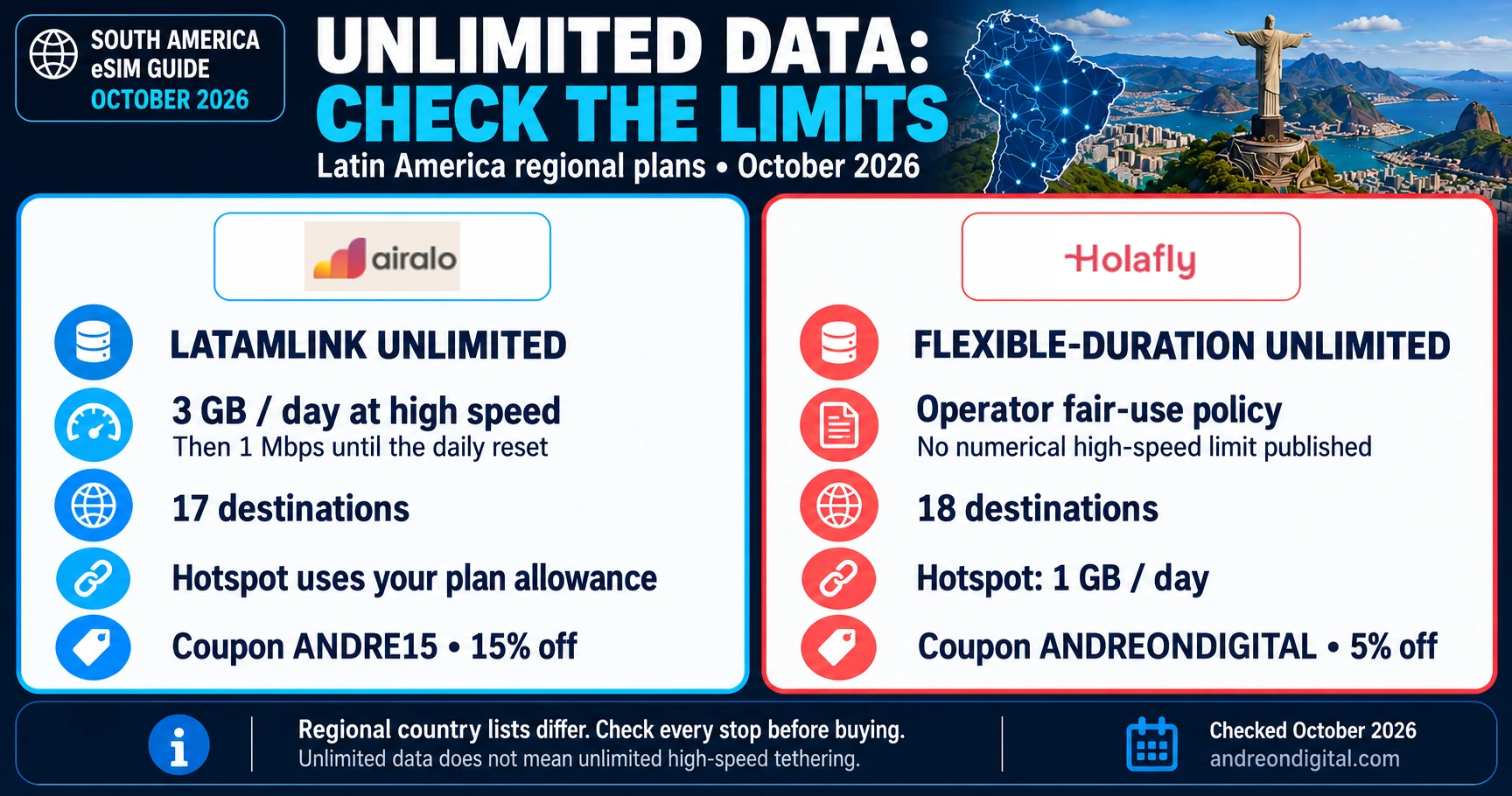
Unlimited data does not mean unlimited high-speed tethering. There are two separate questions: how much high-speed data you can use on the phone, and how much you can share with a laptop or another traveler.
| Regional option | Example USD | Phone high-speed limit | Hotspot |
|---|---|---|---|
| Airalo unlimited | 7 days $39; 30 days $97 | 3 GB per 24 hours, then 1 Mbps | Uses the same plan; fair use applies |
| Holafly unlimited | 7 days $40.90; 30 days $99.90 | Operator fair use; numerical daily quota not published | 1 GB per day |
| Jetpac unlimited | 7 days $62; 30 days $265.50 | 3 GB per 24 hours, then up to 1 Mbps | Sharing allowed; the same speed limit applies |
| Fixed-data packages | See the price tables | Purchased allowance and validity apply | Sharing consumes that allowance |
Airalo’s unlimited policy describes a 24-hour period starting at activation, rather than a reset at local midnight. Its regional package provides 3 GB at available normal network speed, then 1 Mbps for the rest of that period. At a reduced speed, demanding uploads and video calls may be difficult even though the connection remains available.
Holafly’s Latin America product states a 1 GB/day sharing allowance. Its phone data remains subject to operator fair use without a published numerical daily high-speed threshold on the product page. That uncertainty matters if you plan to use it as your only work connection. Jetpac also publishes a 3 GB/24-hour high-speed allowance for its unlimited option before a reduction to up to 1 Mbps.
South America by Region: Coverage Overview
Which South American countries are included?
The following matrix refers to the specific regional products reviewed here. Yes means the destination appears in that package’s list, not guaranteed coverage throughout the country. French Guiana is listed separately as a French territory in South America. None of these five regional packages includes Guyana, Suriname or French Guiana in the catalogs checked.
| Destination | Airalo | Nomad eSIM | Holafly | Saily | Jetpac |
|---|---|---|---|---|---|
| Argentina | Yes | Yes | Yes | Yes | Yes |
| Bolivia | Yes | Yes | Yes | Yes | No |
| Brazil | Yes | Yes | Yes | Yes | Yes |
| Chile | Yes | Yes | Yes | Yes | Yes |
| Colombia | Yes | Yes | Yes | Yes | Yes |
| Ecuador | Yes | Yes | Yes | Yes | Yes |
| Paraguay | Yes | Yes | Yes | Yes | Yes |
| Peru | Yes | Yes | Yes | Yes | Yes |
| Uruguay | Yes | Yes | Yes | Yes | Yes |
| Venezuela | Yes | Yes | No | No | No |
| Guyana | No | No | No | No | No |
| Suriname | No | No | No | No | No |
| French Guiana (territory) | No | No | No | No | No |
This is why the headline number can mislead. Holafly lists 18 destinations across Latin America, but nine are South American countries. Nomad eSIM and Airalo list 17, including ten in South America. Saily lists 12 with nine in South America; Jetpac lists 15 with eight. Mexico, Costa Rica and Caribbean destinations do not increase a package’s South American coverage. If you are visiting offshore islands such as the Galápagos, ask about the exact islands and product; an Ecuador entry alone is not proof of island coverage.
For Bolivia: Airalo, Nomad eSIM, Holafly and Saily include it; Jetpac’s regional package does not. Nomad eSIM’s regional Bolivia entry currently specifies Tigo 3G, so do not buy it on an assumption of continent-wide 5G. For Venezuela: Airalo and Nomad eSIM include it; the other three packages do not. For the Guianas, verify a separate destination-specific product before paying.
The networks depend on the country and the package
| Country example | Nomad eSIM regional | Holafly regional | Jetpac regional |
|---|---|---|---|
| Brazil | Claro LTE/4G | Claro, TIM, Vivo | Claro |
| Argentina | Claro LTE/4G | Telefónica | Claro, Personal |
| Peru | Claro LTE/4G | Movistar, Claro | Claro |
| Bolivia | Tigo 3G | Tigo | Not included |
| Colombia | Tigo LTE/4G | Telefónica | Tigo, Claro |
| Venezuela | Digitel LTE/4G | Not included | Not included |
Nomad eSIM publishes Claro for most of its South American regional entries, Tigo for Bolivia, Colombia and Paraguay, and Digitel for Venezuela. Holafly lists Telefónica in Argentina, Chile and Colombia, with country-specific alternatives elsewhere. Jetpac also publishes country-specific operators. Those details are more useful than a single continent-wide network label.
Airalo’s country membership was confirmed, but we could not confirm its regional operator names in the current product view. Saily does not publish local operator names on its regional page. I have left those entries unconfirmed rather than borrowing networks from a different country package. Multiple listed operators also do not prove that a phone will connect to all of them, or switch instantly to the fastest one.
Cities, the Amazon, the Andes and Patagonia
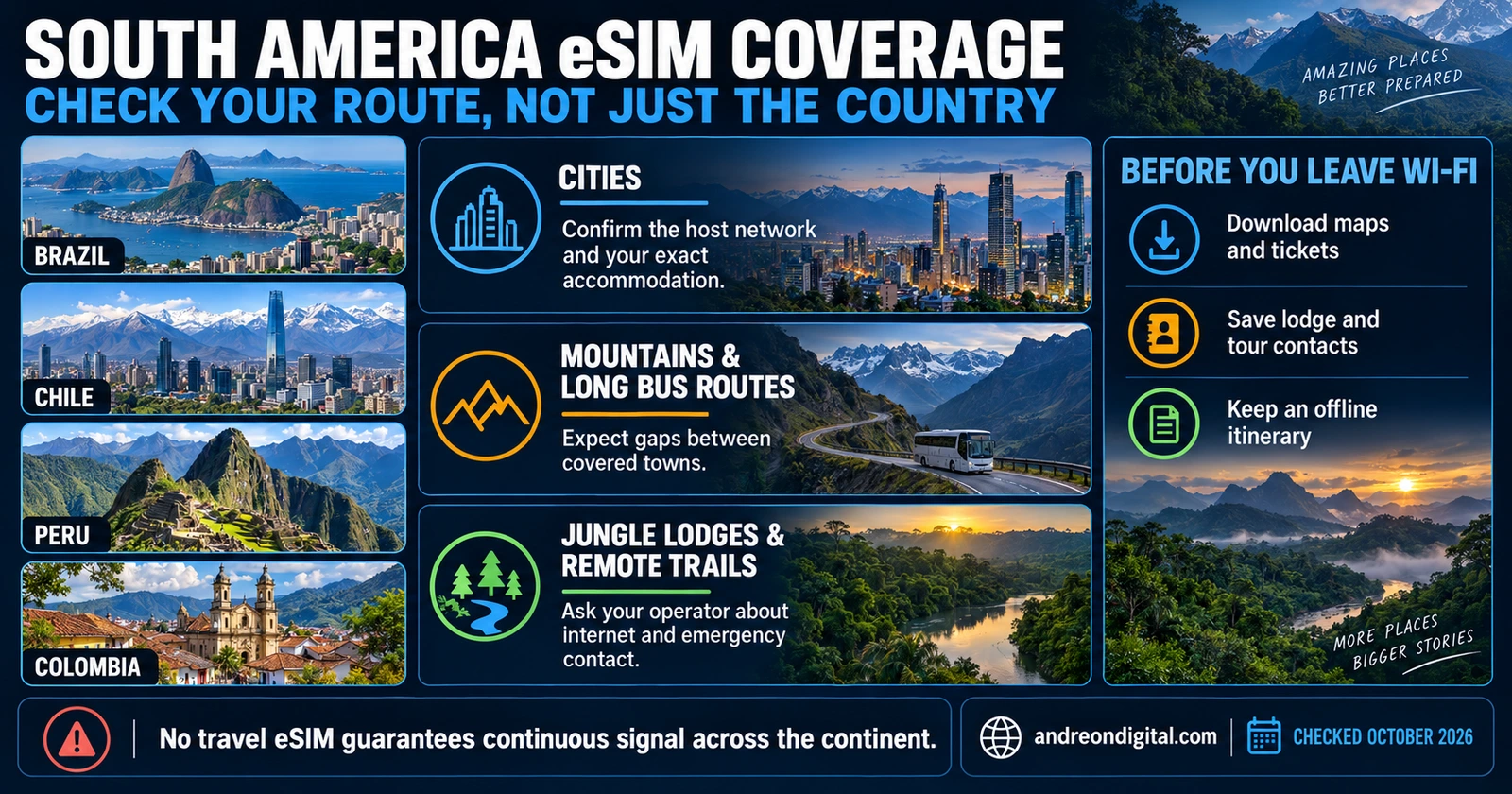
São Paulo, Buenos Aires, Lima, Bogotá and Santiago are places where you can reasonably plan to use mobile data, while still checking the relevant operator and accommodation location. Amazon cities such as Manaus and Iquitos must not be labeled as entirely offline. The connection available in a city tells you little about a river journey or a remote lodge several hours away.
In Patagonia and the Andes, mountains, distance from towers and the exact road or trail matter more than a regional marketing map. A plan including Chile and Argentina can cover a border itinerary without guaranteeing signal on a trekking route. The same distinction applies to Peru: country inclusion is not a promise of continuous reception on every approach to Machu Picchu.
Best eSIM for South America 2026: Travel Tips
- Watch both the balance and the expiry date. A 20 GB package can expire with data left; a 30-day package can run out of data early. Check the app before a long bus journey or border day.
- Use Wi-Fi for large transfers. Cloud photos, app updates and laptop syncing can consume a fixed allowance quickly. Turn off automatic mobile-data backups if you do not need them.
- Keep WhatsApp on your existing number. A travel data line can provide internet while WhatsApp keeps its registered number. That does not change your home operator’s call, SMS or roaming charges.
- Check the exact border connection. Confirm that the next country is included, select the travel eSIM for data, follow its roaming and APN instructions, and allow it to register on the new network. Contact support before deleting a profile.
- Separate app benefits from general internet. Jetpac’s qualified essential-app access after the data allowance runs out is not unlimited browsing, unlimited WhatsApp calls or proof that an expired package remains usable.
- Budget for a different product outside the region. The reviewed packages do not include mainland Spain, Portugal, the United States or Canada. Do not assume a shared language means shared coverage.
If you add Central America or the Caribbean, read the complete regional list again. Holafly includes Belize and Puerto Rico in this product, while Jetpac includes the Dominican Republic and omits Panama. Saily’s extra destinations are Costa Rica, El Salvador and Mexico. Use our Costa Rica guide and international eSIM comparison for a broader itinerary.
FAQ: Best eSIM for South America 2026
What is the best eSIM for South America 2026?
Should I buy a regional eSIM or country plans for South America?
Does an eSIM work in the Amazon?
Is Nomad eSIM or Airalo cheaper for South America?
Which South America eSIM covers the most countries?
Can I use a South America eSIM in Spain or Portugal?
Does the data allowance reset when I cross a border?
Which regional eSIM includes Bolivia and Venezuela?
Can I share a South America eSIM with a laptop?
Do these eSIM plans include a local phone number?
Will a regional eSIM work throughout Patagonia?
When should I install and activate the eSIM?
Final Verdict: Best eSIM for South America 2026
Choose for the route you will actually travel
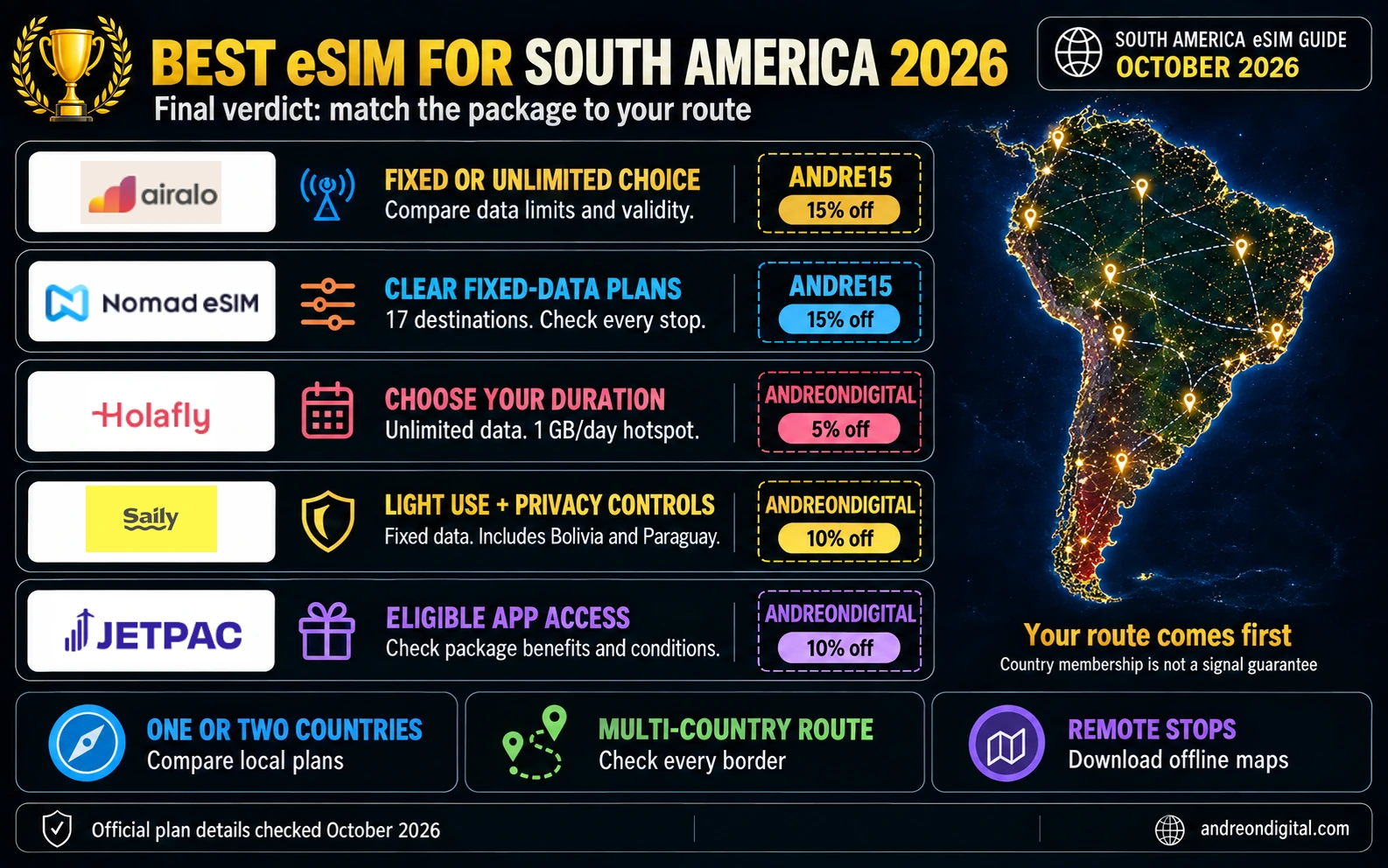
Start with Airalo if you want to compare fixed and unlimited data within one provider. Its $36 regional 10 GB/30-day package has the lowest price at that allowance among the five plans reviewed, and its ten-country South American list includes Bolivia and Venezuela. That makes it my first comparison point, provided the exact package fits your trip.
Nomad eSIM is my alternative for straightforward fixed data and visible network information. The $39/10 GB package is not the cheapest in this comparison, so I would choose it for its package fit, the disclosed country-network list and familiarity with its setup, rather than pretend the $3 price difference is an advantage. Check the Bolivia 3G entry and arrange any eligible add-on before the original package is depleted.
Holafly makes most sense when you know your trip length and want phone data without a fixed total allowance. You can choose the duration instead of fitting your journey into a standard 30-day package. Its 1 GB/day sharing limit and operator fair use make it less suitable for someone who expects unlimited laptop data. Compare Airalo’s published 3 GB/24-hour high-speed model before deciding which kind of unlimited service suits you.
Saily is worth considering for light use and its built-in data-connection controls. The regional 1 GB/7-day plan is $7.99, but its larger fixed-data packages cost more than the closest alternatives here. Jetpac is worth a closer look when its eight-country footprint fits and the qualified essential-app benefit matters to you. It is not the regional option for Bolivia or Venezuela, even if a different Jetpac country product exists.
For one country, I would price the country package first. For an uncertain multi-country route, I would give real value to a shared allowance, while checking every planned stop and both the data and validity limits. A well-chosen package should make the trip easier. It should not require you to discover its missing country at the border.
Sources and update method
For this October 2026 update, we checked the official Airalo, Nomad eSIM, Holafly, Saily and Jetpac regional catalogs. We compared advertised USD prices, durations, actual destination lists, available operator details, hotspot and fair-use conditions. Calculations are identified in the text. We did not measure regional network speeds or test these coupons in a paid checkout.
The shortlist remains at five providers to keep the comparison useful. Other regional products can suit a narrower route, but they need the same scrutiny. For example, the current Ubigi Best LATAM product omits Peru, so it is not interchangeable with a plan for a classic Peru-inclusive circuit. No provider name replaces checking the exact package.
Keep Reading
South America by Country
- Best eSIM for Brazil 2026
- Best eSIM for Argentina 2026
- Best eSIM for Chile 2026
- Best eSIM for Peru 2026
- Best eSIM for Colombia 2026
- Best eSIM for Bolivia 2026