
Most Japan eSIM guides test Tokyo, say everything works, and miss the one thing travelers actually notice first: your signal disappears on the Shinkansen. And they miss the other thing that surprises every first-time Japan visitor — how much data you actually use when Google Translate is pointed at every menu, every sign, and every ticket machine, all day long.
Japan is not a normal eSIM destination. It is the world’s most data-intensive country for tourists — and the eSIM decision matters more here than almost anywhere else. This guide covers what actually works, where it fails, and which provider matches your specific Japan trip. If you are searching for the best eSIM for Japan 2026, the real decision is not just price — it is unlimited data, hotspot support, app reliability, and how each provider behaves across Tokyo, Kyoto, Osaka, and Shinkansen routes. Updated August 2026 with verified pricing from official provider sites.
⚡ Best eSIM for Japan 2026 — Quick Answer · Prices USD · August 2026
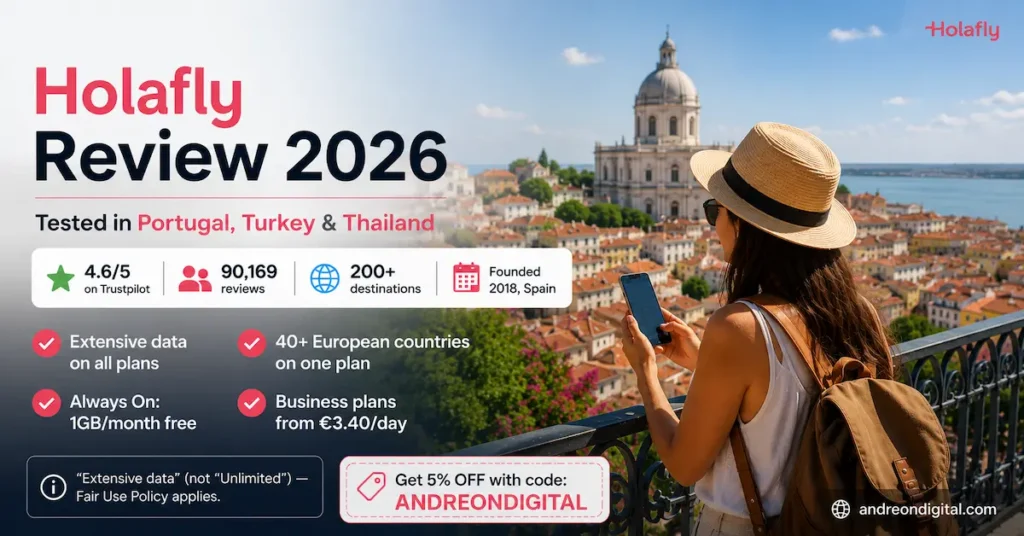
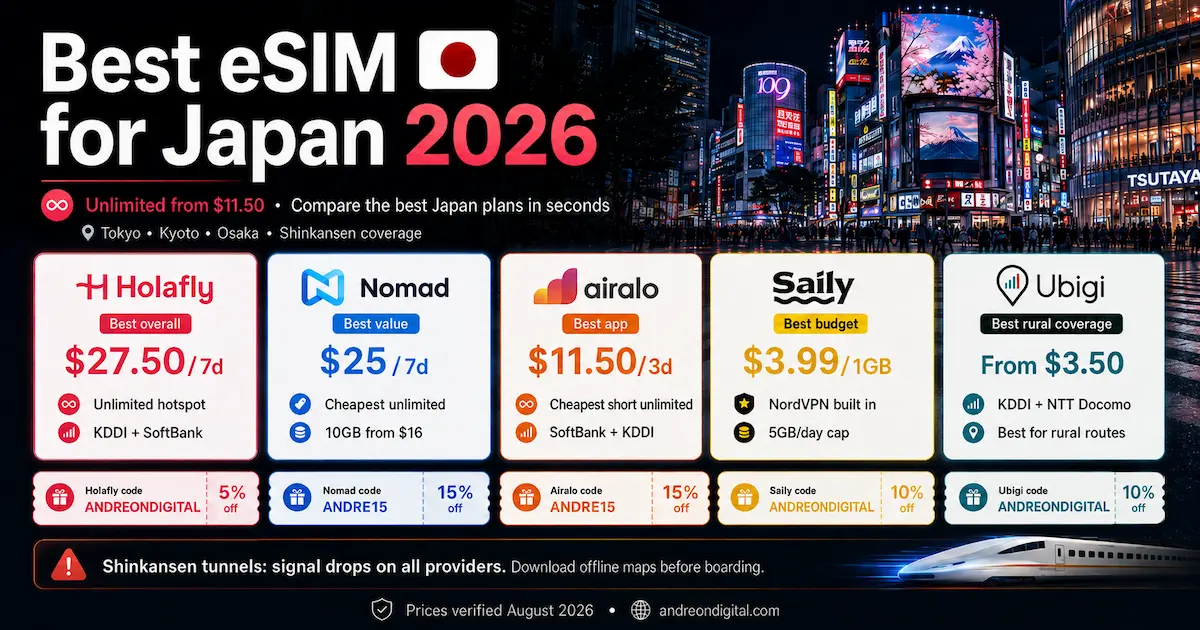
🥇 Holafly — Best overall · unlimited hotspot · $27.50/7d · KDDI+SoftBank · 105,198 reviews
🥈 Nomad — Cheapest unlimited $25/7d · best fixed $16/10GB · KDDI au+SoftBank · 4G/5G
🥉 Airalo — Best app · unlimited from $11.50/3d · SoftBank+KDDI · top-up anytime
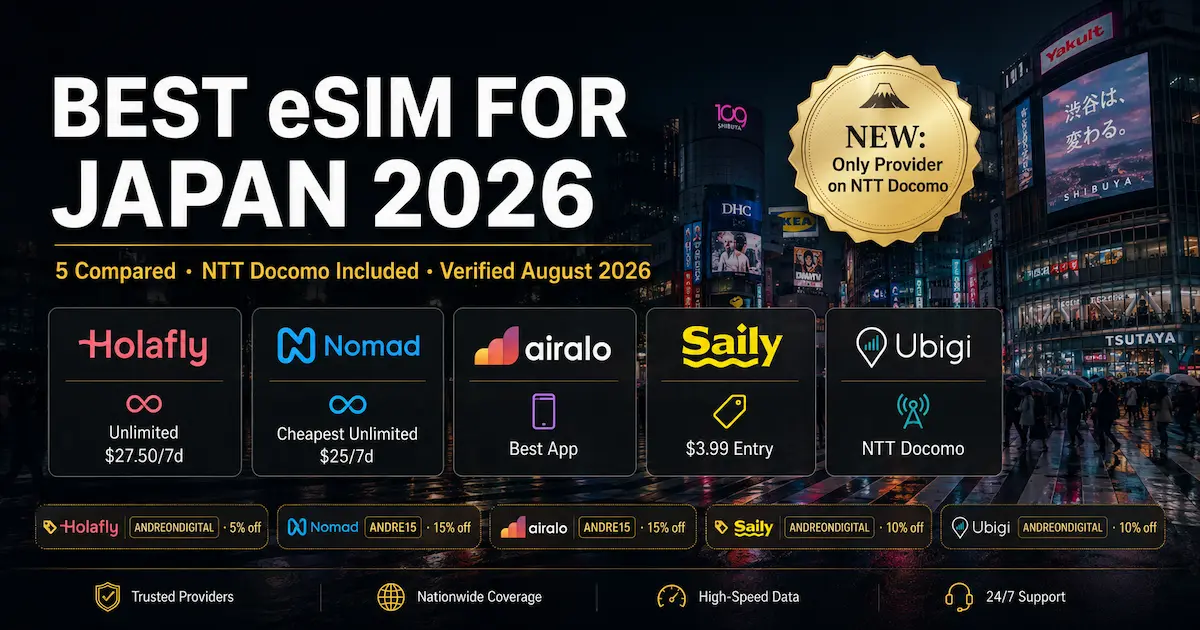
🗻 Ubigi — Only provider on NTT Docomo · from $3.50 · best for rural/tunnel routes
🔒 Saily — Best budget entry $3.99/1GB · NordVPN built-in · 5GB/day unlimited cap
⚠️ Shinkansen tunnels = zero signal on every provider — that’s physics, not the eSIM
Why Japan Is Different From Every Other eSIM Destination
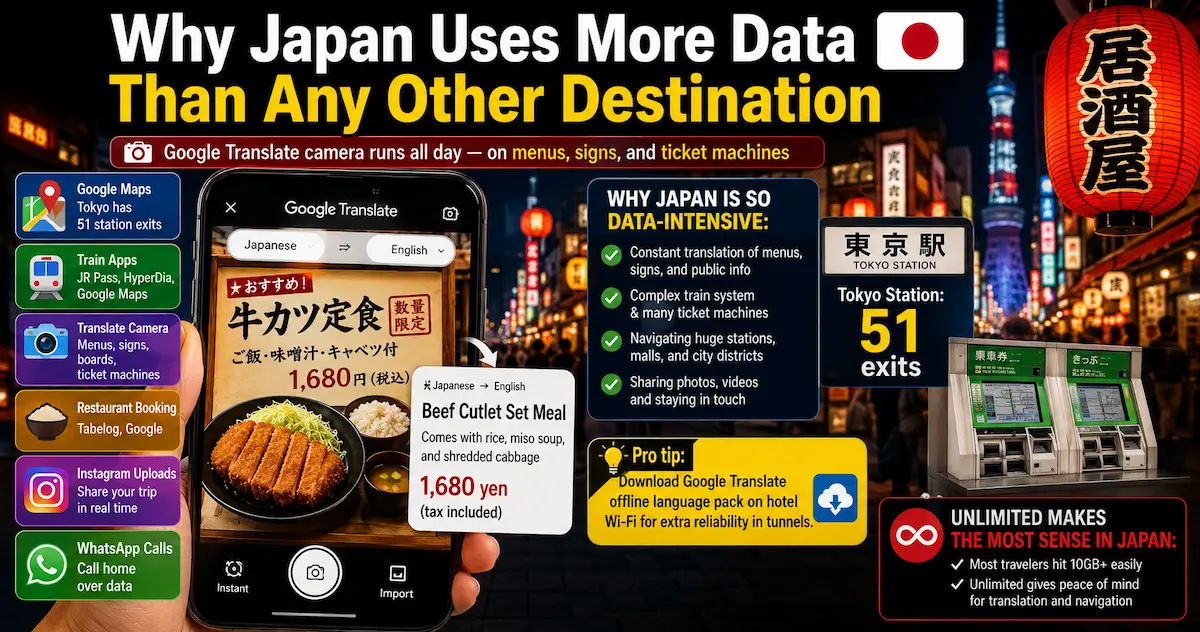
In most countries, your eSIM is for Instagram and Maps. In Japan, it is how you survive the first hour. Google Translate camera pointed at a ramen shop’s handwritten daily menu. Google Maps calculating which of Tokyo station’s 51 exits puts you closest to the right subway line. A booking app that only works in Japanese. A route change when the wrong Shinkansen departs.
All of this runs on data — simultaneously, all day, every day. The travelers who choose a 5GB plan for Japan and the travelers who choose unlimited have very different experiences by day three. Japan is genuinely the one destination where the eSIM choice has a direct impact on the quality of your trip. That is why the best eSIM for Japan 2026 should match your real daily use, not just the cheapest headline price.
🚅 The Shinkansen Reality — Read Before You Board
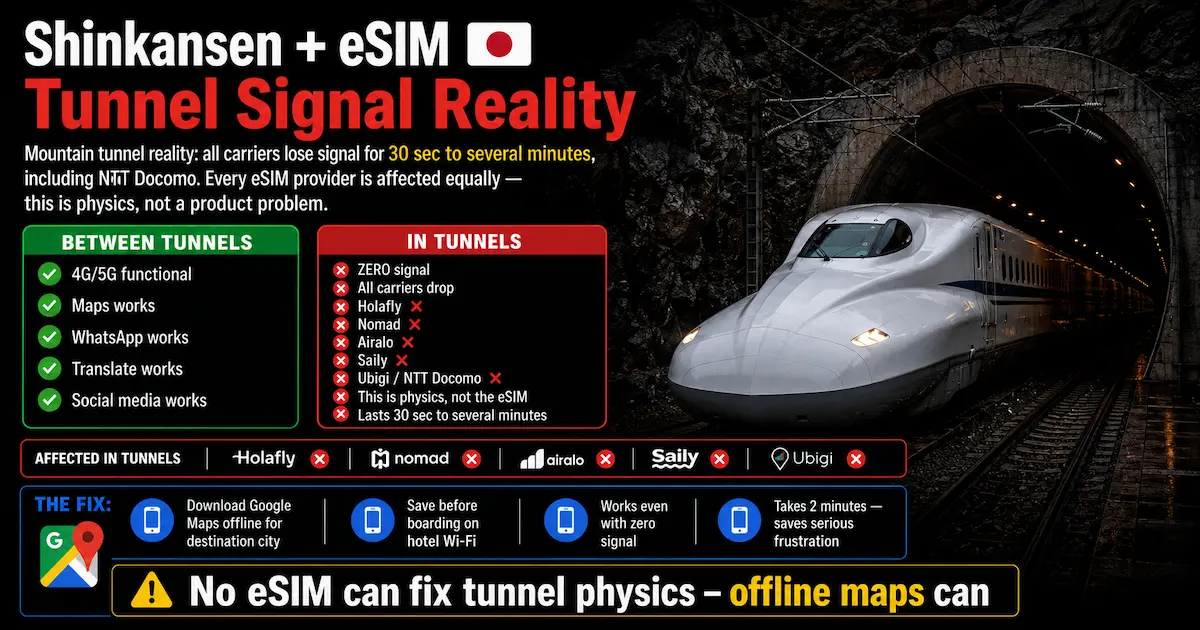
The Shinkansen bullet train passes through hundreds of mountain tunnels where signal disappears completely — on every carrier, every provider, every eSIM. These blackouts last from 30 seconds to several minutes on the Tokyo–Osaka route.
This is not an eSIM problem. It is physics. NTT Docomo, SoftBank, KDDI — all drop in the same tunnels. No provider can fix this. What you can do: download Google Maps offline for your destination city before boarding. Signal returns fully between tunnel sections.
Best eSIM for Japan 2026 Prices — All Plans Compared
All prices USD. Verified August 2026 at official provider sites. Japan has no regional plan benefits — local Japan plans are the most cost-effective for Japan-only visits. This is why a best eSIM for Japan 2026 comparison should focus on local Japan pricing first, then regional Asia plans only if your trip continues to South Korea, Taiwan, Thailand, or other nearby countries.
| Provider | Plan | Price (USD) | Network | Notes |
|---|---|---|---|---|
| Holafly | 3d unlimited | $11.90 | KDDI+SoftBank | Long weekend Tokyo |
| Holafly | 5d unlimited | $20.50 | KDDI+SoftBank | Short trip |
| Holafly | 7d unlimited 🔥 | $27.50 | KDDI+SoftBank | ⭐ Standard Japan trip |
| Holafly | 10d unlimited | $36.50 | KDDI+SoftBank | Extended visit |
| Holafly | 15d unlimited | $50.50 | KDDI+SoftBank | 2-week trip |
| Holafly | 30d unlimited | $73.90 | KDDI+SoftBank | Long stay |
| Holafly | Global sub unlimited | $64.90/mo | Global | Multi-country subscription |
| Nomad | 1GB / 7d | $4.00 | KDDI au+SoftBank | Budget short stay |
| Nomad | 3GB / 30d | $7.00 | KDDI au+SoftBank | Very light use |
| Nomad | 5GB / 30d | $10.00 | KDDI au+SoftBank | Light 1-week use |
| Nomad | 10GB / 30d 🔥 | $16.00 | KDDI au+SoftBank | ⭐ Best fixed value |
| Nomad | 20GB / 30d | $23.00 | KDDI au+SoftBank | Heavy fixed use |
| Nomad | 50GB / 30d | $35.00 | KDDI au+SoftBank | Long stay fixed |
| Nomad | Unlim / 7d 🔥 | $25.00 | KDDI au+SoftBank | ⭐ Cheapest unlimited · 2GB/day 4G/5G |
| Nomad | Unlim / 3d | $11.00 | KDDI au+SoftBank | Short unlimited |
| Nomad | Unlim / 14d | $41.00 | KDDI au+SoftBank | 2-week unlimited |
| Nomad | Unlim / 21d | $49.00 | KDDI au+SoftBank | 3-week unlimited |
| Airalo | 1GB / 3d | $4.00 | SoftBank+KDDI | Very short |
| Airalo | 3GB / 7d | $8.00 | SoftBank+KDDI | Budget week |
| Airalo | 5GB / 7d | $10.00 | SoftBank+KDDI | Standard week fixed |
| Airalo | 10GB / 30d | $18.00 | SoftBank+KDDI | Standard visit |
| Airalo | 20GB / 30d | $25.00 | SoftBank+KDDI | Heavy use |
| Airalo | Unlim / 3d 🆕🔥 | $11.50 | SoftBank+KDDI | ⭐ Cheapest short unlimited |
| Airalo | Unlim / 5d | $17.00 | SoftBank+KDDI | New August 2026 |
| Airalo | Unlim / 7d | $27.00 | SoftBank+KDDI | New August 2026 |
| Airalo | Unlim / 10d | $34.50 | SoftBank+KDDI | New August 2026 |
| Airalo | Unlim / 15d | $48.00 | SoftBank+KDDI | New August 2026 |
| Airalo | Unlim / 30d | $69.00 | SoftBank+KDDI | New August 2026 |
| Saily | 1GB / 7d | $3.99 🔥 | Local networks | Cheapest entry + NordVPN |
| Saily | 3GB / 30d | $7.99 | Local networks | Light trip |
| Saily | 5GB / 30d | $10.99 | Local networks | Standard short |
| Saily | 10GB / 30d | $17.99 | Local networks | Standard + NordVPN |
| Saily | 20GB / 30d | $24.99 | Local networks | Heavy use |
| Saily | Unlim / 5d 🆕 | $18.99 | Local networks | ⭐ Cheapest 5d unlimited · 5GB/day |
| Saily | Unlim / 7d | $26.99 | Local networks | 5GB/day cap |
| Saily | Unlim / 10d | $34.99 | Local networks | 5GB/day cap |
| Saily | Unlim / 15d | $48.99 | Local networks | 5GB/day cap · lounge pass |
| Saily | Unlim / 20d | $59.99 | Local networks | 5GB/day cap · lounge pass |
| Saily | Unlim / 25d | $65.99 | Local networks | 5GB/day cap · lounge pass |
| Saily | Unlim / 30d | $71.99 | Local networks | 5GB/day cap · lounge pass worth $40 |
| Ubigi | 1GB / 3d | $3.50 🔥 | KDDI + NTT Docomo | ⭐ Cheapest entry in this comparison |
| Ubigi | 1GB / 30d | $4.00 | KDDI + NTT Docomo | Longer validity, same 1GB |
| Ubigi | 3GB / 15d | $7.50 | KDDI + NTT Docomo | Short trip |
| Ubigi | 5GB / 15d | $10.00 | KDDI + NTT Docomo | Standard short |
| Ubigi | 10GB / 7d | $14.00 | KDDI + NTT Docomo | Heavy short trip |
| Ubigi | 10GB / 30d 🔥 | $16.50 | KDDI + NTT Docomo | ⭐ Matches Nomad’s best fixed price |
| Ubigi | Unlim / 8d | $25.00 | KDDI + NTT Docomo | Only Docomo unlimited option |
| Ubigi | 25GB / 30d | $32.00 | KDDI + NTT Docomo | Best Seller per Ubigi |
| Ubigi | Unlim / 15d 🔥 | $39.00 | KDDI + NTT Docomo | ⭐ Best Seller · rural/tunnel coverage |
| Ubigi | 50GB / 30d | $55.00 | KDDI + NTT Docomo | Heavy use |
| Ubigi | Unlim / 30d | $65.00 | KDDI + NTT Docomo | Long stay, no daily cap disclosed |
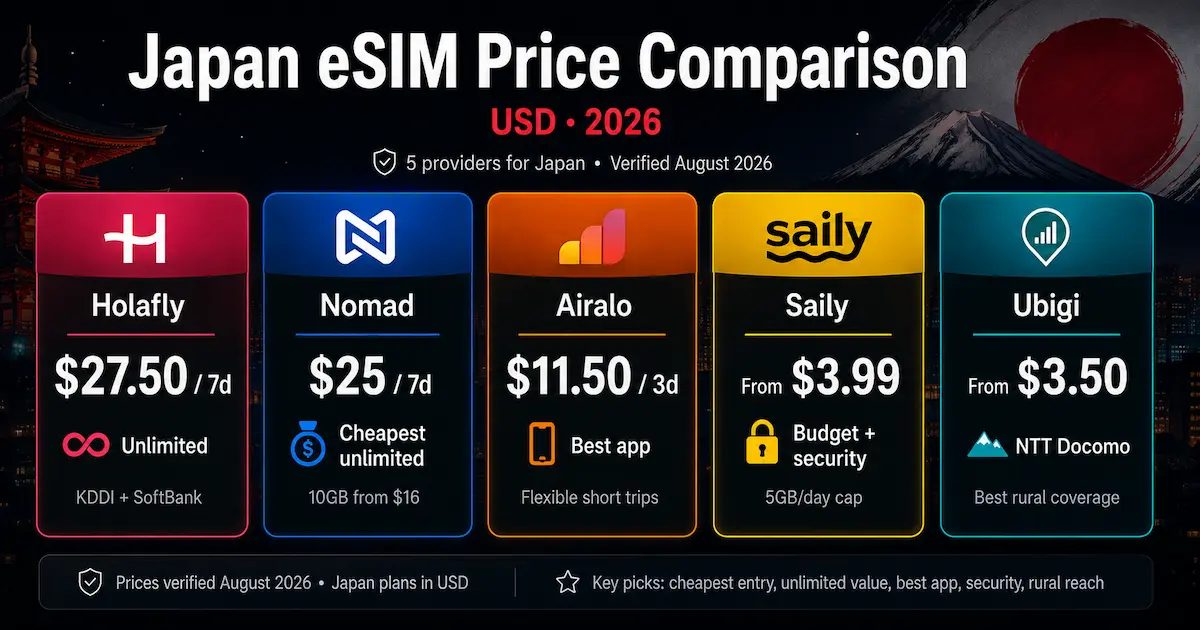
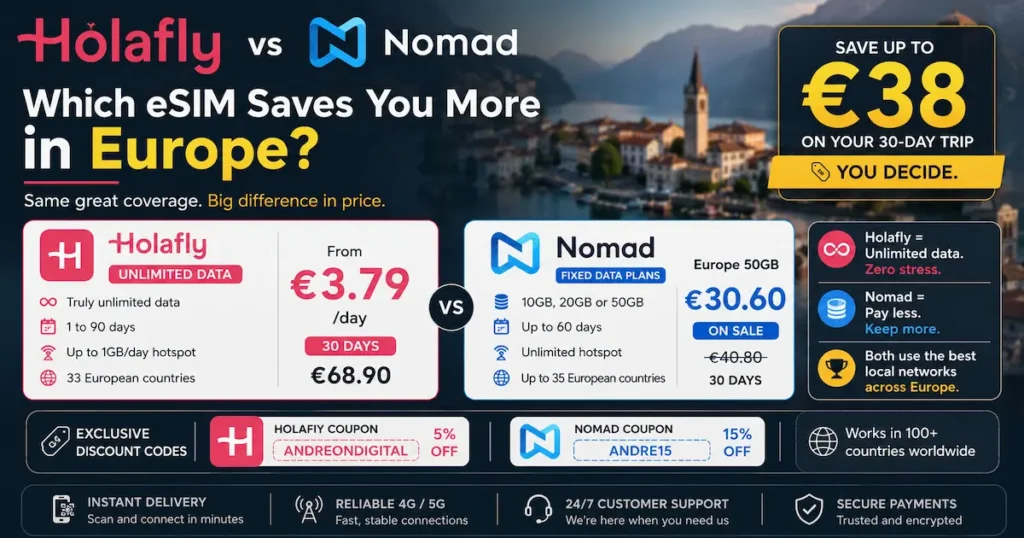
Holafly is the top pick for Japan in 2026. Not because it’s the cheapest — Nomad’s unlimited is $4.30 less per week — but because Japan demands a level of data freedom that fixed plans and capped unlimited plans rarely deliver comfortably. With Holafly, Google Translate camera runs all day. Maps never pauses. Instagram uploads happen when you want. You never open your data counter on a trip where you’re already thinking about 50 other things.
Personally tested in Thailand, Turkey, and Portugal — consistent unlimited performance across different travel environments. These personal tests were outside Japan, so the Japan-specific network and pricing details in this guide are based on current provider information and coverage data. Based on verified coverage data and 105,198 Trustpilot reviews for Japan specifically. Full review: Holafly Review 2026. For many travelers comparing the best eSIM for Japan 2026, Holafly wins when simplicity, unlimited hotspot, and zero data anxiety matter more than saving a few dollars.
Holafly Japan eSIM Setup + Unlimited Hotspot Explained
For travelers landing in Tokyo, Osaka, Kyoto, or using the Shinkansen across Japan, Holafly is one of the most straightforward unlimited eSIM setups in 2026. The main advantage is simple: install before departure, activate on arrival, and use Google Maps, Translate camera, WhatsApp, hotspot, and train apps without checking your data counter all day.
The video below shows how the Holafly Japan eSIM works in practice, including the activation flow, installation process, and unlimited hotspot usage. This matters especially in Japan, where Google Maps, JR train navigation, Translate camera, and restaurant booking apps can use far more mobile data than most travelers expect.
Japan is one of the few destinations where unlimited data can genuinely change the travel experience. Tokyo station alone has dozens of exits, train changes happen constantly, and Translate camera usage often runs throughout the day. For remote workers, content creators, couples sharing hotspot, or travelers doing Tokyo, Kyoto, Osaka, and Hiroshima routes, Holafly’s unlimited hotspot support becomes a strong practical advantage over smaller fixed-data plans.
Holafly Japan Pricing (August 2026)
| Plan | Price (USD) | Per day |
|---|---|---|
| 3 days | $11.90 | $3.97 |
| 5 days | $20.50 | $4.10 |
| 7 days 🔥 | $27.50 | $3.93 ⭐ |
| 10 days | $36.50 | $3.65 |
| 15 days | $50.50 | $3.37 |
| 30 days | $73.90 | $2.46 |
| Global sub | $64.90/mo | — |
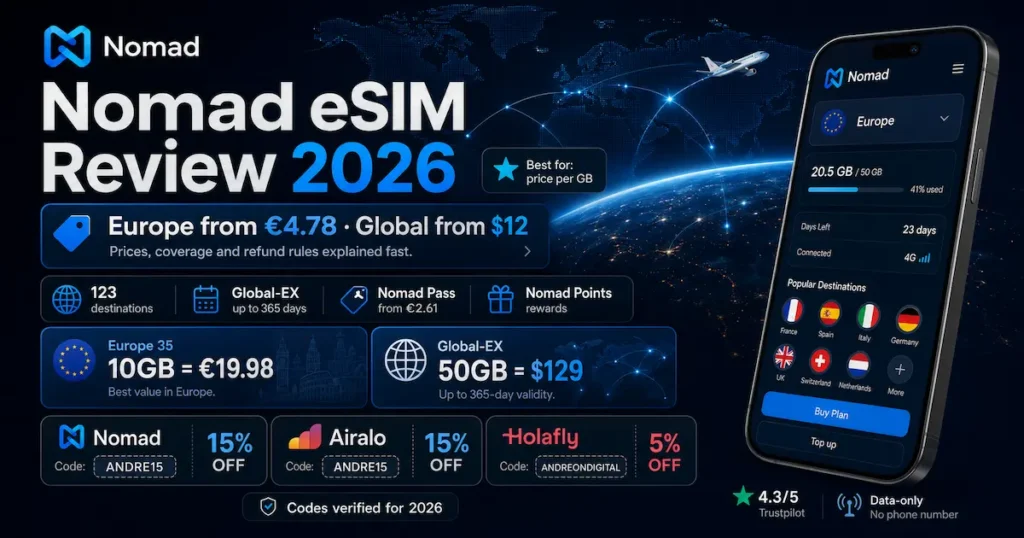
Nomad offers the best fixed-data price per GB for Japan and the cheapest 7-day unlimited in this comparison at $23 — $4.30 less than Holafly and $4 less than Airalo’s 7-day. For budget travelers who want unlimited without paying the daily rate, Nomad’s Unlim/7d at $23 is the clearest value decision in this comparison.
Important update August 2026: Nomad Japan now supports 4G/5G speeds on both unlimited and fixed plans on KDDI au and SoftBank networks. The previous limitation to 4G-only no longer applies to unlimited plans. Fixed plans remain 4G. Personally tested in Portugal — consistent performance. Full review: Nomad eSIM Review 2026.
Nomad Japan eSIM Review + Cheapest Unlimited Plan in 2026
Nomad became one of the strongest Japan eSIM value options in 2026 because it combines the cheapest 7-day unlimited Japan plan with some of the best fixed-data pricing in the market. For travelers who mainly use Google Maps, social media, messaging apps, Translate camera, and occasional hotspot, Nomad offers one of the best price-to-performance ratios for Japan travel.
The video below explains how Nomad Japan eSIM installation works, how activation behaves in real travel conditions, and what travelers should realistically expect from the unlimited data plans.
One major 2026 update for Japan travelers is that Nomad now supports 4G/5G connectivity on unlimited plans using KDDI au and SoftBank partner networks. Previous generations of Japan eSIM plans were more limited, but the newer setup performs better across Tokyo, Kyoto, Osaka, and most major Shinkansen routes between cities. For budget travelers, backpackers, and anyone comparing unlimited pricing carefully, Nomad’s $23 unlimited plan remains one of the strongest value picks in Japan.
Nomad Japan Pricing (August 2026)
Fixed plans (no daily cap):
| Plan | Price (USD) | Validity | $/GB |
|---|---|---|---|
| 1GB | $4.00 | 7 days | $4.00 |
| 3GB | $7.00 | 30 days | $2.33 |
| 5GB | $10.00 | 30 days | $2.00 |
| 10GB 🔥 | $16.00 | 30 days | $1.60 ⭐ |
| 20GB | $23.00 | 30 days | $1.15 |
| 50GB | $35.00 | 30 days | $0.70 |
Unlimited plans (2GB/day 4G/5G → 1Mbps after):
| Plan | Price (USD) |
|---|---|
| 3 days | $11.00 |
| 7 days 🔥 | $25.00 ⭐ Cheapest unlimited |
| 14 days | $41.00 |
| 21 days | $49.00 |
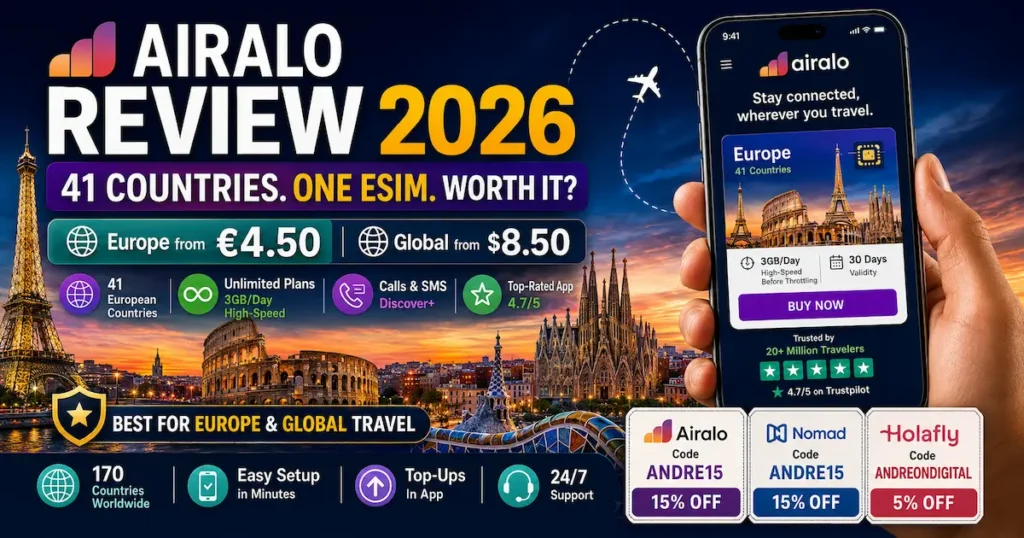
Airalo added unlimited plans for Japan in 2026 — the Unlim/3d at $11.50 is now the cheapest short unlimited in this comparison, and the 7-day at $27.00 is marginally cheaper than Holafly’s $27.50. What makes Airalo the right pick for some travelers isn’t just price — it’s the combination of best-in-class app, in-app top-ups without reinstalling, and flexibility to go fixed or unlimited on the same platform. Personally tested in Portugal, where the setup and mobile data experience were reliable. Full review: Airalo Review 2026.
Airalo Japan eSIM Setup and Unlimited Plans in 2026
Airalo is a practical Japan travel eSIM for travelers who want a polished app, easy top-ups, and the choice between fixed data and unlimited plans. In Tokyo, Kyoto, and Osaka, that flexibility is useful because Maps, Translate camera, train apps, and social media can make daily data usage difficult to predict.
The video below shows the Airalo eSIM experience and helps explain the setup flow before a Japan trip. Installing the eSIM before departure means you can connect after landing and avoid relying on airport Wi-Fi while trying to navigate trains, hotel directions, or local apps.
For short Japan trips, Airalo stands out because its unlimited options start at three days. Travelers staying longer can also begin with fixed data and top up inside the app if usage grows. That makes Airalo especially useful for flexible Tokyo, Kyoto, Osaka, and Shinkansen itineraries.
Airalo Japan Pricing (August 2026)
Standard fixed plans (SoftBank primary + KDDI):
| Plan | Price (USD) | Validity |
|---|---|---|
| 1GB | $4.00 | 3 days |
| 3GB | $7.50 | 3 days |
| 3GB | $8.00 | 7 days |
| 5GB 🔥 | $10.00 | 7 days |
| 10GB | $17.00 | 7 days |
| 5GB | $10.50 | 15 days |
| 10GB | $17.50 | 15 days |
| 20GB | $24.00 | 15 days |
| 5GB | $11.00 | 30 days |
| 10GB | $18.00 | 30 days |
| 20GB | $25.00 | 30 days |
Unlimited plans — 🆕 new August 2026 (SoftBank+KDDI):
| Plan | Price (USD) | Notes |
|---|---|---|
| Unlim / 3d 🆕🔥 | $11.50 | ⭐ Cheapest short unlimited |
| Unlim / 5d | $17.00 | New August 2026 |
| Unlim / 7d | $27.00 | New August 2026 |
| Unlim / 10d | $34.50 | New August 2026 |
| Unlim / 15d | $48.00 | New August 2026 |
| Unlim / 30d | $69.00 | New August 2026 |
Saily’s Japan plans start at $3.99/1GB — the lowest fixed-data entry price in this comparison. The new Unlim/5d at $18.99 is the cheapest 5-day unlimited here. The built-in NordVPN ad blocker saves data passively — meaningful in Japan where news apps and social platforms preload background content. Full review: Saily eSIM Review 2026.
Saily Japan eSIM Setup, Security, and Data Plans in 2026
Saily is a strong budget Japan eSIM for travelers who want low entry pricing together with built-in security features. The service is especially relevant for visitors using public Wi-Fi, train stations, airports, cafés, and hotels while moving between Tokyo, Kyoto, Osaka, and other Japanese cities.
The video below shows how Saily works and gives travelers a clearer idea of the installation and activation process. Setting it up before the flight can make arrival in Japan easier because mobile data is ready for Maps, Translate camera, messaging, and train navigation as soon as the eSIM connects.
Saily also gives heavy users a clearly disclosed full-speed allowance on its unlimited plans. For travelers who want a budget option but still expect high daily usage, the combination of a 5GB daily high-speed allowance and built-in Nord Security features makes it a distinct choice in this Japan comparison.
Saily Japan Pricing (August 2026)
Fixed plans:
| Plan | Price (USD) | Validity |
|---|---|---|
| 1GB 🔥 | $3.99 | 7 days · Cheapest entry |
| 3GB | $7.99 | 30 days |
| 5GB | $10.99 | 30 days |
| 10GB | $17.99 | 30 days |
| 20GB | $24.99 | 30 days |
Unlimited plans (5GB/day full speed → 1Mbps after):
| Plan | Price (USD) |
|---|---|
| 5 days 🆕🔥 | $18.99 ⭐ Cheapest 5d unlimited |
| 10 days | $34.99 |
| 15 days | $48.99 |
| 20 days | $59.99 |
| 30 days | $71.99 |
Ubigi is the newest addition to this comparison, and it earns its place on a genuinely unique point: it’s the only provider here that connects to NTT Docomo, Japan’s largest network and the one with the strongest rural and mountain-tunnel coverage — the exact gap this guide flagged in the carrier section below for years. Entry pricing is also the lowest in this comparison at $3.50 for 1GB/3 days, and the 10GB/30d fixed plan at $16.50 essentially matches Nomad’s best fixed price. Full review: Ubigi Review 2026 covers the wider global catalog beyond Japan.
For travelers who want to check the provider’s Japan information directly, see the official Ubigi Japan page.
Ubigi Japan eSIM and NTT Docomo Coverage Explained
Ubigi is different from the other providers in this comparison because its Japan service includes access to NTT Docomo alongside KDDI. That can matter more outside the main Tokyo, Kyoto, and Osaka corridor, especially for Hokkaido, mountain areas, and routes where rural coverage becomes more important than app features.
The video below explains the Ubigi eSIM experience and helps travelers understand the setup before arriving in Japan. It is especially useful for travelers comparing network access rather than choosing only by price.
For a standard city trip, KDDI and SoftBank are already strong choices. Ubigi becomes more interesting when the itinerary includes Hokkaido, the Japanese Alps, smaller towns, or long rail routes. Its Docomo access gives it a specific coverage advantage that no other provider in this comparison offers.
Ubigi Japan Pricing (August 2026)
Fixed and monthly plans:
| Plan | Price (USD) | Validity |
|---|---|---|
| 1GB 🔥 | $3.50 | 3 days · Cheapest entry |
| 1GB | $4.00 | 30 days |
| 3GB | $7.50 | 15 days |
| 5GB/month | $8.00/mo | Monthly recurring |
| 5GB | $10.00 | 15 days |
| 10GB | $14.00 | 7 days |
| 10GB 🔥 | $16.50 | 30 days · Matches Nomad’s best price |
| 20GB/month | $18.00/mo | Monthly recurring |
| 25GB | $32.00 | 30 days · Best Seller |
| 50GB | $55.00 | 30 days |
Unlimited plans (daily cap not publicly disclosed):
| Plan | Price (USD) | Notes |
|---|---|---|
| 8 days | $25.00 | Only Docomo unlimited option here |
| 15 days 🔥 | $39.00 | ⭐ Best Seller per Ubigi |
| 30 days | $65.00 | Long stay, monthly sub also available at $45/mo |
Best eSIM for Japan 2026 by Trip Length
| Trip length | Best pick | Price | Why |
|---|---|---|---|
| 3 days (stopover) | Airalo Unlim/3d | $11.50 | Cheapest short unlimited in this comparison |
| 3 days budget | Nomad Unlim/3d | $11.00 | $0.50 cheaper than Airalo · 2GB/day cap |
| 5 days | Saily Unlim/5d | $18.99 | 5GB/day cap · cheapest 5d unlimited |
| 5 days alt | Holafly 5d | $20.50 | No disclosed cap · unlimited hotspot |
| 7 days (standard) | Nomad Unlim/7d 🔥 | $25.00 | Cheapest 7d unlimited · good for budget travelers |
| 7 days alt | Holafly 7d | $27.50 | No cap anxiety · unlimited hotspot |
| 8 days rural | Ubigi Unlim/8d | $25.00 | Only Docomo unlimited · best for Hokkaido/Alps routes |
| 14 days | Holafly 15d | $50.50 | Extended unlimited · no counting |
| 14 days budget | Nomad Unlim/14d | $41.00 | Cheapest 2-week unlimited · 2GB/day cap |
| 15 days rural | Ubigi Unlim/15d | $39.00 | Best Seller · Docomo network for rural routes |
| 30 days | Holafly 30d | $73.90 | Unlimited · major price drop from launch pricing |
| 30 days fixed | Nomad 50GB/30d | $35.00 | Best price/GB for long stays with Wi-Fi |
Japan Carrier Coverage — What Each Provider Uses
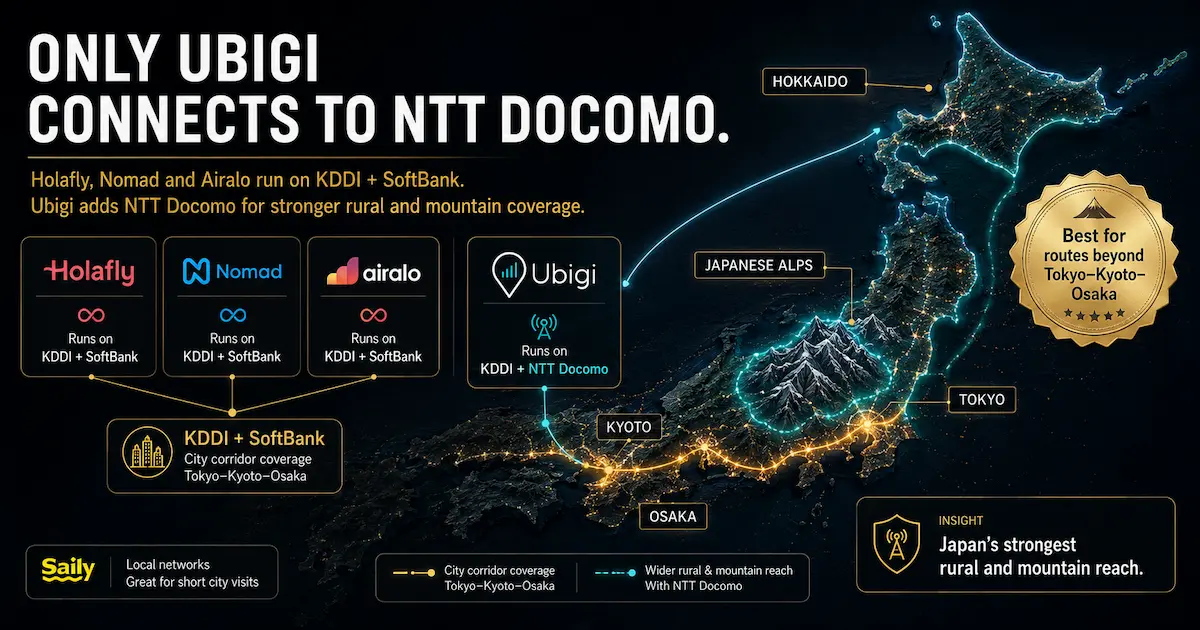
Japan has four major carriers: NTT Docomo (largest, best rural), SoftBank (strong urban), KDDI/au (strong nationwide), and Rakuten (budget, limited rural). Holafly, Nomad, and Airalo all use KDDI and SoftBank — Japan’s two strongest urban networks. Ubigi is the exception: it connects to KDDI plus NTT Docomo, closing the rural-coverage gap this guide flagged in earlier versions. For travelers choosing the best eSIM for Japan 2026, that network difference matters most when the itinerary extends into Hokkaido, the Japanese Alps, or other rural areas.
| Provider | Networks | Notes |
|---|---|---|
| Holafly | KDDI + SoftBank | Dual-carrier · unlimited hotspot |
| Nomad | KDDI au + SoftBank | Dual-carrier · 4G/5G unlimited · 4G fixed |
| Airalo | SoftBank + KDDI | SoftBank primary · KDDI as secondary |
| Saily | Local networks | Carrier not specified — verify at checkout |
| Ubigi | KDDI + NTT Docomo | ⭐ Only provider on Docomo — best rural/tunnel reach |
| Area | Coverage | Notes |
|---|---|---|
| Tokyo (23 wards) | ✅ Excellent 4G/5G | All providers · subway also covered |
| Osaka / Kyoto | ✅ Excellent 4G/5G | All providers |
| Nagoya / Hiroshima | ✅ Very good | All providers |
| Hokkaido (Sapporo) | ✅ Good 4G | All providers |
| Hokkaido (remote) | 🟠 Variable | Ubigi (Docomo) strongest fallback here |
| Okinawa | ✅ Good 4G | All providers |
| Mountain rural | ⚠️ Limited on KDDI/SoftBank | Ubigi’s Docomo access is the strongest option in this comparison |
| Shinkansen (open) | ✅ Good | All providers · between tunnels |
| Shinkansen (tunnels) | ❌ Zero | All carriers drop equally — physics, including Docomo |
Japan eSIM Tips — What Every Traveler Should Know
Choosing the best eSIM for Japan 2026 is only half the job: installing it before arrival, preparing offline maps, and planning for translation-heavy days can make the connection far more useful once the trip starts.
- Install before landing. At home on Wi-Fi — not at Narita, Haneda, or Kansai airport. Your eSIM connects automatically on arrival. No airport Wi-Fi hunt, no queue, no stress. See: Complete eSIM setup guide.
- Google Translate camera is Japan’s killer eSIM use case. Point your camera at Japanese text — menus, signs, ticket machines, restaurant boards — and get instant translation. It runs on live data, not Wi-Fi. Unlimited plans mean you use this constantly without monitoring. This one feature alone justifies unlimited for most travelers.
- Download offline maps before every Shinkansen. Google Maps offline for your destination city. Signal drops in mountain tunnels — 30 seconds to several minutes. Download on hotel Wi-Fi before boarding. Takes 2 minutes, saves serious frustration.
- IC Card for transit, eSIM for data. Japan’s trains, buses, and convenience stores run on IC cards — Suica (Tokyo) or Pasmo. Your eSIM handles internet. Your IC card handles movement and payments. iPhone users can add Suica to Apple Wallet. Android users: get a physical card at any station machine.
- 7-Eleven, Lawson, FamilyMart have free Wi-Fi everywhere. Use convenience store Wi-Fi for large offline map downloads. There’s rarely more than 200m between convenience stores in any Japanese city — the most reliable free Wi-Fi network in the world.
- Extending to South Korea, Taiwan, or Thailand? Japan-specific plans cover Japan only. For multi-country Asia circuits: Airalo Asia regional plan (from $4), Nomad Asia plan, or Holafly global subscription ($64.90/month). See Best eSIM for International Travel 2026.
FAQ — Best eSIM for Japan 2026
Final Verdict: Best eSIM for Japan 2026
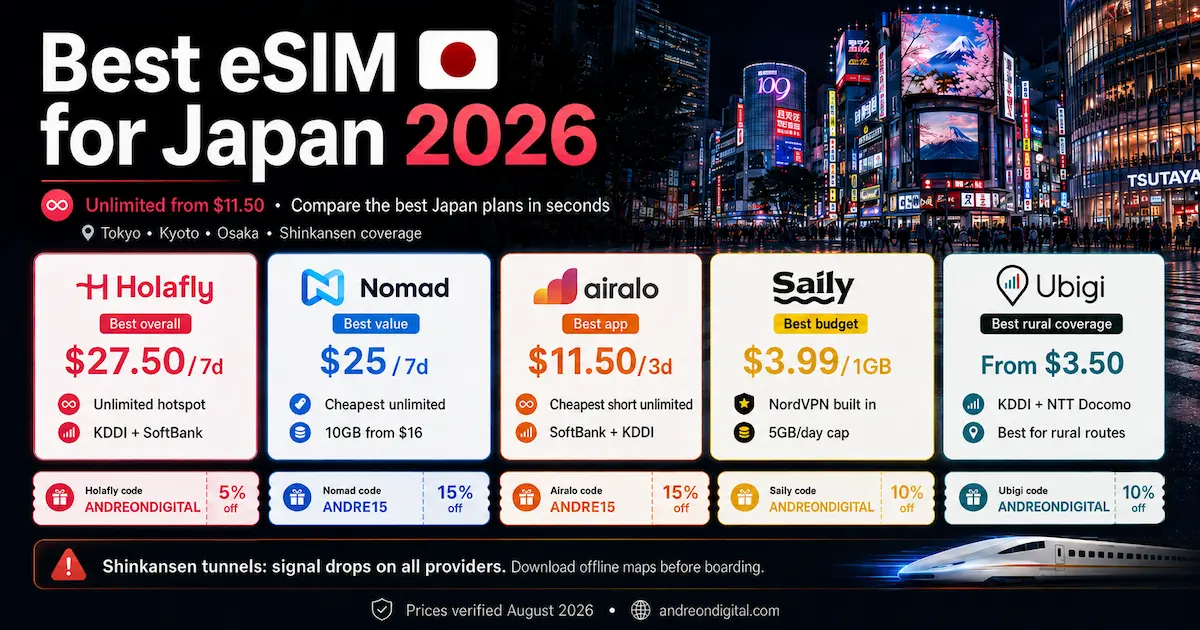
- 🥇 Holafly $27.50/7d: Best overall — unlimited hotspot, no cap anxiety, 105K reviews, KDDI+SoftBank
- 🥈 Nomad $25/7d unlimited: Cheapest unlimited · $16/10GB best fixed · KDDI au+SoftBank 4G/5G
- 🥉 Airalo $11.50/3d unlimited: Cheapest short unlimited · best app · top-up anytime · SoftBank+KDDI
- 🔒 Saily $3.99/1GB: Lowest entry cost · 5GB/day cap · NordVPN built-in free
- 🗻 Ubigi from $3.50: Only provider on NTT Docomo · best for Hokkaido, Alps, and rural routes
- ⚠️ One rule above all: Download Google Maps offline before every Shinkansen. Signal drops in tunnels on every provider equally — including Docomo. The best eSIM doesn’t fix this — offline maps do.
All prices USD. Verified at official provider sites — August 2026. Holafly personally tested in Thailand, Turkey, and Portugal. Nomad personally tested in Portugal. Airalo personally tested in Portugal. Ubigi assessed from official documentation. Prices change frequently — always confirm at checkout. This article contains affiliate links — commission may be earned at no extra cost.
Last verified: August 2026.
Keep Reading
Asia & Pacific
- Best eSIM for Thailand 2026
- Best eSIM for South Korea 2026
- Best eSIM for Bali 2026
- Best eSIM for Asia 2026