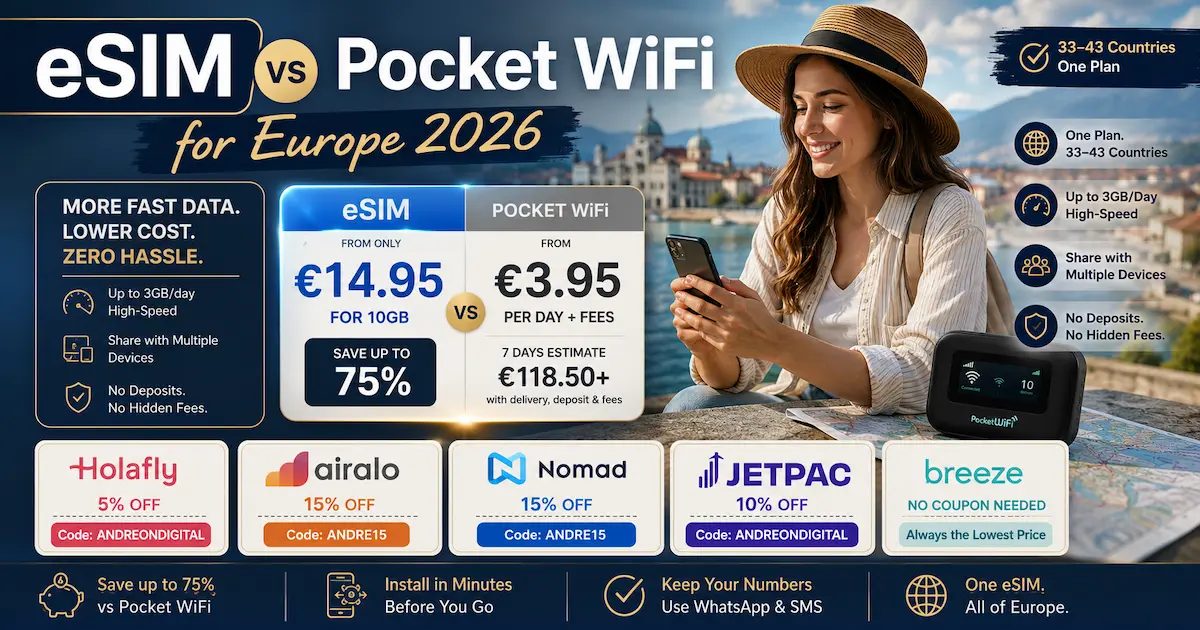

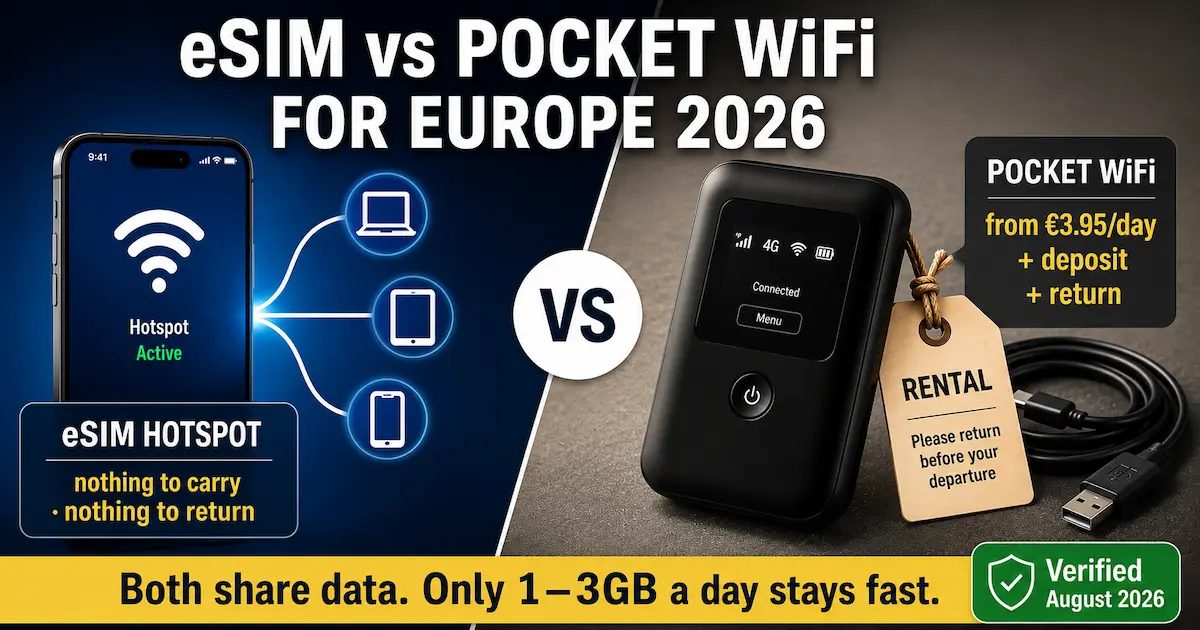
For travelers comparing eSIM vs Pocket WiFi for Europe, the practical difference begins with what must be carried, charged and returned.
I carried a pocket WiFi across Japan once. Never again. The device needed charging every few hours, it took up bag space, the daily rental added up fast, and I still had to return it at the airport or get charged a late fee. When I switched to eSIM, the difference was immediate — no extra device, no battery stress, no returning anything.
But here’s the thing almost every eSIM vs pocket WiFi comparison gets wrong, including the previous version of this one: they ask whether an eSIM can share data. That’s the easy question — all five providers below can. The question that actually decides your trip is how many of those shared gigabytes stay at full speed.
The answer rangesfrom 1GB a day to 3GB a day depending on the provider, and on one plan you can’t share the data at all after the first gigabyte. That gap matters far more than the price difference.
⚡ The short answer
👤 Solo, couple, or one laptop → eSIM. No device, no deposit, no return, and cheaper at every trip length.
👨👩👧👦 Family or group sharing all day → pocket WiFi still has a real case — or one big fixed-data eSIM plan.
📵 Phone without eSIM support → pocket WiFi, no debate.
🔥 Best eSIM for replacing a pocket WiFi → Airalo or Jetpac — 3GB/day at full speed, no separate tethering cap.
⚠️ Worst fit for sharing → Holafly — unlimited on your phone, but only 1GB/day can be shared.
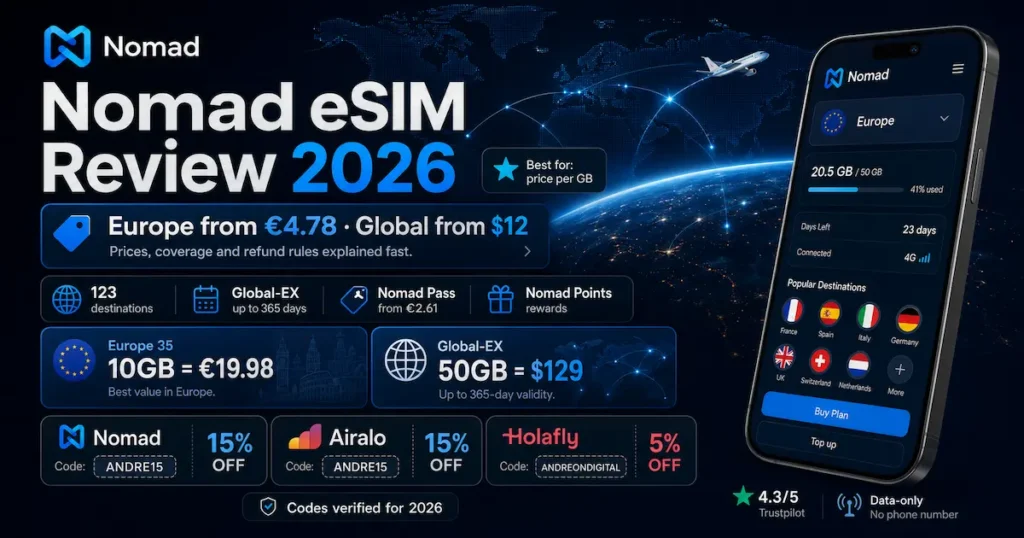
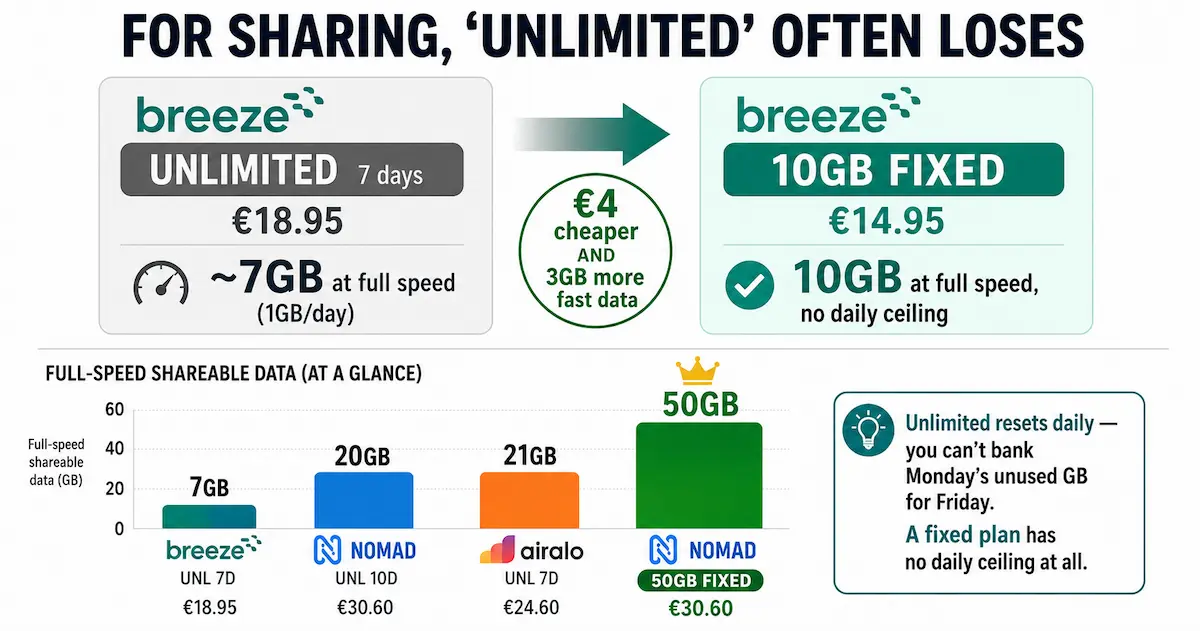
🧠 The counter-intuitive winner → a big fixed plan. Nomad’s 50GB at €30.60 shares 50GB at full speed with no daily ceiling.
💶 7-day reality check: cheapest pocket WiFi ≈ €27.65 + fees · Breeze Europe Lite 10GB €14.95 · Nomad 20GB €23.61 · Airalo unlimited €24.50.
How Each One Works (And Why They’re More Alike Than You Think)
In a practical eSIM vs Pocket WiFi for Europe comparison, both options use mobile networks; the hardware and rental process are what change.
An eSIM is a digital SIM built into your phone. You buy a data plan online from a provider like Nomad, Airalo, Holafly, Jetpac or Breeze, install it before you fly, and your phone connects to local European carriers on arrival — Orange in France, Deutsche Telekom in Germany, Cosmote in Greece. No extra device, no pickup, no return. Your regular SIM stays active for calls and messages while the eSIM carries data.
Travelers who already have an eligible EU or EEA mobile contract should also compare these options with the European Union’s official Roam Like at Home guidance. Domestic roaming may already cover occasional travel, although fair-use data limits can still apply.
A pocket WiFi is a small portable router you rent or buy. It creates a private WiFi network that several devices connect to at once. In Europe you can rent from companies like HippocketWifi, TravelWifi, My Webspot, MioWiFi, Solis or GlocalMe — collected at an airport counter, delivered to your hotel, or shipped to your home before departure.
The Real Question: How Much Sharing Stays at Full Speed?
The most useful way to judge eSIM vs Pocket WiFi for Europe is to measure how much hotspot data remains at full speed.
Every eSIM here supports hotspot. That’s the answer to the question everyone asks, and it’s the least useful fact in this article. What separates them is the daily high-speed allowance — the point at which your shared connection stops being fast and starts being merely present. Here’s what each provider publishes.
| Provider | Hotspot rule | Full-speed allowance | Device limit | What it means for sharing |
|---|---|---|---|---|
| Airalo (unlimited) | No separate tethering cap | 3GB / 24h, then 1 Mbps | None stated | Strongest all-round case against pocket WiFi |
| Jetpac (unlimited) | “Unlimited hotspot” (official) | First 3GB / 24h at normal speed, then up to 1 Mbps | None stated | Ties with Airalo on shareable full-speed data |
| Nomad (unlimited) | Tethering allowed, FUP applies | ~2GB / day, then ~512 kbps–2 Mbps by plan | — | Middle of the pack for unlimited |
| Nomad (fixed plans) | No separate hotspot allowance — tethering uses the plan’s data | The entire plan, no daily ceiling | — | The most full-speed shareable data per euro |
| Breeze Europe Lite | Hotspot included free on all Europe Lite plans | 1GB / 24h on the unlimited plan | — | Cheapest ticket, smallest fast allowance |
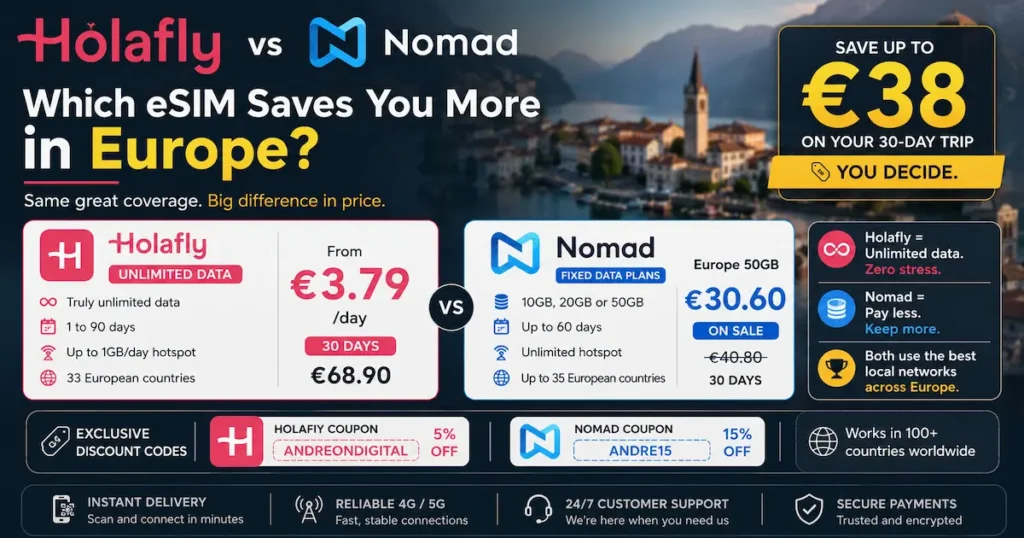
| Holafly | Sharing allowed but capped | Phone use unlimited — but only 1GB/day shareable | — | ⚠️ Weakest fit for replacing a pocket WiFi. Always On backup data can’t be shared at all |
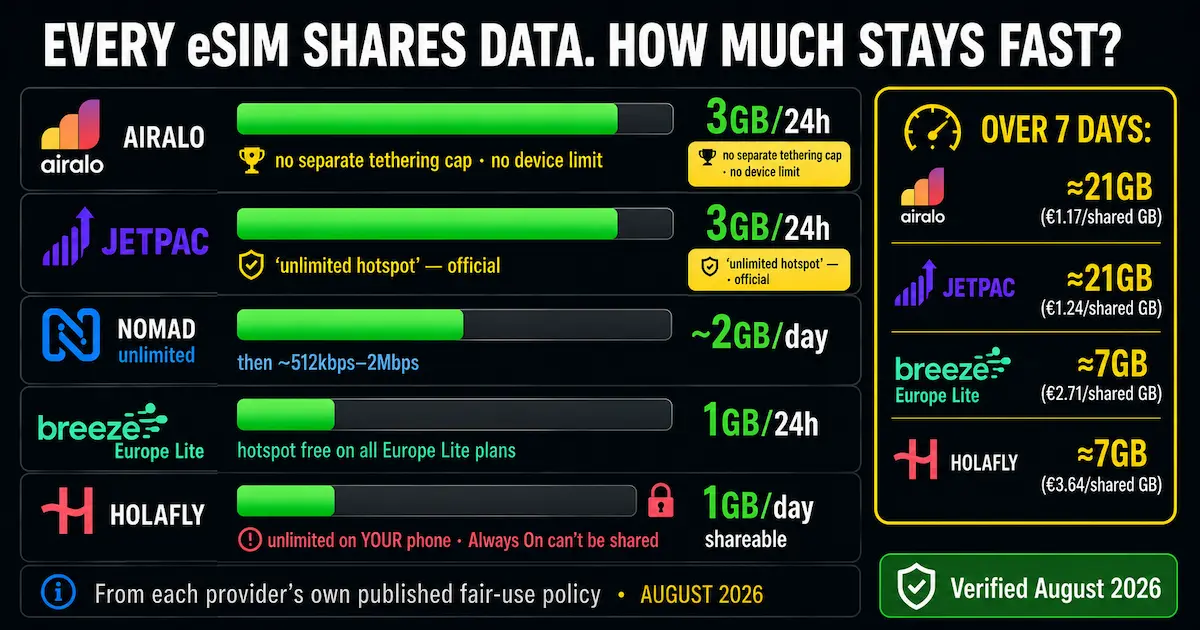
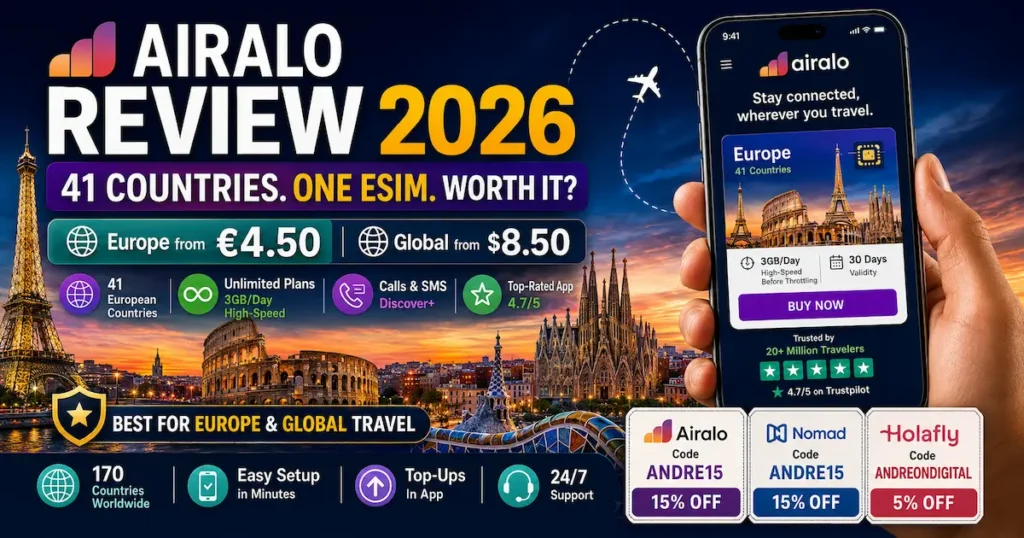
🥇 Airalo unlimited 7d — €24.50 → about 21GB full speed (3GB × 7) = €1.17 per shareable GB
🥈 Jetpac unlimited 7d — €26.00 → about 21GB full speed = €1.24 per shareable GB
🥉 Breeze Europe Lite unlimited 7d — €18.95 → about 7GB full speed = €2.71 per shareable GB
⚠️ Holafly Europe 7d — €25.50 → 7GB shareable (1GB/day hotspot cap) = €3.64 per shareable GB
Nomad doesn’t sell a 7-day unlimited plan; its 5-day is €16.61 (≈10GB full speed) and its 10-day €29.73 (≈20GB). So the cheapest ticket and the most sharing are not the same product — Breeze wins the price race by €5.55 and loses the sharing race by 14GB.
Airalo Hotspot Test for Europe
For eSIM vs Pocket WiFi for Europe, Airalo is strongest when several devices need a predictable daily high-speed allowance.
Airalo is one of the strongest eSIM alternatives to pocket WiFi because its unlimited Europe plan does not apply a separate tethering limit. The video below shows the Airalo setup and real-world experience, helping you understand how the plan works before using it as a hotspot for a laptop, tablet or another traveler’s phone.
The main number to remember is the 3GB high-speed allowance every 24 hours on the unlimited plan. After that threshold, the connection continues at a reduced speed. For a solo traveler, couple or one connected laptop, that is usually enough to replace a separate pocket WiFi device.
Jetpac Hotspot Test for Europe
Jetpac officially promotes unlimited hotspot use, making it another direct alternative to renting a portable WiFi router. This video gives you a closer look at Jetpac and how its travel eSIM works when you need to share data across several devices.
Jetpac provides the first 3GB of each 24-hour period at normal speed on its unlimited plan. That puts it level with Airalo for full-speed daily sharing, while still removing the delivery, deposit and return process that comes with pocket WiFi rentals.
Nomad eSIM for Heavy Hotspot Sharing
Nomad becomes especially interesting when you compare its fixed-data plans with unlimited plans. Instead of resetting a small high-speed allowance every day, a large fixed plan lets you share the full data balance whenever you need it. The video below shows the Nomad experience and installation process.
For travelers who need to connect a laptop or share data with several people on specific heavy-use days, Nomad’s fixed plans can be more practical than an unlimited plan. There is no daily hotspot ceiling on the fixed allowance, so the entire plan remains available at full speed until it is used.
Holafly for Unlimited Phone Data
Holafly is designed mainly for travelers who want unlimited data directly on their own phone. It can still share data, but the Europe plan limits hotspot use to about 1GB per day. Watch the video below to see how Holafly works and decide whether unlimited personal use matters more to you than heavy sharing.
Holafly is a good choice when most of the data will stay on your own phone for maps, social media, messaging and streaming. It is less suitable as a full pocket WiFi replacement for a family or group because only a limited amount can be shared each day.
Breeze Europe Lite Hotspot Option
Breeze Europe Lite sits at the lower-cost end of this comparison and includes tethering on its plans. The video below gives you a practical overview of Breeze before you decide whether its lower price and smaller daily high-speed allowance match your trip.
Its unlimited option provides about 1GB at high speed every 24 hours, while the fixed 10GB plan can be the smarter hotspot choice because the full allowance is available without a daily ceiling. This makes Breeze useful for lighter sharing and budget-focused trips.
What Pocket WiFi Actually Costs in Europe
Any honest eSIM vs Pocket WiFi for Europe cost comparison must include rental extras instead of comparing only the headline daily rate.
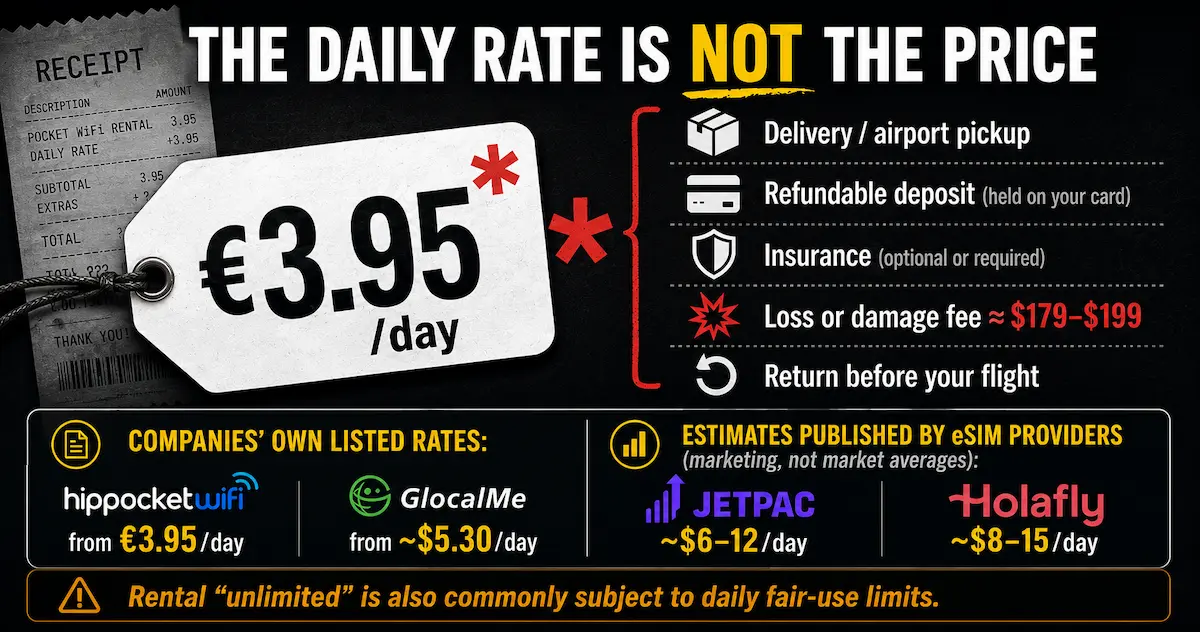
This is where the previous version of this guide was wrong, so let’s fix it properly. Pocket WiFi is not uniformly expensive — the bottom of the rental market is cheaper than most eSIM comparisons admit, and pretending otherwise doesn’t help anyone.
| Source type | Daily rate | 7 days | 14 days | 30 days |
|---|---|---|---|---|
| HippocketWifi — company’s own listed rate unlimited, 40+ European countries, up to 10 devices | from €3.95 | ≈€27.65 | ≈€55.30 | ≈€118.50 |
| GlocalMe — company’s own listed rate rentals across 140+ countries | from ≈$5.30 | ≈$37 | ≈$74 | ≈$159 |
| Estimate published by Jetpac for European rentals generally | ≈$6–$12 | ≈$42–$84 | ≈$84–$168 | ≈$180–$360 |
| Estimate published by Holafly for pocket WiFi generally | ≈$8–$15 | ≈$56–$105 | ≈$112–$210 | ≈$240–$450 |
Read the source column, not just the number. The first two rows are rates the rental companies advertise themselves. The last two are estimates published by eSIM providers about their own competition — useful context, but they are marketing material, not independent market averages, and this guide labels them as such. The honest takeaway: European pocket WiFi starts around €4 a day, not $8.
Head to Head: The Honest Numbers
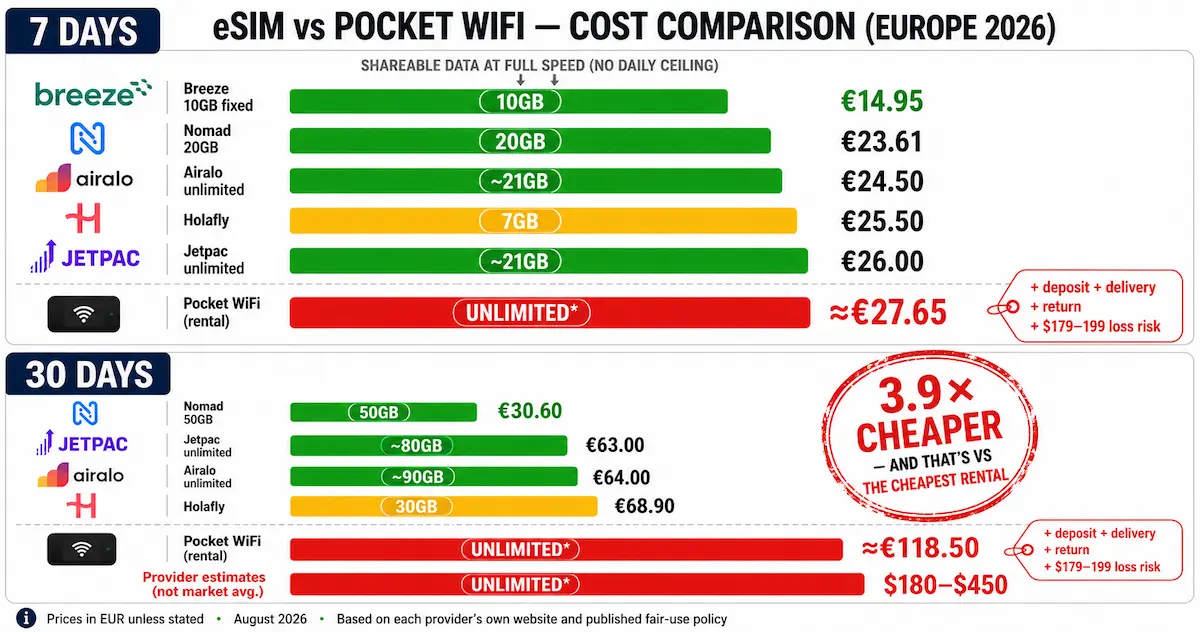
This eSIM vs Pocket WiFi for Europe price check uses the cheapest listed rental against real seven-day and 30-day eSIM plans.
Cheapest rental against real eSIM plans, with what you can actually share at full speed. No rounding in anyone’s favour.
| 7-day trip | Cost | Full-speed shareable data | Extras & admin |
|---|---|---|---|
| Breeze Europe Lite 10GB (fixed) | €14.95 | 10GB, no daily ceiling | None |
| Nomad 20GB (fixed) | €23.61 | 20GB, no daily ceiling | None |
| Airalo unlimited 7 days | €24.50 | ≈21GB (3GB/day) | None |
| Holafly Europe 7 days | €25.50 | 7GB shareable (1GB/day cap) | None |
| Jetpac unlimited 7 days | €26.00 | ≈21GB (3GB/day) | None |
| Cheapest pocket WiFi rental | ≈€27.65 | Unlimited — daily FUP may apply | ⚠️ Delivery · deposit · insurance · loss fee $179–$199 · return |
| 30-day trip | Cost | Full-speed shareable data |
|---|---|---|
| Nomad 50GB (fixed) | €30.60 | 50GB, no daily ceiling |
| Airalo unlimited 30 days | €64.00 | ≈90GB (3GB/day) |
| Jetpac unlimited 30 days | €63.00 | ≈90GB (3GB/day) |
| Holafly Europe 30 days | €68.90 | 30GB shareable (1GB/day cap) |
| Cheapest pocket WiFi rental | ≈€118.50 | Unlimited — daily FUP may apply |
| Pocket WiFi per provider-published estimates | ≈$180–$450 | Unlimited — daily FUP may apply |
Battery: The Trade-Off Nobody Puts in a Table
Battery is the overlooked part of eSIM vs Pocket WiFi for Europe: one option charges a second device, while the other uses the phone you already carry.
This is the one place pocket WiFi has an argument that price can’t answer. Airalo’s own comparison puts typical rental hotspots at roughly 8 to 15 hours of battery while supporting around 5 to 10 connected devices. That’s a dedicated battery doing a dedicated job.
An eSIM hotspot draws on your phone instead — and tethering drains a phone noticeably faster than normal use. So the honest framing isn’t “extra device vs no extra device.” It’s: do you want to carry and charge a router, or carry a power bank for the phone that’s now doing two jobs?
For a solo traveleror a couple, the power bank wins easily — you were probably carrying one anyway. For a family running four devices off one phone from breakfast to bedtime, the dedicated battery is a genuine argument, and the person whose phone is the router will feel it by mid-afternoon.
| Factor | eSIM | Pocket WiFi |
|---|---|---|
| Extra hardware | ✅ None — no device, charger, collection or return | ❌ Another device to carry and charge |
| Setup | ✅ Installed before departure, activated on arrival | ⚠️ Delivery or pickup, rental setup, return |
| Multi-device sharing | ✅ All five providers — but hotspot and FUP rules differ | ✅ Built for it — around 5–10 devices |
| Battery | ⚠️ Uses your phone’s battery, faster drain | ✅ Its own battery, ≈8–15 hours |
| High-speed sharing | 1GB–3GB/day on the unlimited plans checked; no daily ceiling on fixed plans | Also commonly subject to daily fair-use limits |
| Loss & damage | ✅ Nothing to lose beyond your phone | ❌ Rental gear can be lost, damaged or stolen — fees ≈$179–$199 |
| Cross-border travel | ✅ One regional plan across 33–43 European countries | ⚠️ Depends on the countries the rental covers |
| Keep your own number | ✅ Home SIM stays active for calls and codes | ➖ Not applicable — it’s a separate router |
| Best use case | Solo travelers, couples, one-laptop remote work | Families or groups with several heavy simultaneous users |
When Pocket WiFi Still Wins
The answer to eSIM vs Pocket WiFi for Europe is not always eSIM, especially when compatibility or heavy all-day group sharing changes the requirement.
Three scenarios, and they’re real — anyone who tells you pocket WiFi is dead is selling something.
1. Your phone doesn’t support eSIM. No workaround, no debate. Check Settings → About for an EID number; if it’s absent, rent the device. Full list: eSIM Compatible Phones 2026. One middle path worth knowing: if even one person in your group has an eSIM-compatible phone, that phone’s hotspot does the same job for far less money.
2. A family or group sharing heavily, all day, every day. This is the strongest case. Four people streaming, navigating and working off one connection from morning to night will burn through a 3GB daily allowance quickly — and more importantly, nobody wants to be the person whose phone is the household router. A dedicated device with its own 8–15 hour battery solves a social problem as much as a technical one.
The counter-argument, though, is the fixed-plan maths above: Nomad’s 50GB at €30.60 shares 50GB at full speed with no daily ceiling, for a quarter of what a month’s rental costs. Run both numbers against your actual usage before you book.
3. Thin eSIM coverage in remote corners. In parts of the rural Balkans or remote Eastern Europe, a multi-carrier rental device can sometimes find signal where a single-carrier eSIM struggles. For mainstream European travel — France, Italy, Spain, Germany, Greece, Portugal — this isn’t a real concern; the eSIM providers ride the major national networks. If your route is genuinely remote, check which carriers your plan uses before deciding.
When eSIM Wins (Most Travelers)
For most ordinary trips, eSIM vs Pocket WiFi for Europe favors eSIM because it removes rental logistics without removing hotspot access.
Solo travelers. No extra device, no extra battery, no extra weight, no return. There’s no scenario where renting a router beats a plan in the phone already in your pocket.
Couples. One eSIM with hotspot covers both. At €14.95–€23.61 for a week’s worth of full-speed shareable data, it costs less than three days of the cheapest rental.
Multi-country trips. Paris → Amsterdam → Berlin → Prague: a regional eSIM switches carriers automatically at every border, across 33 to 43 countries depending on the plan. A rental works too — if the countries are on its list. Check before you cross.
Remote work with one laptop. This is the sweet spot for Airalo or Jetpac: neither applies a separate cap to tethering, so your laptop draws on the same 3GB daily full-speed allowance as your phone. For heavier days, a large fixed plan removes the daily ceiling entirely. More on the working-abroad setup: Best eSIM for Digital Nomads in Europe.
Anyone who values not thinking about it. No pickup at Schiphol or CDG. No returning at Fiumicino while your gate closes. No deposit sitting on your card. No “where did I put the WiFi device?” at 6am.
FAQ — eSIM vs Pocket WiFi for Europe
The Verdict
The final eSIM vs Pocket WiFi for Europe decision should follow your real sharing pattern rather than the word “unlimited” on a sales page.
For most European trips in 2026, an eSIM does the same job with less equipment, less admin and a lower price — and the gap widens the longer you stay. But the reason isn’t the one usually given. It isn’t that eSIMs are “3–5× cheaper,” because at the bottom of the rental market they aren’t. It’s that a hotspot-enabled eSIM delivers the same essential function with nothing to collect, charge, insure or return — and if you buy the right plan, more full-speed shareable data than the rental.
🏁 Pick by what you actually need to share
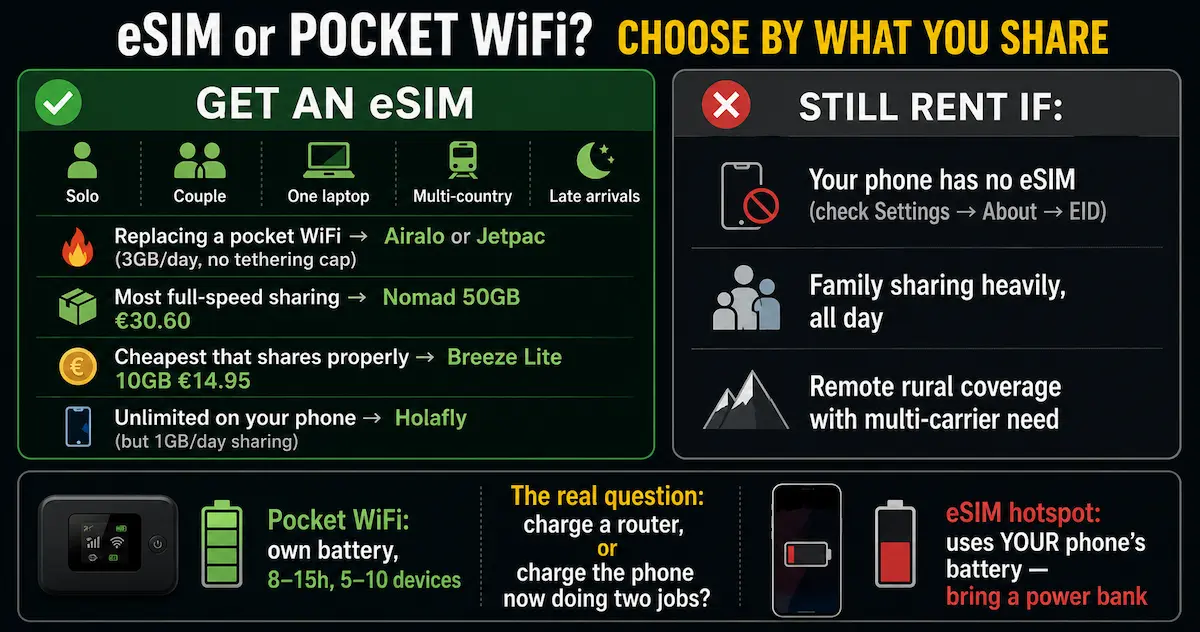
🔥 Replacing a pocket WiFi, group sharing → Airalo or Jetpac: 3GB/day full speed, no separate tethering cap. Airalo €24.50/7d · Jetpac €26/7d.
📦 Most full-speed sharing per euro → Nomad 50GB €30.60, no daily ceiling at all — the quiet winner of this whole comparison.
🪙 Cheapest that still shares properly → Breeze Europe Lite 10GB fixed €14.95 — cheaper and faster-sharing than its own unlimited plan.
📱 Unlimited on your own phone → Holafly from €3.79/day — excellent for you, weak for sharing (1GB/day cap).
🎒 Still rent if → your phone has no eSIM support, or a family needs several devices connected all day on a dedicated 8–15 hour battery.
This article contains affiliate links — if you buy through them I may earn a commission at no extra cost to you. It doesn’t change the conclusions: this update corrects two claims from earlier versions of this article, including its own “3–5× cheaper” figure, and names the plan that wins on shareable data rather than the one that pays best.
eSIM prices in euros (€) come from each provider’s official Europe page in August 2026, including promotional pricing where displayed. Hotspot rules and daily high-speed allowances come from each provider’s published fair-use policy. Pocket WiFi figures are labelled by source and are not presented as independent market averages.
Delivery, deposits, insurance and loss or damage fees vary by rental company, so read the specific agreement before paying. Prices and policies can change without notice; always confirm the final terms at checkout. I have personally used Holafly, Nomad and Airalo; Jetpac and Breeze are assessed from their official documentation.
Last verified: August 2026
Keep Reading
Use the guides below to continue your eSIM vs Pocket WiFi for Europe research with country coverage, setup and troubleshooting details.
eSIM Guides
- Best eSIM for Europe 2026: providers compared
- Cheapest eSIM for Europe 2026
- eSIM Europe Price Comparison: 11 providers
- Best eSIM for 30 Days in Europe
- Best Unlimited Data eSIM for Europe
- How Much Data Do You Need for Europe?
- eSIM vs Physical SIM for Europe
- Best eSIM for Digital Nomads in Europe
- Best eSIM for Families in Europe
- Best eSIM for European Cruises
Setup & Troubleshooting
eSIM by Country
Portugal | Spain | Italy | France | Germany | Greece | Netherlands | UK
Croatia | Turkey | Austria | Switzerland | Czech Republic