

Two phones, one trip: do you need two eSIMs, or does one with hotspot sharing cover you both? The answer comes down to two things — how much data the second person actually needs, and whether their phone stays within about 15 metres of yours through the day.
Get those two questions right and one eSIM with hotspot typically costs 30 to 40% less than two separate plans , with zero compromise for a couple who travel together. This best eSIM for couples traveling Europe guide keeps that choice tied to real travel behavior rather than marketing labels.
This guide prices six providers in euros for August 2026, works out exactly where the savings land, and — just as importantly — tells you honestly when splitting into two plans is worth paying for. For technical background, the GSMA overview of eSIM technology explains how downloadable operator profiles work on compatible devices.
⚡ Quick answer — couples in Europe, August 2026
🥇 Best hotspot overall → Jetpac: officially unlimited hotspot , and Maps/WhatsApp/Uber keep working even after data ends
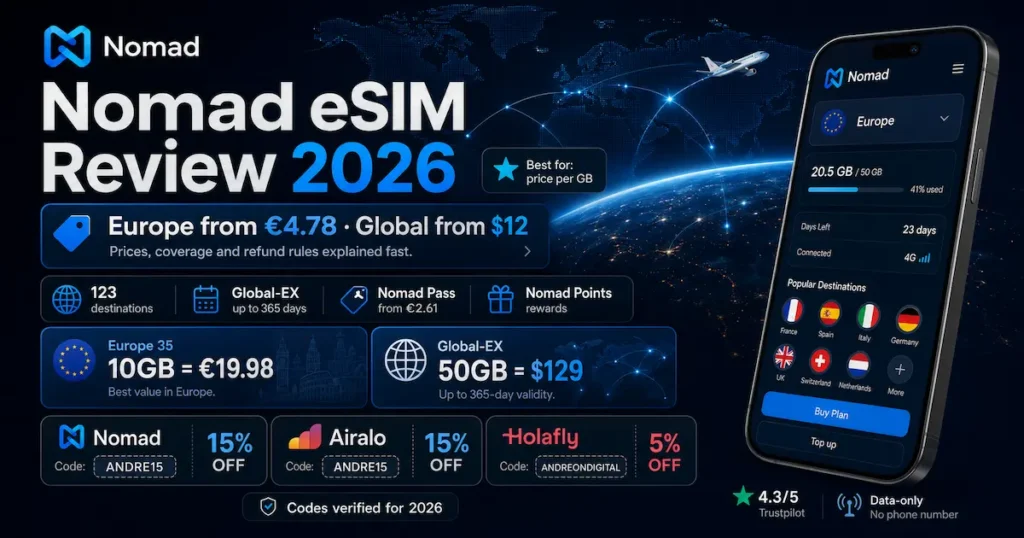
💰 Best value → Nomad 20GB €23.73: no separate hotspot allowance, saves ~35–41% vs two plans
🌍 Widest coverage → Airalo: 42 countries, no tethering cap, no device limit
🗺️ Repeat visitors → Ubigi: 38 destinations, no hotspot cap, annual from €24
🔒 VPN + optional number → Saily: “no hotspot restrictions” + NordVPN bundled
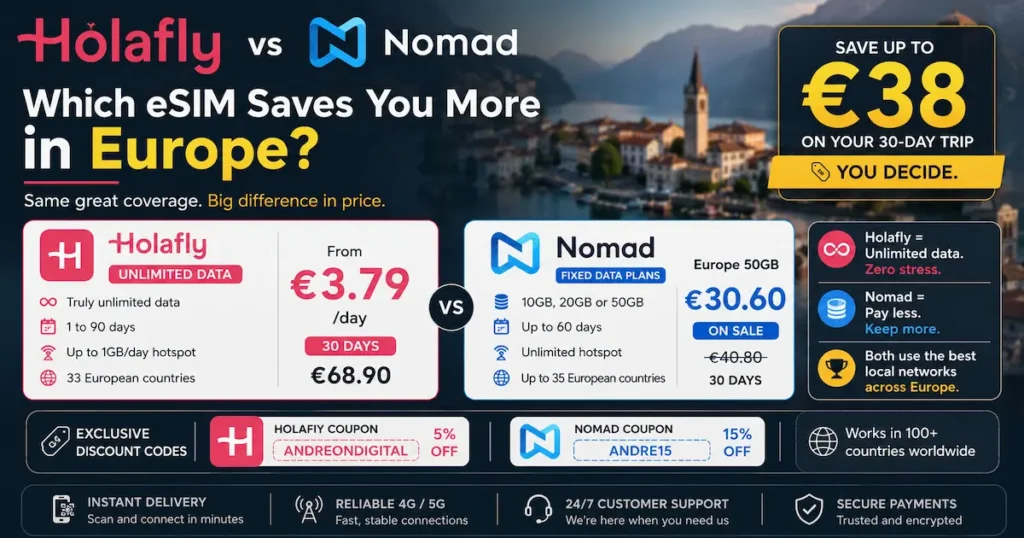
♾️ One partner unlimited, one light → Holafly: from €3.79/day, but hotspot capped ~1GB/day
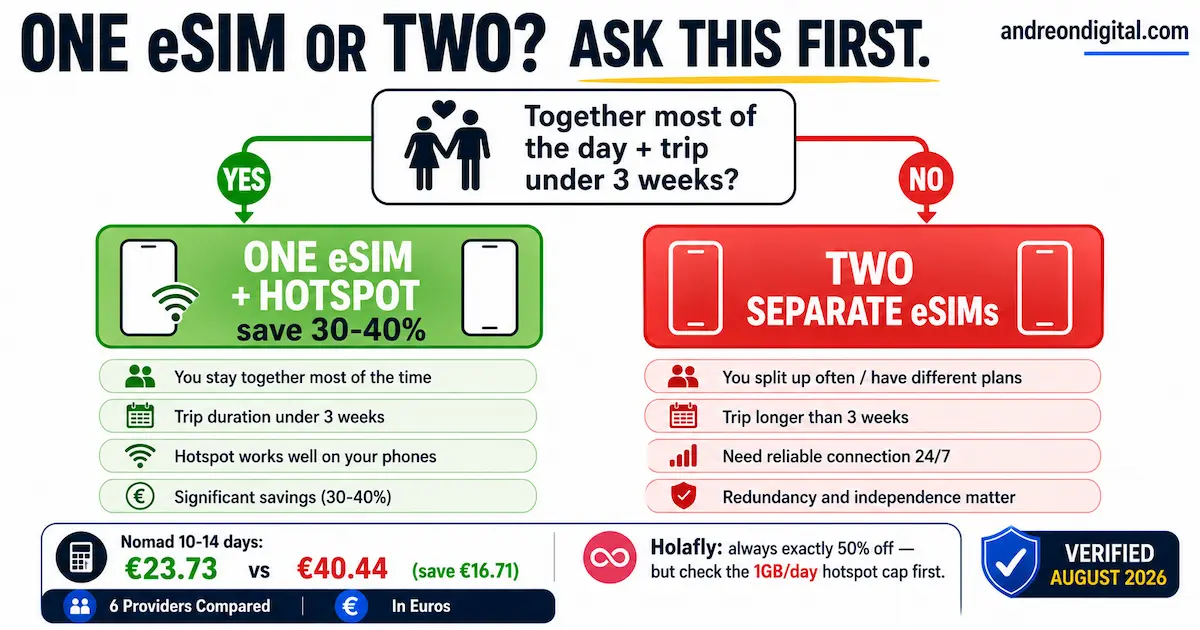
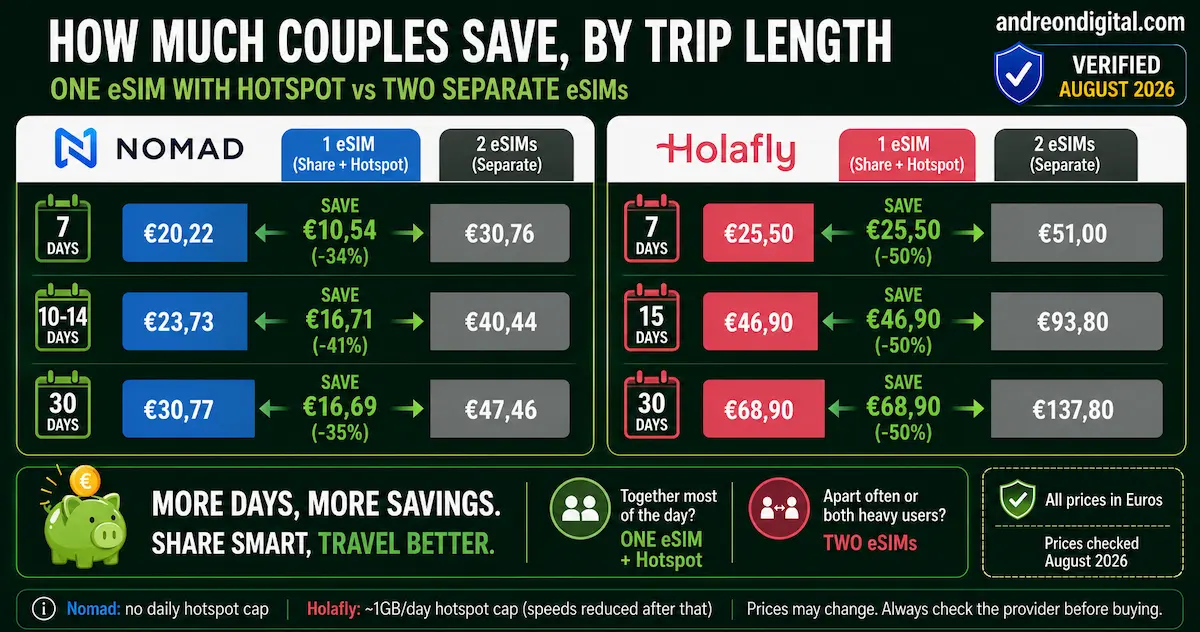
💶 The savings, concretely: Nomad 10–14 days → one 20GB plan €23.73 vs two 10GB plans ≈€40.44 ( save €16.71 ).
Holafly 7 days → one plan €25.50 vs two €51 ( save €25.50 ).
The best eSIM for couples traveling Europe is therefore the plan that matches how often you stay together, how much data you share and whether either phone must remain independently connected.
Best eSIM for Couples Traveling Europe: One eSIM + Hotspot, or Two Separate eSIMs?
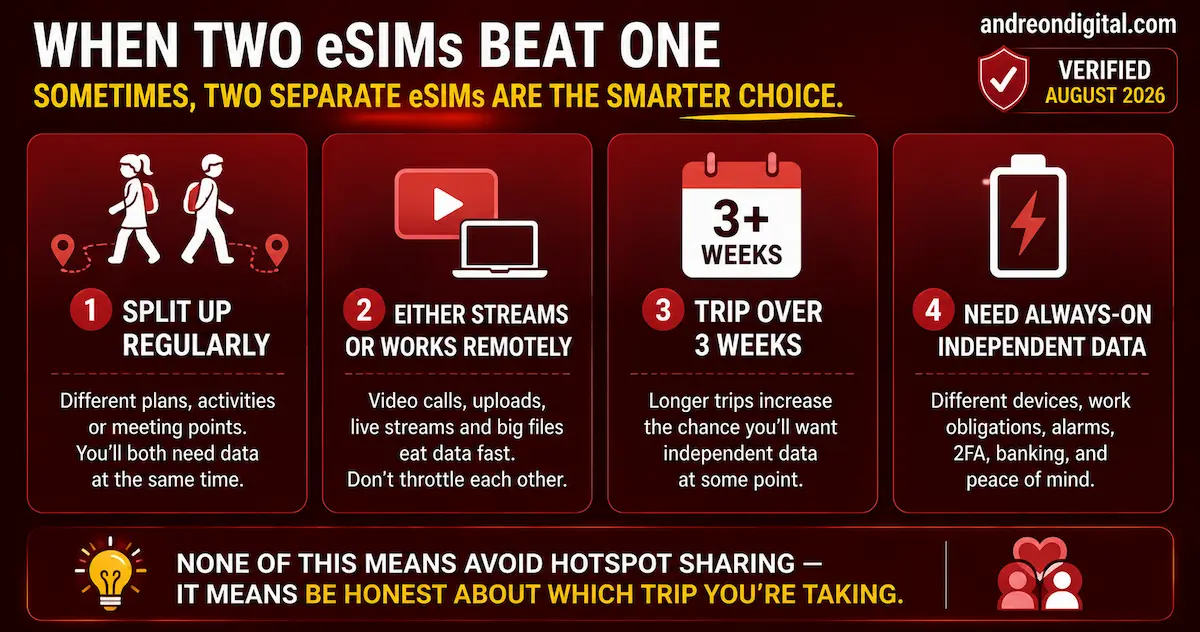
This is the only decision that matters before you look at a single price. Two questions decide it.
| Question | If yes → one eSIM + hotspot | If no → two eSIMs |
|---|---|---|
| Do you stay within ~15m of each other most of the day? | ✅ Hotspot range is fine | ❌ Second phone loses signal when apart |
| Is one of you a light user (maps, messaging)? | ✅ Shared pool covers it easily | — |
| Is the trip under 3 weeks? | ✅ Data needs stay predictable | ❌ Needs tend to diverge over longer stays |
| Does either of you stream or video-call heavily, independently? | — | ❌ Will exhaust a shared plan fast |
The Savings, Calculated Openly
Nomad — fixed data, no separate hotspot allowance
| Trip length | 1 eSIM + hotspot | 2 separate eSIMs | You save |
|---|---|---|---|
| ~7 days | 10GB/30d — €20.22 | 5GB/30d × 2 — €30.76 | €10.54 (34%) |
| 10–14 days | 20GB/30d — €23.73 | 10GB/30d × 2 — €40.44 | €16.71 (41%) |
| ~30 days | 50GB/30d — €30.77 | 20GB/30d × 2 — €47.46 | €16.69 (35%) |
Holafly — unlimited primary, ~1GB/day hotspot
| Trip length | 1 eSIM (unlimited + hotspot) | 2 separate eSIMs | You save |
|---|---|---|---|
| 7 days | €25.50 | €51.00 | €25.50 (50%) |
| 15 days | €46.90 | €93.80 | €46.90 (50%) |
| 30 days | €68.90 | €137.80 | €68.90 (50%) |
Read the two tables differently. On Nomad, the saving comes from not paying twice for a pool you didn’t need split — the second phone shares the same uncapped plan, so you’re simply not buying a duplicate.
On Holafly, the saving is exactly 50% every time, because a second full-price unlimited plan is pure duplication — but remember what you’re not getting: the hotspot partner is capped at roughly 1GB a day , not unlimited. If they’d stream independently, the “savings” evaporate the moment they run out at 3pm.
Hotspot Rules Compared: The Detail That Actually Matters
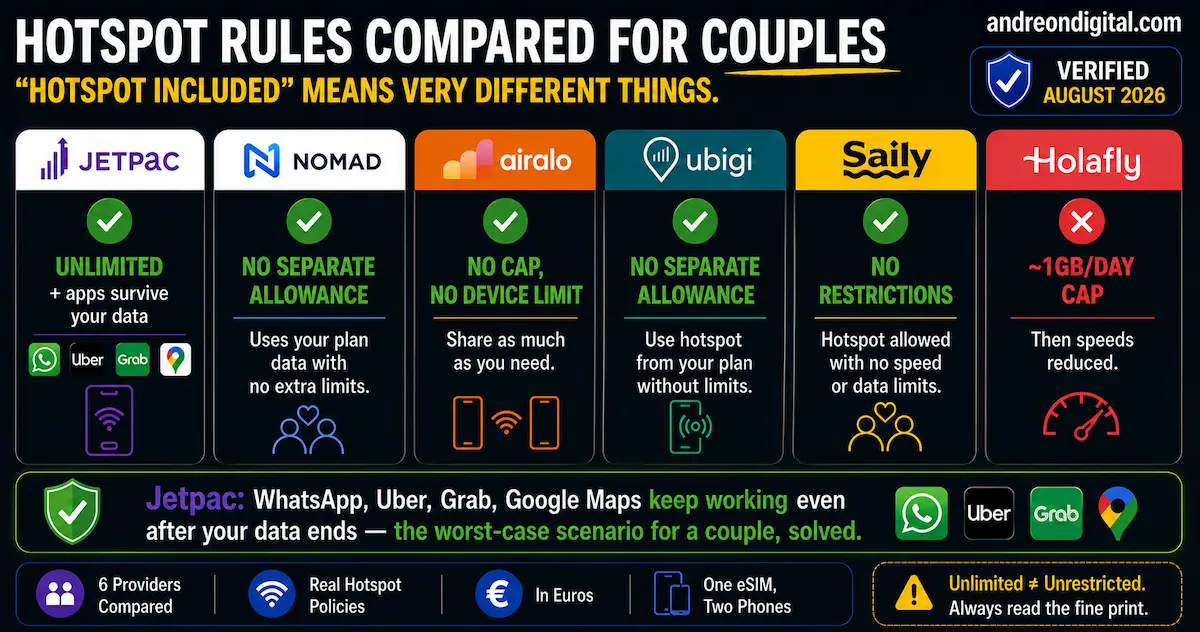
“Hotspot included” means very different things depending on the provider. This is the table to read before any price on this page.
| Provider | Hotspot rule | What it means for your partner |
|---|---|---|
| Jetpac | Unlimited hotspot, officially advertised | No cap at all — plus Maps, WhatsApp, Uber, Grab keep working even after data ends |
| Nomad (fixed plans) | No separate allowance — tethering uses the plan’s data | Full speed, whole plan shareable, no daily ceiling |
| Airalo | No separate tethering cap, no device limit | Full sharing within the 3GB/day full-speed allowance |
| Ubigi (fixed plans) | No separate hotspot allowance | Shareable within the plan’s own limits |
| Saily | “No hotspot restrictions or limitations” | Officially uncapped, per Saily’s own policy |
| Holafly | ~1GB per day to the connected device | ⚠️ Fine for maps and messaging — not for streaming or heavy use |
The Six Providers for Couples, In Detail
Jetpac wins this comparison on the two things that go wrong on a couple’s trip: hotspot limits and a partner going offline. Unlimited hotspot is officially advertised — no daily cap, no separate allowance to track.
And its safety net is unmatched: on packs of 3GB and above, WhatsApp, Uber, Grab and Google Maps keep working free after the data itself runs out . If your partner’s phone is the one on the hotspot, that’s the difference between a real problem and a non-event.
Coverage is 43 European countries, and unactivated packs stay valid three months, useful for a trip booked well ahead.
Prices: 1 day: 3GB €8.50 · 10GB €12 | 7 days: 5GB €12.50 · 10GB €17.50 | 30 days: 10GB €21 · 20GB €38 · 30GB €28.50 · 40GB €33.50 | unlimited 3d €12.50 · 7d €26 · 30d €63.
Jetpac eSIM Video: Hotspot and Connectivity for Couples
This Jetpac video gives couples a closer look at how the service works before buying. Watch it alongside the hotspot rules above, especially if one phone will supply the connection for both travelers.
For couples, the main takeaway is simple: Jetpac is strongest when uninterrupted hotspot access matters. Its essential-app backup also adds protection if the shared data allowance runs out during the trip.
Nomad’s fixed-data plans are built for exactly this: no separate hotspot allowance, so the whole plan is shareable at full speed with no daily ceiling. 20GB at €23.73 is the sweet spot for a 10 to 14-day trip for two — roughly 700MB per person per day of shared allowance, enough for full navigation, messaging and social media without either of you tracking usage.
Prices: 1GB/7d €4.83 · 5GB/30d €15.38 · 10GB €20.22 · 20GB €23.73 · 50GB €30.77 | unlimited 5d €16.70 · 10d €29.89.
Nomad eSIM Video: Using One Plan on a Couple’s Trip
This Nomad video helps show the setup and everyday experience of using the service in Europe. It is especially relevant for couples considering one fixed-data plan with the second phone connected by hotspot.
The fixed-data option remains Nomad’s best fit for two people because the full allowance can be shared without a separate daily hotspot cap. That is what makes the 20GB and 50GB plans more practical than buying two smaller plans.
Airalo applies no separate tethering cap and no limit on connected devices , within its 3GB daily full-speed allowance on unlimited plans — good news for a couple sharing one connection. Eurolink’s 42-country coverage is the widest here, useful if your trip crosses into the Balkans or Turkey.
Short validity windows (3, 7, 15 days) mean you’re not forced into a 30-day plan for a week-long trip.
Prices (Eurolink): 1GB/3d €5 · 5GB/7d €17 · 10GB/7d €23.50 · 10GB/30d €28 | unlimited 3d €10.50 · 7d €24.50 · 30d €64.
Airalo eSIM Video: Coverage and Tethering in Europe
This Airalo video provides a practical overview of the provider and its eSIM experience. For couples crossing several European borders, pay particular attention to coverage and how easily the second device can remain connected.
Airalo works best here for couples who value broad country coverage and unrestricted tethering. The main decision is whether Eurolink’s wider reach is worth paying more than the smaller EU and UK plan.
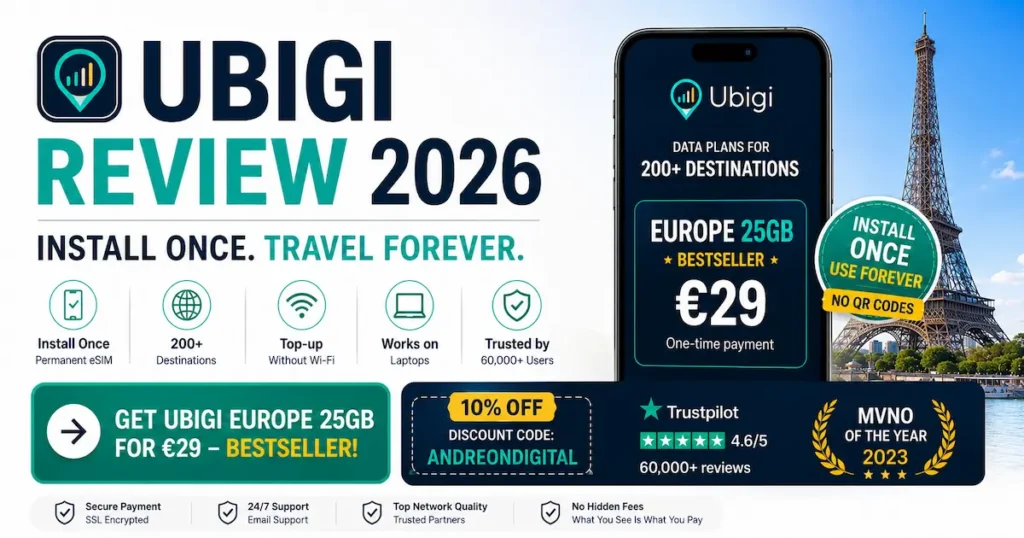
Ubigi’s fixed-data plans carry no separate hotspot allowance, and its coverage — 38 European destinations including the UK, Switzerland, Ukraine and Moldova — is wider than most regional plans. 10GB valid 7 days at €12 is well suited to a week-long couple’s trip with normal shared use.
Prices: 3GB/30d €7 · 10GB/7d €12 · 10GB/30d €15 · 25GB €29 | unlimited 7d €23 · 30d €62 (60GB full speed, then 2 Mbps) | annual from €24.
Ubigi eSIM Video: A Practical Option for Repeat Europe Trips
This Ubigi video explains the service in a more visual way and is useful for couples planning repeated trips to Europe. It complements the annual-plan comparison and the no-separate-hotspot-cap policy described above.
Ubigi stands out when the same couple expects to return to Europe more than once. A reusable profile and annual options can reduce setup work while still letting both phones share the fixed-data allowance.
Saily states “no hotspot restrictions or limitations” — the most direct language of any provider here — and comes from the NordVPN team , with an ad blocker and web protection included. Useful if you’ll both be on hotel or café Wi-Fi as much as mobile data.
It also offers optional calls and SMS plans , useful if one partner wants a real number for restaurant bookings or a hotel to call back on.
Prices (converted from USD): 1GB/7d ≈€4.39 · 5GB/30d ≈€17.13 · 10GB/30d ≈€31.63 (with NordVPN Complete) | unlimited 15d ≈€43.94 · 30d ≈€63.27.
Saily eSIM Video: Security Features and Hotspot Sharing
This Saily video gives more context on the app, setup and included security features. It is useful for couples who expect to use a mixture of mobile data, hotel Wi-Fi and café Wi-Fi during the same trip.
Saily’s appeal is broader than data alone. The unrestricted hotspot policy, web protection and optional calls and SMS can suit couples who want extra tools inside one travel app.
Holafly’s case for couples is specific: if one partner is a heavy user — streaming, constant uploads, remote work — and the other is light, unlimited on the primary phone plus hotspot on the second removes data anxiety for the person who needs it most.
From €3.79 a day , configurable 1 to 90 days, with Always On leaving free backup data every month for life. It’s the provider I’ve personally used most, across three countries.
Prices: 1 day €3.79 · 7 days €25.50 · 15 days €46.90 · 30 days €68.90.
Holafly eSIM Video: Unlimited Data with a Hotspot Limit
This Holafly video shows the provider’s unlimited-data experience and setup. Couples should watch it with one limitation in mind: unlimited data applies to the primary phone, while the connected partner has a daily hotspot allowance.
Holafly makes the most sense when one traveler is a heavy user and the other only needs maps, messaging and light browsing. When both people need independent heavy use, two separate plans are safer than relying on the shared hotspot.
How Much Data Does a Couple Actually Need?
Realistic numbers, not the inflated ones some guides use to sell bigger plans. This is for two people navigating, messaging, posting occasionally and taking photos — not two people streaming constantly.
| Style | Combined per day | 10-day trip | Best fit |
|---|---|---|---|
| Light — maps, WhatsApp, occasional photos | 3–5GB | 30–50GB | Nomad 20GB (with margin) or 50GB |
| Moderate — more browsing, navigation, some social posting | 5–10GB | 50–100GB | Nomad 50GB or unlimited |
| Heavy — one or both stream, frequent video calls, remote work | 10GB+ | 100GB+ | Holafly unlimited or two separate plans |
Note on these numbers: two people navigating and messaging genuinely use less than the “2–4GB per person per day” figure sometimes quoted for standard use — that estimate assumes regular streaming or heavy video, which most couples sightseeing together aren’t doing constantly.
If you’re planning heavier use — content creation, remote work, frequent video calls home — size up accordingly using the table above rather than the light-use figures. For a full activity-by-activity breakdown, see How Much Data Do You Need for Europe?
Practical Tips for Couples
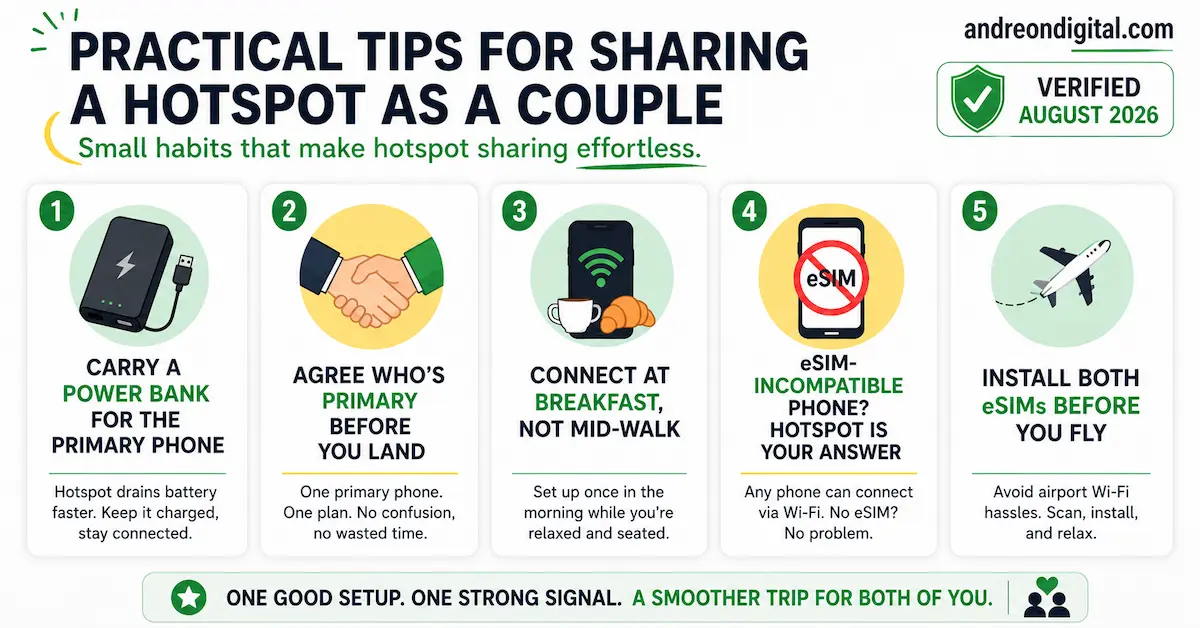
Set the hotspot up before your first day out, not mid-walk. Connect the partner’s phone once at breakfast and leave it connected. Reconnecting mid-street because it dropped is a minor but real friction point — check it’s stable before you leave the hotel each morning if your provider doesn’t hold the connection reliably.
Carry a power bank for the primary phone. Hosting a hotspot all day drains the battery of whoever holds the eSIM noticeably faster than normal use. On a full sightseeing day with both phones navigating and taking photos, that phone is doing double duty — a power bank removes the anxiety entirely.
Agree who’s “primary” before you land. Whoever has the better phone battery, or whoever is less likely to accidentally close the connection, should hold the eSIM. It sounds trivial until one of you is stranded without maps because the other’s phone died at 40%.
If you’ll split up some days, plan for it rather than discover it. A day where you separate — one museum each, one person working from the hotel — is the moment hotspot sharing breaks down. If that’s a regular pattern rather than a one-off, two separate eSIMs from the start is simpler than switching mid-trip.
If it’s occasional, most providers let the non-primary person buy a small standalone plan just for that day.
Install both eSIMs before you fly. Whether you’re going with one shared plan or two separate ones, set everything up on home Wi-Fi in advance so you land already connected. Full walkthrough: How to Activate an eSIM for Europe . Not sure both your phones support it?
Check eSIM Compatible Phones 2026 — if one doesn’t, that settles the decision: hotspot sharing is your only option, and a good one.
FAQ — eSIMs for Couples Traveling Europe
Final Verdict
For most couples travelling together through Europe, the answer is simple: one eSIM with hotspot sharing . It saves 30 to 50% over two separate plans, and on the providers that apply no separate hotspot allowance, there’s no speed or quality compromise at all.
The exceptions — splitting up regularly, heavy independent use, trips past three weeks — are real, but they’re the minority case, not the default to plan around.
In practice, the best eSIM for couples traveling Europe is the option that gives both travelers dependable access without paying twice for data they will not use independently.
🏁 The picks, August 2026
🥇 Best hotspot → Jetpac: unlimited, apps survive your data ending → ANDREONDIGITAL −10%
💰 Best value → Nomad 20GB €23.73: no separate hotspot cap, saves ~35–41% → ANDRE15 −15%
🌍 Widest coverage → Airalo: 42 countries, no tethering cap → ANDRE15 −15%
🗺️ Repeat visitors → Ubigi: annual from €24, no hotspot cap → ANDREONDIGITAL −10%
🔒 VPN bundled → Saily: “no hotspot restrictions” → ANDREONDIGITAL −10%
♾️ One heavy user, one light → Holafly: unlimited primary, ~1GB/day hotspot → ANDREONDIGITAL −5%
⚠️ Splitting up most days, or a trip past 3 weeks? Buy two plans from the start — it’s simpler than switching mid-trip.
If a friend messaged me tonight saying they and their partner were doing 10 days across Portugal and Spain together, I’d send them Nomad’s 20GB at €23.73 — one purchase, no cap on the hotspot, and cheaper than either of them buying alone.
If one of them mentioned working remotely most mornings from a café while the other explored, I’d change that answer to two separate plans without hesitating.
This article contains affiliate links — if you buy through them I may earn a commission at no extra cost to you. It hasn’t shaped the advice: this guide names Holafly’s ~1GB/day hotspot cap as a real limitation and states plainly when two separate plans, not one, are the better buy.
All prices are in euros (€), read from each provider’s official Europe pages in August 2026, including promotional prices where displayed. Nomad’s 20GB and 50GB are sale prices and may revert.
Saily publishes US dollar prices; its euro figures here are conversions at approximately 1 EUR = 1.1378 USD, marked “≈”, so your checkout total may differ. Hotspot rules and fair-use figures come from each provider’s own published documentation.
Multi-trip cost comparisons are simple multiples of published prices. Data-usage estimates are general figures for typical couple travel patterns, not measurements of your specific usage.
I have personally used Holafly in Portugal, Turkey and Thailand, Nomad in Portugal, and Airalo in Portugal. Jetpac, Ubigi and Saily are assessed from their official documentation. Always confirm prices and hotspot terms at checkout.
Last verified: August 2026
Keep Reading
By traveler type
- Best eSIM for Families in Europe
- Best eSIM for Students in Europe
- Best eSIM for Digital Nomads in Europe
- Best eSIM for Backpacking Europe
By trip type
- Best eSIM for Road Trips in Europe
- Best eSIM for Short Trips to Europe
- Best eSIM for Long Stays in Europe
- Best eSIM for 30 Days in Europe
Prices & rankings
- Best eSIM for Europe 2026
- Best eSIM Providers for Europe — 11 scored
- eSIM Europe Price Comparison
- How Much Data Do You Need for Europe?
Setup & troubleshooting
Reviews
eSIM by Country