Best eSIM for Ecuador 2026: $9.50/3GB, Galápagos Included
Last updated: September 2026. Every price and network was read from each provider’s own Ecuador page. Carrier assignments were verified provider by provider, which turned up a claim in two published guides that does not match what those providers publish. All prices in USD, which is also Ecuador’s official currency. Always confirm at checkout.
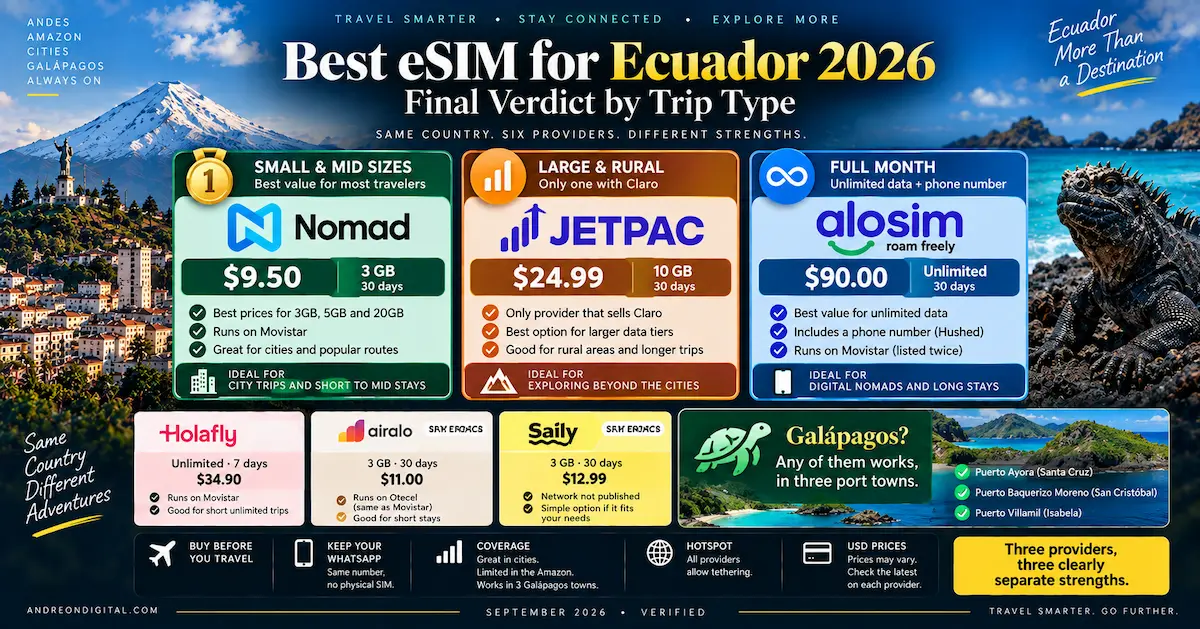
Best eSIM for Ecuador 2026: six providers compared on price and carrier. Five run on Movistar and one on Claro, and the Galápagos question has a clearer answer than most guides give. Verified September 2026.
Ecuador packs an unusual amount into a small country. Quito at 2,850 metres, the Amazon a few hours east, colonial Cuenca to the south, and a thousand kilometres out in the Pacific, the Galápagos. For anyone comparing the Best eSIM for Ecuador 2026, the practical question is not just price but whether the same plan keeps working across those very different parts of the trip. Over two million international visitors arrive each year, and a large share of them are asking the same thing before they fly: will my data work on the islands?
The answer is yes, with one important qualification, and it is worth stating clearly because a prominent guide says the opposite in capital letters. While checking that, something else turned up: five of the six providers here run on the same carrier, and the two guides ranking for this search both describe the situation backwards.
How this guide is built: This Best eSIM for Ecuador 2026 guide is based on provider-published plan and carrier data rather than a generic destination database. I’m based in Belgium and compare eSIM providers full-time. Every price and carrier assignment below was read from each provider’s own Ecuador page in September 2026, never from a third-party database, and cross-checked against independent coverage reporting. I’ve personally tested Airalo and Nomad in Portugal and Holafly in Portugal, Turkey and Thailand, so no Ecuadorian speed or coverage claim here comes from my own experience. Where published sources contradict each other, and on both the Galápagos and the carrier question they do, this guide sets out both sides and says which the evidence supports. If your trip continues into neighbouring countries, see Best eSIM for Argentina 2026 or our Central America guide.
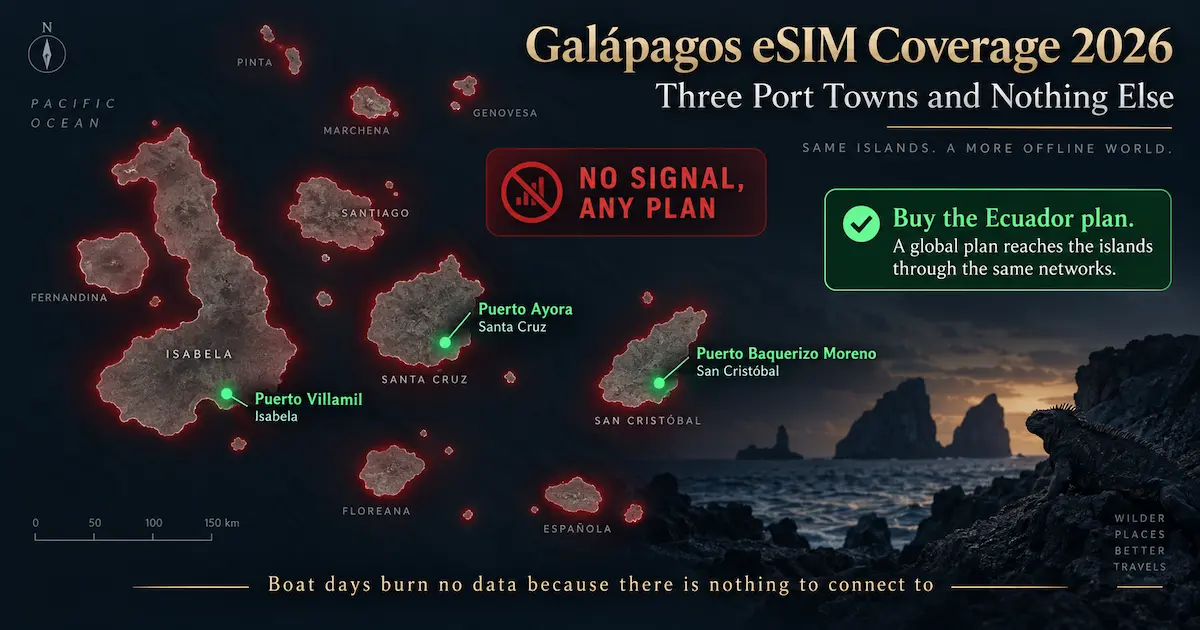
🐢 The Galápagos question, answered: an Ecuador plan does work there. That matters directly when choosing the Best eSIM for Ecuador 2026. The archipelago is politically part of Ecuador and runs on the same Ecuadorian carriers, so a country plan connects. Four independent sources confirm it, one of them naming the exact towns. A fifth states in capitals that Ecuador-specific plans do not cover the islands and that you need a global or regional plan, which appears to conflate two different things: no coverage in the remote islands and at sea, which is true, with the plan not reaching the archipelago at all, which is not. What you actually get is signal in three port towns: Puerto Ayora on Santa Cruz, Puerto Baquerizo Moreno on San Cristóbal and Puerto Villamil on Isabela, at patchy 3G to 4G. Everywhere else, including every boat day, is offline. As one guide puts it, days on the water burn no data because there is no signal.
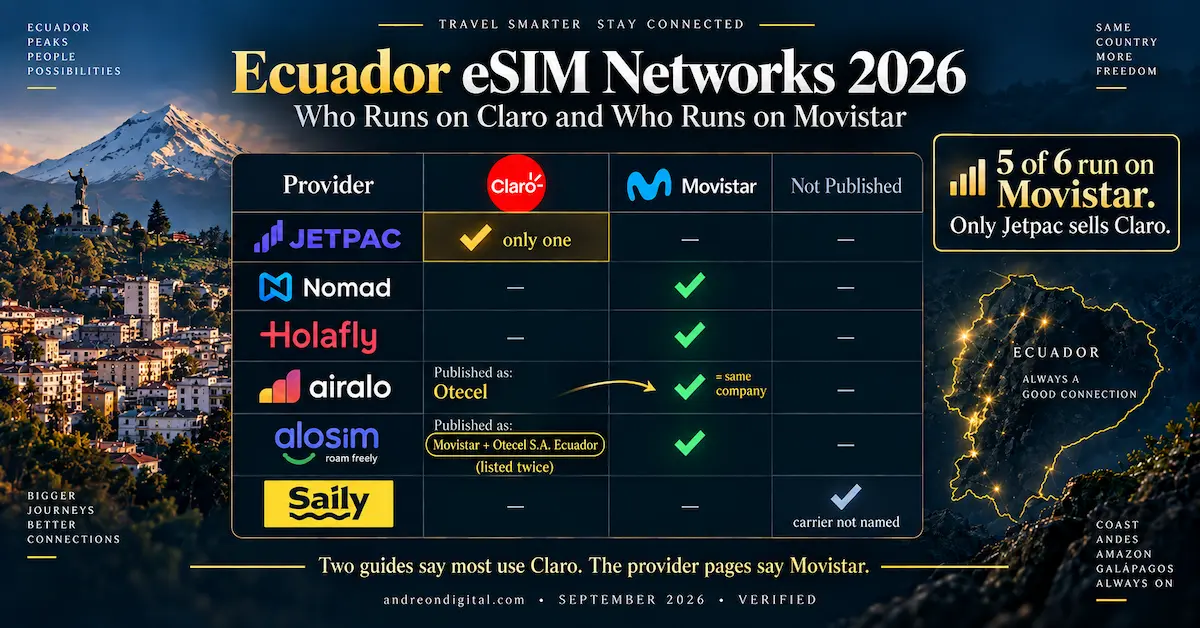
📡 And the carrier finding: five of six run on Movistar, and only Jetpac sells Claro. Read from each provider’s own page in September 2026: Airalo publishes Otecel, Nomad publishes Movistar, Holafly publishes Movistar Ecuador, aloSIM publishes Movistar and Otecel S.A. Ecuador, Saily does not name its carrier, and Jetpac publishes Claro Ecuador. That matters because Claro has the widest 4G footprint in the country, so the strongest network here is sold by exactly one provider. Two published guides state the reverse, one saying most travel eSIMs route through Claro and the other repeating that and adding that aloSIM uses it. aloSIM’s own page says Movistar. We are not accusing anyone of bad faith; carrier assignments change and these pages are easy to get wrong. But the provider pages are the record, and they say Movistar.
⚡ Best eSIM for Ecuador 2026, Quick Answer
🥇 Best value overall: Nomad · $9.50 for 3GB, $16 for 5GB, $47 for 20GB · Movistar · 4G
📶 Only one on Claro: Jetpac · $24.99 for 10GB, $29.99 for 15GB · the widest 4G footprint
♾️ Cheapest unlimited month: aloSIM · $90 · and the only included phone number
📅 Shortest unlimited window: Airalo · $19 for three days
🗓️ Buying far ahead: Saily · 180 days to activate · 3GB a day on unlimited
🐢 Galápagos: your Ecuador plan works, in three port towns only
⚠️ Never buy Jetpac’s 20GB at $60, when its 30GB costs $49.99
🌳 The Amazon goes dark fast. Signal in Tena and Coca, then nothing
Choosing the Best eSIM for Ecuador 2026 starts with the underlying carrier, because the provider name matters less than the Ecuadorian network carrying the data. Ecuador runs on three networks: Claro, Movistar and CNT. Claro has the widest 4G footprint and Movistar follows, with both reliable across Quito, Guayaquil, Cuenca and the main tourist routes. For a regulator-level reference, compare these assignments with ARCOTEL’s official mobile coverage map. Here is what each provider publishes.
Provider
Network published
What that means
Speed published
Jetpac
Claro Ecuador
✅ The widest 4G footprint, and the only plan here with it
2G / 3G / 4G
Nomad
Movistar
Movistar, named plainly
4G
Holafly
Movistar Ecuador
Movistar, named plainly
4G / LTE, 5G where available
⚠️ Airalo
Otecel
⚠️ Also Movistar. Otecel S.A. is its corporate name
Not published
⚠️ aloSIM
Movistar + Otecel S.A. Ecuador
⚠️ The same company, listed twice
LTE
Saily
Not published
Described only as Ecuador’s best networks
3G / 4G / LTE / 5G
🔤 Two labels worth translating before you compare.Otecel S.A. is the legal corporate name of Movistar Ecuador, so an Airalo plan listing Otecel puts you on Movistar. That is not a smaller or different network, it is the same one under its registered name. The label still matters, because someone researching whether Otecel performs well in Quito or the Galápagos will find almost nothing, while searching Movistar Ecuador returns everything. aloSIM creates the opposite problem, listing MOVISTAR and Otecel S.A. Ecuador as two separate network entries, which makes its coverage look broader than it is. It is one network written two ways. Read Otecel as Movistar in both cases.
🧭 How much the carrier choice actually matters here. For Quito, Guayaquil, Cuenca and the main tourist circuit, Claro and Movistar both deliver reliable 4G and the difference is academic, so buy on price. Coverage also holds through the inter-city bus corridors and smaller towns including Mindo, Baños and Otavalo. Where Claro’s wider footprint starts to count is rural highland routes and the approaches to the Oriente. If your itinerary is city-based, any provider here works; if it runs deep into the countryside, Jetpac is the only one giving you the broader network.
Five of six Ecuador eSIMs run on Movistar and only Jetpac sells Claro, despite two published guides claiming most providers use Claro. Airalo’s Otecel and aloSIM’s double listing are both Movistar.
Prices Compared, September 2026
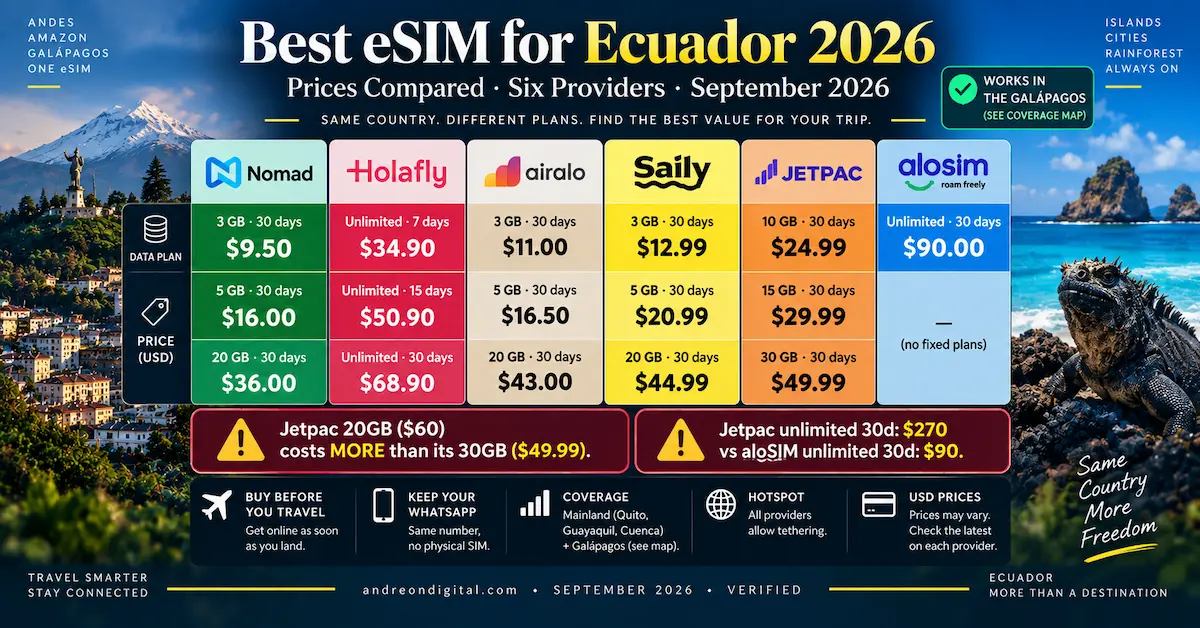
For the Best eSIM for Ecuador 2026, the useful price comparison is not a single cheapest provider. Nomad leads the common small and mid-size fixed plans, Jetpac becomes stronger at larger fixed allowances, and aloSIM is the value reference for a full unlimited month.
Fixed data
Size
Nomad
Jetpac
Saily
aloSIM
Airalo
Cheapest
1GB
$5.00 / 7d
$4.00 / 4d
$5.99 / 7d
$7.00 / 7d
$5.00 / 3d
Jetpac
2GB
—
—
—
$13.00 / 15d
—
aloSIM, only tier
3GB / 30d
$9.50
$11.00 / 7d
$15.99
$18.00
$15.00 / 7d
Nomad, $6.49 under Saily
5GB / 30d
$16.00
$16.00
$24.99
$28.00
$24.00
Nomad and Jetpac tie
10GB / 30d
$28.00
$24.99
$34.99
$46.00
$35.00
Jetpac
15GB / 30d
—
$29.99
—
—
—
Jetpac, only tier
20GB / 30d
$47.00
⚠️ $60.00
—
—
$49.00
Nomad
30GB / 30d
—
$49.99
—
—
—
Jetpac, only tier
Unlimited
Duration
aloSIM
Airalo
Saily
Holafly
Jetpac
Cheapest
1 day
—
—
—
$9.50
$9.00
Jetpac by $0.50
3 days
$20.50
$19.00
—
$19.90
$27.00
Airalo
5 days
$31.00
$28.00
$27.99
$28.90
—
Saily by a cent
7 days
$36.00
$35.00
$34.99
$36.50
⚠️ $63.00
Saily
10 days
$43.00
$38.50
$38.99
$39.50
—
Airalo
15 days
$60.00
$52.00
$51.99
$53.50
—
Saily by a cent
30 days
$90.00
$99.00
$98.99
$106.50
⚠️ $270.00
aloSIM, $16.50 under Holafly
Fair use differs. Saily and Jetpac both give 3GB a day before reducing to 1 Mbps. Airalo, aloSIM and Holafly apply their own policies. Saily also allows 180 days to activate and Nomad 60 days, the two longest windows here. Nomad sells no unlimited tier for Ecuador.
🚨 Two Jetpac pricing traps, and one is the worst kind. Its 20GB costs $60 while its 30GB costs $49.99, so you pay $10.01 more for 10GB less, and its 15GB at $29.99 gives you three quarters of the data for half the price of the 20GB. This is not an Ecuador glitch: our Jetpac eSIM Review 2026 audited all 175 plans in the catalogue and found the same 20GB inversion in six regions, and we have since confirmed it in South Korea, Hungary, Argentina and the Czech Republic. Ecuador makes eleven. Second, its unlimited plans are extraordinarily expensive here: $270 for thirty days against aloSIM’s $90, three times the price. Buy Jetpac for Claro access on a 10GB, 15GB or 30GB fixed plan. Never its 20GB, and never its unlimited beyond a single day.
💰 Where the value actually sits.Nomad owns the small and mid tiers at $9.50 for 3GB and $16 for 5GB, undercutting Saily by $6.49 and aloSIM by $8.50 at 3GB. Jetpac owns the larger fixed plans at $24.99 for 10GB and $29.99 for 15GB, and it is the only provider with a 30GB tier. And aloSIM owns the unlimited month at $90, which is $16.50 under Holafly and $9 under both Airalo and Saily. Three providers, three clearly separate strengths, which is unusually tidy for a country comparison.
Ecuador eSIM prices September 2026: Nomad is cheapest at 3GB ($9.50) and 5GB ($16), Jetpac at 10GB ($24.99) and 15GB ($29.99), and aloSIM takes the unlimited month at $90.
The Six Providers in Detail
The Best eSIM for Ecuador 2026 changes with the trip: a city itinerary, a rural route, a short unlimited stay and a month-long visit do not reward the same provider. The six sections below keep those use cases separate so the recommendation follows the itinerary rather than the brand.
🥇 Best value at the sizes most people buy
Nomad, $9.50 for 3GB on Movistar
Movistar · 4G · $16 for 5GB · $47 for 20GB · 43,282 reviews · 60 days to activate
Nomad is the default recommendation for most Ecuador trips because it is cheapest exactly where most people buy. $9.50 for 3GB undercuts Saily by $6.49 and aloSIM by $8.50, and $16 for 5GB is $8 under Airalo. It names its carrier plainly as Movistar at 4G, with no corporate-name confusion, and plans can be activated within 60 days of purchase. Full detail in our Nomad eSIM Review 2026. I’ve tested Nomad in Portugal.
Plan
Days
Price
Cheapest rival
1GB
7
$5.00
Jetpac $4 over 4 days
3GB ⭐
30
$9.50
Saily $15.99 · aloSIM $18
5GB ⭐
30
$16.00
Airalo $24 · Saily $24.99
10GB
30
$28.00
Jetpac $24.99
20GB ⭐
30
$47.00
Airalo $49 · Jetpac $60
⚠️ It sells no unlimited tier for Ecuador at all, so if you want uncapped data you are choosing between the other five. And being on Movistar rather than Claro means slightly less reach on rural highland routes, which matters only if your itinerary goes well off the tourist circuit.
Best for: standard Quito, Cuenca and Galápagos itineraries on a fixed allowance, which covers most visitors.
How to Install and Activate Nomad eSIM for Ecuador
Before using Nomad in Ecuador, it helps to see the installation and activation flow once from start to finish. This walkthrough shows where the eSIM is added on the phone and how the Nomad setup works before travel, which is especially useful if you want the plan ready before landing in Quito or Guayaquil.
Once the eSIM is installed, keep the Nomad line available for mobile data when you arrive. For this Ecuador guide, Nomad remains the fixed-data option focused on the 3GB, 5GB and 20GB tiers discussed above, while the video gives you the practical setup context before you travel.
📶 The only Claro plan, and the only 15GB and 30GB
Jetpac, Claro Ecuador and the widest 4G footprint
Claro · $24.99 for 10GB · $29.99 for 15GB · $49.99 for 30GB · apps keep working after data runs out
Jetpac is the only provider here selling Claro Ecuador, which has the widest 4G footprint in the country, and that alone makes it worth considering for anything beyond the main cities. It also fills the gaps nobody else covers, with 15GB at $29.99 and 30GB at $49.99, and takes 10GB at $24.99. On any pack of 3GB or above, WhatsApp, Uber and Google Maps navigation keep working after your allowance runs out, which on an Amazon or highland drive is worth more than it sounds. Full detail in our Jetpac eSIM Review 2026.
Plan (30 days)
Price
Per GB
Shorter windows
5GB
$16.00
$3.20
7d: 3GB $11 · 4d: 1GB $4
10GB ⭐
$24.99
$2.50
Nomad $28 · Airalo $35
15GB ⭐ only tier
$29.99
$2.00
No rival at this size
⚠️ 20GB
⚠️ $60.00
$3.00
⚠️ Its own 30GB costs $49.99
30GB ⭐ only tier
$49.99
$1.67
Best large-data rate here
Best for: rural and highland routes where Claro’s reach counts, and anyone needing 10GB or more. Never its 20GB, and never its unlimited, which costs $270 for thirty days.
How to Install and Activate Jetpac eSIM for Ecuador
Jetpac is the only provider in this comparison that publishes Claro Ecuador, so the setup matters most for travellers choosing it specifically for that network. This video walks through the Jetpac installation and activation process before you depend on it for maps, messaging or navigation in Ecuador.
After setup, use Jetpac as your mobile-data line when the plan is active. The video complements the pricing section above, where the 10GB, 15GB and 30GB plans are the relevant Jetpac choices for Ecuador rather than its unusually expensive 20GB and unlimited tiers.
📞 Cheapest unlimited month, and the only phone number
aloSIM, $90 for thirty days and a number tour operators can call
Movistar · unlimited month $90 · free international phone number with every plan
aloSIM does two things here worth the price difference. Its unlimited month at $90 is the cheapest uncapped option, $16.50 under Holafly and $9 under Airalo and Saily. And it includes a free international phone number with every Ecuador plan, which is the only default number on this page. In Ecuador that fills a real gap: Galápagos tour operators, boat crews, hotels outside the main cities and InDriver drivers often call rather than message, and a data-only eSIM leaves you dependent on WhatsApp for all of it. Full detail in our aloSIM Review 2026.
Prepaid
Price
Unlimited
Price
1GB / 7d
$7.00
3 days
$20.50
2GB / 15d
$13.00
7 days
$36.00
3GB / 30d 🔥
$18.00
10 days
$43.00
5GB / 30d
$28.00
15 days
$60.00
10GB / 30d 🎁
$46.00
30 days ⭐
$90.00
⚠️ Its fixed plans are the most expensive here at every size, by $8.50 against Nomad at 3GB and $21.01 against Jetpac at 10GB. And the included number is a starter credit rather than a calling plan, as our review explains in detail. Its page also lists MOVISTAR and Otecel S.A. Ecuador as two networks, which is the same company twice. Buy it for the unlimited month or the number, not for fixed data.
Best for: Galápagos trips where a callable number genuinely helps, and anyone wanting uncapped data for a month.
aloSIM stands out in this Ecuador comparison because it combines data plans with an included international phone number. This video shows the eSIM setup flow so you can understand the installation before relying on the plan for data and the separate calling features described above.
With the eSIM installed, the Ecuador plan can be used as the data line while the aloSIM calling feature remains a separate part of the service. That distinction matters here because the included number comes with starter credit rather than an unlimited calling allowance.
📅 Cheapest short unlimited window
Airalo, $19 for three days on Otecel
Otecel, which is Movistar · six unlimited durations · widest tier range · Latin America plan from $7
Airalo has the broadest structure here, with eleven fixed tiers across three validity windows and six unlimited durations, so whatever shape your trip is there is probably a plan that fits it exactly. It takes the cheapest short unlimited at $19 for three days, useful for a Galápagos hop or a weekend in Quito. Its Latin America regional plan from $7 is worth comparing if your route continues into Peru or Colombia. Full detail in our Airalo Review 2026, and a head-to-head in Saily vs Airalo. I’ve tested Airalo in Portugal.
Fixed data
Price
Unlimited
Price
1GB / 3d
$5.00
3 days ⭐
$19.00
5GB / 30d
$24.00
7 days
$35.00
10GB / 30d
$35.00
10 days ⭐
$38.50
20GB / 30d
$49.00
15 days
$52.00
10GB / 7d
$34.00
30 days
$99.00
⚠️ Its page names the carrier as Otecel, which is Movistar’s corporate name. That is accurate but unhelpful, since researching Otecel returns almost nothing while Movistar Ecuador returns everything. Its fixed-data pricing also sits above Nomad at every shared tier, by $8 at 5GB and $7 at 10GB.
Best for: short unlimited windows, unusual trip lengths, and routes continuing into the rest of Latin America.
Airalo offers both fixed and unlimited options for Ecuador, including short unlimited windows. This video gives you the installation flow before travel, helping you see how the eSIM is added and where the Airalo line appears in your phone settings.
Once installed, use the Airalo eSIM for mobile data according to the plan you selected. In Ecuador, the provider publishes Otecel as the network name, which this guide explains is Movistar Ecuador under its corporate name.
🗓️ 180 days to activate, and calls available
Saily, cheapest unlimited week at $34.99
Network not published · 3GB a day on unlimited · security tools included · calls and SMS available
Saily takes the cheapest unlimited week at $34.99 and the cheapest fifteen days at $51.99, both by a cent or two over Airalo, and its 180-day activation window is the longest here by a wide margin. Regular plans include an ad blocker and web protection at no extra cost, and unlike most providers here it offers calls and SMS in Ecuador through a separate number and minutes plan. Full detail in our Saily Review.
Standard
Price
Unlimited (3GB a day)
Price
1GB / 7d
$5.99
5 days
$27.99 ⭐
3GB / 30d
$15.99
7 days ⭐
$34.99
5GB / 30d
$24.99
10 days
$38.99
10GB / 30d
$34.99
15 days ⭐
$51.99
180 days to activate
30 days
$98.99
⚠️ It does not publish its Ecuadorian carrier, describing it only as the country’s best networks. Every other provider here except none names theirs. Given that the Claro and Movistar difference decides rural reach, that is a real gap for an itinerary heading off the tourist circuit, though it matters little for Quito and the islands.
Best for: buying months ahead, short unlimited windows, and travellers who want the bundled security tools.
Saily is useful for travellers who want to buy well before departure because the Ecuador plans in this comparison have a long activation window. This video shows the Saily installation flow and gives you a visual reference for preparing the eSIM before the trip.
After installation, the plan can stay ready until you need it within its activation window. The video supports the practical side of the Saily section, while the comparison above covers its Ecuador pricing, unlimited-data policy and bundled security tools.
♾️ Simplest uncapped, nothing to track
Holafly, unlimited only from $9.50 a day
Movistar Ecuador · $36.50 for a week · $106.50 for thirty days · 112,066 reviews
Holafly sells only unlimited plans, which on a trip mixing Quito, the Amazon and the islands removes any need to think about allowances. It names its carrier plainly as Movistar Ecuador, and its ten-day plan at $39.50 is competitive against Airalo’s $38.50 and Saily’s $38.99 for the same period. Full detail in our Holafly Review 2026, and a comparison in Holafly vs Nomad. I’ve tested Holafly in Portugal, Turkey and Thailand.
Days
Price
Per day
Cheapest rival
1 day
$9.50
$9.50
Jetpac $9.00
3 days
$19.90
$6.63
Airalo $19.00
7 days
$36.50
$5.21
Saily $34.99
10 days
$39.50
$3.95
Airalo $38.50, within a dollar
15 days
$53.50
$3.57
Saily $51.99
⚠️ 30 days
⚠️ $106.50
$3.55
⚠️ aloSIM $90, $16.50 less
⚠️ It is the most expensive at the full month by a clear margin, at $106.50 against aloSIM’s $90 and roughly $99 from both Airalo and Saily. Its own page also notes that coverage quality is weaker in mountains and jungles, which in a country that is largely Andes and Amazon is an honest disclosure worth reading rather than boilerplate.
Best for: shorter trips where you would rather not track anything, particularly the three to ten day range.
Holafly keeps the Ecuador choice simple by selling unlimited-data plans rather than fixed allowances. This video shows the installation process before departure, which is useful if you want the eSIM already on the phone before arriving and only need to switch to the travel line when required.
With the eSIM prepared, the remaining decision is mainly the trip duration and price. In this Ecuador comparison, Holafly uses Movistar Ecuador and is most relevant to travellers who prefer unlimited data without tracking a fixed allowance.
The Galápagos in Detail: Three Towns, and Nothing Else
For the Best eSIM for Ecuador 2026, the Galápagos question changes the buying decision more than almost any other destination detail. This is the question that brings most people to this page, so here is the full answer rather than a yes or a no.
Where
What you get
Notes
Puerto Ayora, Santa Cruz
✅ Patchy 3G to 4G in town
The main hub, best of the three
Puerto Baquerizo Moreno, San Cristóbal
✅ Patchy 3G to 4G in town
The archipelago’s capital
Puerto Villamil, Isabela
✅ Partial coverage
Thinner than the other two
⚠️ At sea, between islands
❌ Nothing, on any plan
Most of a Galápagos itinerary
⚠️ Remote and uninhabited islands
❌ No signal
Española, Fernandina, Genovesa and the rest
⚠️ Highlands and interior of the inhabited islands
❌ Drops quickly outside town
Tortoise reserves, lava tunnels
🐢 What this means in practice, and it is good news for your data budget. A Galápagos week is mostly boat days, snorkelling and guided landings on islands with no infrastructure at all. Those hours consume nothing, because there is nothing to connect to. Your data gets used in the evenings back in Puerto Ayora or Puerto Baquerizo Moreno, and that is it. So the islands portion of your trip needs far less data than the mainland portion, which is the opposite of what most people assume when budgeting. Treat island connectivity as a bonus rather than a plan, download everything you need before you fly west, and enjoy being unreachable for a few days.
⚠️ Where the confusion comes from. One comparison states in capitals that Ecuador-specific eSIM plans do not cover the Galápagos and that you need a global or regional plan. That reading would cost you money for no benefit, since a global plan reaches the islands through the same Ecuadorian networks a country plan uses. The claim appears to conflate no coverage at sea and on remote islands, which is entirely correct, with the plan not reaching the archipelago, which is not. Four other sources, including two that name the port towns individually, describe country plans working there. Buy the Ecuador plan.
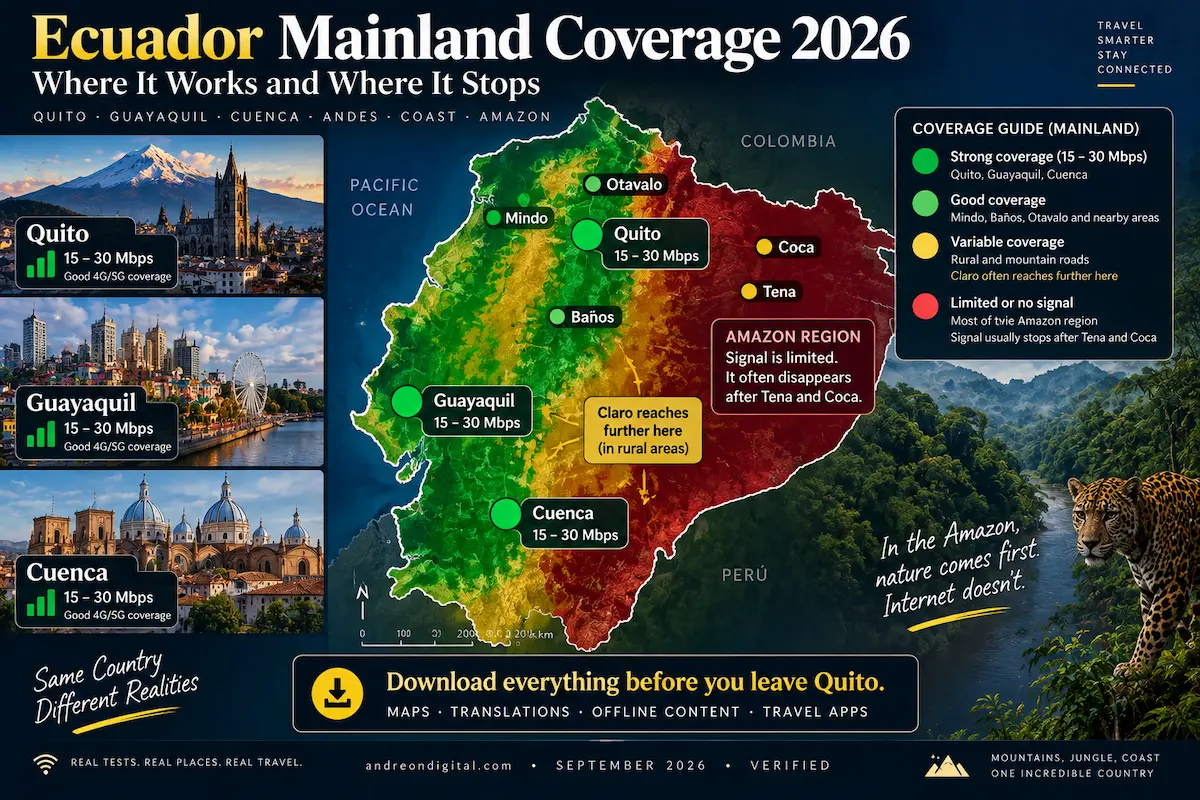
An Ecuador eSIM does work in the Galápagos, in three port towns: Puerto Ayora, Puerto Baquerizo Moreno and Puerto Villamil. At sea, on the remote islands and in the highlands there is no signal on any plan.Ecuador mainland coverage September 2026: dense LTE at 15 to 30 Mbps in Quito, Guayaquil and Cuenca, holding through Mindo, Baños and Otavalo. In the Amazon there is signal in Tena and Coca, then nothing.
Mainland Coverage: Where It Works and Where It Stops
The Best eSIM for Ecuador 2026 still depends on where the trip leaves the main cities. Quito, Guayaquil and Cuenca are straightforward; the real coverage differences start on rural highland routes and become much more important when the itinerary reaches the Oriente and the Amazon.
Region
What to expect
Typical speeds
Quito, Guayaquil, Cuenca
Dense LTE, reliable throughout
15 to 30 Mbps
Mindo, Baños, Otavalo
Coverage holds in town and on the approach
Good 4G
Inter-city bus corridors
Holds along the main routes
Variable but workable
Rural highland routes
🟡 Thinner, where Claro’s wider footprint helps
Patchy
⚠️ Amazon and the Oriente
❌ Signal in Tena and Coca, then it disappears
None outside towns
🌳 The Amazon goes dark faster than people expect. Signal exists in the main Oriente towns, Tena and Coca, and disappears shortly after you leave them. A jungle lodge stay should be planned as offline regardless of which provider you buy, because the limitation is infrastructure rather than carrier quality. Download maps, lodge bookings, transfer details and any guide information before leaving Quito, and screenshot anything you will need to show someone. This is the same discipline we recommend for Borneo’s interior, and for the same reason.
📶 On 5G, expect none. Ecuador ran early 5G trials in 2025 and commercial coverage remains very limited, so 4G is what you should plan around. At 15 to 30 Mbps in the main cities that is entirely adequate for maps, messaging, ride-hailing and social media, which is what travel data is mostly used for. Worth noting that one published comparison contradicts itself on this point, describing 5G as very limited in one paragraph and as available in major cities in another. Among the providers here, Nomad publishes 4G, aloSIM publishes LTE and Jetpac publishes 2G, 3G and 4G, none of them claiming 5G.
🛂 The local SIM alternative, and what it actually costs you. Claro, Movistar and CNT all have kiosks at Mariscal Sucre in Quito and José Joaquín de Olmedo in Guayaquil, and a typical tourist package runs around $15 for 5GB over thirty days with local calls and texts. That is competitive against the eSIMs here on price. What it costs is time: prepaid registration requires a passport and a queue, and installing an eSIM before you fly saves roughly 30 to 60 minutes on arrival. On a late landing into Quito, with a taxi to arrange at 2,850 metres after a long flight, that is worth more than the price difference. One convenience of Ecuador worth knowing: the country uses the US dollar, so every price on this page is already in the currency you will be spending. That is why the Best eSIM for Ecuador 2026 should be judged on time saved, carrier reach and the right data allowance, not simply on the lowest headline price.
FAQ, Best eSIM for Ecuador 2026
These are the questions that most often decide the Best eSIM for Ecuador 2026 for a real itinerary, especially when Galápagos coverage, carrier choice, local SIM alternatives and Amazon connectivity matter.
Does an Ecuador eSIM work in the Galápagos?
Yes, and one widely-read guide says otherwise. The Galápagos are politically part of Ecuador and run on the same Ecuadorian carriers, so a country plan connects there. Four independent sources confirm it, including one that names the exact places where signal exists. One comparison states in capitals that Ecuador-specific plans do not cover the archipelago and that you need a global or regional plan, which appears to conflate two different things: no coverage in the remote islands and at sea, which is true, with the plan not reaching the archipelago at all, which is not. What you actually get is signal in three port towns only: Puerto Ayora on Santa Cruz, Puerto Baquerizo Moreno on San Cristóbal and Puerto Villamil on Isabela, at patchy 3G to 4G. Verified September 2026.
Which eSIM providers use Claro in Ecuador?
One of the six compared here: Jetpac. Verified on each provider’s own page in September 2026, Airalo publishes Otecel, Nomad publishes Movistar, Holafly publishes Movistar Ecuador, aloSIM publishes Movistar and Otecel S.A. Ecuador, and Saily does not name its carrier. Jetpac publishes Claro Ecuador with 2G, 3G and 4G. This matters because Claro has the widest 4G footprint in the country, so the strongest network is sold by a single provider. Two published guides state the opposite, claiming most travel eSIMs route through Claro and that aloSIM uses it, and neither matches what those providers publish. Verified September 2026.
What is Otecel, and why does Airalo list it?
Otecel S.A. is the legal corporate name of Movistar Ecuador, so Airalo listing Otecel means you are on Movistar. It is not a separate or smaller network. The label matters because a traveller researching whether Otecel performs well in Quito or the Galápagos will find very little, while searching Movistar Ecuador returns everything they need. aloSIM handles it differently and creates a different problem: it lists MOVISTAR and Otecel S.A. Ecuador as two separate network entries, which are the same company written two ways. That makes its network count look larger than it is. Read Otecel as Movistar in both cases. Verified September 2026.
Which Ecuador eSIM is cheapest in 2026?
It splits by size. Jetpac takes 1GB at $4 over four days, 10GB at $24.99 and 15GB at $29.99, and it is the only provider selling a 30GB tier, at $49.99. Nomad takes 3GB at $9.50, 5GB at $16 and 20GB at $47, which covers the sizes most travellers actually buy. For unlimited, aloSIM is cheapest for a full month at $90, against Saily’s $98.99, Airalo’s $99 and Holafly’s $106.50. Airalo takes the shortest unlimited window at $19 for three days. Avoid Jetpac’s unlimited entirely, which costs $270 for thirty days, three times the cheapest alternative. Verified September 2026.
Why does Jetpac’s 20GB plan cost more than its 30GB?
Because the larger tiers carry heavy promotional discounts while the 20GB sits at full list price. In Ecuador, Jetpac charges $60 for 20GB, $49.99 for 30GB and $29.99 for 15GB, so the 30GB plan gives 50% more data for $10.01 less and the 15GB gives you three quarters of the data for half the price. This is not an Ecuador quirk. Our Jetpac review audited all 175 plans in its catalogue and found the same inversion in six regions, and we have since confirmed it in South Korea, Hungary, Argentina and the Czech Republic. Ecuador makes eleven. Take the 15GB or the 30GB instead. Verified September 2026.
How much data do I need for Ecuador and the Galápagos?
Less than a comparable trip elsewhere, because boat days generate no usage at all. For a standard leisure itinerary with maps, WhatsApp, ride-hailing and moderate social media, 3GB over fifteen days is the pragmatic figure, which Nomad sells for $9.50 over thirty days. A two-week trip mixing Quito, Cuenca and the islands typically lands in the 5 to 10GB range. Step up to 10GB or more only if you are tethering a laptop, streaming or doing extended video calls. The Galápagos portion consumes almost nothing, since you are either at sea with no signal or in a port town for a few hours. Verified September 2026.
Can I buy a local SIM card in Ecuador instead?
Yes, and it costs you time rather than money. Claro, Movistar and CNT all have kiosks at Mariscal Sucre in Quito and José Joaquín de Olmedo in Guayaquil, and prepaid registration requires a passport and a short queue. A typical local tourist package runs around $15 for 5GB over thirty days with local calls and texts included, which is competitive with the travel eSIMs on price. Installing an eSIM before you fly saves roughly 30 to 60 minutes on arrival and means your maps and ride-hailing app work the moment you leave the terminal, which on a late arrival into Quito is worth more than the difference. Verified September 2026.
Is there 5G in Ecuador?
Barely. Ecuador ran early 5G trials in 2025 and commercial coverage remains very limited, so 4G is what you should expect and plan around. Typical 4G speeds in Quito, Guayaquil and Cuenca run 15 to 30 Mbps, which is comfortable for maps, messaging, ride-hailing and social media. Note that one published comparison contradicts itself on this point, describing 5G as very limited in one paragraph and as available in major cities in another. Among the providers here, Nomad and aloSIM both publish 4G and LTE respectively rather than claiming 5G, and Jetpac publishes 2G, 3G and 4G. Verified September 2026.
Where does coverage fail on the Ecuadorian mainland?
The Amazon region, and it fails quickly. Signal exists in the main Oriente towns such as Tena and Coca and disappears shortly outside them, so a jungle lodge stay should be treated as offline regardless of which plan you buy. Remote highland areas are similar. What does work well is the main tourist circuit: Quito, Guayaquil and Cuenca have dense LTE, and coverage holds through the inter-city bus corridors and smaller towns including Mindo, Baños and Otavalo. Download maps, lodge bookings and any guide details before leaving Quito, and treat connectivity in the Oriente as a bonus. Verified September 2026.
Which provider gives me a phone number in Ecuador?
aloSIM includes a free international number with every Ecuador plan, and it is the only one here that does by default. That fills a genuine gap in this country: Galápagos tour operators, boat crews, hotels outside the main cities and InDriver drivers often call rather than message, and a data-only eSIM leaves you dependent on WhatsApp for everything. Saily also offers calls and texts in Ecuador, but through a separate phone number and minutes plan rather than included. Nomad, Airalo, Holafly and Jetpac are data-only, with Jetpac selling voice packs for in-app calling. Note that aloSIM’s included number comes with a starter credit rather than a calling allowance. Verified September 2026.
Ecuador 2026 verdict: Nomad for the sizes most people buy, Jetpac for Claro and the large tiers, aloSIM for the unlimited month and a phone number, Airalo for short unlimited windows.
Final Verdict: Best eSIM for Ecuador 2026
The Best eSIM for Ecuador 2026 becomes straightforward once two things are clear: your Ecuador plan does work in the Galápagos, in three port towns, and five of the six providers here run on the same carrier. After that it is a price decision, and the three strengths divide unusually cleanly.
🥇 Most trips:Nomad at $9.50 for 3GB and $16 for 5GB, cheapest exactly where most people buy
📶 Rural, highland or large plans:Jetpac, the only Claro plan, at $24.99 for 10GB and $49.99 for 30GB
♾️ A full month uncapped:aloSIM at $90, which also includes a number Galápagos operators can call
📅 A few days uncapped:Airalo at $19 for three days, or Saily at $34.99 for a week
🗓️ Buying months ahead:Saily, with 180 days to activate
Three things to carry away. Your Ecuador plan works in the Galápagos, in Puerto Ayora, Puerto Baquerizo Moreno and Puerto Villamil, and nowhere else in the archipelago, so do not pay for a global plan you do not need. Only Jetpac sells Claro, despite two published guides saying most providers do, and Airalo’s Otecel and aloSIM’s double listing are both Movistar. And never buy Jetpac’s 20GB at $60 when its 30GB costs $49.99, which is the eleventh region where we have found that inversion.
This article contains affiliate links. I may earn a commission at no extra cost to you. Every price and carrier assignment was read from each provider’s own Ecuador product page in September 2026: Airalo publishes Otecel, Nomad publishes Movistar, Holafly publishes Movistar Ecuador, aloSIM publishes Movistar and Otecel S.A. Ecuador as two entries, Jetpac publishes Claro Ecuador, and Saily does not name its carrier.
Otecel S.A. is the registered corporate name of Movistar Ecuador. All prices are in USD, which is also Ecuador’s official currency. I’ve personally tested Airalo and Nomad in Portugal and Holafly in Portugal, Turkey and Thailand, so no Ecuadorian speed or coverage claim here comes from my own experience; coverage and speed figures are attributed to the reporting and provider information used in this guide.
Where published sources contradict each other, this guide states the disagreement. One comparison asserts that Ecuador-specific plans do not cover the Galápagos, while four sources describe country plans working in the port towns. Two comparisons state that most travel eSIMs route through Claro, which does not match what those providers publish. Galápagos coverage exists in Puerto Ayora, Puerto Baquerizo Moreno and Puerto Villamil only, with no signal at sea or on remote islands. Prices and promotions change without notice, so always confirm at checkout.
We use cookies to improve your experience. Accept or manage preferences.
Functional
Always active
The technical storage or access is strictly necessary for the legitimate purpose of enabling the use of a specific service explicitly requested by the subscriber or user, or for the sole purpose of carrying out the transmission of a communication over an electronic communications network.
Preferences
The technical storage or access is necessary for the legitimate purpose of storing preferences that are not requested by the subscriber or user.
Statistics
The technical storage or access that is used exclusively for statistical purposes.The technical storage or access that is used exclusively for anonymous statistical purposes. Without a subpoena, voluntary compliance on the part of your Internet Service Provider, or additional records from a third party, information stored or retrieved for this purpose alone cannot usually be used to identify you.
Marketing
The technical storage or access is required to create user profiles to send advertising, or to track the user on a website or across several websites for similar marketing purposes.