Roamless Review 2026: The Fixed Plans Usually Lose
Last updated: September 2026 — This is a documentary audit with original arithmetic, not a field test. Every price, rate, rule and limitation was read from Roamless’s own product pages, support articles and terms on 9 September 2026 — covering 994 fixed packages, 203 pay-as-you-go rates and 951 country-by-plan comparisons. Roamless publishes all prices in USD, including Europe; no currency conversion has been applied. No network, speed or support testing was carried out. Always confirm at checkout.
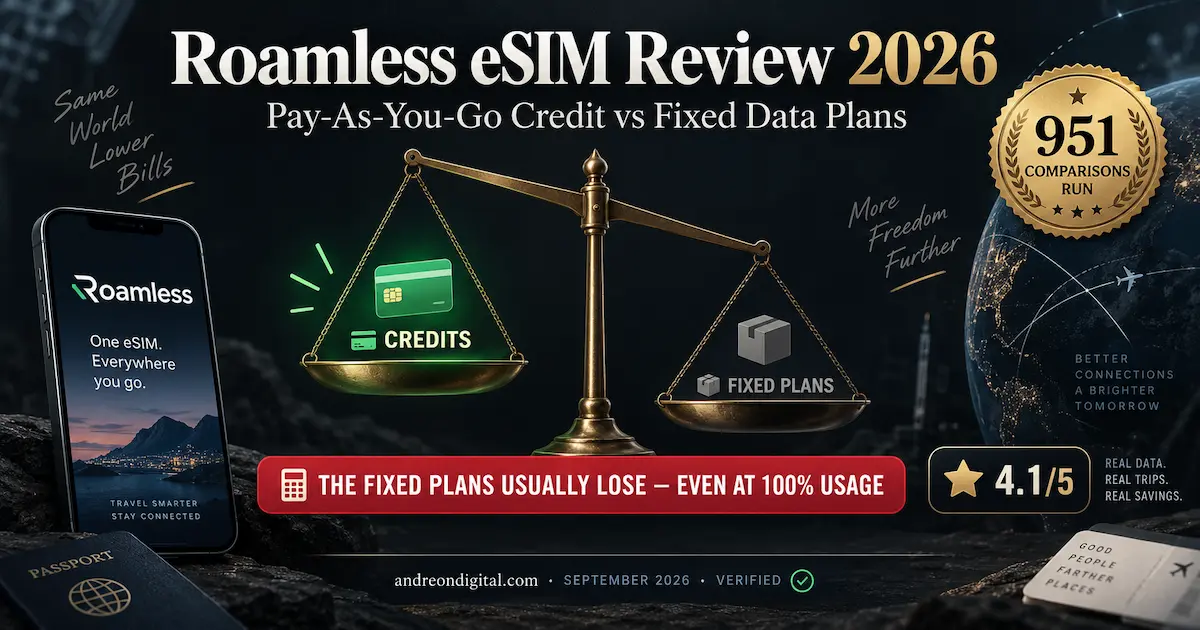
Roamless eSIM Review 2026: 951 country-by-plan comparisons run on Roamless’s own published prices. Contrary to almost every review, pay-as-you-go usually beats the fixed plans — even at full allowance usage. Verified September 2026.
This Roamless eSIM Review 2026 starts with the part that makes the service different. Roamless sells credit — money in a balance, spent per megabyte at each destination’s own rate, on a single global eSIM you never reinstall. Alongside that it also sells conventional fixed 30-day plans. Two models, one profile. Instead of selling you a data pack that expires, it sells you credit — money in a balance, spent per megabyte at each destination’s own rate, on a single global eSIM you never reinstall. Alongside that it also sells conventional fixed 30-day plans. Two models, one profile.
Every review of Roamless we found reaches the same conclusion about which to choose: the credits are the flexible-but-expensive option, and the fixed plans are the economical one. We ran the arithmetic on 951 country-by-plan pairs using Roamless’s own published prices. That conclusion is wrong for most of the tiers people actually buy — and the reason is a piece of arithmetic nobody appears to have done.
How this review is built, and what it is not: I’m based in Belgium and compare eSIM providers full-time. This is a documentary audit with original price analysis, not a field test — I have not used Roamless, so there are no speed, coverage or support claims from experience here. What there is: every rate and rule read from Roamless’s own product pages, help centre and terms on 9 September 2026, plus 951 break-even calculations I ran on those published figures. Where Roamless’s own documents contradict each other — and they do, in three places — this review reports both versions rather than choosing the more flattering one. Related: Saily vs Airalo 2026 · aloSIM Review 2026.
🧮 The finding: for most tiers, Roamless’s fixed plans cannot save you money — even if you use every single gigabyte. In the United States, pay-as-you-go costs $1.95 per gigabyte. Consuming an entire 5GB on credits therefore costs $9.75. The 5GB fixed plan costs $13.45. So the credit route is $3.70 cheaper at 100% usage of the fixed allowance — and cheaper still at any usage below it. The same holds at 1GB, 3GB and 10GB in the US, at 5GB in France and the UK, and across hundreds of other pairs. The fixed plan only starts winning from around 20GB upward. Every published review we found says the opposite.
⚡ Roamless eSIM Review 2026 — Verdict at a Glance
⭐ Rating: 4.1 / 5 — a genuinely different model, let down by documentation that contradicts itself.
✅ The credits are the product: cheaper than the fixed plans at most tiers people buy.
✅ One eSIM, never reinstalled: fixed plans start on first data used, not on purchase.
✅ 203 pay-as-you-go destinations: more than the Global fixed plan’s 126.
✅ Automatic fallback: fixed data can hand off to credit so you are not cut off mid-trip.
❌ “Credits never expire” sits against a 12-month inactivity clause in the Terms.
❌ Activation window: documented as both 18 months and 12 months.
❌ You can’t buy a fixed plan with your credit balance: Roamless says this is “in development”.
❌ One eSIM per account: families need separate accounts.
❌ Numbers can’t be paid with credits and aren’t refundable.
The comparison at the centre of this Roamless eSIM Review 2026 is easier to follow when RoamlessFlex credits and RoamlessFix plans are separated by how they charge, expire and cover destinations.
RoamlessFlex (credits)
RoamlessFix (fixed plans)
What you buy
A monetary balance in USD
A gigabyte allowance
How it’s spent
Per megabyte at each destination’s rate
From the allowance, wherever the plan covers
Validity
Marketed as non-expiring ⚠️
30 days from first data used
Destinations
203
Global 126 · Europe 39 · Africa 43
Same rate everywhere?
❌ Varies by country — $1.95 to $17.45/GB
Flat within the plan’s coverage
Can be paused?
Effectively yes — you just stop spending
❌ No, once activated the clock runs
Buy with credits?
—
❌ Not currently — “in development”
💡 The one thing both share: a single global eSIM profile. You install once and add credit or plans to it as you go, rather than downloading a new eSIM per country. That is unusual in this category and is a real convenience — and it is also why the two models can hand off to each other, covered below.
Roamless App and Global eSIM: How the System Works
For this Roamless eSIM Review 2026, Roamless is easier to understand once you separate the eSIM profile from the way you pay for data. The profile stays on the device, while RoamlessFlex credit or a RoamlessFix plan supplies the data. That single-profile approach is what lets the service follow you between supported destinations without installing a new eSIM each time.
The video above gives the product-level view. The pricing decision still comes down to the numbers: whether you should keep spending from credit or switch to a fixed allowance. The next section runs that comparison using Roamless’s published rates instead of assuming the fixed plan is automatically cheaper.
The Arithmetic Nobody Ran: When a Fixed Plan Cannot Win
The core calculation in this Roamless eSIM Review 2026 changes the recommendation. Divide the fixed plan’s price by the destination’s pay-as-you-go rate. That gives you the break-even: the number of gigabytes you would need to consume for the plan to beat credits.
📐 If the break-even is higher than the plan’s own allowance, the plan cannot save you money at any usage level. Worked example: the US 5GB fixed plan costs $13.45, and US credits cost $1.95/GB. Break-even = 13.45 ÷ 1.95 = 6.9GB. But the plan only holds 5GB. You would need to use 6.9GB out of a 5GB allowance for it to pay off — which is impossible. The plan is worse at every usage level, including 100%.
🇺🇸 United States — PAYG $1.95/GB
Fixed plan
Fix price
Same GB on credits
Break-even
Verdict
1GB
$3.95
$1.95
2.0GB
❌ Credits win by $2.00
3GB
$8.95
$5.85
4.6GB
❌ Credits win by $3.10
5GB
$13.45
$9.75
6.9GB
❌ Credits win by $3.70
10GB
$22.45
$19.50
11.5GB
❌ Credits win by $2.95
20GB
$36.45
$39.00
18.7GB
✅ Fix wins above 18.7GB
50GB
$41.95
$97.50
21.5GB
✅ Fix wins clearly
🇬🇧 UK · 🇫🇷 France · 🇪🇸 Spain · 🇯🇵 Japan — where the flip happens
Destination & plan
PAYG rate
Fix price
Same GB on credits
Cheaper
UK 5GB
$1.95/GB
$12.95
$9.75
Credits by $3.20
France 5GB
$1.95/GB
$11.95
$9.75
Credits by $2.20
France 10GB
$1.95/GB
$18.95
$19.50
Fix by $0.55 — a coin flip
Spain 3GB
$1.95/GB
$5.95
$5.85
Credits by $0.10 — effectively tied
Spain 5GB
$1.95/GB
$8.95
$9.75
Fix by $0.80
Japan 3GB
$2.45/GB
$7.95
$7.35
Credits by $0.60
Japan 5GB
$2.45/GB
$9.95
$12.25
Fix by $2.30
Brazil 3GB
$2.95/GB
$9.45
$8.85
Credits by $0.60
⚠️ The pattern, stated honestly. Credits win decisively at the small and mid tiers in cheap-rate countries — the US, UK, France and most of Western Europe at $1.95/GB. The fixed plan wins where the per-gigabyte rate is higher (Spain’s 5GB, Japan’s 5GB) or where the allowance is large (20GB and above almost everywhere). This is not a blanket verdict against fixed plans. It is a specific finding that at the tiers most travellers actually buy — 3GB to 10GB in common destinations — the credit route usually costs less, which is the opposite of the prevailing advice.
Break-even analysis on Roamless’s own prices: US 5GB costs $9.75 on credits against $13.45 fixed, and a USA–France–Japan trip costs $31.75 on credits against $65.95 for the Global 20GB plan.
Multi-Country Trips: Where the Gap Becomes Large
For the multi-country part of this Roamless eSIM Review 2026, the single-country comparison is close in places. Across borders it stops being close, because a regional or global plan charges you for coverage you may not use while credits charge each country at its own rate.
Itinerary (5GB per country)
On credits
Cheapest single plan
Plan price
Difference
🇺🇸 USA + 🇫🇷 France + 🇯🇵 Japan
$31.75
Global 20GB
$65.95
Credits save $34.20
🇫🇷 France + 🇪🇸 Spain + 🇹🇷 Turkey
$29.25
Europe 20GB
$47.95
Credits save $18.70
🇫🇷 France + 🇪🇸 Spain
$19.50
Europe 10GB
$30.95
Credits save $11.45
🇺🇸 USA + 🇨🇦 Canada + 🇲🇽 Mexico
$36.75
North America 20GB
$39.95
Credits save $3.20
🇯🇵 Japan + 🇹🇭 Thailand + 🇮🇩 Indonesia
$36.75
Asia & Oceania 20GB
$38.95
Credits save $2.20
🇧🇷 Brazil + 🇦🇷 Argentina + 🇨🇱 Chile
$51.75
Latin America 20GB
$48.95
⚠️ Fix wins by $2.80
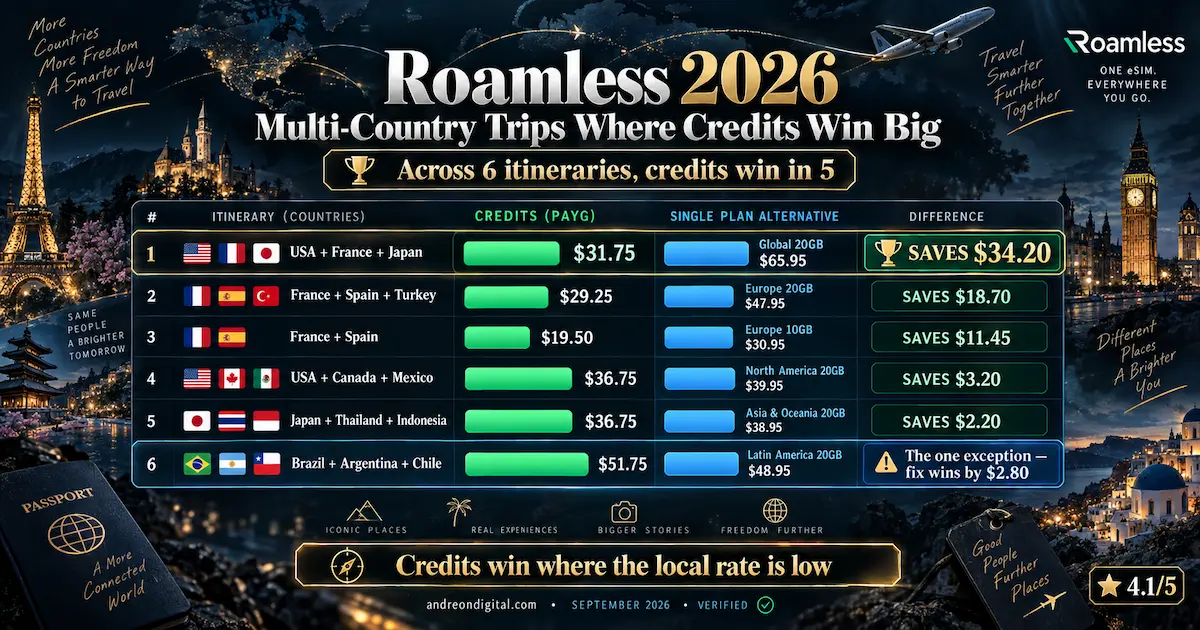
🚨 The Global plan is the one to think hardest about. On a USA–France–Japan trip using 5GB in each country, the credits cost $31.75 and the cheapest Global plan that covers 15GB costs $65.95 — more than double, and you would still have 5GB left unused. That is the single widest gap in our comparison. Latin America is the exception: with rates of $2.95 to $3.95 per gigabyte across Brazil, Argentina and Chile, the regional plan genuinely wins. The rule that emerges is about rates, not about plan type: credits win where the local per-gigabyte rate is low, and lose where it is high.
Across six itineraries, credits beat the single-plan alternative in five. A USA–France–Japan trip saves $34.20, France–Spain–Turkey saves $18.70, and only Latin America favours the regional plan.
Coverage: Credits Reach More Places Than the Global Plan
Coverage is another place where the Roamless eSIM Review 2026 data changes the usual assumption. Roamless advertises 200-plus destinations. As with every provider we audit, that is the brand catalogue — but here the detail runs in an unusual direction.
Offer
Destinations
Entry price
Note
Pay-as-you-go credits
203
$1.95/GB at cheapest
Widest reach of anything Roamless sells
Global fixed plan
126
$8.45 / 1GB
77 fewer than credits
Africa
43
$10.95 / 1GB
Most expensive regional entry
Europe
39
$4.95 / 1GB
50GB at $69.95 = $1.40/GB
Caribbean
28
$7.95 / 1GB
—
Asia & Oceania
20
$3.95 / 1GB
50GB at $58.95 = $1.18/GB — best rate
Latin America
14
$6.95 / 1GB
The one region where fixed beats credits
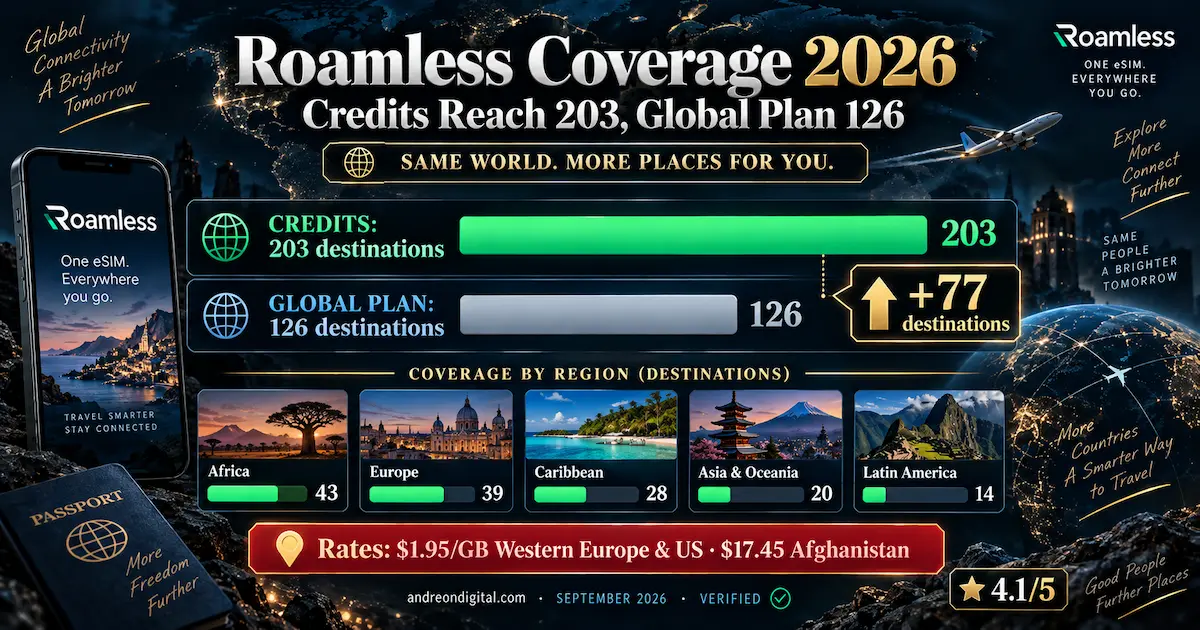
🗺️ Credits cover 77 more destinations than the Global plan. That inverts the usual assumption that the flexible option is the narrow one. If you are heading somewhere unusual, the credit balance may reach it where the Global fixed plan does not — a second reason, alongside price, that the credits are not simply the expensive convenience option. Rates vary enormously though: $1.95/GB in Western Europe and the US, against $17.45 in Afghanistan, $14.95 in Belize and $14.45 in Burundi. The widely-quoted “$2.45 per GB average” is dragged upward by those outliers; in the countries most people visit, the rate is lower.
Roamless coverage September 2026: pay-as-you-go credits reach 203 destinations against the Global fixed plan’s 126 — inverting the usual assumption that the flexible option is the narrow one.
Three Contradictions in Roamless’s Own Documentation
One reason this Roamless eSIM Review 2026 reports both versions of a rule is that Roamless’s own published pages do not always agree with one another.
🚨 1. “Credits never expire” versus a 12-month inactivity clause. Roamless markets its credits as non-expiring, consistently across its product pages, and every review repeats it. Its Terms and Conditions contain a separate clause allowing account inactivation after 12 months without activity, with consequences for the balance. We are not in a position to determine which text prevails — that is a legal question. But the conflict sits inside Roamless’s own published documents. Separately, promotional and bonus credits definitely do expire: support states windows of 30 to 180 days depending on the code.
🚨 2. The activation window is 18 months in one article and 12 in another. Fixed plans start their 30-day clock on first data used, which is genuinely useful — you can buy months ahead. How long you have to start one is documented inconsistently across two Roamless support articles. We report both rather than publishing either as a guarantee.
🚨 3. The annual Numbers price doesn’t match its own displayed monthly equivalent. Roamless lists a number subscription at $59.95 per year and displays a $4.95 monthly equivalent alongside it. $59.95 ÷ 12 = $5.00. It is five cents, and it changes nothing about whether to buy — but use the annual total rather than the displayed equivalent when comparing.
What Happens When Your Data Runs Out
A practical part of this Roamless eSIM Review 2026 is what happens after a fixed allowance is exhausted, because the connection can continue by drawing from your credit balance.
🔄 Roamless documents a consumption priority: eligible rewards first, then a valid fixed plan, then your credit balance. So when fixed data is exhausted or expires, the connection continues by drawing on whatever credit you hold. That is genuinely useful — it is why several reviewers recommend keeping a few dollars of credit as insurance against being cut off mid-trip, and we agree with that advice.
⚠️ But it means a fixed plan is not a spending cap. If you buy a fixed plan expecting it to be a hard ceiling on what you spend, the fallback quietly removes that ceiling whenever you have a balance. Two related conditions: Auto Top Up triggers whenever your balance drops below $5 — a fixed trigger, and having fixed data remaining does not prevent that charge. And the minimum top-up validated on the public web selector is $1. If you want a genuine cap, keep the balance at zero and Auto Top Up off.
Consumption priority: rewards, then fixed plan, then credits. The fallback prevents being cut off mid-trip — but it also means a fixed plan is not a spending cap while you hold a balance, and Auto Top Up fires below $5 regardless.
Roamless Numbers, Calls and SMS
The Roamless eSIM Review 2026 also checks the phone-number features separately from mobile data. The eSIM itself remains data-only. Calls, SMS and phone numbers are app features, running over any internet connection — Wi-Fi, another SIM, or the Roamless data itself.
Feature
Detail
Number subscription
$6.95/month or $59.95/year, per number · multiple subscriptions allowed
Number origins
🇺🇸 US · 🇨🇦 Canada · 🇬🇧 UK · 🇦🇺 Australia — no KYC documented for these four
Incoming calls & SMS
Free with an active subscription
Outgoing calls
Draw on your credit balance · advertised from $0.01/min · price shown before dialling
Calls without a subscription
✅ Possible — outgoing only, paid from credits
Roamless-to-Roamless
Free and end-to-end encrypted — both users need a number or verified line
Use your own number
Free verification · outgoing caller ID only · one per account
Renewal
Three days before the next period — cancel before that
Refunds on Numbers
❌ None — stated basis is that the number is in use immediately
Paying with credits
❌ Not possible — card, Apple Pay or Google Pay only
Message history
❌ Cannot be backed up or restored
📞 Two things “one balance” does not cover. First, the Numbers subscription cannot be paid with Roamless Credits — it requires a card or wallet. So the single-balance idea covers data and outgoing call charges, but not the subscription itself. Second, verifying your own number is not porting: your number stays with your original carrier, incoming calls still ring through your normal phone app, and incoming SMS still arrive in your normal messaging app. Only a purchased Roamless Number receives conventional SMS inside the app. Support states these Numbers can receive OTP and two-factor codes — but no bank or app was tested here, so treat that as a provider statement rather than a verified result.
Setup, Devices and Account Limits
Before installing, confirm that your phone supports eSIM and is carrier-unlocked. Our eSIM compatible phones list covers supported models, while the eSIM activation guide walks through the general setup process. For the platform-level steps, Apple’s official eSIM setup guide explains how eSIM activation works on supported iPhones. If you are deciding between digital and traditional connectivity for a Europe trip, see eSIM vs physical SIM for Europe.
✅ Support declared for 9eSIM, eSIM.me and similar — adapter is a separate product
Reinstalling the profile
✅ Can be deleted and reinstalled without losing balance — no stated limit
Changing phones
✅ eSIM can be moved to a new device, preserving account and balance
Family / multiple devices
❌ One active eSIM per account — several devices need separate accounts
Free starter credit
$1.25 for new users, once per account, up to around 500MB depending on destination
Payment
Cards, Apple Pay, Google Pay · charged in USD
Refunds
Documented for device incompatibility · ❌ not for used balance · Terms stricter than help articles
Deleting your account
⚠️ Permanent — removes credits, plans and rewards, and invalidates the eSIM
Speed
No provider-imposed cap advertised — a commercial statement, not a measured result
✅ Two genuine advantages worth naming. The profile can be deleted and reinstalled without losing your balance, and the eSIM can be moved to a new phone — both unusual in this category, where most providers tie the profile to the first device permanently. If you have ever lost a plan by changing handsets mid-trip, that difference matters more than a few dollars per gigabyte.
How to Install Roamless eSIM on iPhone
If you are using an iPhone, the installation is separate from choosing between credits and a fixed plan. The eSIM profile is added to iOS first, then the Roamless account determines what balance or package the connection can use.
After installation, keep the Roamless line available for mobile data and follow the app’s activation instructions for your trip. If the eSIM installs but does not connect, work through our eSIM not working troubleshooting guide before deleting the profile or changing network settings at random.
Is Roamless pay-as-you-go cheaper than its fixed plans?
Usually, and that contradicts what almost every review of Roamless concludes. We ran the arithmetic on 951 country-by-plan pairs from Roamless’s own published prices in September 2026. In the United States, pay-as-you-go costs $1.95 per gigabyte, so consuming an entire 5GB costs $9.75 — against $13.45 for the 5GB fixed plan. The credit route is $3.70 cheaper even if you use every last megabyte of the fixed allowance. The same holds at 1GB, 3GB and 10GB in the US, and at 5GB in France and the UK. The fixed plan only starts winning from around 20GB upward. The reason is simple once you see it: for those tiers, the fixed price divided by the per-gigabyte rate is higher than the allowance itself, so there is no usage level at which the plan pays off. Verified September 2026.
What is the break-even point between Roamless credits and fixed plans?
Divide the fixed plan’s price by the destination’s pay-as-you-go rate. That gives the number of gigabytes you would have to consume for the plan to beat credits. If that figure is larger than the plan’s own allowance, the plan cannot save you money at any usage level. A worked example: the US 5GB fixed plan costs $13.45 and US credits cost $1.95 per gigabyte, so the break-even is 6.9GB — but the plan only holds 5GB. You would need to use 6.9GB out of a 5GB allowance for it to pay off, which is impossible. By contrast the US 20GB plan at $36.45 breaks even at 18.7GB, comfortably inside its allowance, so it does save money if you use most of it. Verified September 2026.
Do Roamless credits really never expire?
That is what the product pages say, and there is a conflicting clause in the terms worth knowing about. Roamless markets its credits as non-expiring, and the marketing is consistent across its pages. However, its Terms and Conditions contain a separate clause allowing account inactivation after 12 months without activity, with possible consequences for the balance. We are not in a position to determine which text prevails in a dispute — that is a legal question, not an editorial one. What we can say is that the conflict exists inside Roamless’s own published documents, and that promotional or bonus credits are a different matter entirely: support states those carry expiry windows of 30 to 180 days depending on the code. Verified September 2026.
What happens when a Roamless fixed plan runs out?
It falls back to your credit balance automatically, and this is worth understanding before you rely on a fixed plan as a spending cap. Roamless documents a consumption priority: eligible rewards first, then a valid fixed plan, then your pay-as-you-go credits. So when the fixed data is exhausted or expires, the connection continues by drawing on whatever credit balance you hold. That is genuinely useful as insurance against being cut off mid-trip. It also means a fixed plan does not create an absolute ceiling on spending if you have credits sitting in the account. If you want a hard cap, keep the balance at zero — and note that Auto Top Up, if enabled, triggers a charge whenever the balance drops below $5, regardless of how much fixed data you still have. Verified September 2026.
When does a Roamless fixed plan’s 30 days start?
On the first eligible data consumed, not on purchase or installation. That is a genuine advantage over most travel eSIMs, because you can buy ahead without burning validity. Two caveats. First, once activated the plan cannot be paused — switching the eSIM off stops consumption but does not stop the 30-day clock. Second, the window for starting a plan after purchase is documented inconsistently: one Roamless support article states 18 months, another states 12. We report both rather than publishing either as a guarantee. If you are buying months ahead, that difference could matter, so it is worth confirming with support. Verified September 2026.
How many destinations does Roamless actually cover?
More on pay-as-you-go than on its Global plan, which is the opposite of what most travellers assume. Roamless publishes pay-as-you-go rates for 203 destinations, while its fixed Global plan lists 126. The regional plans are narrower still: Africa covers 43, Europe 39, the Caribbean 28, Asia and Oceania 20, and Latin America 14. So if your destination is unusual, the credit balance may reach it when the Global plan does not — another reason the flexible option is not simply the expensive one. As always, open the specific plan’s country list rather than relying on the 200-plus headline, which describes the brand catalogue. Verified September 2026.
How much do Roamless Numbers cost?
$6.95 per month or $59.95 per year for each number, purchased as a separate subscription. Numbers are available from four origins — United States, Canada, United Kingdom and Australia — with no KYC documented for that initial set, and you can hold more than one subscription on the same account. Incoming calls and SMS are free with an active subscription; outgoing calls to ordinary phones draw on your credit balance, with rates advertised from $0.01 per minute and shown in the app before you dial. Note one arithmetic detail: the annual price works out to $5.00 a month, while Roamless’s own page displays a $4.95 monthly equivalent. Use the annual total rather than the displayed equivalent. Verified September 2026.
Can I pay for Roamless Numbers with my credit balance?
No, and this is the clearest limit on the one-balance idea. Roamless support specifies that Numbers subscriptions are paid by card, Apple Pay or Google Pay — not with Roamless Credits. So the slogan describing a single balance covers data and outgoing call charges, but not the number subscription itself. Two related conditions: Numbers are not refunded, on the stated basis that the number goes into use immediately; and an active subscription blocks removal of your saved payment method until you cancel. Renewal is processed three days before the next billing period, so cancel before that window rather than on the renewal date. Verified September 2026.
Can I use my own phone number with Roamless?
For outgoing calls and texts, yes — and it is free to verify, with no Numbers subscription required. Verification happens in the app profile and lets your existing number appear as the caller ID on outgoing calls and SMS made through Roamless. Three things it is not. It is not number porting: your number stays with your original carrier. Incoming calls to that number still ring through your carrier and your normal phone app, not Roamless. And incoming SMS to it still arrive in your normal messaging app — only a purchased Roamless Number receives conventional SMS inside the app. You can verify one number per account, and swapping it means removing the current one first. Verified September 2026.
What are the main limitations of Roamless?
Five worth knowing before you buy. Only one eSIM can be active per account, so a family travelling together needs separate accounts rather than several profiles under one. Fixed plans cannot currently be bought with your credit balance — support describes that as in development. Message history in the app cannot be backed up or restored. Refunds are documented for device incompatibility but not for unused balance after usage has begun, and the terms are more restrictive than the help articles on this point. And while the product advertises no provider-imposed speed cap, that is a commercial statement rather than an independently measured result — no speed, coverage or support testing was carried out for this review. Verified September 2026.
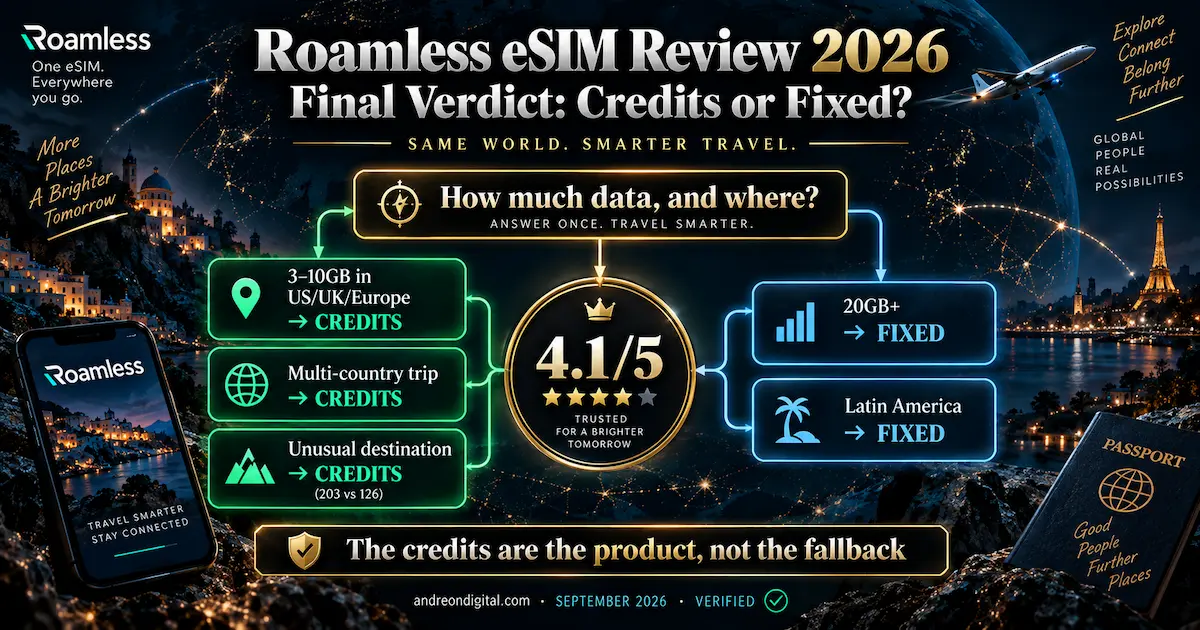
Roamless Review 2026 verdict: 4.1/5. Buy credits for 3–10GB in cheap-rate countries and for multi-country trips; buy fixed plans from 20GB upward and in Latin America. The credits are the product, not the fallback.
Final Verdict: Roamless eSIM Review 2026 — 4.1 / 5
Roamless is doing something genuinely different, and the received wisdom about how to use it is backwards. The credits are not the expensive convenience option to fall back on — at the tiers most people buy, in the countries most people visit, they are simply the cheaper product.
💳 Buy credits for: 3–10GB in the US, UK, France and most of Western Europe at $1.95/GB — cheaper than the fixed plan even at 100% usage
🌍 Buy credits for multi-country trips: USA–France–Japan costs $31.75 on credits against $65.95 for the Global plan
🗺️ Buy credits for unusual destinations: 203 covered against the Global plan’s 126
📦 Buy fixed plans from 20GB upward — the US 20GB at $36.45 beats $39 on credits, and 50GB isn’t close
🌎 Buy fixed plans in Latin America — the one region where the regional plan genuinely wins, by $2.80 on a three-country trip
⚠️ Whatever you buy: a fixed plan is not a spending cap while you hold credits, and Auto Top Up fires below $5 regardless
Three caveats to carry. “Credits never expire” sits against a 12-month inactivity clause in the Terms, and we cannot say which prevails. The activation window is documented as both 18 and 12 months.
Only one eSIM can be active per account, so a couple or family travelling together needs separate accounts rather than several profiles. These are not automatic reasons to avoid Roamless, but they are reasons to check the specific page for the product you are buying.
This article may contain affiliate links; where it does, I may earn a commission at no extra cost to you. This review is a documentary audit with original price analysis rather than a field test, and is presented as such. I have not used Roamless, so there are no speed, coverage, network or customer-support claims from experience here, and none should be inferred.
Every price, rate, rule and limitation was read from Roamless’s own product pages, help centre articles and Terms and Conditions on 9 September 2026. The audit covers 994 fixed packages, 203 pay-as-you-go rates, 498 coverage rows and 1,648 raw voice and SMS references.
The 951 break-even comparisons and six itinerary scenarios are my own arithmetic applied to those published figures, without promotions, coupons or rewards, and assuming full consumption of each fixed allowance. Roamless publishes all prices in USD, including for European destinations; no currency conversion has been applied.
Where Roamless’s own documents contradict each other, this review reports both versions rather than selecting one. Credits are marketed as non-expiring while the Terms contain a 12-month inactivity clause; the fixed-plan activation window appears as both 18 and 12 months; and the annual Numbers price of $59.95 equates to $5.00 monthly rather than the $4.95 displayed. Prices and terms change without notice, so always confirm at checkout.
We use cookies to improve your experience. Accept or manage preferences.
Functional
Always active
The technical storage or access is strictly necessary for the legitimate purpose of enabling the use of a specific service explicitly requested by the subscriber or user, or for the sole purpose of carrying out the transmission of a communication over an electronic communications network.
Preferences
The technical storage or access is necessary for the legitimate purpose of storing preferences that are not requested by the subscriber or user.
Statistics
The technical storage or access that is used exclusively for statistical purposes.The technical storage or access that is used exclusively for anonymous statistical purposes. Without a subpoena, voluntary compliance on the part of your Internet Service Provider, or additional records from a third party, information stored or retrieved for this purpose alone cannot usually be used to identify you.
Marketing
The technical storage or access is required to create user profiles to send advertising, or to track the user on a website or across several websites for similar marketing purposes.