





Nearly every guide answers this the same way. Two countries, so buy two country plans, because regional bundles are for people crossing five borders. It sounds obvious, and for one common itinerary it is correct.
For Best eSIM for Japan and South Korea 2026, the useful question is not simply whether regional or local plans are cheaper. It is whether the package structure fits the way your days and data are actually divided between the two countries.
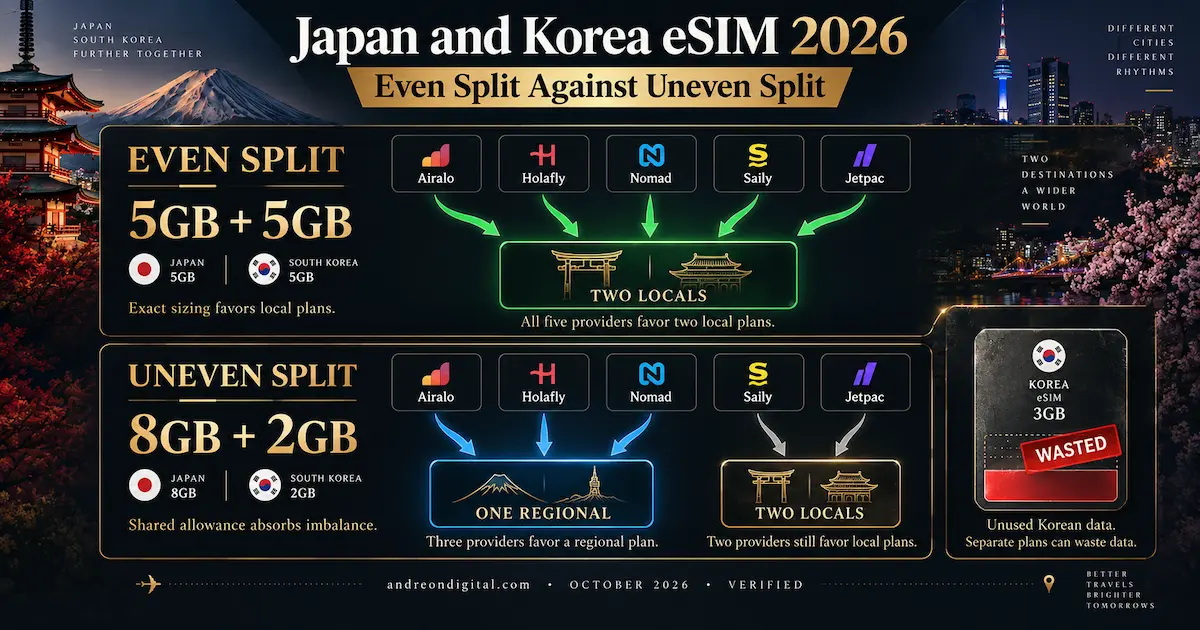
We costed six real Japan and Korea itineraries against five providers, picking the cheapest package from each that genuinely covers both the data and the days. On an even split the local plans win on every provider, while on an uneven split the regional plan wins on three of five.
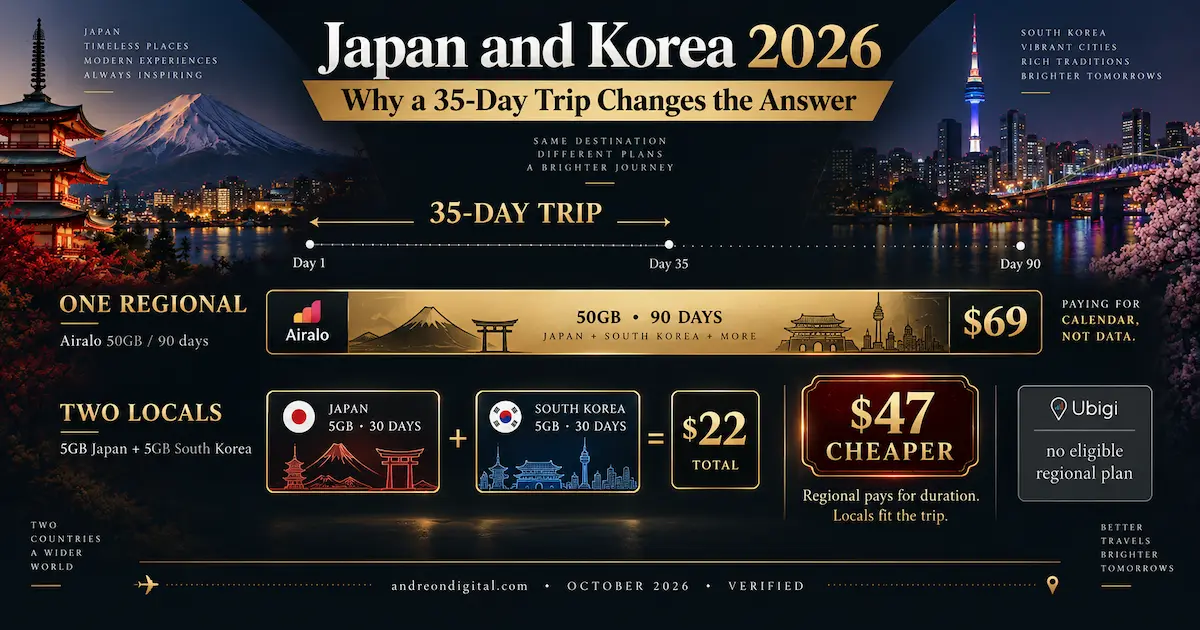
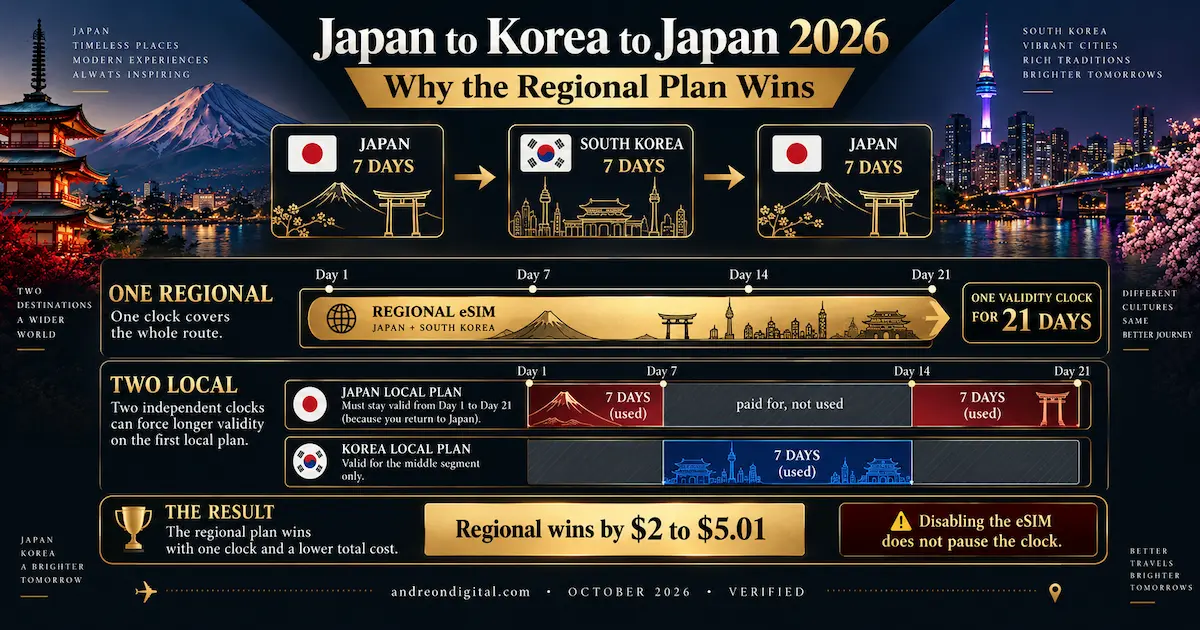
On a 35-day trip the local plans win by as much as $47. If you return to Japan after Korea, the regional plan wins again, which is why a single rule cannot describe every itinerary.
Two things explain all of it, and neither has anything to do with coverage. A regional plan is one allowance on one clock. Two local plans are two allowances on two independent clocks. Which of those suits you is decided entirely by the shape of your trip.
⚡ Which Structure for Which Trip
⚖️ Even split, 7 days and 5GB each: ✅ Two local plans, on all five providers
📊 Uneven split, 8GB and 2GB: ✅ One regional on Airalo, Jetpac and Nomad
📅 Long trip, 35 days: ✅ Two local plans, by up to $47
🔁 Japan, then Korea, then Japan again: ✅ One regional, by up to $5
💶 Cheapest overall for two weeks: Jetpac · regional $19.99 · two locals $17.50
🌏 Widest regional footprint: Airalo Asialink · 18 destinations · 10GB/15d $24
⚠️ Ubigi’s $6 Japan and Korea plan is monthly with a three-month minimum
⚠️ You cannot top up a Japan plan to make it work in Korea. Both say so
The Two Things That Decide It
In Best eSIM for Japan and South Korea 2026, two variables explain almost every price reversal: whether the data allowance is shared or separated, and whether one validity clock or two independent clocks fit the route better.
| One regional plan | Two local plans | |
|---|---|---|
| Data | ✅ One shared allowance. Unused Korean gigabytes work in Japan | ⚠️ Two separate allowances. What you do not use in one country is lost |
| Validity | ⚠️ One clock that has to stretch across the whole trip | ✅ Two independent clocks, each sized to its own leg |
| Wins when | Your use is uneven, or you return to the first country | Your split is even, or the trip is long |
| Setup | One profile, one install | Two profiles, two QR codes, one switch mid-trip |
| Networks | ⚠️ Can differ from the country plan’s, and between regional products | Published per country by most providers |
Six Itineraries, Costed
For Best eSIM for Japan and South Korea 2026, each figure below is the cheapest package from that provider that genuinely covers the required data in each country and the full number of travel days. A negative number means two local plans came out cheaper.
⚖️ Even split: 7 days Japan and 7 days Korea, 5GB each
| Provider | One regional | Two locals | Difference | Winner |
|---|---|---|---|---|
| Jetpac | $19.99 | $17.50 | −$2.49 | ✅ Locals |
| Nomad | $21 | $20 | −$1 | ✅ Locals |
| Airalo | $24 | $20 | −$4 | ✅ Locals |
| Ubigi | $28 | $22 | −$6 | ✅ Locals |
| Saily | $35.99 | $21.98 | −$14.01 | ✅ Locals |
This is the itinerary the standard advice is built on, and the advice is right: two local plans win on all five providers. We cover this case in more detail in our Asia guide; everything below is where it stops being that simple.
📊 Uneven split: 10 days Japan and 4 days Korea, 8GB and 2GB
| Provider | One regional | Two locals | Difference | Winner |
|---|---|---|---|---|
| Jetpac | $19.99 | $23.50 | +$3.51 | ✅ Regional |
| Nomad | $21 | $24 | +$3 | ✅ Regional |
| Airalo | $24 | $26.50 | +$2.50 | ✅ Regional |
| Ubigi | $28 | $23.50 | −$4.50 | Locals |
| Saily | $35.99 | $26.98 | −$9.01 | Locals |
📅 Long trip: 18 days Japan and 17 days Korea, 5GB each
| Provider | One regional | Two locals | Difference | Why |
|---|---|---|---|---|
| Airalo | $69 | $22 | ⚠️ −$47 | Nearest regional fit is 50GB over 90 days |
| Jetpac | $50 | $21 | ⚠️ −$29 | Nearest fit is a global plan over 180 days |
| Saily | $48.99 | $21.98 | ⚠️ −$27.01 | Needs the 25GB over 60 days tier |
| Nomad | $31 | $20 | −$11 | Its 45-day regional softens the gap |
| ⚠️ Ubigi | ⚠️ None eligible | $30.50 | — | ⚠️ No regional plan in our sample covered 35 days |
🔁 Return trip: 7 days Japan, 7 days Korea, then 7 days Japan again, 8GB and 2GB
| Provider | One regional | Two locals | Difference | Winner |
|---|---|---|---|---|
| Jetpac | $19.99 | $25 | +$5.01 | ✅ Regional |
| Nomad | $21 | $24 | +$3 | ✅ Regional |
| Airalo | $25 | $27 | +$2 | ✅ Regional |
🧳 Heavier two-week trip: 14 days Japan and 7 days Korea, 10GB each
| Provider | One regional | Two locals | Difference | Winner |
|---|---|---|---|---|
| Ubigi | $44 | $28.50 | −$15.50 | ✅ Locals |
| Saily | $48.99 | $36.98 | −$12.01 | ✅ Locals |
| Jetpac | $39.99 | $30 | −$9.99 | ✅ Locals |
| Airalo | $39 | $35.50 | −$3.50 | ✅ Locals |
| Nomad | $31 | $34 | +$3 | ✅ Regional |
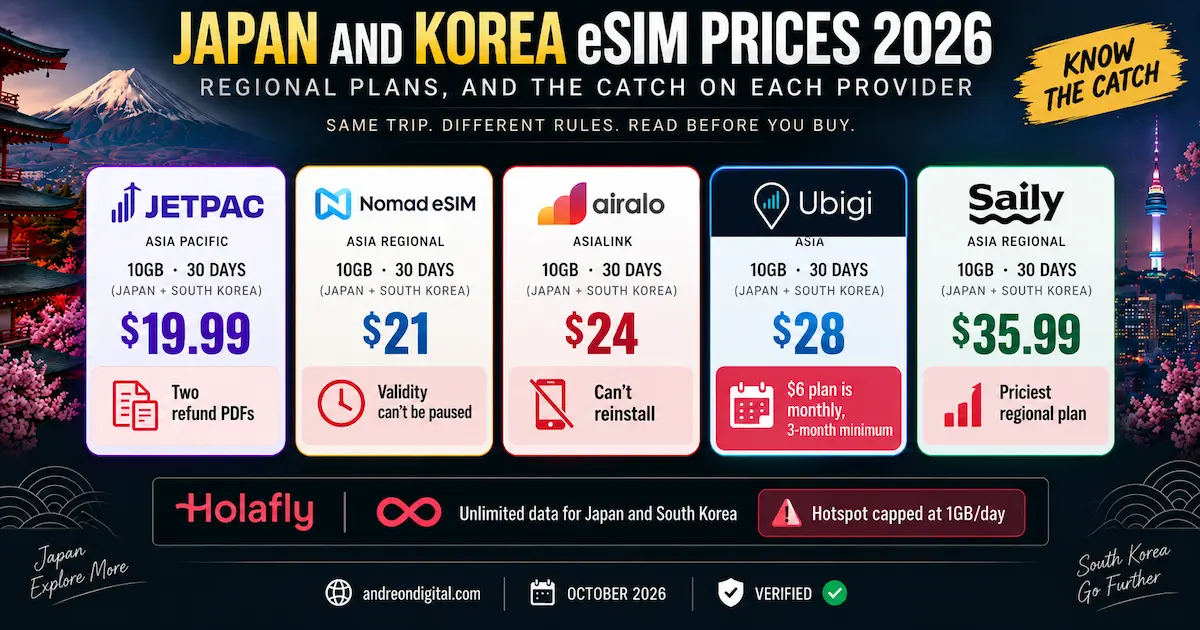
The Six Providers at a Glance
This provider snapshot turns Best eSIM for Japan and South Korea 2026 into a quick shortlist: the headline price matters, but the refund, validity, reinstall, subscription and hotspot conditions can change which plan actually fits your trip.
| Provider | Regional for both | The catch worth knowing |
|---|---|---|
| Jetpac | Asia Pacific 10GB / 30d $19.99 · 30GB / 30d $39.99 | ⚠️ Two refund PDFs with different rules, one with a Moneyback clause and one without |
| Nomad | APAC 10GB / 30d $21 · CN-JP-KR 20GB / 45d $31 | ⚠️ Validity starts once and cannot be paused. Add-ons only while the plan is still active |
| Airalo | Asialink 10GB / 15d $24 · 10GB / 30d $25 · 20GB / 30d $39 | ⚠️ Usually cannot reinstall a removed profile. 365 days to activate |
| Ubigi | Best Asia 10GB / 30d $28 · 25GB / 30d $44 | ⚠️ The $6 Japan and Korea plan is monthly with a three-month minimum |
| Saily | Asia and Oceania 10GB / 30d $35.99 · 25GB / 60d $48.99 | ⚠️ Most expensive regional here, while staying competitive on local plans |
| Holafly | A dedicated Japan plus South Korea unlimited product by duration | ⚠️ Hotspot capped at 1GB a day. No published gigabyte or speed ceiling on its fair use |
The Six Providers in Detail
Prices below are the published one-off packages read on 4 October 2026. Where a provider publishes the networks per package we name them, and where it does not we say so rather than guessing.
Jetpac came out cheapest in our costings whichever structure you choose, which is unusual and makes it the default starting point for this route. Its Asia Pacific 10GB over 30 days is $19.99 across 17 destinations, and its two local plans for a standard week in each country come to $17.50.
That makes Jetpac the price benchmark inside Best eSIM for Japan and South Korea 2026. It is also the only provider here that publishes a named network for each country on the local plans, KDDI in Japan and SK Telecom in Korea. Our Jetpac review covers the app and perks, and our Jetpac vs Airalo comparison runs 24 matched pairs across other regions.
| Plan | USD | EUR | Scope |
|---|---|---|---|
| Asia Pacific 10GB / 30 days | $19.99 | €19 | 17 destinations |
| Asia Pacific 5GB / 30 days | $13.50 | €13 | 17 destinations |
| Asia Pacific 15GB / 30 days | $29.99 | €28.50 | 17 destinations |
| ⚠️ Asia Pacific 20GB / 30 days | ⚠️ $55 | €52.50 | ⚠️ More than the 30GB |
| Asia Pacific 30GB / 30 days | $39.99 | €38 | 17 destinations |
| 🇯🇵 Japan 5GB / 7 days · 10GB / 30 days | $8 · $16 | €8 · €15.50 | KDDI |
| 🇰🇷 South Korea 5GB / 7 days · 10GB / 30 days | $9.50 · $17 | €9.50 · €16.50 | SK Telecom |
| Asia Pacific Unlimited 7 days · 30 days | $24.99 · $65.99 | €24 · €63 | 3GB per 24h, then up to 1 Mbps |
Best for: almost everyone on this route, either way, as long as you check the tier above.
Jetpac eSIM for Japan and South Korea: Video Review
If Jetpac is on your shortlist, this video gives you a visual walkthrough of the provider before you choose between its Asia Pacific plan and separate Japan and South Korea packages. Use it together with the current prices above, because the best-value tier can change even inside the same Jetpac range.
The practical takeaway is to compare the regional package with both local plans for your exact dates and data need. For this Japan and South Korea comparison, Jetpac is strongest when its shared Asia Pacific allowance matches your route without forcing you into an oversized tier.
Nomad is the only provider here with a product designed for exactly this corner of Asia, and it is why it won our heavier two-week scenario outright. The China, Japan and South Korea plan gives 20GB over 45 days for $31, which is both the right volume and a duration no one else matches at that price.
Within Best eSIM for Japan and South Korea 2026, Nomad stands out when the route adds China or needs 45 days of validity. Its locals are competitive too, at $10 for 5GB over 30 days in each country. Our Nomad review explains how its regional range is organised.
| Plan | USD | EUR | Destinations |
|---|---|---|---|
| CN-JP-KR 20GB / 45 days | $31 | €27.55 | 3 |
| CN-JP-KR 5GB / 30 days | $14 | €12.44 | 3 |
| Regional APAC 10GB / 30 days | $21 | €18.66 | ⚠️ 14 |
| ⚠️ Regional APAC 10GB / 30 days | ⚠️ $31 | €27.55 | ⚠️ 21 |
| 🇯🇵 Japan 5GB · 10GB / 30 days | $10 · $16 | €8.89 · €14.22 | KDDI au, SoftBank |
| 🇰🇷 South Korea 5GB · 10GB / 30 days | $10 · $18 | €8.89 · €16 | LG U+, SK Telecom |
| 🇯🇵 Japan Unlimited 7 days | $25 | €22.22 | 2GB per 24h, then up to 1 Mbps |
| ⚠️ 🇰🇷 Korea Unlimited 7 days | $25 | €22.22 | 2GB per 24h, then up to 512 kbps |
Best for: routes that add China, heavier two-week trips, and anyone who wants 45 days of validity rather than 30.
Nomad eSIM for Japan and South Korea: Video Review
This Nomad video adds a visual reference for the app and plan experience before you decide between APAC, the dedicated China, Japan and Korea package, or two local plans. That distinction matters here because Nomad sells regional products with different destination counts at different prices.
For this route, check the exact package name, destination count, allowance and validity before checkout. The dedicated China, Japan and South Korea option is especially relevant when China is part of the same trip or when 45 days of validity fits better than a standard 30-day plan.
Airalo’s Asialink covers 18 destinations, the widest regional footprint in this comparison, which makes it the one to pick if the route might extend beyond these two countries. Its local plans are well priced too, at $10 for 5GB over 7 days in either country.
For Best eSIM for Japan and South Korea 2026, Airalo is especially relevant when you want a broader Asia footprint or buy well ahead of travel, since it gives 365 days to activate after purchase. Our Airalo review covers the app, Airmoney and refund rules in full.
| Plan | USD | EUR | Networks published |
|---|---|---|---|
| Asialink 10GB / 15 days | $24 | €22 | ⚠️ Not published per country |
| Asialink 5GB / 30 days · 10GB / 30 days | $15 · $25 | €14 · €23 | ⚠️ Not published per country |
| Asialink 20GB / 30 days · 50GB / 90 days | $39 · $69 | €35.50 · €62.50 | ⚠️ Not published per country |
| 🇯🇵 Moshi Moshi 5GB / 7 days | $10 | €9.50 | ✅ SoftBank 5G, KDDI 5G |
| 🇯🇵 Moshi Moshi 10GB · 20GB / 30 days | $18 · $25 | €16.50 · €23 | ✅ SoftBank 5G, KDDI 5G |
| 🇰🇷 Jjang 5GB / 7 days | $10 | €9.50 | ✅ SK 5G |
| 🇰🇷 Jjang 10GB · 20GB / 30 days | $19 · $30 | €17.50 · €27.50 | ✅ SK 5G |
| Asialink Unlimited 7 days · 30 days | $26 · $73.50 | €23.50 · €66.50 | 3GB per 24h, then up to 1 Mbps |
Best for: routes that may extend past Japan and Korea, and anyone buying well ahead of travel.
Airalo eSIM for Japan and South Korea: Video Review
This Airalo video is useful if you want to see the provider experience before comparing Asialink with the separate Moshi Moshi and Jjang country plans. The important point for this article is that a regional allowance is shared across both countries, while the two local allowances remain separate.
After watching, compare the exact Airalo package against your itinerary rather than choosing by brand alone. For Japan and South Korea, the local plans can be cheaper on balanced trips, while the shared regional allowance can make more sense when your data use is uneven.
Ubigi’s appeal here is structural rather than purely about price. Its app lets you hold plans for both countries inside one profile, selecting the right one as you move, which gives you local pricing without installing two eSIMs.
Its local plans are genuinely cheap, with Korea 10GB over 30 days at $14 and Japan 10GB at $16.50, and they perform well in the uneven-split and heavier-trip scenarios. Its regional range is the weak spot, which is why local plans beat it in most of the comparisons above.
| Plan | USD / EUR | Note |
|---|---|---|
| ⚠️ Japan + South Korea | ⚠️ $6 / €6 a month | ⚠️ Three-month minimum, so around $18 to start |
| 🇰🇷 South Korea 10GB / 30 days | $14 / €14 | LG U+ named on this package |
| 🇰🇷 South Korea 3GB / 7 days · 25GB / 30 days | $7 · $25 | — |
| 🇯🇵 Japan 10GB / 30 days | $16.50 / €16.50 | KDDI named on this package |
| 🇯🇵 Japan 5GB / 15 days · 25GB / 30 days | $10 · $32 | — |
| Asia 10GB / 30 days | $42 / €42 | 26 destinations |
| ⚠️ Japan Unlimited / 30 days | $65 / €65 | ⚠️ 60GB in total, then up to 2 Mbps |
| ⚠️ Korea Unlimited / 7 days | $25 / €25 | ⚠️ 25GB in total, then up to 2 Mbps |
Best for: keeping both countries in one profile, cheap Korean data, and regular travellers on this route who can use the monthly plan properly.
Ubigi eSIM for Japan and South Korea: Video Review
This Ubigi video gives you a visual look at the service before you compare its one-off country plans, regional plans and the Japan plus South Korea subscription. That product mix is important because the low monthly headline is not the same type of purchase as a one-off travel package.
For a normal holiday, compare Ubigi using the one-off Japan and South Korea plans unless the subscription terms genuinely fit your travel pattern. Its ability to keep plans for both countries inside one profile is useful, but the price comparison still needs to use equivalent products.
Saily was the most expensive regional option in every scenario we ran, while its local plans remain competitive. At $10.99 for 5GB over 30 days in either country it sits alongside the cheaper providers, but its Asia and Oceania 10GB at $35.99 is $16 more than Jetpac’s regional equivalent.
Where Saily does lead is the fair use limit: its unlimited plans publish 5GB a day, the most generous daily allowance here, against 3GB on Airalo and Jetpac and 2GB on Nomad. Our Saily review covers the bundled security tools, and our Saily vs Airalo comparison looks at how the two line up elsewhere.
| Plan | USD | EUR | Note |
|---|---|---|---|
| 🇯🇵 Japan 5GB / 30 days | $10.99 | €9.99 | KDDI and SoftBank on 4G/LTE |
| 🇯🇵 Japan 10GB · 20GB / 30 days | $17.99 · $24.99 | €15.99 · €21.99 | — |
| 🇰🇷 South Korea 5GB / 30 days | $10.99 | €9.99 | Networks not published |
| 🇰🇷 South Korea 10GB · 20GB / 30 days | $18.99 · $29.99 | €16.99 · €26.49 | — |
| Asia and Oceania 10GB / 30 days | ⚠️ $35.99 | €31.99 | ⚠️ Priciest regional here |
| Asia and Oceania 25GB / 60 days | $48.99 | €43.49 | 60 days of validity |
| Korea Unlimited 7 days | $26.99 | €23.99 | ✅ 5GB per 24h, then up to 1 Mbps |
| ⚠️ Japan Unlimited 7 days | ⚠️ Not published | €23.99 | ⚠️ Only the euro price was retrievable |
Best for: local plans on this route, and anyone who wants the highest daily allowance on an unlimited plan.
Saily eSIM for Japan and South Korea: Video Review
This Saily video gives you a visual reference for the provider before you compare its local Japan and South Korea plans with the wider Asia and Oceania package. On this route, that comparison matters because Saily is much more competitive locally than regionally in the prices audited above.
The main decision is whether you need one shared regional allowance or two cheaper country packages. If unlimited data is the reason you are considering Saily, also check the published daily high-speed allowance on the exact plan rather than relying on the word unlimited alone.
Holafly is the only provider in this comparison selling a package built specifically for these two countries and nothing else. On its own catalogue, the regional versus local question has an unusually clean answer because its Japan plus South Korea unlimited plan costs exactly the same as either single-country plan at every duration we checked.
Seven days is $27.50 for Japan alone, $27.50 for Korea alone and $27.50 for both together. Thirty days is $73.90 in all three cases. Our Holafly review covers the wider range, and I have personally used Holafly in Portugal, Turkey and Thailand, though not on this route.
| Duration | 🇯🇵 Japan only | 🇰🇷 Korea only | 🇯🇵+🇰🇷 Both |
|---|---|---|---|
| 3 days | $11.90 | $12.50 | $12.50 |
| 5 days | $20.50 | $20.50 | $20.50 |
| 7 days | $27.50 | $27.50 | ✅ $27.50 |
| 10 days | $36.50 | $36.50 | $36.50 |
| 14 days | — | — | ✅ $47.50 · €43.90 |
| 15 days | $50.50 | $50.50 | $50.50 |
| 30 days | $73.90 | $73.90 | ✅ $73.90 |
Best for: heavy phone use across both countries, where a fixed allowance would run out and you accept an unpublished fair use limit.
Holafly eSIM for Japan and South Korea: Video Review
This Holafly video is the visual companion to the unlimited-data section above. Holafly is different from the fixed-data providers here because it offers a bilateral Japan plus South Korea product priced by duration, so the decision is less about splitting gigabytes and more about trip length and fair-use conditions.
For this specific route, compare the bilateral Holafly package with the same-duration single-country options before checkout. Also keep the hotspot limit in mind if you expect to share data with a laptop or another traveller, because that can matter more than the headline unlimited label.
Rules That Catch People Out
| Rule | What the providers document |
|---|---|
| ❌ Topping up a local plan does not extend it to the other country | Nomad’s help centre prohibits swapping the country or converting a plan’s coverage. Airalo distinguishes recharging within an eSIM’s own scope from buying a different one |
| ⏸️ Disabling an eSIM does not pause its validity | Stated by Airalo. The clock runs whether or not the profile is switched on, which is what makes a return leg expensive on local plans |
| ➕ Add-ons have a deadline | Nomad says you can only add data while the plan is still active, not after it expires. Buy before it runs out, not after |
| 🕐 When the clock starts | Most of these plans start on first connection at the destination, not on purchase or install. Airalo gives 365 days to activate, Jetpac gives three months |
| 📡 Regional networks can differ from country networks | Nomad lists KDDI and SoftBank 5G in Japan and SK, KT and LG 5G in Korea on one APAC variant, while noting other products carry different lists. ⚠️ Do not assume one list applies across a provider’s range |
| 🔌 Reinstalling | ⚠️ Airalo warns it is usually not possible to reinstall a removed profile. Keep both installed for the whole trip |
| 📶 Hotspot | Permitted on these providers, drawing on the same allowance and the same fair use. ⚠️ Holafly’s bilateral product caps it at 1GB a day |
| 📞 Voice and SMS | ❌ All data only. No local number, no minutes, no SMS. Calls run through apps over the data you bought |
FAQ, Best eSIM for Japan and South Korea 2026
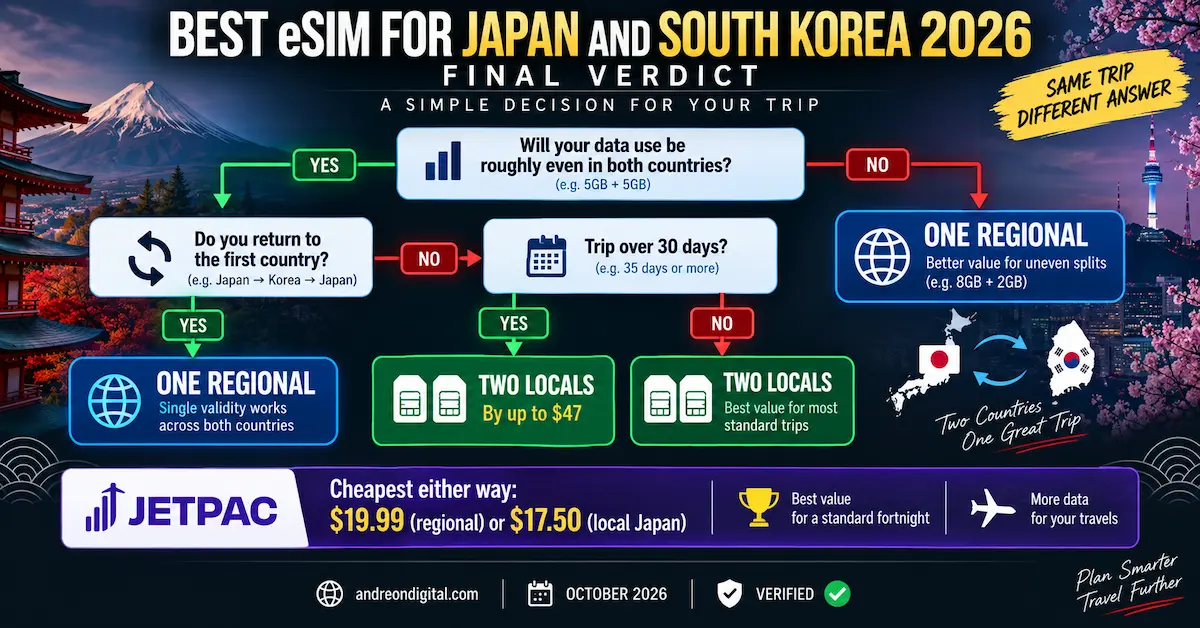
Final Verdict: One Regional or Two Local?
There is no rule here, which is why the guides that offer one are right about half the time. A regional plan gives you one allowance on one clock, two local plans give you two allowances on two clocks, and your itinerary decides which of those is worth paying for. Once you know the shape of your trip, the arithmetic is quick.
- ⚖️ Even split, roughly equal days and data: two local plans, which won on all five providers, by $1 to $14.01
- 📊 Uneven split, one country dominates: one regional on Jetpac, Nomad and Airalo, by $2.50 to $3.51
- 📅 Anything beyond 30 days: two local plans, and the gap is wide. Airalo $22 against $69
- 🔁 Returning to Japan after Korea: one regional, by $2 to $5.01, and more if the return leg is long
- 💶 Cheapest either way for a fortnight: Jetpac, at $19.99 regional and $17.50 for two locals
- 🇨🇳 Adding China to the route: Nomad’s CN-JP-KR 20GB over 45 days at $31, the one plan built for it
Three things to carry away. Ask whether your data use is even and whether you come back, because those two questions move the price more than the provider you choose. You cannot top up a Japan plan to make it work in Korea, and disabling an eSIM does not pause its validity.
Check the networks on the exact package, since a provider’s regional plan can run on different carriers from its country plan. We are affiliates of several providers here, which is why every figure is a costed package rather than a recommendation.
This article contains affiliate links for several of the providers compared, and we may earn a commission at no extra cost to you. This is a documentary audit rather than a field test, and is presented as such. There are no speed measurements, latency figures, coverage results or support response times from our own use, and none should be inferred. No claim is made about which network performs better in either country.
Every price, allowance, validity window, fair use rule, activation condition and network list was read from each provider’s own catalogue, product pages, help centre and terms on 4 October 2026, covering 257 current options and 54 documented conditions. For each itinerary we selected the cheapest package that covers both the stated data and the stated number of days rather than comparing headline prices.
Prices are native quotations in USD and EUR with no conversion and no coupons or promotional discounts applied, and promotional reference prices are excluded. Monthly commitments are not equivalent to one-off validity and are identified as such. Ubigi’s Japan and South Korea offer at $6 or €6 carries a three-month minimum.
Where a provider’s own documents diverge, this guide reports the divergence rather than resolving it. Jetpac publishes two refund documents with different rules, one containing a Moneyback clause and one not. Nomad’s catalogue-linked refund policy and its help centre differ on the conditions, and its add-on guidance also differs between plan documentation and general help.
Network lists are published per package and can differ between regional and country products, so the list on the specific SKU prevails. All plans compared are data only, with no local number, minutes or SMS.
No provider published a passport or identity requirement for these packages, which is recorded as not published rather than as confirmation that none applies. Unlimited products carry published daily limits where stated and are not uncapped. Prices and terms change without notice, so always confirm at checkout.
Last verified: October 2026.
Keep Reading
Each Country on Its Own
- Best eSIM for Japan 2026
- Best eSIM for South Korea 2026
- Best eSIM for Asia 2026
- Best eSIM for Malaysia 2026
The Providers Compared Here
- Jetpac eSIM Review 2026
- Nomad eSIM Review 2026
- Airalo Review 2026
- Ubigi Review 2026
- Saily eSIM Review 2026
- Holafly Review 2026
- Jetpac vs Airalo 2026
- Saily vs Airalo 2026
Setup and Devices
- eSIM Compatible Phones 2026
- How to Activate an eSIM
- eSIM Not Working, Nine Fixes
- Wi-Fi Calling With a Travel eSIM
- Best eSIM for iPad Travel 2026