Some booking links earn us a commission at no extra cost to you. Prices below were checked on 27 November 2026.
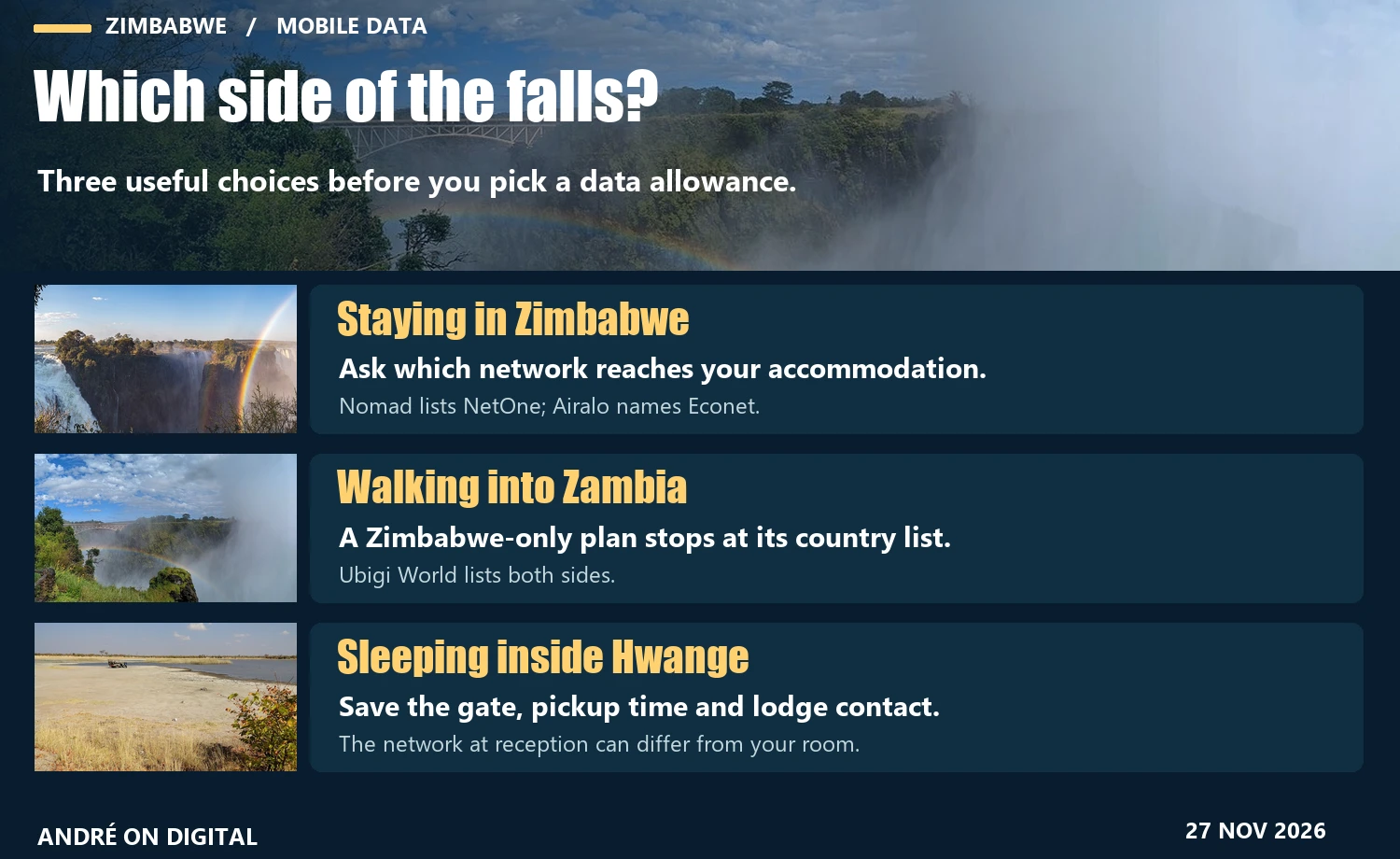
The drive to a safari lodge and the walk across Victoria Falls Bridge pose different problems for a phone. At the bridge, the signal you want may belong to another country. On the drive, the right country can be selected and the phone can still have no service for miles. The cheapest gigabyte answers neither question.
This guide compares four travel eSIMs and one local alternative against three specific purchases: data for a short arrival, a plan to take across the border, and enough time to keep the line alive until the trip home. The network names and prices below come from the providers. Conditions at individual lodges need a separate check.
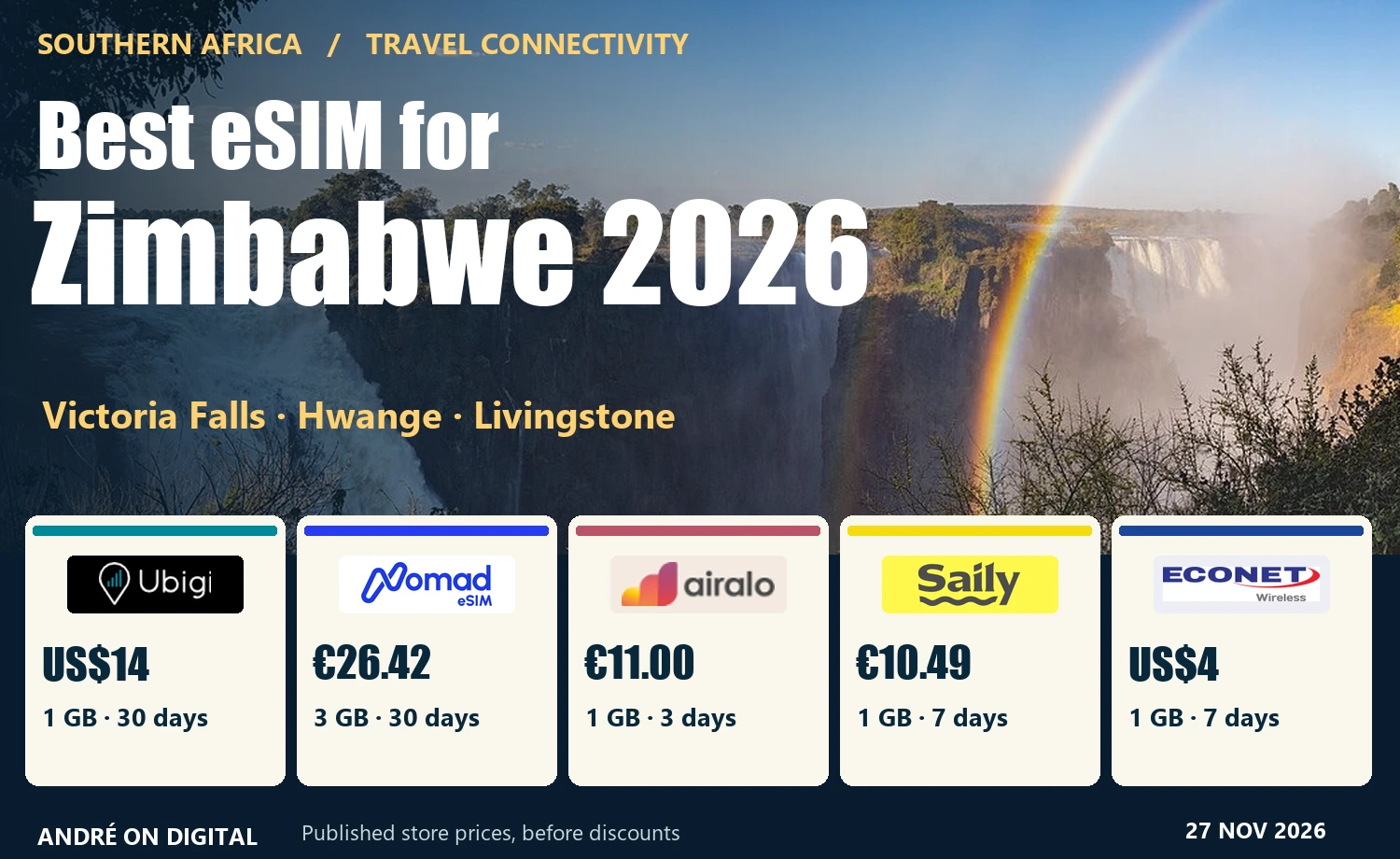
Zimbabwe eSIM price comparison for 2026
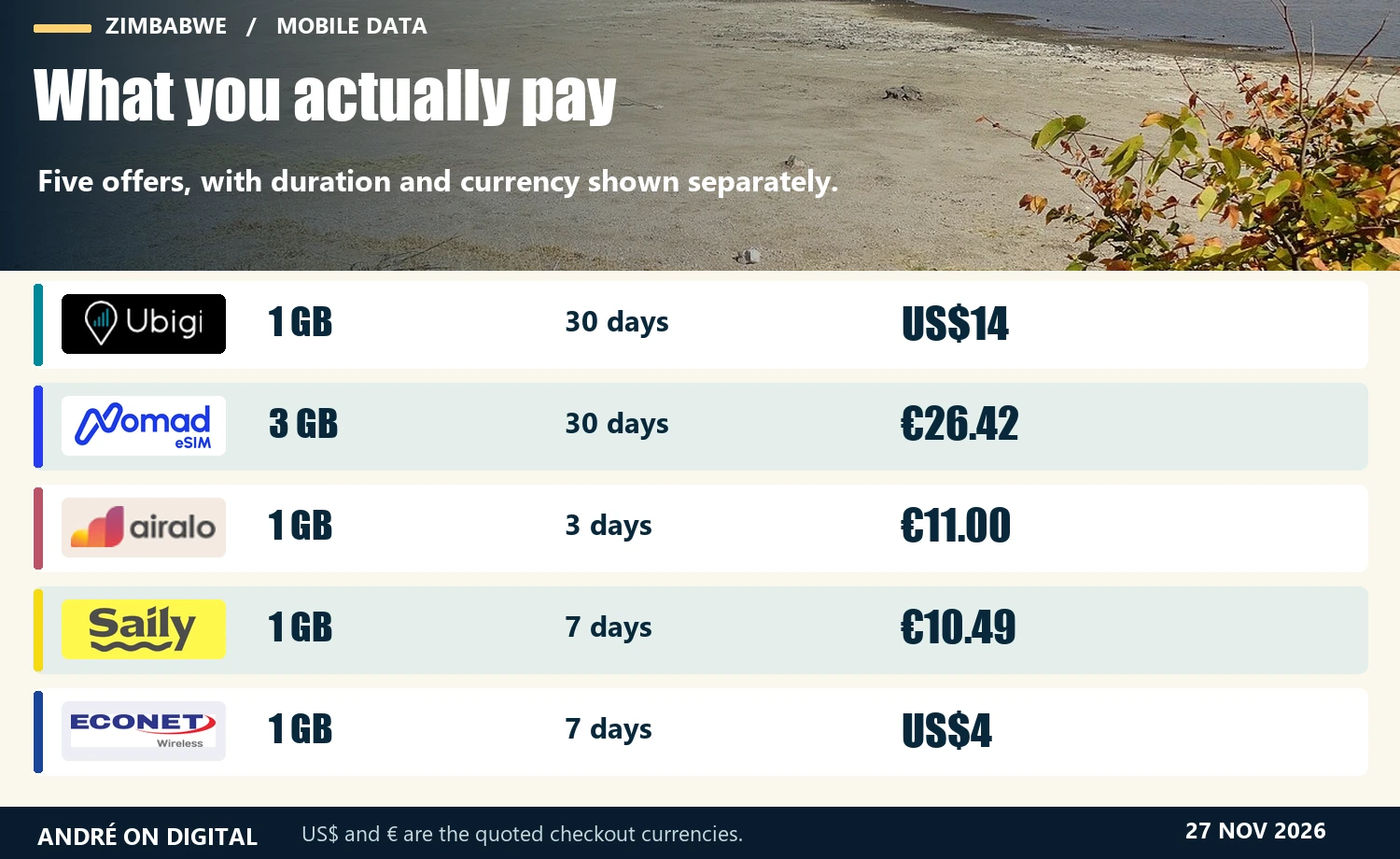
Read the country list before the price column. Ubigi’s World plan can serve a two-country itinerary. The figures for Airalo, Nomad and Saily below are for their Zimbabwe packages. Econet’s local bundle assumes you already have access to a registered local line. Where a store displayed euros, the table keeps the euro quote so you can reproduce the comparison without relying on a moving exchange rate.
| Provider | Data | Validity | Quoted price | Best fit |
|---|---|---|---|---|
| Ubigi | 1 GB | 30 days | US$14 | Zimbabwe + Zambia |
| Nomad eSIM | 3 GB | 30 days | €26.42 | Longer stay |
| Airalo | 1 GB | 3 days | €11.00 | Short Econet stay |
| Saily | 1 GB | 7 days | €10.49 | Arrival week |
| Econet Wireless | 1 GB | 7 days | US$4 | Local prepaid line |
The closest match is a surprisingly close call. At 3 GB, Nomad charges €26.42 for 30 days and Saily charges €26.49 for 30 days. Seven cents will rarely decide a trip. If your lodge says NetOne is the network to bring, Nomad’s published network is worth more than a small difference in the allowance. If you have an active Saily profile you already know how to use, check with its support about the specific itinerary before changing provider.
Which network will your eSIM actually use?
A shop can sell a Zimbabwe bundle while another company operates the towers. The name on your purchase receipt may therefore be different from the one you see at the top of your phone. Ask your host for the local network name. A reply of “Econet works at the reception desk” is useful in a way that “we have internet” is not. The latter might mean that the lodge has Wi-Fi at dinner.
| Product | Listed local network | Purchase facts |
|---|---|---|
| Ubigi | Telecel (ZW) · MTN (ZM) | Read plan details |
| Nomad eSIM | NetOne | Read plan details |
| Airalo | Econet (primary) | Read plan details |
| Saily | Operator not listed | Read plan details |
| Econet Wireless | Econet local service | Read plan details |
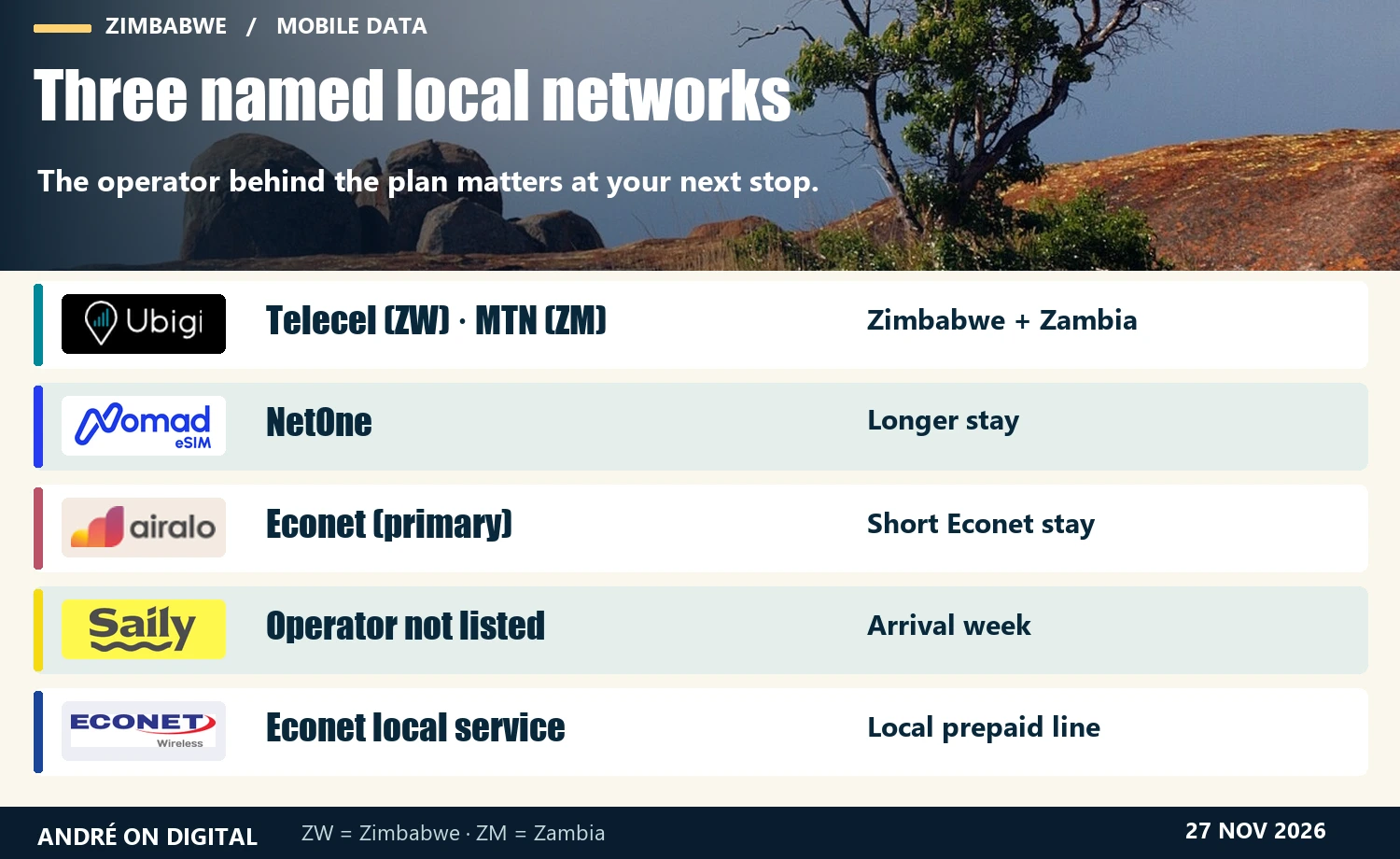
Two phones are only useful as a backup if they offer different ways online. A local Econet line and an Airalo plan listing Econet as primary may share the same weak point. If one traveler already has Econet and the host also reports a usable NetOne signal, a NetOne-based plan on the second phone gives the group a different option. Where there is no mobile reception at all, changing the brand on the phone may achieve nothing.
Five ways to get connected, and where each makes sense
Ubigi World for Victoria Falls and Livingstone
Pick Ubigi World if your itinerary actually crosses into Zambia. Its official 1 GB, 30-day World package lists Telecel for Zimbabwe and MTN for Zambia. You can install one profile before departure and draw from the same allowance on either side. Its appeal here is the country list. A cheaper single-country product would leave a different problem to solve after the crossing.
One gigabyte is a modest pool. Use it for messaging, a pickup confirmation, small map searches and accommodation details. Download the map over Wi-Fi and hold photos or device backups until you are back on a known connection. If a partner shares the hotspot, that second phone draws from the same gigabyte. Compare a larger plan if you intend to use two phones this way for most of the trip.
Video from Ubigi · buying and installing on iPhone
Nomad for several stops over a month
Nomad lists NetOne on its local Zimbabwe page. We found €11.84 for 1 GB over seven days, €26.42 for 3 GB over 30 days and €41 for 5 GB over 30 days. The three-day visitor to Victoria Falls and the traveler returning to Harare after two weeks on the road are buying different things. Buying 30 days can be more useful than buying extra gigabytes on a package that expires on day seven.
Before choosing the 5 GB tier, look at the usage meter on your current phone. If the screen time is mostly messaging and offline navigation, the 3 GB option leaves €14.58 in your pocket. A phone that routinely uses mobile data for video calls or photo sync can spend that difference in a hurry. Have the host confirm NetOne at the overnight stops if those calls are important.
Video from Nomad eSIM · installation and activation on iPhone
Airalo for a short stay on Econet
Airalo identifies Econet as its primary network for this local plan. Its 1 GB option was €11 for three days. We also found 3 GB for seven days at €28, 5 GB for seven days at €41.50 and 5 GB for 30 days at €43.50. Here, moving the same 5 GB to the longer validity cost €2 at the time of the check. That can matter more than a coupon if your last pickup is on day eight.
A traveler who only needs the Zimbabwe side, sleeps in a town hotel that recommends Econet and leaves in 48 hours has a good reason to start here. Crossing the bridge changes the question. Open the plan’s country list and check Zambia by name, or use a separate Zambia option. “Victoria Falls” in a hotel address does not tell you which country your next airport is in.
Video from Airalo · how an Airalo eSIM works
Saily for an arrival week and light use
Saily’s Zimbabwe page listed €10.49 for 1 GB over seven days, €26.49 for 3 GB over 30 days and €40.99 for 5 GB over 30 days. It supports sharing data and does not identify a local operator on that public page. This is a practical choice when you need a week of occasional messages and can use confirmed Wi-Fi for large downloads. For a route where one named carrier matters, ask support before checkout.
The published activation instructions distinguish installing the eSIM from starting the package. Saily says an eligible plan activates automatically on arrival when the phone connects with data roaming enabled. The pre-activation window is limited, so check the activation deadline on your order before buying months in advance. Save the support channel and installation details somewhere you can access on Wi-Fi if the phone cannot attach on landing.
Video from Saily eSIM · getting started with the Saily app
Econet local service if you can register a line
Econet’s US-dollar data menu lists a 1 GB seven-day bundle at US$4. The breakdown is easy to miss: 800 MB peak and 224 MB off-peak. A visitor expecting all of that data to be available at any hour is budgeting for a different product. Econet also lists a separate 1 GB plus eight minutes offer. Read the row for the exact bundle you intend to buy.
The published bundle price buys an allowance on an eligible local line. A new customer still needs to arrange registration and the SIM or eSIM itself. Check onboarding, documents, opening hours and any charge for the line with Econet before counting that US$4 as your entire arrival cost. Local service is attractive if calls to a driver or lodge are central to the trip, but a data-only bundle by itself does not include ordinary voice minutes.
Victoria Falls, Hwange and Harare, stop by stop
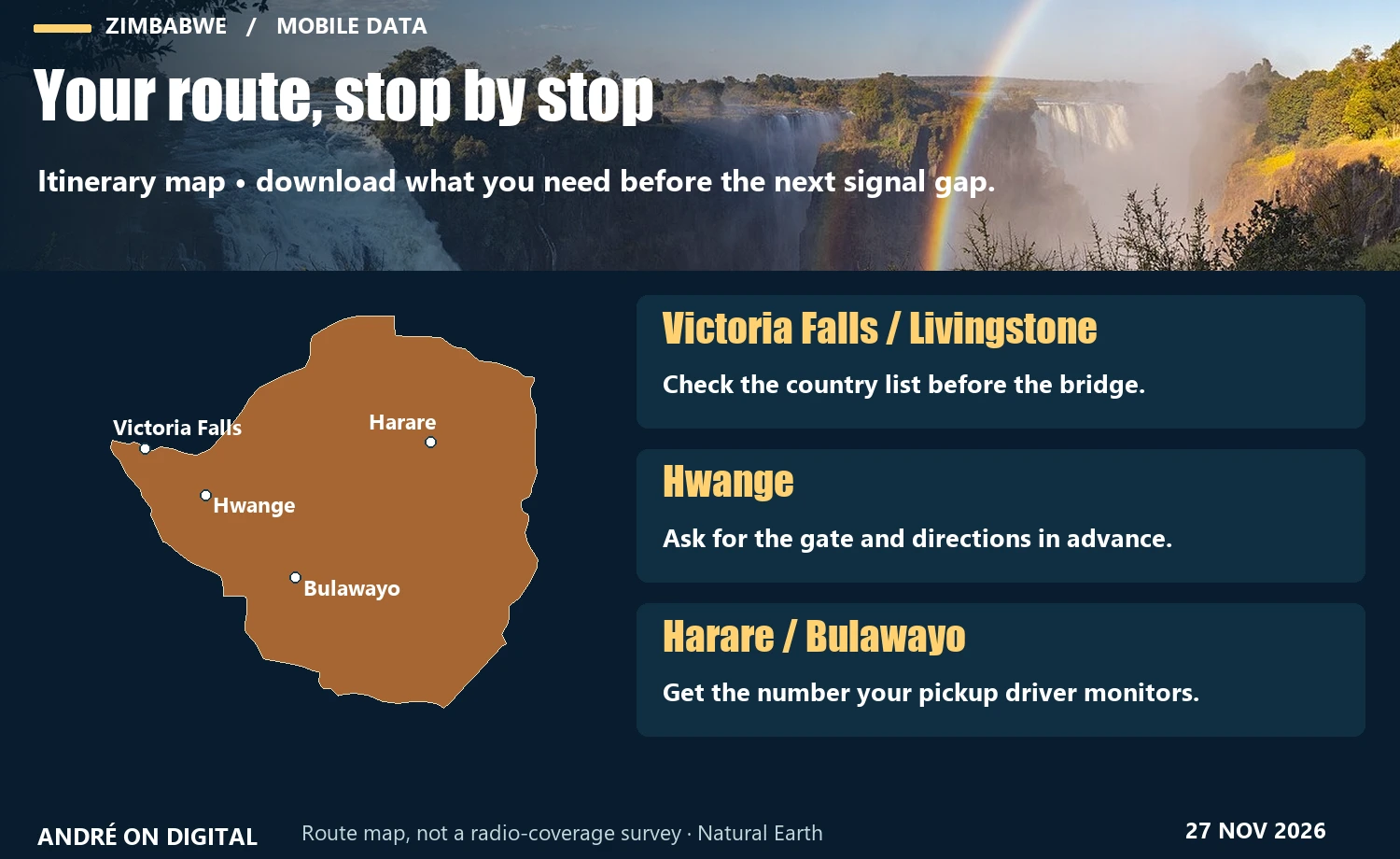
Victoria Falls Airport, the town and the bridge
An airport transfer can go wrong before anyone runs out of data: “Victoria Falls” might mean a pickup from Victoria Falls Airport in Zimbabwe or from Livingstone in Zambia. Save the airport name, country, meeting point and the phone number the driver actually monitors. If the number accepts ordinary calls only, a data-only travel eSIM cannot dial it by itself. Agree on a messaging app or an alternative line before you fly.
For a bridge crossing, keep the same map area offline on both sides. A national plan can stop serving you when the handset switches country. A regional plan may take a little time to find its local partner. Once across, check your data line, wait for the operator name to change and open a small web page. Leave home-line data roaming off to prevent the device using a costly fallback.
Hwange National Park and access roads
ZimParks’ official directions to Robins Camp give a sense of the distances involved: from Victoria Falls, the Pandamatenga turnoff is roughly 46 km away, and the next stretch to the camp is about 64 km. The map pin alone is a poor handover between traveler and driver. Ask the camp for the correct entrance for that day, save the written directions and carry a copy of the booking with a contact number.
When asking about reception, name three places: the access gate, the accommodation and the nearest place staff can make a call. A signal near the office may be perfectly adequate for a check-in message but irrelevant to someone joining a scheduled video call from a tent. Make arrangements with the guide for loss of contact before leaving town. An eSIM does not substitute for the operator’s emergency arrangements.
Harare, Bulawayo and an onward domestic transfer
If you will connect the same day to another flight, the first useful download is often a boarding document or an updated pickup message. Keep both offline before leaving your previous airport. When comparing a three-day and a seven-day plan, count the final travel day too. A working eSIM on the return to Harare can be more valuable than an extra gigabyte that expired while you were away.
Install and test without moving the wrong line
On home or hotel Wi-Fi, confirm the phone is carrier-unlocked and that the specific model supports eSIM. Label the new line “Zimbabwe data” and keep its order number and support instructions offline. Check when validity starts for the package you bought. A QR code shown on a second screen is easy to scan; if your only device contains the email, use the provider’s in-app installation or supplied manual instructions.
On arrival select the travel line for mobile data, turn off automatic data switching, and enable roaming on the travel line when the provider requires it. Keep the home number available for texts if you need it, after checking the home operator’s voice and SMS charges. Test a new web page with Wi-Fi off. A network name on the screen only establishes that the phone sees a network. Loading a fresh page tests the data path.
If it fails, check whether you are in the country listed on the order, whether the plan has started and whether the preferred network is available. Follow the APN supplied with that exact plan. Avoid deleting the profile as a first step. Many installation codes are single-use, and replacing one from the roadside is a harder job than correcting a setting over Wi-Fi.
Video from Ubigi · installing a Ubigi eSIM with a QR code on iPhone
Zimbabwe eSIM questions travelers actually ask
Can I use the same eSIM in Zimbabwe and Zambia?
Yes, if the purchased package lists both. Ubigi World 1 GB for 30 days listed both countries at US$14 when checked on 27 November 2026. A local Zimbabwe package should be treated as Zimbabwe-only unless its own coverage list says otherwise.
Which Zimbabwe travel eSIM uses Econet?
Airalo lists Econet as the primary network on its Zimbabwe page. An Econet local line also uses Econet and has its own onboarding and bundle prices. Neither listing establishes coverage at a particular safari property.
Which one uses NetOne?
Nomad identifies NetOne for its Zimbabwe package. Its 3 GB for 30 days was €26.42. If the lodge recommends NetOne, confirm the name on the actual plan variant before buying.
What is the cheapest option for a week?
Among the travel eSIMs compared here, Saily showed 1 GB for seven days at €10.49. Econet listed a US$4 local bundle with peak and off-peak data on an eligible local line. The currencies, eligibility and allowances differ.
Can I call my safari guide with a data-only eSIM?
You can use an internet calling app when both people use it and the data connection works. A normal call to a landline or mobile number needs a voice service. Ask the guide which method they will monitor on pickup day.
Can I rely on mobile data inside Hwange?
Check your specific camp, gate and route with the operator and download directions before entry. A network’s presence in Zimbabwe is not evidence that a phone will connect from your camp or vehicle.
Final verdict for Zimbabwe
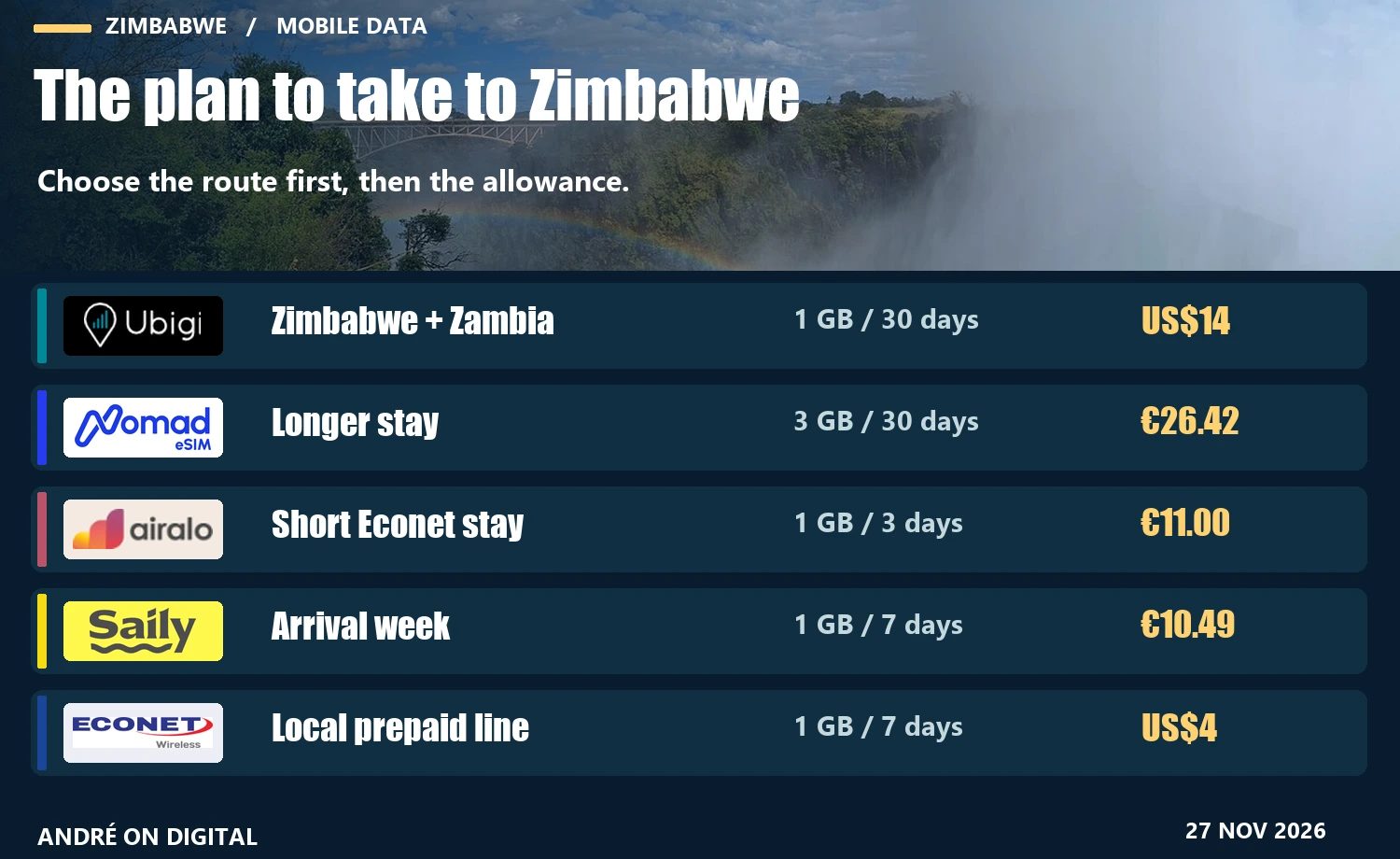
For a weekend on both sides of the falls, the US$14 Ubigi World package solves the border problem with one small allowance. For Zimbabwe alone, ask the lodge one question before spending anything: “Which mobile network works where guests sleep?” A specific answer makes Airalo on Econet or Nomad on NetOne much easier to choose. If you can register a local line, compare Econet’s bundle breakdown against the times of day you will actually need it.
Sources, photography and update notes
Plan evidence comes from the destination and network pages below. These are desk-researched offers. No local speed tests were used to rank them.
- Ubigi
- Nomad eSIM
- Airalo
- Saily
- Econet Wireless
- Econet local eSIM and registration
- Official Hwange directions from ZimParks
- Planning the Zambia side
Photograph and map credits
Photographs were cropped and combined with original layout. Each adapted photograph retains its source licence. Country outlines from Natural Earth.
- Diego Delso · Cataratas Victoria, Zambia-Zimbabue, 2018-07-27, DD 30-34 PAN · CC BY-SA 4.0
- Fabio Achilli from Milano, Italy · Hwange National Park, Zimbabwe (48595113747) · CC BY 2.0
- Dicklyon · Victoria Falls Bridge from the Knife Edge Bridge trail · CC BY-SA 4.0
- ru:User:Digr · ZW Matobo Stones · CC BY-SA 3.0
- Natural Earth