AT&T International Day Pass vs eSIM 2026: Good Deal or Not?
Last updated: 30 September 2026. AT&T’s prices, allowances, triggers and eligibility rules were read from its own legal terms, support articles and plan pages on 25 September 2026. The eSIM side compares 997 catalogue options across Airalo, Jetpac, Saily and Roamless, with 2,178 coverage relations including 492 AT&T destination entries. Scenarios model the additional cost of a trip, not your monthly bill. Prices in USD with EUR shown natively where published.
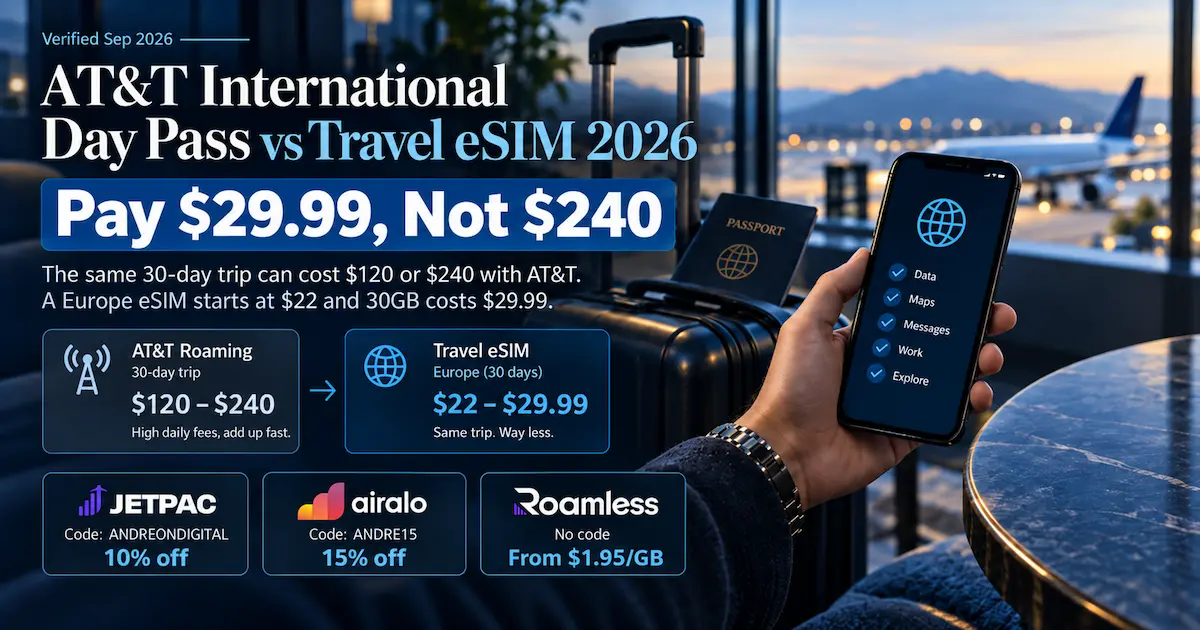
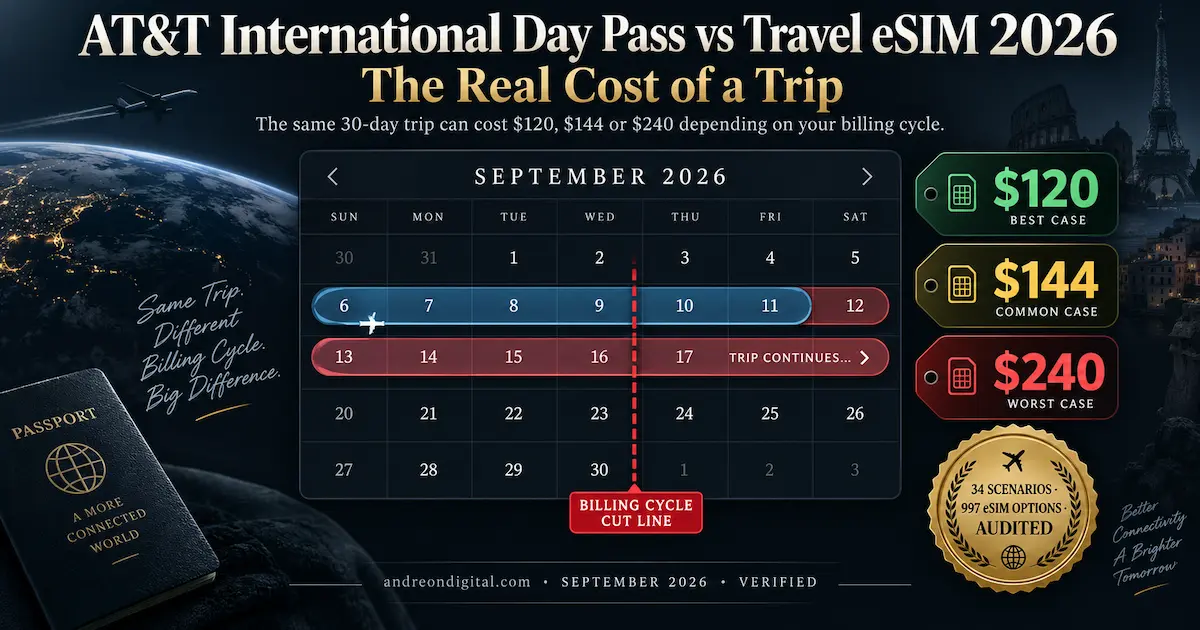
AT&T International Day Pass vs travel eSIM 2026: the same 30-day trip can cost $120, $144 or $240 depending on where the AT&T billing cycle resets. The comparison is based on 34 travel scenarios and 997 eSIM catalogue options, verified September 2026.
For anyone comparing AT&T International Day Pass vs eSIM 2026, AT&T’s International Day Pass is the better designed of the two big American roaming products because it has a ceiling. Ten charges per line per billing cycle, then the rest of that cycle is included. On paper that turns an open-ended $12 a day into a worst case of $120, and it is why the Day Pass is genuinely cheaper than the internet usually says.
The core issue in AT&T International Day Pass vs eSIM 2026 is that the ceiling is per billing cycle, not per trip, and almost no comparison models what that means. The same 30-day trip to Europe costs $120, $144 or $240 depending entirely on where your bill closes. Move a departure date by three days and the total changes by more than a hundred dollars. This guide costs 34 scenarios against the current eSIM catalogues, and covers the additional-line discount that nobody mentions, the plan on which you cannot buy a Day Pass at all, and the unlock rules that decide whether a travel eSIM is even an option.
How this comparison is built: This AT&T International Day Pass vs eSIM 2026 comparison is based on documented plan terms and provider catalogue pricing. I’m based in Belgium and compare eSIM providers full-time. AT&T’s figures come from its own legal terms, support articles and plan pages read on 25 September 2026, and the eSIM prices from each provider’s own catalogue on the same date. This is a documentary audit rather than a field test, so there are no speed measurements or coverage results from my own use, and none should be inferred. Two disclosures: we have no relationship with AT&T and are not a customer, and we are affiliates of the eSIM providers compared, which is why the scenarios where AT&T costs you nothing are set out as carefully as the ones where it does not. The companion piece for the other carrier is our Verizon TravelPass vs Travel eSIM guide, and the structural difference between them is covered below.
🔢 For AT&T International Day Pass vs eSIM 2026, five basic facts about this product are reported five different ways. Across the guides ranking for this search: the daily rate appears as $12 and as $10, the monthly ceiling as $120 and as $100, the data allowance as 2GB then 128kbps and as your full domestic allowance with no throttle, the day as 24 rolling hours and as midnight in the destination, and the cap as automatic and as dependent on your exact plan. AT&T’s own terms settle four of them: $12 per 24-hour session, a maximum of ten charges per line per cycle, no separate international data allowance because the Day Pass uses your domestic plan’s, and an additional-line rate of $6 tied to the US calendar date. The $100 figure appears to be borrowed from Verizon’s International Monthly Plan, which genuinely does cost that. Every number in this guide comes from AT&T’s own pages, and the sources are worth checking yourself before you budget.
⚡ The Short Answer
AT&T International Day Pass vs eSIM 2026 comes down to your billing cycle, destination and current AT&T plan.
💸 14 days in Europe, one billing cycle: Day Pass $120 · Jetpac 10GB $22
⚠️ The same 14 days split across two cycles: Day Pass $168
⚠️ 30 days split across two cycles: Day Pass $240 · Jetpac 30GB $29.99
👨👩👧👦 A family of four on one account, 14 sessions:$300, not $480
✅ AT&T costs $0 extra if you are on Elite 2.0, which includes 20GB a cycle
✅ $0 extra for Canada, Mexico and 20 Latin American countries on eligible plans
✅ $0 if you have already hit the ten-charge cap this cycle
⚠️ At sea it is $20 a day with no cap and no family discount
⚠️ On Elite 2.0 you cannot buy a Day Pass at all when the 20GB runs out
✅ Receiving a text does not trigger a charge. Sending one does
AT&T International Day Pass vs eSIM 2026: How Billing Works
Offer
Price
Cap
High-speed data
Voice and texts
Day Pass, land and equipped flights
$12 per line per 24h session
✅ 10 charges per line per cycle
⚠️ Your domestic plan’s allowance. No separate international figure
Received and to the US and other Day Pass destinations · unlimited outgoing SMS and MMS
Additional lines, same account, same US date
$6 per line per session
Same cap, per line
Per plan
Per plan
⚠️ Day Pass at sea
⚠️ $20 per line per session
❌ No cap and no discount
500MB, then up to 512kbps on the ships concerned
Received and to the US and Day Pass destinations
AT&T Elite 2.0, included
$0 extra
—
20GB per cycle, then up to 512kbps for the rest of it
Unlimited received and to eligible destinations
Elite 2.0 Cruise Day Pass
$15 per line per session
—
500MB, then up to 512kbps
Per Elite 2.0
Canada and Mexico on eligible plans
$0 extra
—
Per plan · ⚠️ off-net roaming can run at 2G
Unlimited within and between the US, Canada and Mexico
Roam Latin America, eligible plans
$0 extra
—
Per plan · ⚠️ speeds can be 3G
Received and to the US and Day Pass destinations
Prepaid International Travel add-on
$35
—
5GB over 7 days
Unlimited per the pack, plus calls to the US
⚠️ Day Pass for Business
$12
❌ Terms deny both the cap and the discount
Per the business plan
Per the business plan
🧮 The formula AT&T’s terms actually describe, which is worth having before you plan a trip. For one line, in each billing cycle: new charges = the lesser of the sessions you trigger and whatever remains of your ten. Add the cycles together and multiply by the applicable rate. For a group travelling on one account with matching dates, a charged day costs $12 plus $6 for each additional line. Two conditions on the group rate that decide whether it applies: the same account, and charges falling on the same calendar date in the account’s US time zone rather than the destination’s. The full-rate line is not necessarily the first one to use its phone.
⚠️ And the structural difference against the other big carrier, which cuts both ways.AT&T caps at ten charges per cycle and discounts additional lines. Verizon does neither, charging $12 a day with no ceiling, which is why a 30-day European trip reaches $360 on Verizon and $120 on AT&T inside one cycle. Against that, Verizon’s cap-free structure is at least predictable, while AT&T’s ceiling resets with your bill and can double the same trip. Our Verizon guide runs the same scenarios on the other side.
The Finding: Your Billing Cycle Decides the Bill
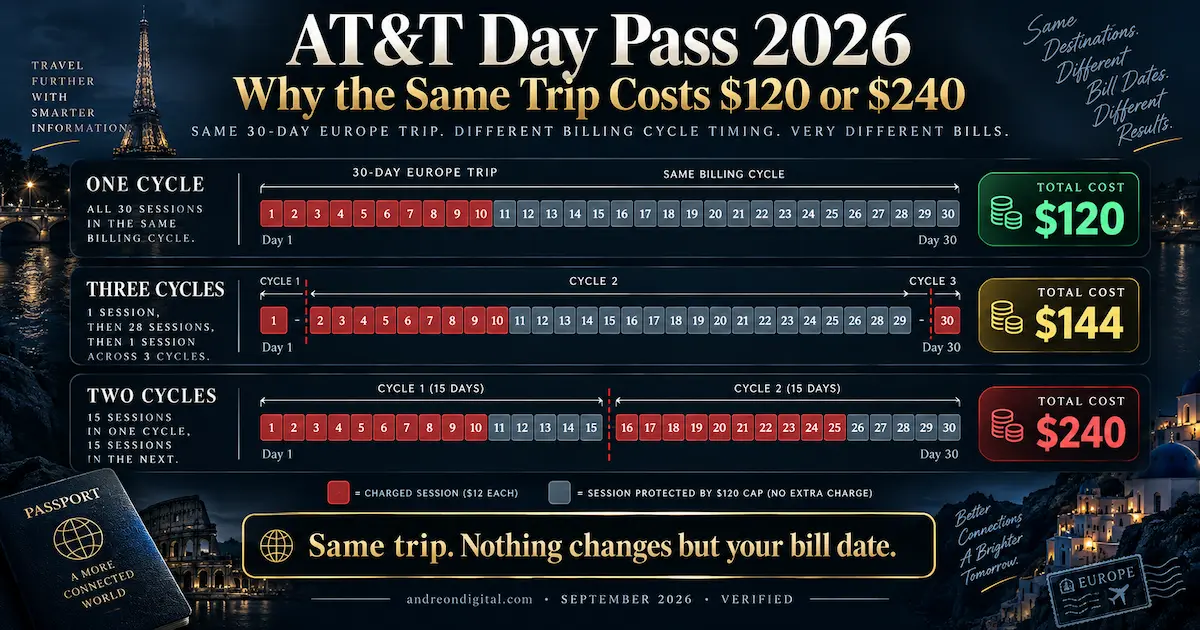
In AT&T International Day Pass vs eSIM 2026, this is the part that changes the answer most: the same number of sessions can produce very different totals when they fall on different sides of the bill date. Each row below keeps the trip length the same and changes only the billing-cycle split.
Trip
How the sessions fall
Day Pass
Cheapest eSIM
You keep
🇪🇺 Europe, 14 sessions
✅ All 14 in one cycle
✅ $120
Jetpac $22
$98
🇪🇺 Europe, 14 sessions
⚠️ 7 in each of two cycles
⚠️ $168
Jetpac $22
$146
🇪🇺 Europe, 30 sessions
✅ All 30 in one cycle
✅ $120
Jetpac 30GB $29.99
$90
🇪🇺 Europe, 30 sessions
⚠️ 15 in each of two cycles
⚠️ $240
Jetpac 30GB $29.99
$210
🇪🇺 Europe, 30 sessions
1, then 28, then 1 across three cycles
$144
Jetpac 30GB $29.99
$114
📅 The same thirty days costs $120, $144 or $240, and nothing about the trip changes. The ceiling of ten charges resets when your bill does, so a trip that sits neatly inside one cycle hits the cap once and stops, while the same trip split across two cycles hits it twice. Moving a departure by three days can change the total by $120. The three-cycle row is the one people stumble into without noticing: a trip that starts on the last day of one cycle and ends on the first day of another triggers a single charge at each end, with the bulk protected by the cap in the middle, which is why it lands at $144 rather than $240. Before you book, find your bill close date and count the sessions on each side of it. That one check is worth more than any promotional code in this article.
AT&T Day Pass 2026: the ten-charge ceiling resets with the billing cycle, not the trip. The same 30-day Europe trip can cost $120 in one cycle, $144 across three cycles or $240 when split across two billing cycles.
The rest of the scenarios
Trip, one line, one cycle
Day Pass
Cheapest eSIM
You keep
🇪🇺 Europe, 3 days, 3GB
$36
Airalo $10
$26
🇪🇺 Europe, 7 days, 5GB
$84
Jetpac $13
$71
🇪🇺 Europe, 10 days, 10GB
$120
Jetpac $22
$98
🇯🇵 Japan, 14 days, 10GB
$120
Roamless $14.95
$105
🇬🇧 United Kingdom, 14 days, 10GB
$120
Jetpac $17
$103
🇲🇽 Mexico, 14 days, 10GB
$120
Airalo $17.50
$102.50
🇦🇪 United Arab Emirates, 14 days, 10GB
$120
Airalo $19
$101
🇨🇦 Canada, 14 days, 10GB
$120
Airalo $20
$100
🇧🇷 Brazil, 14 days, 10GB
$120
Airalo $21
$99
🌎 Latin America, 14 days, 10GB
$120
Airalo $32
$88
🌐 Global, 14 days, 10GB
$120
Jetpac $45
$75
🇫🇷 France, 1 day, 0.5GB
$12
Roamless $0.98
$11
🇪🇺 Europe unlimited, 7 days
$84
Jetpac $25.99
$58
How to Set Up a Jetpac eSIM Before Your Trip
After comparing Jetpac inside AT&T International Day Pass vs eSIM 2026, the next practical step is installation. This official Jetpac tutorial shows how to set up the eSIM before travel so the data line is ready when you need it abroad.
For this AT&T comparison, the practical point remains the same: compare the eSIM package price with the number of Day Pass sessions that would fall inside each billing cycle. For a broader provider-to-provider comparison, see our Jetpac vs Airalo 2026 guide.
Families, and the $180 that depends on whose name is on the account
Four travellers, 14 sessions, Europe
Day Pass
Four eSIMs
You keep
✅ One account, all 14 in one cycle
$300
4× Jetpac $88
$212
⚠️ One account, 7 in each of two cycles
$420
4× Jetpac $88
$332
⚠️ Four separate accounts, one cycle
⚠️ $480
4× Jetpac $88
$392
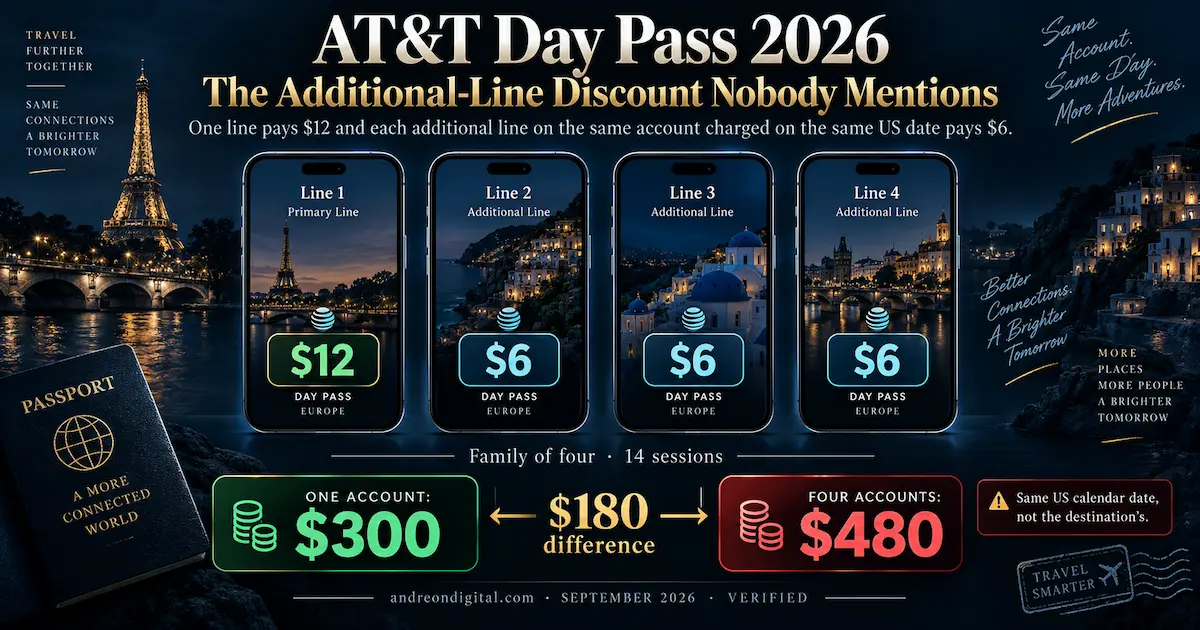
👨👩👧👦 The additional-line discount is real, substantial and almost never mentioned. One line pays $12 and every other line charged on the same US calendar date on the same account pays $6, so a charged day for four people costs $30 rather than $48. Over fourteen sessions in one cycle that is $300 instead of $480, which means $180 rides on whether everyone is on one account. Two conditions decide whether it applies: the same account, and charges landing on the same calendar date in the account’s US time zone rather than the destination’s, which for an Asian trip is not the same day at all. AT&T also has not clarified what happens when one line has already hit its cap while another is still being charged. For families, this is one of the most important details in AT&T International Day Pass vs eSIM 2026.
AT&T Day Pass 2026: one line pays $12 and each additional line on the same account charged on the same US calendar date pays $6. Over 14 sessions, a family of four pays $300 on one account versus $480 on four separate accounts, a $180 difference.
The Cases Where AT&T Costs You Nothing
A fair AT&T International Day Pass vs eSIM 2026 comparison also has to show when AT&T already covers the trip. We are affiliates of the eSIM providers above and not of AT&T, so these zero-extra-cost cases are treated with the same care as the paid eSIM scenarios.
Situation
Day Pass
An eSIM would cost
The condition
✅ You are on AT&T Elite 2.0
$0
Jetpac $22
20GB per cycle, then up to 512kbps
✅ You have already hit the ten-charge cap
$0
Airalo $10
Further sessions in that cycle are included
✅ Canada or Mexico on an eligible plan
$0
Airalo $17.50 to $20
⚠️ Off-net roaming can run at 2G
✅ One of 20 Latin American countries on Premium 2.0 or Elite 2.0
$0
Airalo $21 for Brazil
⚠️ Speeds can be 3G · a named list, not the continent
🟡 Eight charges already used, new 7-session trip
$24
Jetpac $13
Only two charges left before the cap
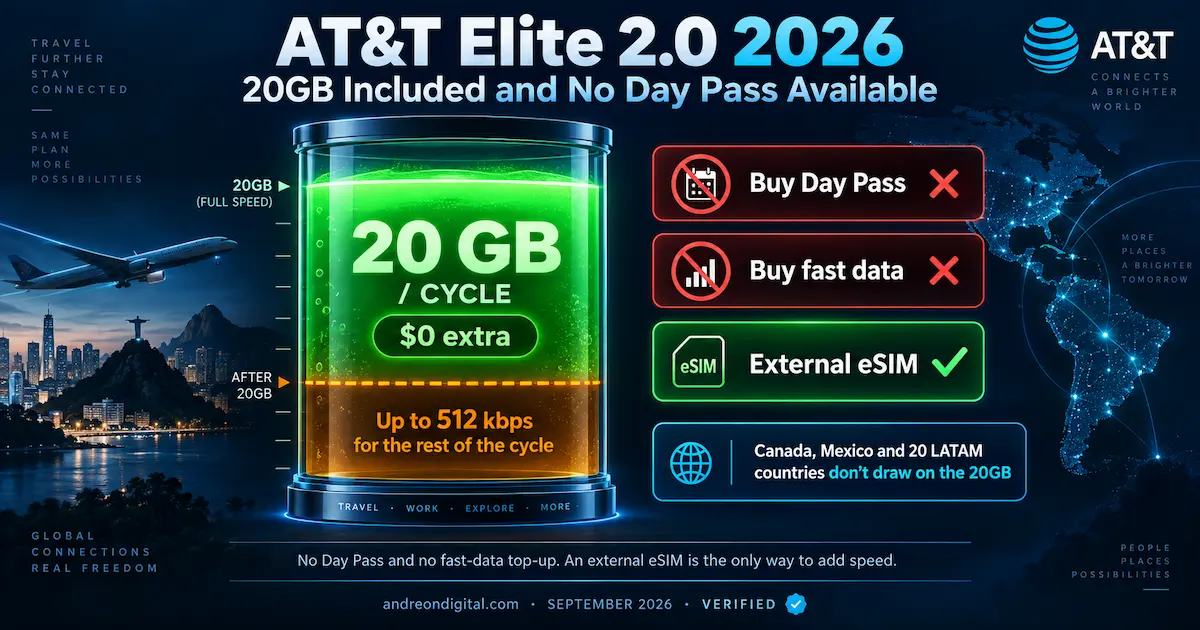
✅ Elite 2.0 is the strongest of these and it comes with an unusual catch. The plan includes 20GB of international data per billing cycle at no additional roaming charge, which covers most two-week trips comfortably, then drops to up to 512kbps for the rest of the cycle. Canada, Mexico and the 20 Roam Latin America countries do not draw on that 20GB, which effectively extends it. The catch: the terms exclude both the Day Pass and additional fast-data purchases on this plan, so when the 20GB runs out you cannot buy your way back to full speed from AT&T at all. An external travel eSIM becomes the only route to fast data, which is a genuine reason for an Elite 2.0 customer to carry one even though they will usually not need it. Note too that tablets and smartwatches on the plan do not inherit the benefit, and that AT&T’s international terms cite more than 190 destinations while the Elite page advertises 210 or more.
🌎 And the Latin America benefit is a named list, not a continent. Roam Latin America covers 20 enumerated countries plus Canada and Mexico on Premium 2.0, Elite 2.0 and some legacy Premium and Elite plans. The Dominican Republic is explicitly included. Cuba, French Guiana and the rest of the Caribbean are not. Speeds can be 3G, and the benefit is written for residents whose main use is in the United States, with predominant use abroad potentially leading to its removal. If your route runs through the Caribbean rather than the mainland, our Caribbean guide and Central America guide cover which regional eSIM plans actually reach where.
How to Install an Airalo eSIM on iPhone and Android
Within AT&T International Day Pass vs eSIM 2026, Airalo is one of the travel eSIM providers priced in the destination examples above. This official 2026 tutorial shows the installation process on iPhone and Android, including direct installation, QR-code setup and manual installation.
The important comparison is still destination-specific. An AT&T inclusion can make the extra roaming cost zero, while a paid eSIM can make more sense when the Day Pass would trigger repeated sessions. Our Airalo Review 2026 goes deeper into the provider itself.
AT&T International Day Pass vs eSIM 2026: What Starts a Charge
Action
Starts a session?
Detail
Using data, including background apps
❌ Yes
You do not need to open anything
Making or receiving a call
❌ Yes
Both directions, unlike text messages
Sending a message
❌ Yes
SMS and MMS outgoing are unlimited once the session starts
✅ Receiving a text
✅ No
✅ Billed as a domestic message. Stated in the FAQ and the terms
Moving to another eligible country mid-session
✅ No new land charge
The session continues
⚠️ A missed call going to voicemail
⚠️ Possible
The general agreement warns of roaming charges even without a message
⚠️ Turning off data roaming
⚠️ Does not stop voice or messages
The help distinguishes blocking data from calls and texts working
⚠️ Removing the Day Pass
⚠️ Does not block the line
⚠️ Usage can fall to pay-per-use rates instead
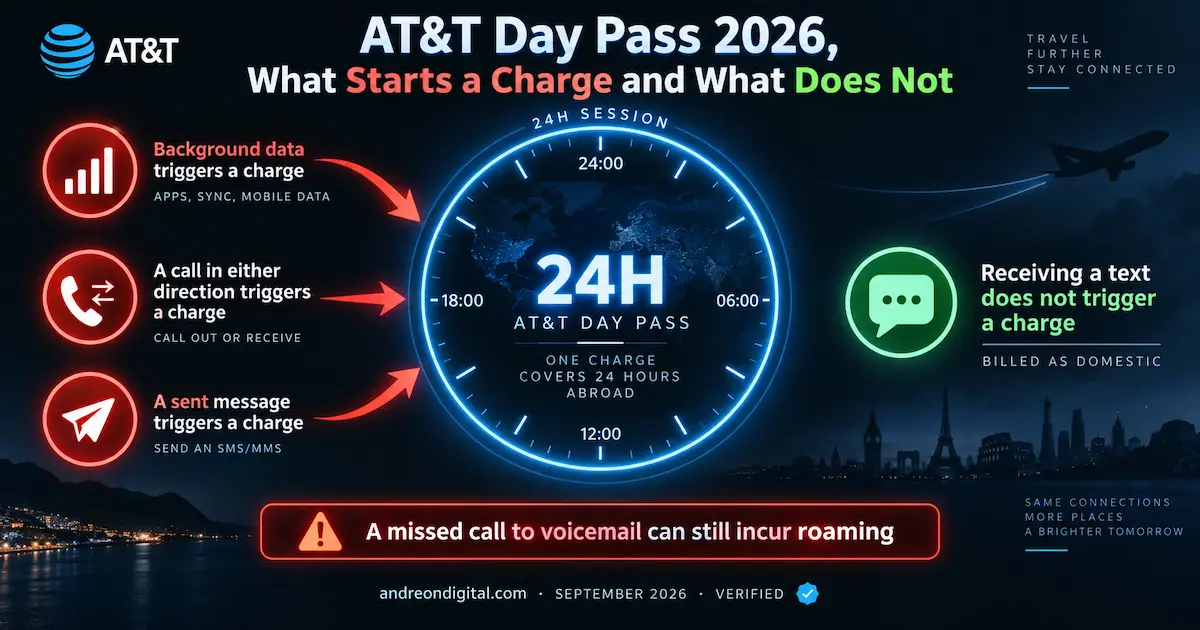
✉️ The one genuinely traveller-friendly rule here, and it makes the dual-SIM setup work properly.Receiving a text does not start a charge and is billed as a domestic message, which AT&T states explicitly in both its current FAQ and the Day Pass terms. That means you can keep the AT&T line registered while a travel eSIM handles data, and verification codes from your bank arrive without triggering $12. Two qualifications worth keeping: this covers AT&T’s own SMS and MMS rather than iMessage or WhatsApp, which run over data, and no carrier guarantees delivery of any particular authentication code. The setup fails the moment you place a call or send a text from that line, so treat it as receive-only.
⚠️ Three traps around the charge itself.AT&T tries to add the Day Pass automatically to eligible lines that travel without international protection, and its own agreement acknowledges that the detection, the notification text and the addition can all fail, so confirm your line before you fly rather than relying on the alert. Removing the Day Pass does not block the line, it just removes the protection, and usage can then fall to pay-per-use rates. And charges from foreign carriers can arrive up to three billing cycles late, so a bill that looks clean in October can still grow in December.
📶 On Wi-Fi Calling, check your destination before you rely on it. Calls over Wi-Fi to US numbers carry no additional charge and the Day Pass includes Wi-Fi calls between its destinations, but placing the call can itself start the daily charge. More importantly, AT&T still publishes a list of countries where Wi-Fi Calling cannot be used, including China, Cuba, India, Iran, Israel, Pakistan, Saudi Arabia, Sudan, Syria, Turkey, the United Arab Emirates and Vietnam. That page is dated May 2024 and was still live when we checked in September 2026, so anyone planning to lean on Wi-Fi Calling in Istanbul or Dubai should verify it first.
AT&T Day Pass 2026: background data, a call in either direction and a sent SMS or MMS can start a 24-hour session. Receiving a text does not trigger the Day Pass and is billed as a domestic message, while a missed call forwarded to voicemail may still incur roaming.
AT&T International Day Pass Video: How the Day Pass Works
This official AT&T video is specifically about International Day Pass and gives a quick overview of what the service is, its benefits and pricing. That makes it a direct companion to AT&T International Day Pass vs eSIM 2026, while the tables and scenarios in this article go further into billing-cycle caps, charge triggers and travel eSIM alternatives.
Use the video for the product overview, then use the billing-cycle examples above to estimate the real trip cost. The detail that matters most is still the same: the ten-charge ceiling applies per billing cycle, not per trip, so crossing a bill date can materially change what you pay.
What an eSIM Does Not Replace, and the Unlock Question
A practical AT&T International Day Pass vs eSIM 2026 decision also depends on whether the phone is unlocked and what you still need from your AT&T number while abroad.
What you need
How to cover it
Your US number receiving calls and texts
✅ Keep the AT&T line on with data roaming off. Incoming texts cost nothing
Calls from your own number
Airalo Discover+ includes a +1 number with minutes and SMS. Roamless can use a verified number as caller ID for outgoing calls
⚠️ Connectivity at sea
⚠️ Neither product covers it. AT&T charges $20 a day uncapped, or $15 on Elite 2.0, and travel eSIM regional plans are land-based
Connectivity in the air
✅ Equipped flights fall under the land rate and the same ten-charge cap, above 20,000 feet and beyond 200 nautical miles from the US
Hotspot
Per your domestic plan: 3, 50, 100 or 250GB on Value 2.0 through Elite 2.0. ⚠️ Do not add the 250GB domestic figure to Elite 2.0’s 20GB international
🔓 Before any of this matters, check whether your phone is unlocked, because the 60-day rule people remember is only half the requirement. A postpaid device must have been purchased more than 60 days ago and be paid in full, must not be reported lost, stolen or fraudulent, must not be active on another account, and the account must not be past due. Eligible Apple, Samsung and Google devices may unlock automatically once all of that is satisfied, and other cases can require a request. Prepaid now requires 12 months of paid AT&T service, not the six months older guides quote. Being eSIM-compatible does not make a phone unlocked, and a locked phone cannot install a travel eSIM at all. Our eSIM compatible phones guide covers the hardware side, and our activation guide the setup once you are through.
💳 And a note on the prepaid product, which is not the Day Pass at all. AT&T Prepaid sells an International Travel add-on at $35 for 7 days with 5GB, voice and texts included. Two differences matter: the seven days start when you add it to the account, not when you first connect, so buy it on arrival rather than before you fly, and the ten-charge cap does not apply because it is a different product with its own selected country list. Against a Jetpac or Airalo package covering the same week for $13 to $18.50, it is rarely the cheaper choice.
AT&T Elite 2.0 includes 20GB of international data per billing cycle at no extra charge. After 20GB, speeds can drop to up to 512 kbps, and the plan does not allow a Day Pass or fast-data top-up, making an external eSIM the option for adding more high-speed data.
How to Install a Roamless eSIM on iPhone
In AT&T International Day Pass vs eSIM 2026, Roamless appears as a flexible travel eSIM option. This official tutorial shows how to install and configure a Roamless eSIM on an iPhone running iOS 26 before using it as the travel data line.
That model can be useful when you do not know exactly how much data you will need, while fixed packages can be easier to budget for heavier use. For the full provider analysis, continue with our Roamless eSIM Review.
FAQ: AT&T International Day Pass vs eSIM 2026
How much does the AT&T International Day Pass cost per day?
Twelve dollars per line for each 24-hour session you trigger on land or on an equipped flight, with a maximum of ten charges per line in each billing cycle, which puts the ceiling at $120. Additional lines on the same account charged on the same US calendar date pay $6 rather than $12. At sea the rate is $20 per line per session, with no cap and no additional-line discount. Several widely read guides published in 2026 still give the rate as $10, and one gives the monthly ceiling as $100 rather than $120. Both figures circulate because the price and the cap are easy to confuse with Verizon’s, whose International Monthly Plan does cost $100 and whose TravelPass has no cap at all. Verified September 2026.
Why does the same trip cost $120 or $240?
Because the ten-charge ceiling applies per billing cycle rather than per trip, so where your cycle closes decides the bill. A 30-day European trip that falls entirely inside one cycle reaches the cap at ten charges and costs $120. The same 30 sessions split evenly across two cycles triggers ten charges in each and costs $240. Split one, twenty-eight and one across three cycles, the way a trip straddling two cycle dates can, and it comes to $144. A 14-day trip inside one cycle is $120, and the same 14 days split seven and seven is $168. None of this is hidden, but almost no comparison models it. Check your bill close date before you book, because moving a departure by three days can change the total by $120. Verified September 2026.
Does the AT&T Day Pass include a daily data allowance?
No, and this is the most misreported detail about it. The Day Pass uses your domestic plan’s allowance with the same data and speed restrictions, so there is no separate international high-speed figure. One guide states 2GB then 128kbps; another states you get your full domestic allowance with no throttle. The second is closer, but the correct framing is that whatever your plan does at home is what it does abroad, including any congestion management. AT&T’s current plans publish hotspot allowances of 3, 50, 100 and 250GB for Value 2.0, Extra 2.0, Premium 2.0 and Elite 2.0, dropping to 128kbps afterwards, and Value 2.0 and Extra 2.0 carry congestion thresholds at 5GB and 100GB per cycle. Verified September 2026.
Is there a discount for a family on one account?
Yes, and almost no comparison mentions it. One line pays $12 and every other line charged on the same US calendar date on the same account pays $6, so a charged day for four lines costs $30 rather than $48. Over 14 sessions inside one cycle that brings a family of four to $300 rather than the $480 they would pay on four separate accounts. The condition is strict: same account, and charges falling on the same calendar date in the account’s US time zone rather than the destination’s. Splitting those same 14 sessions across two cycles takes the family to $420. Note that International Day Pass for Business explicitly excludes both the discount and the cap. Verified September 2026.
What triggers a Day Pass charge, and what does not?
Using data, making or receiving a call, or sending a message starts a 24-hour session, and background apps can consume data without you opening anything. The useful exception is that receiving a text does not trigger a charge and is billed as a domestic message, which AT&T states explicitly in both its FAQ and the Day Pass terms. Changing to another eligible country during a session does not automatically start a second land charge. Two cautions: missed calls forwarded to voicemail can still incur roaming according to the general agreement, and turning off data roaming does not stop voice and messages from triggering a session. Verified September 2026.
Can I keep my AT&T number and use a travel eSIM for data?
Yes, and AT&T’s own trigger rules make this work better than on some rivals, because receiving a text does not start a charge. The setup is to install the travel eSIM as the data line and switch Data Roaming off on the AT&T line so it stays registered for voice and incoming messages. Verification codes arrive without a $12 charge. The limit is the same as everywhere: making or receiving a call and sending a message still trigger a session, so treat the AT&T line as receive-only for texts and make your calls over the eSIM’s data. Be aware that AT&T attempts to add the Day Pass automatically to eligible lines without international protection, and its own agreement says that detection can fail. Verified September 2026.
What happens on AT&T Elite 2.0?
It includes 20GB of international data per billing cycle at no additional roaming charge, then speeds can drop to 512kbps for the rest of that cycle. For most two-week trips that is more than enough and the marginal cost is zero. The catch is unusual: the terms exclude the International Day Pass and additional fast-data purchases on this plan, so when the 20GB runs out you cannot buy your way back to full speed from AT&T. An external travel eSIM is the only way to add fast data, assuming your phone is unlocked. Canada, Mexico and the 20 Roam Latin America countries do not draw on the 20GB, and tablets and smartwatches on the plan do not inherit the benefit. Verified September 2026.
Does the Day Pass work on a cruise?
It does, at a different price and without the protections that apply on land. Sea use costs $20 per line per 24-hour session, with no ten-charge cap and no additional-line discount, and includes 500MB before speeds can drop to 512kbps on the ships concerned. If you use the phone on land and at sea on the same calendar date, only the maritime rate applies, so do not add $12 and $20 together. AT&T Elite 2.0 has its own Cruise Day Pass at $15 per line per session. The ceiling of $120 that protects a long land trip does not protect a cruise, and travel eSIM regional plans are land-based, so neither product solves connectivity between ports. Verified September 2026.
Will a travel eSIM work on an AT&T phone?
Only if the phone is unlocked, and AT&T’s criteria are stricter than the 60-day figure people remember. A postpaid device must have been purchased more than 60 days ago and be paid in full, must not be reported lost, stolen or fraudulent, must not be active on another account, and the account must not be past due. Eligible Apple, Samsung and Google devices may unlock automatically once those conditions are met, and other cases can require a request. Prepaid now requires 12 months of paid AT&T service rather than the six months quoted in older guides, with iPhone needing a request and Android using the designated unlock app. Verified September 2026.
Which travel eSIM is cheapest for an AT&T customer?
It depends on the destination, and the four we priced on 25 September 2026 split cleanly. Jetpac was cheapest across Europe at $22 for 10GB over 30 days, $29.99 for 30GB and $17 for the United Kingdom. Airalo was cheapest for Canada at $20, Mexico at $17.50, Brazil at $21, the United Arab Emirates at $19 and Latin America at $32. Roamless was cheapest in Japan at $14.95 and across North America at $19.95, and it is the only pay-as-you-go option here, charging $1.95 per gigabyte in Western Europe with a one dollar minimum. Saily was rarely cheapest but bundles security tools and allows 180 days to activate. Verified September 2026.
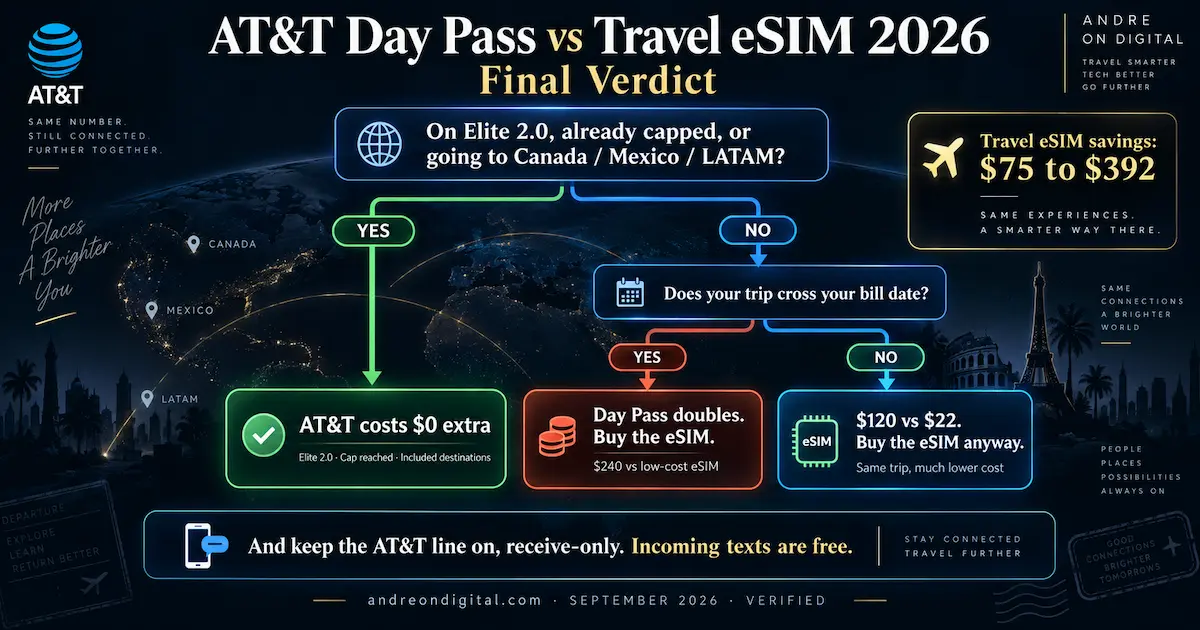
AT&T Day Pass vs Travel eSIM 2026: Elite 2.0, a reached Day Pass cap or an included Canada, Mexico or Latin America destination can mean $0 extra with AT&T. Otherwise, a travel eSIM can save about $75 to $392, with the billing-cycle date helping determine the final Day Pass cost.
Final Verdict: Day Pass or a Travel eSIM
AT&T’s Day Pass is the more sensibly built of the two big carrier products, and the ten-charge ceiling genuinely limits the damage on a long trip. It still costs four to six times a comparable eSIM package, and the ceiling behaves in a way that most travellers never check.
✅ Stay on AT&T if you are on Elite 2.0.20GB per cycle, already included, at $0 extra
✅ Stay on AT&T if you have already hit the ten-charge cap this cycle, or if your destination is Canada, Mexico or one of the 20 Latin American countries on an eligible plan
📅 Check your bill close date before you book. The same 30 days costs $120, $144 or $240
💶 Otherwise buy the eSIM. Europe 14 days: $22 against $120 or $168. Japan: $14.95 against $120
👨👩👧👦 If you do use the Day Pass, get everyone on one account. $300 against $480 for a family of four
🧩 And keep both. AT&T line on with data roaming off, eSIM as the data line. Incoming texts cost nothing
Three things matter most. The ceiling is per billing cycle, not per trip, which is why the same trip can cost double. On Elite 2.0 you cannot buy a Day Pass or a fast-data top-up, so an external eSIM is the route back to high-speed data once the included 20GB is gone.
At sea, there is no cap and no family discount, at $20 a line a day, so the $120 land ceiling does not protect a cruise. We are affiliates of the eSIM providers here and not of AT&T, which is why the cases where AT&T costs nothing are presented as carefully as the paid alternatives.
This article contains affiliate links for the eSIM providers compared. We have no affiliate relationship with AT&T and are not an AT&T customer, and we may earn a commission when you buy an eSIM through these links at no extra cost to you. That is why the scenarios in which staying on AT&T costs nothing are set out in as much detail as those in which it does not.
This is a documentary audit rather than a field test: there are no speed measurements, coverage results or support response times from our own use, and none should be inferred. AT&T’s prices, allowances, triggers, eligibility rules and unlocking criteria were read from its own legal terms, support articles and plan pages on 25 September 2026. eSIM prices come from each provider’s own catalogue on the same date, covering 997 options across Airalo, Jetpac, Saily and Roamless with 2,178 coverage relations including 492 AT&T destination entries.
Scenario totals are the additional cost of connectivity, assuming the phone is used on every day of the trip, and exclude your monthly plan, taxes, fees and long distance outside the inclusion. The cost model applies AT&T’s own rule: new charges in a cycle equal the lesser of the sessions triggered and the remainder of ten, with additional lines at $6 when charged on the same US calendar date on the same account.
Where sources disagree, this guide reports the divergence. Guides published in 2026 variously give the rate as $10, the ceiling as $100, the allowance as 2GB then 128kbps and the day as resetting at midnight local, none of which match AT&T’s terms. AT&T’s Day Pass terms exclude wearables while its Roam Latin America FAQ suggests the Day Pass for an Elite 2.0 watch, a divergence AT&T has not reconciled.
AT&T’s international terms cite more than 190 destinations while the Elite 2.0 page advertises 210 or more, and official destination lists include territories and alternative names rather than sovereign countries only. AT&T publishes no automatic refund promise for the Day Pass, and foreign carrier records can arrive up to three billing cycles late. Prices and terms change without notice, so confirm on AT&T’s own pages and at each provider’s checkout.
We use cookies to improve your experience. Accept or manage preferences.
Functional
Always active
The technical storage or access is strictly necessary for the legitimate purpose of enabling the use of a specific service explicitly requested by the subscriber or user, or for the sole purpose of carrying out the transmission of a communication over an electronic communications network.
Preferences
The technical storage or access is necessary for the legitimate purpose of storing preferences that are not requested by the subscriber or user.
Statistics
The technical storage or access that is used exclusively for statistical purposes.The technical storage or access that is used exclusively for anonymous statistical purposes. Without a subpoena, voluntary compliance on the part of your Internet Service Provider, or additional records from a third party, information stored or retrieved for this purpose alone cannot usually be used to identify you.
Marketing
The technical storage or access is required to create user profiles to send advertising, or to track the user on a website or across several websites for similar marketing purposes.