Verizon TravelPass vs eSIM 2026: Best Way to Save $146
Last updated: September 2026. Verizon’s prices, allowances and rules were read from its own support pages, plan pages and legal terms on 25 September 2026, covering 117 documented conditions. The eSIM side compares 996 catalogue options across Airalo, Jetpac, Saily and Roamless, with 1,902 coverage relations. Scenarios calculate the additional cost of a trip, not the cost of your domestic plan. Prices in USD unless stated.
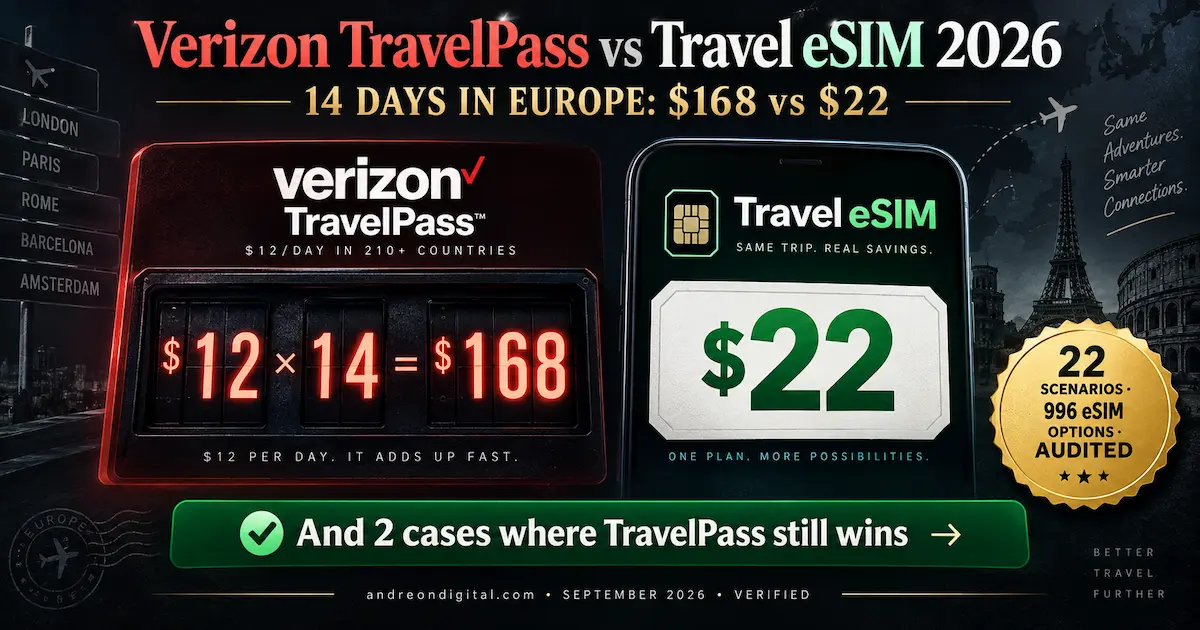
Verizon TravelPass vs eSIM 2026 is a simple cost comparison on the surface. TravelPass charges $12 per line for each 24-hour session you use your phone abroad, so two weeks in Europe comes to $168. A travel eSIM covering the same fortnight with 10GB costs $22 to $36 in total. That is the comparison nearly every guide runs, and the conclusion is correct.
It is also incomplete, because TravelPass is not really selling you data at a bad price. It is selling you your existing number staying live with no setup, and there are exactly two situations where that turns out to be the cheaper choice. This guide covers both, along with the trigger rules that decide whether you get charged at all, and a change to Verizon’s unlocking policy that can stop a travel eSIM from working before you even compare prices.
How this comparison is built: I’m based in Belgium and compare eSIM providers full-time. Verizon’s figures come from its own support pages, plan pages and legal terms read on 25 September 2026, and the eSIM prices from each provider’s own catalogue on the same date. This is a documentary audit rather than a field test, so there are no speed measurements or coverage results from my own use. Two disclosures that matter here: we are not a Verizon customer and have no relationship with Verizon, and we are affiliates of the eSIM providers compared, which is precisely why the section on when TravelPass wins is written as carefully as the rest. If you want the provider detail behind the prices, see our Airalo Review, Jetpac Review and Roamless Review.
🔢 Before the comparison, be careful which TravelPass price you are reading. The figures circulating in 2026 are wrong in several directions at once, because the rate rose from $10 to $12 in early 2025 and much of the web has not caught up. One guide updated in June 2026 gives the price as $10 a day, the high-speed allowance as 2GB and the reduced speed as 600kbps. Verizon’s official TravelPass page says $12, 5GB and 3G. The same guide gives the International Monthly Plan as 250MB of high-speed data, where Verizon’s plan page says 20GB. A separate comparison lists Canada and Mexico at $10 a day, where Verizon says $6. None of this is malicious, and the rate genuinely did change. It does mean that every figure in this guide comes from Verizon’s own pages, and that you should confirm on those pages before budgeting a trip.
⚡ Verizon TravelPass vs eSIM 2026: The Short Answer
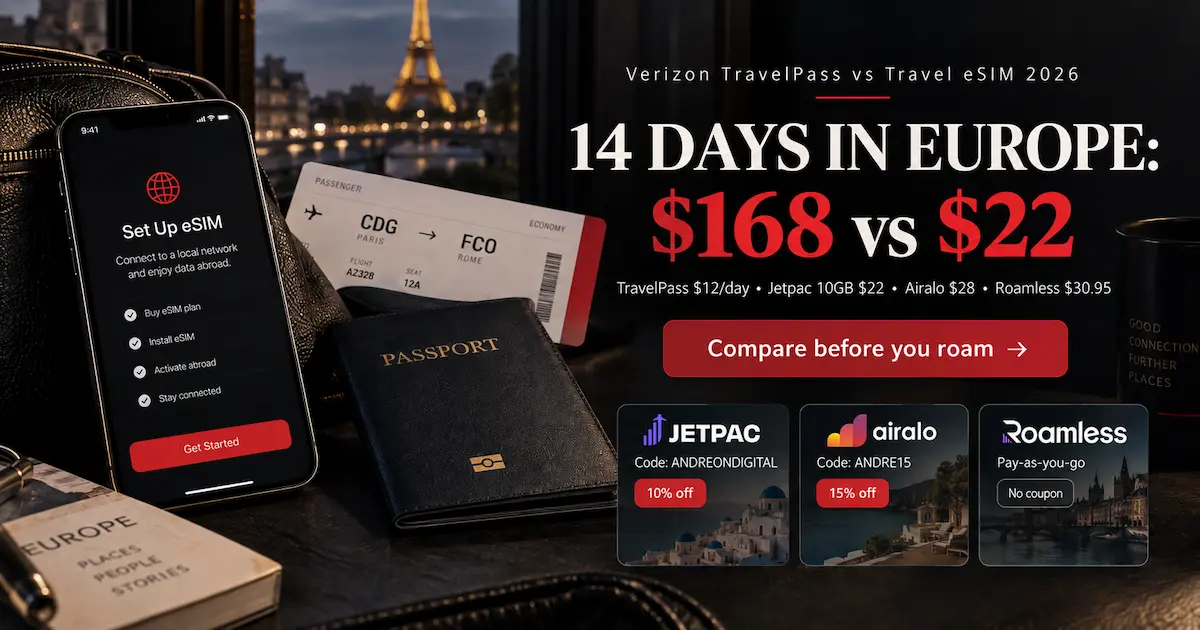
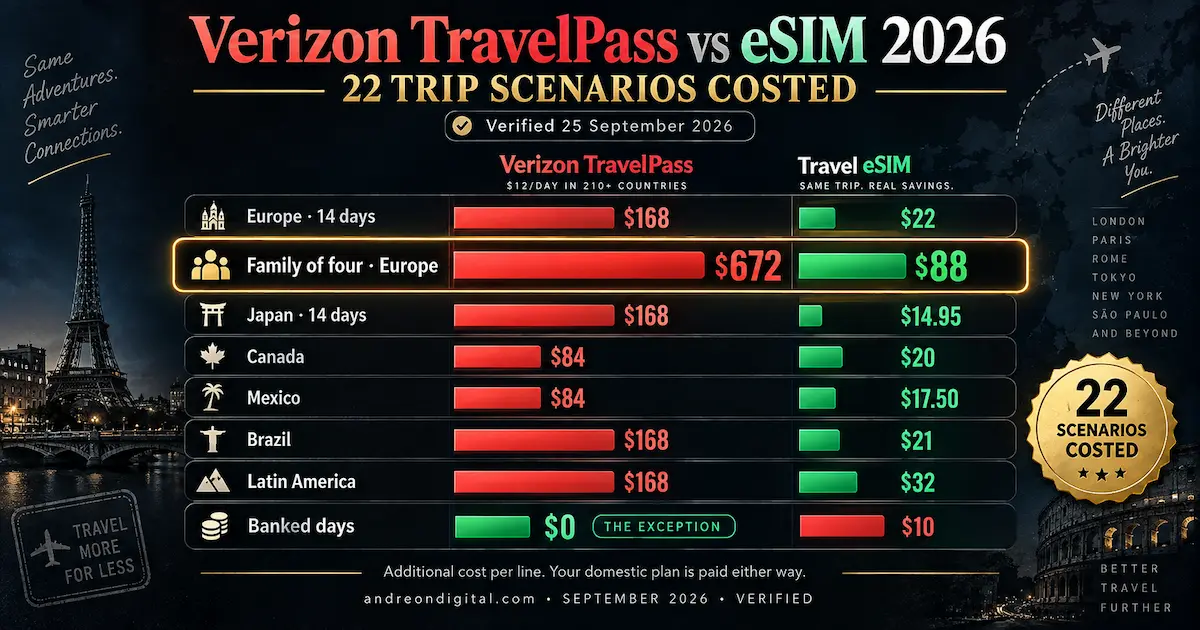
💸 14 days in Europe: TravelPass $168 · Jetpac 10GB $22 · you keep $146 👨👩👧👦 A family of four, same trip: TravelPass $672 · four eSIMs $88 · you keep $584 🇯🇵 14 days in Japan: TravelPass $168 · Roamless 10GB $14.95
✅ TravelPass wins if you already have banked days from the $10 perk. Marginal cost: $0 ✅ TravelPass wins if you are on Unlimited Ultimate, which includes 15GB a cycle abroad.
⚠️ A session starts on a call, a text or background data. Not on opening an app. ⚠️ Verizon’s unlock rule changed in 2026. The 60-day rule is out of date. ⚠️ Turning off data roaming does not stop a call from triggering $12.
Verizon TravelPass vs eSIM 2026: What Each Product Actually Is
Verizon offer
Price
Billed on
High-speed data
Then
Voice and texts
TravelPass, most destinations
$12
Per line, per 24-hour session
5GB
3G for the rest of the session
✅ Unlimited in-country and to the US
TravelPass, Canada and Mexico
$6
Per line, per session, only if not already included
5GB
3G
✅ Same
TravelPass Boost
$10 · $5 in CA/MX
Optional add-on to a session already paid
+2GB
Back to reduced speed
❌ Adds nothing
3 TravelPass Days perk
$10 a month
Per eligible line, gives 3 sessions
⚠️ Conflict: perk terms say 2GB, TravelPass says 5GB
—
As TravelPass
International Monthly Plan
$100
Per line, per month, plus taxes
20GB
3G
250 minutes, then $0.25/min · unlimited texts
Unlimited Ultimate, included
$0 extra
Already in the plan you pay for
15GB per billing cycle
Up to 1.5 Mbps
✅ Unlimited in-country and to the US
Canada and Mexico on eligible Unlimited
$0 extra
Included roaming
2GB a day
3G
Per the plan
⚠️ Cruise Daily Pass
$20
Per line, per 24h with onboard use
⚠️ 0.5GB
3G
Received calls and calls to the US
⚠️ In-flight Daily Pass
$20
Per line, per 24h on participating flights
No fast allowance published
Unlimited 3G
Not included in this pass
Prepaid TravelPass
$12
Per line, per session, needs balance
5GB
3G
⚠️ 140+ destinations, not 210+
🧭 The structural difference in one line. TravelPass charges by time, so the bill grows with the length of your trip and does not care how little you use. A travel eSIM charges by data, so the bill is fixed before you leave and does not care how long you stay. That is why the gap widens the longer you travel, and why the two products are hardest to separate on a single overnight trip. It also explains the other half of the comparison: TravelPass includes unlimited calls and texts on your own number, which a data-only eSIM does not, and that is what you are really paying the premium for.
Verizon TravelPass vs eSIM 2026: Twenty-Two Trip Scenarios Costed
Each row is the additional cost of connectivity for one line, assuming you use the phone every day of the trip. Your domestic plan is paid either way and is not counted here.
Trip
TravelPass
Cheapest eSIM
You keep
Monthly Plan
🇪🇺 Europe, 3 days, 3GB
$36
Airalo $10
$26
$100
🇪🇺 Europe, 7 days, 5GB
$84
Jetpac $13
$71
$100
🇪🇺 Europe, 9 days, 10GB
$108
Jetpac $22
$86
$100
🇪🇺 Europe, 14 days, 10GB
$168
Jetpac $22
$146
$100
🇪🇺 Europe, 30 days, 20GB
$360
Jetpac 30GB $29.99
$330
$100
🇯🇵 Japan, 14 days, 10GB
$168
Roamless $14.95
$153
$100
🇬🇧 United Kingdom, 14 days, 10GB
$168
Jetpac $17
$151
$100
🇧🇷 Brazil, 14 days, 10GB
$168
Airalo $21
$147
$100
🇦🇪 United Arab Emirates, 14 days, 10GB
$168
Airalo $19
$149
$100
🌎 Latin America, 14 days, 10GB
$168
Airalo $32
$136
$100
🌐 Global, 14 days, 10GB
$168
Jetpac $45
$123
$100
🇨🇦 Canada, 14 days, 10GB
$84
Airalo $20
$64
$100
🇲🇽 Mexico, 14 days, 10GB
$84
Airalo $17.50
$66.50
$100
👨👩👧👦 Europe, family of 4, 14 days, 10GB each
$672
4× Jetpac $88
$584
$400
🇫🇷 France, one day, 0.5GB
$12
Roamless $0.98
$11
$100
🇫🇷 France, 3 days, 1GB
$36
Roamless $1.95
$34
$100
🇪🇺 Europe unlimited, 7 days
$84
Jetpac $25.99
$58
$100
🇪🇺 Europe unlimited, 30 days
$360
Jetpac $65.99
$294
$100
✅ Europe, 3 days covered by banked perk days
✅ $0
Airalo $10
⚠️ TravelPass wins by $10
$100
📉 Two patterns in that table are worth naming. First, the gap is not proportional to trip length, it is proportional to the number of sessions you trigger, and a travel eSIM costs the same whether you stay three days or thirty. That is why a 30-day European trip reaches $360 against $29.99. Second, Verizon’s own International Monthly Plan at $100 beats TravelPass from the ninth session onward, since nine sessions cost $108. If you are committed to staying on Verizon for a longer trip, the monthly plan is the cheaper Verizon option and most comparisons skip it entirely. It still costs three to five times a comparable eSIM package.
Jetpac in This Verizon TravelPass Comparison
In Verizon TravelPass vs eSIM 2026, Jetpac appears repeatedly as the lowest-cost eSIM in the European scenarios above. The table prices it at $13 for the seven-day Europe scenario, $22 for the 10GB Europe scenarios and $29.99 for the 30GB option. That is why the gap becomes especially large when TravelPass is charged day after day. For the provider-level details behind those prices, see our Jetpac eSIM Review 2026.
The key point is that Jetpac is being used here as a data-cost benchmark, while TravelPass also keeps Verizon voice and text features attached to your existing line. If you are deciding between the two eSIM brands that appear most often in the Europe rows, our Jetpac vs Airalo 2026 comparison goes deeper into that choice.
Airalo in This Verizon TravelPass Comparison
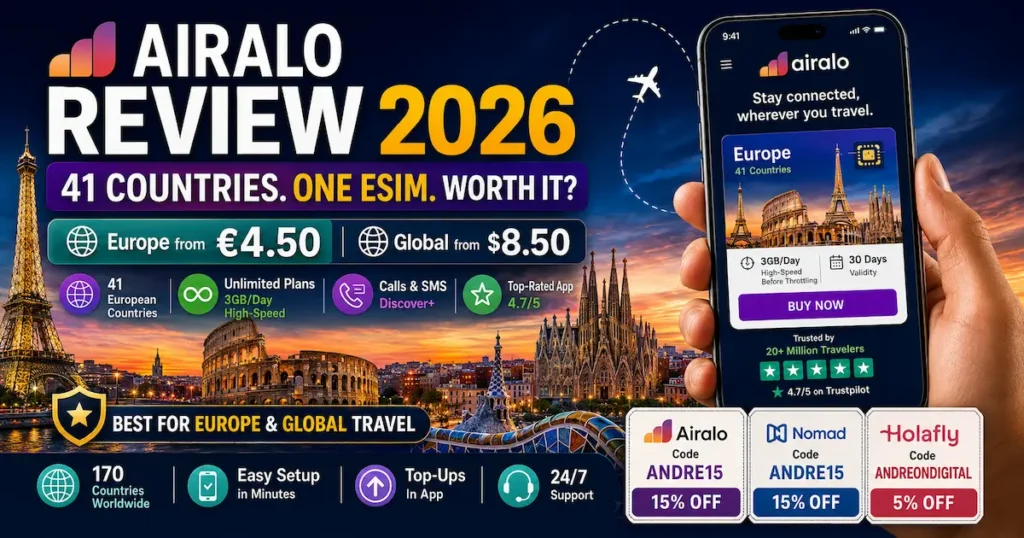
In Verizon TravelPass vs eSIM 2026, Airalo is the lowest-cost eSIM in several rows where Jetpac is not, including the short Europe scenario plus Brazil, the United Arab Emirates, Latin America, Canada and Mexico. It also matters in the feature comparison because Discover+ can include a +1 number with minutes and SMS. Our Airalo Europe Review 2026 explains the provider in more detail.
That distinction matters because a travel eSIM is not automatically a full replacement for everything TravelPass provides. In this article, Airalo is both a price comparison and an example of how some eSIM plans add calling features, while your Verizon line can still remain active for incoming calls and verification texts.
Roamless in This Verizon TravelPass Comparison
In Verizon TravelPass vs eSIM 2026, Roamless fills a different role in the scenarios above. It is the lowest-cost option shown for the 10GB Japan example and for the very light France examples, where pay-as-you-go pricing can keep the total far below a full TravelPass day. For a closer look at its pay-as-you-go model, fixed plans and calling features, see our Roamless eSIM Review 2026.
For this comparison, Roamless is most useful when your data needs are small or when its destination pricing undercuts a fixed package. The Verizon line can still stay active alongside it, but avoiding a TravelPass charge requires treating that Verizon line as receive-only and keeping mobile data on the eSIM.
Verizon TravelPass vs eSIM 2026: The Two Cases Where TravelPass Wins
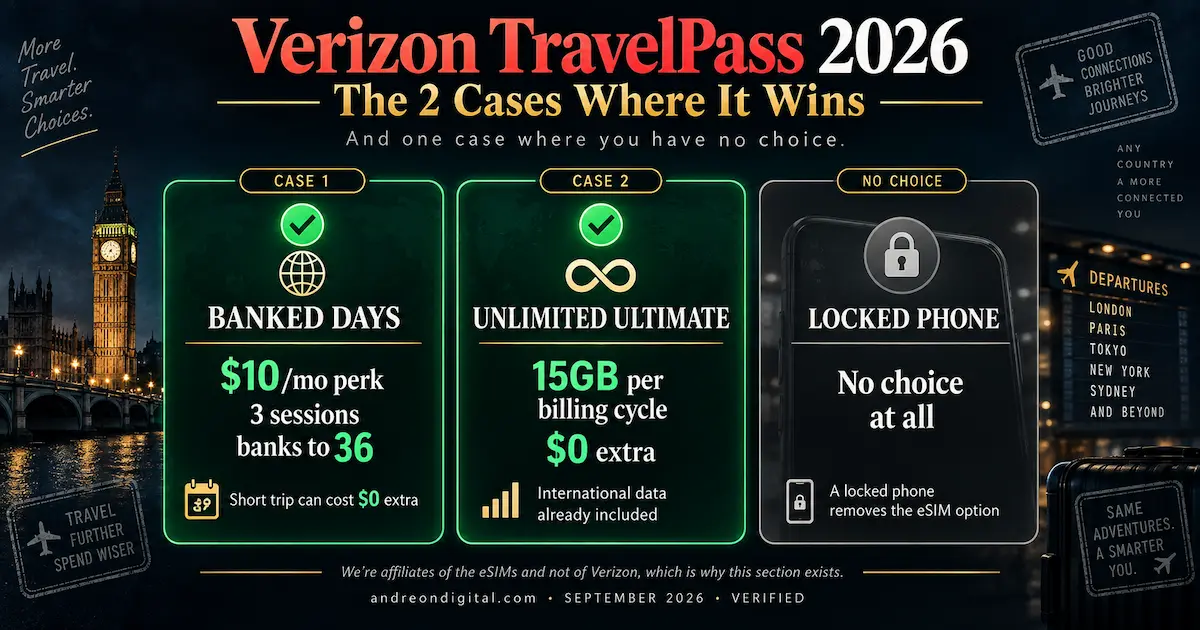
Verizon TravelPass vs eSIM 2026 has two cases where staying on Verizon is the cheaper answer, and one where it is the only workable one. We are affiliates of the eSIM providers in the table above, so this section deserves more care than the rest, not less.
✅ Case one: you already have banked TravelPass days. The 3 TravelPass Days perk costs $10 a month and grants three 24-hour sessions per eligible line, on Simplicity, Unlimited Plus or Unlimited Welcome. Unused days bank up to 36, each batch lasting twelve months, and the soonest to expire are used first. If a weekend in Europe fits inside days you have already paid for, the marginal cost is zero and buying a $10 eSIM is money you did not need to spend. Two conditions: the days are not shareable between lines, so a family still needs a perk per line, and migrating to Unlimited Ultimate removes TravelPass entirely, leaving banked days sitting unusable until they expire.
✅ Case two: you are already on Unlimited Ultimate. The current version, which began on 7 May 2026, includes 15GB of high-speed international data per billing cycle at no additional roaming charge, then up to 1.5 Mbps, with unlimited calls in the country you are visiting and back to the US. For a traveller already paying for that plan, the extra cost of connectivity abroad is nothing until the 15GB runs out, which covers most two-week trips comfortably. Three things to hold onto: the 15GB is per billing cycle, not per trip, per day or per country, so a long trip spanning two cycles gets two allowances while two trips in one cycle share one. The legacy Unlimited Ultimate 1.0 documentation also shows 15GB. And the $10 top-up buys 2GB more when it runs out.
⚠️ And the case that is not about money at all: a locked phone. If your device is locked to Verizon, a travel eSIM will not install, so the comparison never happens. Verizon’s unlocking policy changed in 2026 and the advice you may remember is out of date. The old rule was automatic unlocking after 60 days. Under the current postpaid policy, unlocking follows payment of the device in full, with payment by a non-secure method potentially requiring a 35-day wait, and lost, stolen or fraud-flagged devices excluded. Prepaid activations from 27 January 2026 require 365 days of paid and active service. Verizon’s own Dual SIM help page still mentions the 60-day rule, which conflicts with its dedicated unlocking policy updated in February 2026. Check your specific device before buying anything, and see our eSIM compatible phones guide for the hardware side.
Verizon TravelPass vs eSIM 2026: What Triggers a $12 Charge
Action
Starts a session?
Detail
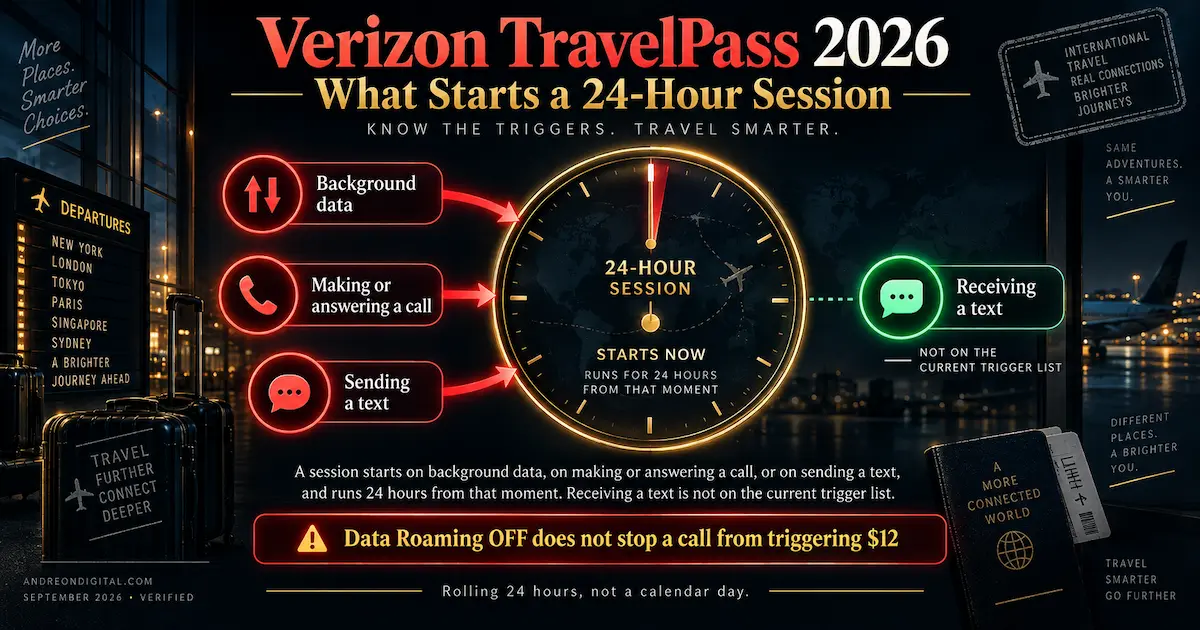
Using data, including background processes
❌ Yes
You do not need to open an app. Sync and updates count
Making or answering a call
❌ Yes
Including when data roaming is switched off
Sending a text
❌ Yes
Including when data roaming is switched off
Receiving a text
✅ Not on the current list
⚠️ Picture messages can still generate international data
Crossing a border
Depends
Destinations at the same rate may share one session
Standing near a border
Possible
The phone can attach to a neighbouring country’s network
Removing TravelPass from the line
⚠️ Does not block roaming
⚠️ Without an applicable plan you can be billed pay as you go
🕐 The session is a rolling 24 hours from first use, not a calendar day, and this is where budgets go wrong. Land at 11pm and check your messages and that session runs to 11pm the following night, so a three-night trip can bill three sessions or four depending on when you first touch the phone. Verizon does not cap the number of sessions on a standard line, unlike some competitors. There is also a small but telling error on Verizon’s own FAQ: the page carries an AI-generated summary saying the usage notification arrives two hours before the session ends, while the body of the same page says it is sent two hours after the session starts. Those are different things, and the detailed body text is the one to trust.
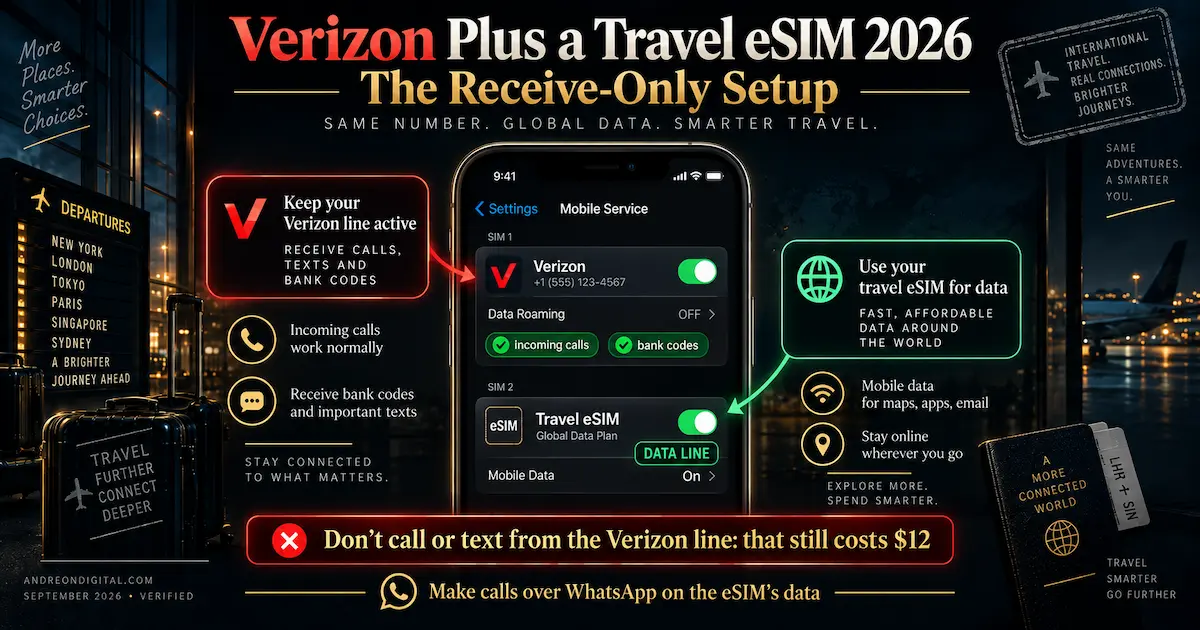
Verizon TravelPass vs eSIM 2026 setup warning: 📵 And the correction to the advice you will read everywhere else. Several guides recommend keeping the Verizon line for calls and texts while a travel eSIM handles data, with Data Roaming switched off on the Verizon line. That is the right setup and it is described incompletely. Turning off data roaming stops data from triggering a session. It does not stop a call or an outgoing text from doing so, because making or answering a call and sending a text remain on Verizon’s own list of triggers. So the setup saves you money only if you treat the Verizon line as receive-only: let calls and verification codes arrive, and make your own calls through WhatsApp or FaceTime over the eSIM’s data. Our activation guide covers setting the data line correctly.
Verizon TravelPass vs eSIM 2026: What the eSIM Does Not Replace
What you lose
How to cover it
Your US number receiving calls and texts
✅ Keep the Verizon line active with data roaming off, and treat it as receive-only
Calls from your own number
Airalo Discover+ includes a +1 number with minutes and SMS. Roamless can use your verified Verizon number as caller ID for outgoing calls, though it does not forward incoming calls
Wi-Fi Calling to non-US numbers
⚠️ Billed at international rates and not part of the TravelPass allowance. ⚠️ On iPhone it must be enabled while connected to Verizon before you leave
⚠️ Connectivity at sea
⚠️ Neither product covers it. Verizon sells a Cruise Daily Pass at $20 with 0.5GB, and travel eSIM regional plans are land-based
Connectivity in the air
Verizon’s In-flight Daily Pass at $20 on participating flights. Not included in TravelPass or banked days
Calls to a third country
⚠️ Not in TravelPass either. Only the visited country and the US are included
Verizon TravelPass vs eSIM 2026 works best as a dual-line setup for many travellers. 📞 The setup that gets you both, and what it costs. Keep the Verizon line active with Data Roaming off so your US number still rings and bank codes still arrive, and install a travel eSIM as the data line. That combination gives you full reachability on your own number plus local data at eSIM prices, provided you do not place calls or send texts on the Verizon line. If you also need to make calls from a real number, Airalo’s Discover+ bundles a +1 number with minutes and SMS into the plan itself, which no other provider here matches. And if your trip includes a cruise, our GigSky review covers maritime plans, because a Caribbean or Mediterranean eSIM will not work between ports.
🌍 Two coverage points worth checking before you assume TravelPass reaches everywhere. Verizon’s TravelPass country table contains 216 nominal entries, which include countries, territories and individual localities rather than 216 sovereign states, and nine requested destinations did not appear on it at all. Prepaid TravelPass covers 140-plus destinations rather than the 210-plus quoted for postpaid, so a prepaid line should not assume the postpaid list. And Verizon’s terms allow it to limit or remove service if more than half your time is spent abroad, which rules TravelPass out as a permanent substitute for a local line on a long stay.
FAQ: Verizon TravelPass vs eSIM 2026
How much does Verizon TravelPass actually cost per day?
Twelve dollars per line per 24-hour session in most destinations, and six dollars in Canada and Mexico when those are not already included in your plan. Several guides still publish ten dollars, including one updated in June 2026, because the rate rose from ten to twelve in early 2025. That same guide also gives the high-speed allowance as 2GB and the reduced speed as 600kbps, where Verizon’s own FAQ says 5GB and 3G, and gives the International Monthly Plan as 250MB where Verizon says 20GB. Another widely read comparison lists Canada and Mexico at ten dollars rather than six. Check Verizon’s own TravelPass page before budgeting, because the third-party figures circulating in 2026 are wrong in several directions at once. Verified September 2026.
What does a 14-day trip to Europe cost on each?
On TravelPass, $168 per line if you use your phone every day, since each 24-hour session bills separately and Verizon does not cap the total. On a travel eSIM covering the same trip with 10GB, the cheapest options we priced on 25 September 2026 were Jetpac at $22, Airalo at $28, Roamless at $30.95 and Saily at $35.99. So the gap on a single line is around $146, and on a family of four travelling together it is $584, because TravelPass is charged per line while each traveller simply buys their own eSIM package. Verizon’s own International Monthly Plan at $100 with 20GB is cheaper than TravelPass from the ninth session onward, so it is worth comparing on longer trips. Verified September 2026.
When is Verizon TravelPass actually the better choice?
In two situations, and they are narrower than the daily rate suggests. The first is when you already have TravelPass days banked from the three-day perk, which costs $10 a month and grants three 24-hour sessions per eligible line. If a short trip fits inside days you have already paid for, the marginal cost is zero and any eSIM purchase is money you did not need to spend. The second is if you are already on Unlimited Ultimate, whose current version includes 15GB of high-speed international data per billing cycle at no additional roaming charge, then up to 1.5 Mbps. For a traveller already paying for that plan, the extra cost of connectivity abroad is nothing until the 15GB runs out. Verified September 2026.
What triggers a TravelPass charge?
Making or answering a call, sending a text, or using data, including background processes your phone runs without you opening anything. That is why the charge often appears before travellers think they have used the phone. Receiving a text does not trigger a session according to the current list, though picture messages can generate international data. The clock is a rolling 24 hours from that first use rather than a calendar day, so a late evening landing and the following morning can fall inside one session or across two depending on the hour. Verizon’s own FAQ also carries an AI-generated summary saying the usage notification arrives two hours before the session ends, while the body of the same page says it is sent two hours after the session starts. Verified September 2026.
Can I keep my Verizon number and use a travel eSIM for data?
Yes, and this is the setup most travellers should use, with one correction to the advice you will read elsewhere. You install the travel eSIM, set it as your data line, and switch Data Roaming off on the Verizon line so it stays registered for voice and SMS. Incoming calls ring and texts arrive, including verification codes from US banks. The correction is that turning off data roaming does not stop a TravelPass session from starting: making or answering a call, or sending a text, still triggers the daily charge on most devices. So the setup protects you only if you treat the Verizon line as receive-only and make your calls through WhatsApp or FaceTime over the eSIM’s data. Verified September 2026.
Will a travel eSIM work on a locked Verizon phone?
No, and Verizon’s unlocking policy changed in 2026, so the advice you may remember is out of date. The old rule was automatic unlocking after 60 days. Under the current postpaid policy, devices are unlocked once the device is paid in full, with payment by a non-secure method potentially requiring a 35-day wait, and lost, stolen or fraud-flagged devices excluded. Prepaid activations from 27 January 2026 require 365 days of paid and active service. Verizon’s own Dual SIM help page still mentions the 60-day rule, which conflicts with the dedicated unlocking policy updated in February 2026. Confirm your specific device’s status before buying any travel eSIM, because a locked phone will not install one. Verified September 2026.
How much high-speed data does TravelPass actually include?
Five gigabytes per 24-hour session on consumer postpaid, after which Verizon describes the speed as 3G for the rest of that session. You can buy an extra 2GB for $10 in most destinations or $5 in Canada and Mexico, and that top-up only applies to the remainder of the same session rather than extending it. There is a documented conflict worth knowing: the terms for the three-day TravelPass perk state 2GB per day, while the current TravelPass documentation states 5GB. On Unlimited Ultimate the structure is different again, at 15GB per billing cycle rather than per session, then up to 1.5 Mbps, with a $10 top-up for 2GB more. Verified September 2026.
Does TravelPass work on a cruise or a plane?
No, and this catches people out because both are sold separately at $20 a day. The Cruise Daily Pass covers use on participating ships twelve miles or more from land and includes only 0.5GB at high speed before dropping to 3G, which is a fifth of what a land TravelPass session gives. The In-flight Daily Pass covers participating international flights and is described as unlimited 3G with no published high-speed allowance. Neither is included in a land TravelPass session or in banked perk days. Travel eSIMs do not solve this either, since regional plans are land-based, so a cruise needs a maritime product regardless of which route you choose. Verified September 2026.
Does TravelPass cover calls to any country?
No. Calls within the country you are visiting and calls back to the United States are included, and calls to a third country follow Verizon’s international long distance rates instead. That distinction matters on a multi-country trip where you might call a hotel in the next country on your itinerary. Wi-Fi Calling is separate again: calls over Wi-Fi to US numbers carry no additional charge, while calls to numbers in other countries are billed at international rates and do not draw on the TravelPass allowance. If you use an iPhone, Wi-Fi Calling has to be enabled while connected to the Verizon network before you leave, rather than after you arrive. Verified September 2026.
Which travel eSIM should a Verizon customer buy?
It depends on the trip, and the four we priced cover different models. Jetpac was cheapest in most European scenarios, at $22 for 10GB over 30 days and $29.99 for 30GB. Airalo was cheapest for Canada at $20, Mexico at $17.50, Brazil at $21 and Latin America at $32, and it is the only one of the four selling a global plan with a real +1 number, minutes and SMS through Discover+. Roamless was cheapest in Japan at $14.95 and is the only pay-as-you-go option, charging $1.95 per gigabyte in Western Europe with a one dollar minimum, which suits very light use. Saily was rarely cheapest but bundles security tools and allows 180 days to activate. Verified September 2026.
Verizon TravelPass vs eSIM 2026: Final Verdict
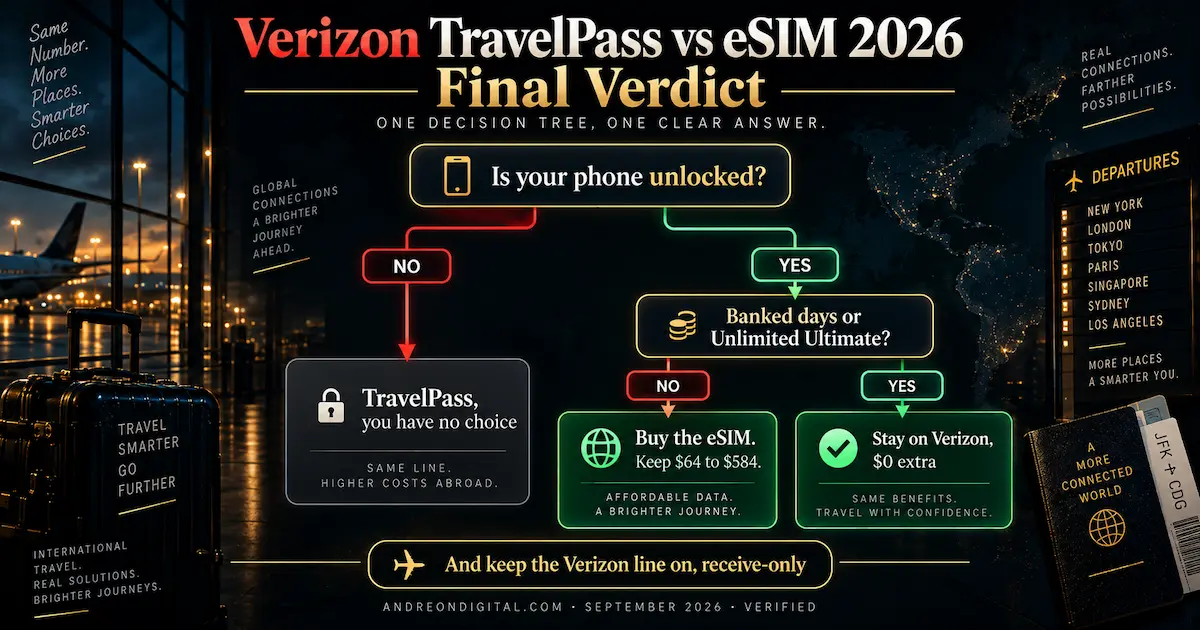
For almost every traveller the answer is a travel eSIM, and the margin is large enough that it is not really a close call. What makes this comparison worth writing is the small number of cases where it goes the other way, and the fact that the setup most people should use keeps both.
✅ Stay on Verizon if you have banked perk days. A short trip inside days you already paid for costs $0
✅ Stay on Verizon if you are on Unlimited Ultimate.15GB per billing cycle abroad, already included
⚠️ You have no choice if your phone is locked. Check first, because the 60-day rule no longer applies
💶 Otherwise buy the eSIM. Europe 14 days: $22 against $168. A family of four: $88 against $672
🧩 And keep both. Verizon line on with data roaming off, eSIM as the data line, and treat Verizon as receive-only
📅 If you insist on Verizon for a long trip, the $100 International Monthly beats TravelPass from the ninth session
Three things to carry away. Turning off data roaming does not make you safe, because making or answering a call and sending a text still start a $12 session. Check the price on Verizon’s own page, since guides updated in 2026 still publish $10 a day, 2GB and 600kbps where Verizon says $12, 5GB and 3G.
Neither product works at sea, where Verizon charges $20 a day for half a gigabyte and travel eSIM regional plans are land-based. We are affiliates of the eSIM providers here and not of Verizon, which is exactly why the two cases where Verizon wins are set out in as much detail as the twenty where it does not.
This article contains affiliate links for the eSIM providers compared. We have no affiliate relationship with Verizon and are not a Verizon customer, and we may earn a commission when you buy an eSIM through these links at no extra cost to you. That is why the two scenarios in which staying on Verizon is cheaper are set out in as much detail as the twenty in which it is not.
This is a documentary audit rather than a field test: there are no speed measurements, coverage results or support response times from our own use, and none should be inferred. Verizon’s prices, allowances, triggers, eligibility rules and unlocking policy were read from its own support pages, plan pages and legal terms on 25 September 2026, covering 117 documented conditions. eSIM prices come from each provider’s own catalogue on the same date, covering 996 options across Airalo, Jetpac, Saily and Roamless with 1,902 coverage relations.
Scenario totals are the additional cost of connectivity for one line, assuming the phone is used on every day of the trip, and exclude your domestic plan, taxes and fees. Where sources disagree, this guide reports the divergence: the terms for the three-day perk state 2GB per day while current TravelPass documentation states 5GB; Verizon’s own TravelPass FAQ carries an AI-generated summary about notification timing that contradicts the body of the same page; and Verizon’s Dual SIM help page still references a 60-day unlocking rule that conflicts with the dedicated unlocking policy updated in February 2026.
Third-party guides published or updated in 2026 variously state the TravelPass rate as $10, the allowance as 2GB, the reduced speed as 600kbps, the Canada and Mexico rate as $10 and the International Monthly allowance as 250MB, none of which match Verizon’s current pages. Verizon’s TravelPass country table contains 216 nominal entries including territories and localities rather than sovereign states. Prices and terms change without notice, so confirm on Verizon’s own pages and at each provider’s checkout.
We use cookies to improve your experience. Accept or manage preferences.
Functional
Always active
The technical storage or access is strictly necessary for the legitimate purpose of enabling the use of a specific service explicitly requested by the subscriber or user, or for the sole purpose of carrying out the transmission of a communication over an electronic communications network.
Preferences
The technical storage or access is necessary for the legitimate purpose of storing preferences that are not requested by the subscriber or user.
Statistics
The technical storage or access that is used exclusively for statistical purposes.The technical storage or access that is used exclusively for anonymous statistical purposes. Without a subpoena, voluntary compliance on the part of your Internet Service Provider, or additional records from a third party, information stored or retrieved for this purpose alone cannot usually be used to identify you.
Marketing
The technical storage or access is required to create user profiles to send advertising, or to track the user on a website or across several websites for similar marketing purposes.