Wi-Fi Calling With a Travel eSIM 2026: Ultimate Guide
Wi-Fi Calling with a travel eSIM 2026. Last updated: October 2026. This is a documentary audit of official sources rather than a field test. We read the published policies of twelve carriers across the US, UK, Canada and Australia, plus 41 device findings from Apple, Google and Android references, 36 plan prices across six eSIM providers and 25 provider conditions, all on 3 October 2026. No calls, messages or verification codes were tested. Prices in USD and EUR as each provider publishes them.
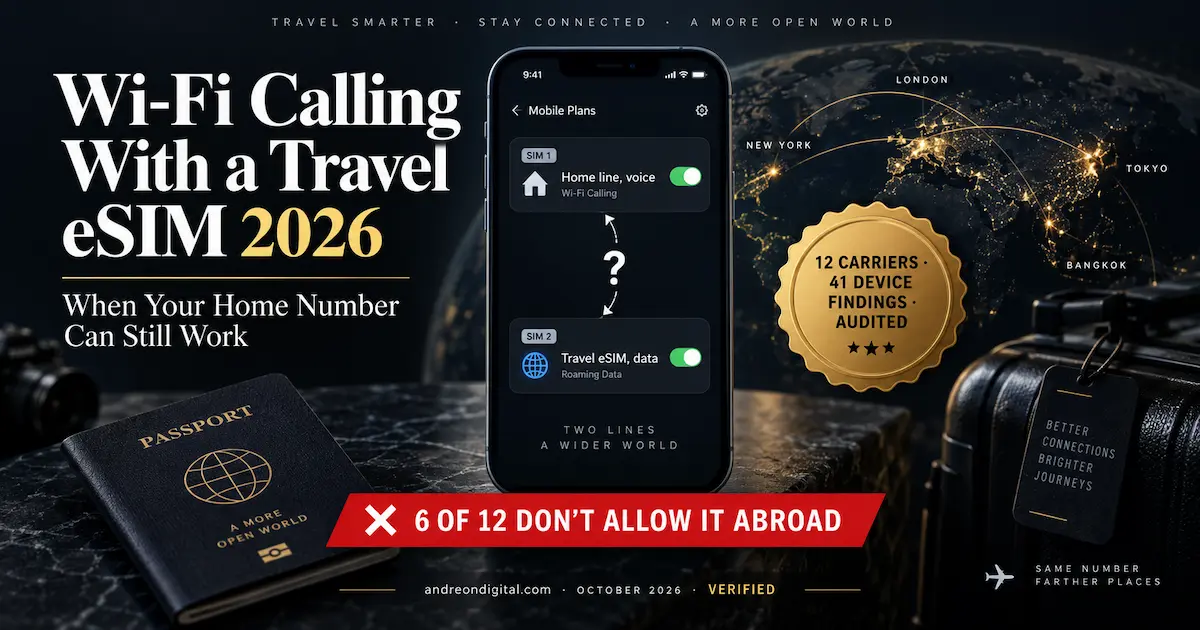
Wi-Fi Calling With a Travel eSIM 2026: our audit found that 6 of 12 carriers do not allow Wi-Fi Calling abroad, while none of the twelve officially confirms it over a travel eSIM’s own mobile data. Verified October 2026.
The setup sounds perfect, and it is the most repeated advice in travel connectivity. Wi-Fi Calling With a Travel eSIM 2026 is built around that same idea: keep your home SIM active for your number, put a cheap travel eSIM in for data, and let Wi-Fi Calling carry your calls so your number still rings in Lisbon or Lima. No roaming bill, no missed bank codes.
It does work, for a lot of people. But the guides promising it are almost all written by companies selling eSIMs, and when you read what the carriers themselves publish, two gaps appear that most of those guides never explain.
For Wi-Fi Calling With a Travel eSIM 2026, those gaps are decisive: six of the twelve carriers we audited do not support Wi-Fi Calling abroad at all, including four of the five biggest British networks. And not one of the twelve confirms that it works over a travel eSIM’s own mobile data, which is the scenario most of those guides actually describe.
How this guide is built, and what it is not: For this Wi-Fi Calling With a Travel eSIM 2026 audit, I’m based in Belgium and compare eSIM providers full-time. This is a documentary audit of official sources rather than a field test: we read what twelve carriers, Apple, Google and six eSIM providers publish, on 3 October 2026, and we tested no calls, messages or verification codes. Where a source says nothing, this guide records that as unconfirmed rather than filling the gap. We are affiliates of several eSIM providers mentioned here, which is worth saying plainly on a question where every page competing for this search is published by one. Related reading: eSIM vs Physical SIM, our AT&T Day Pass comparison and our Verizon TravelPass comparison, which cover the roaming side of the same decision.
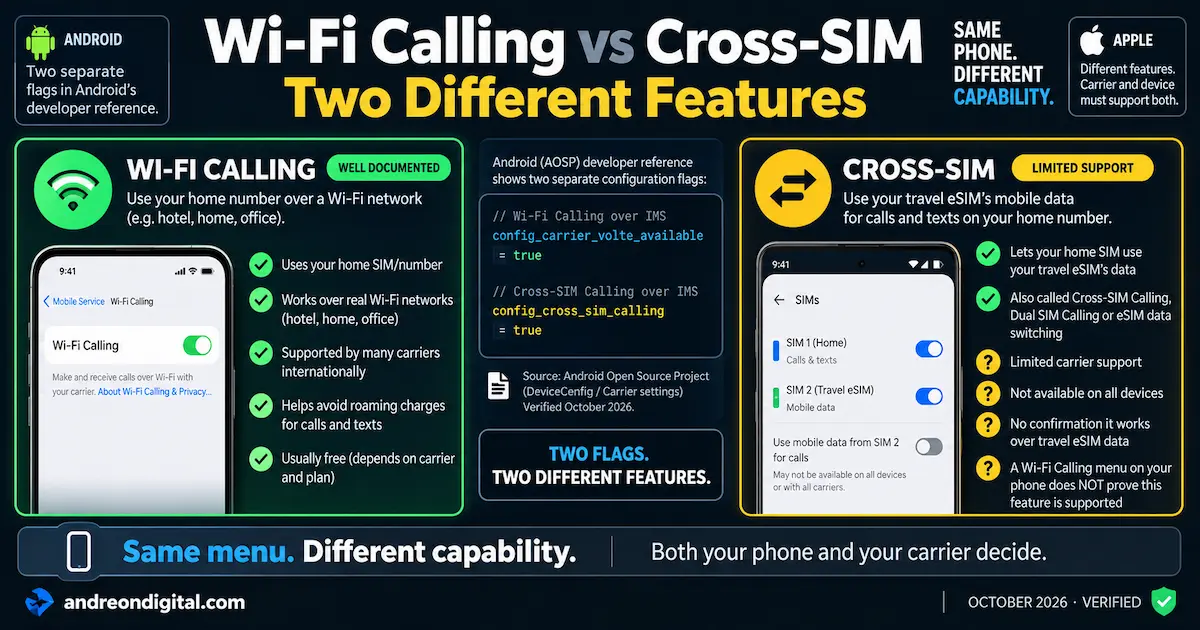
🔍 The gap between what the sellers say and what the carriers publish. Searching this question in October 2026 returns pages from six different eSIM companies, and three of them state as settled fact that your home line can run Wi-Fi Calling over the travel eSIM’s mobile data, with no Wi-Fi network involved. One illustrates it with a personal anecdote. Three others hedge the same claim with may, some devices or depends on your carrier. We checked the twelve carriers those travellers would actually be on. None of them confirms it. AT&T comes closest, with an iPhone tutorial describing receiving calls that way, which the audit records as partial. Apple illustrates the scenario and attaches conditions. Android’s own developer reference defines Wi-Fi Calling and Cross-SIM as two separate capability flags, which is the clearest evidence that these are not the same feature. None of this makes the setup a myth. It makes it something to verify on your own line rather than assume.
⚡ The Short Answer
✅ Over real Wi-Fi: works on most US, Australian and some Canadian carriers
⚠️ Over your travel eSIM’s data:none of the 12 carriers confirms it. AT&T is partial
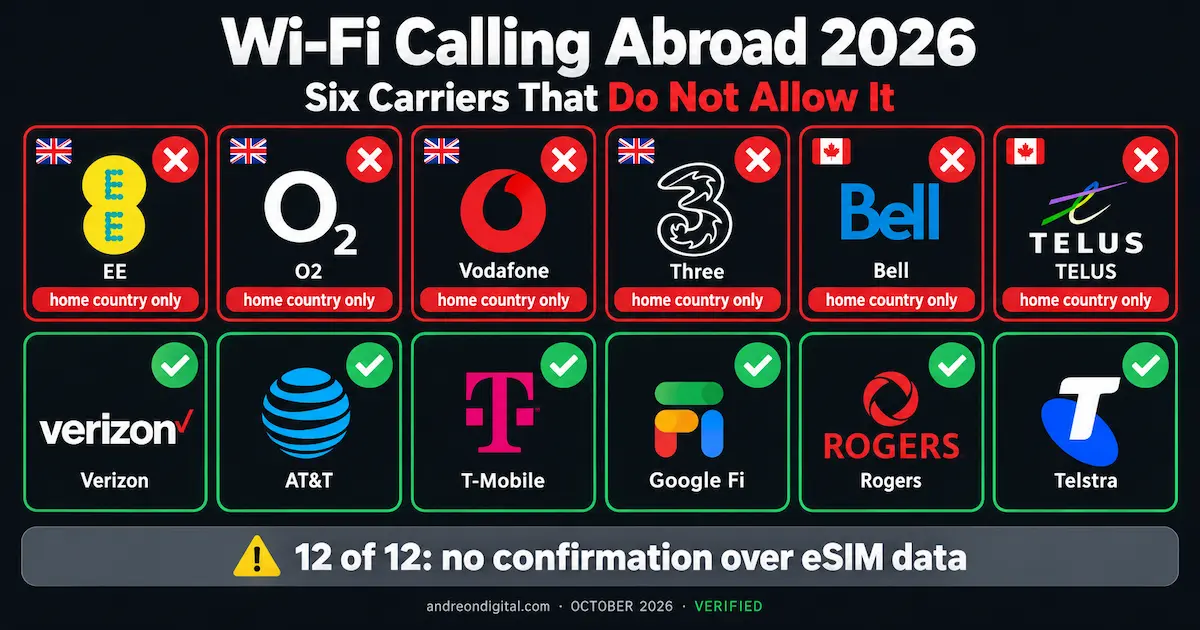
❌ Not abroad at all: EE consumer, O2, Vodafone, Three, Bell and TELUS
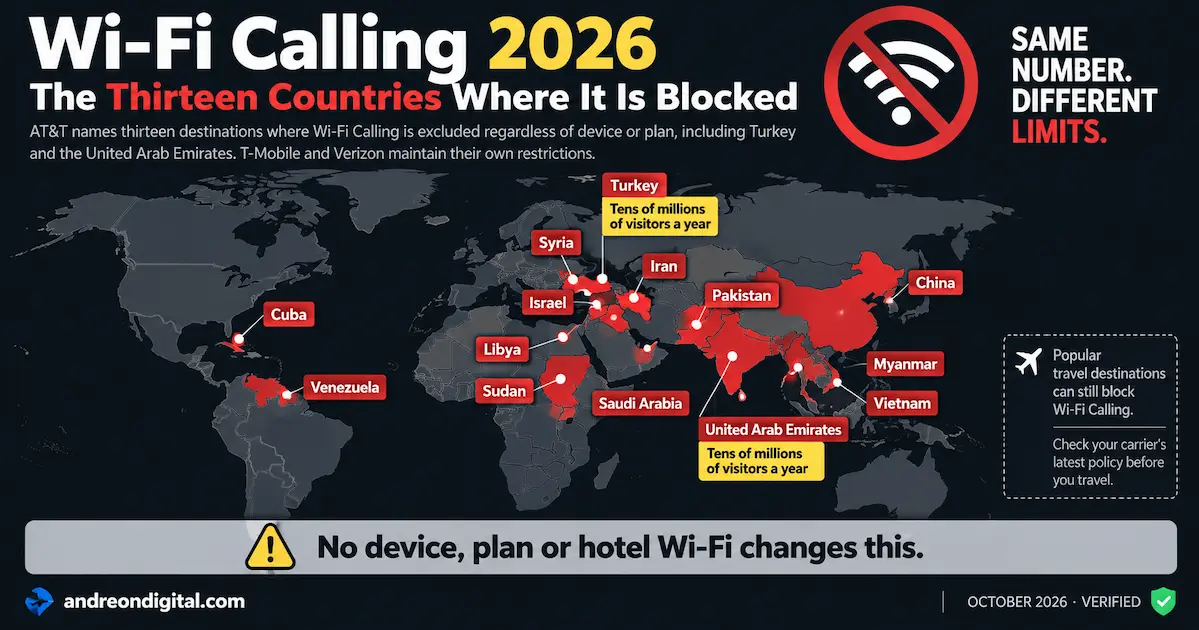
❌ Blocked outright in 13 countries: AT&T includes Turkey and the UAE
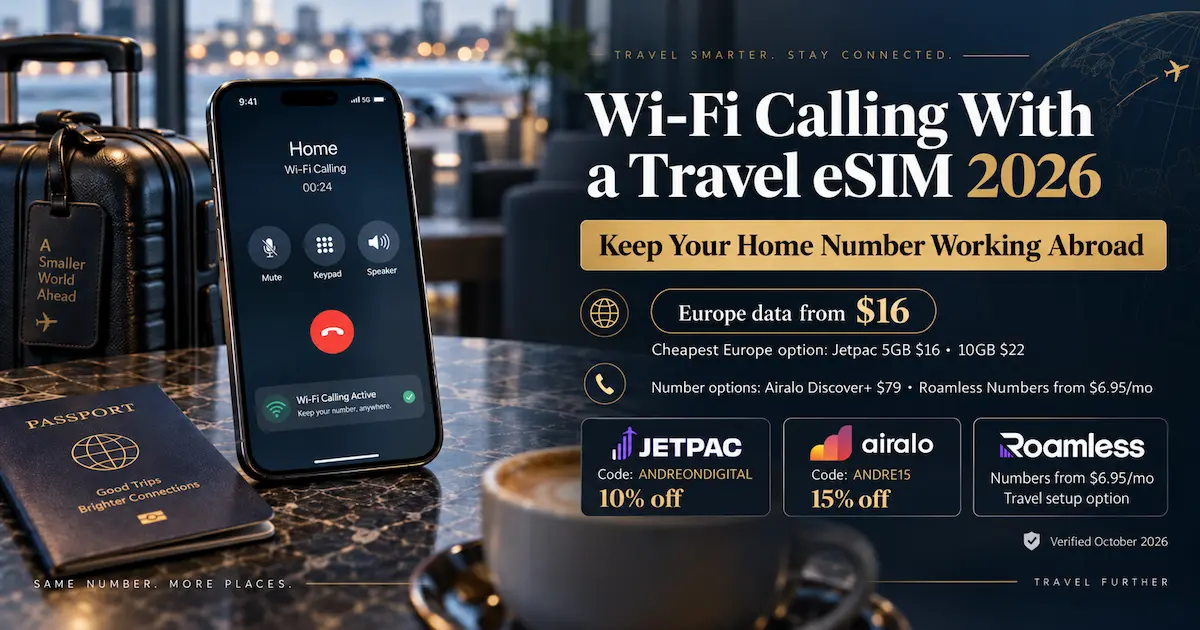
💶 Cheapest Europe data: Jetpac $16 for 5GB and $22 for 10GB
📞 A real number in the plan: Airalo Discover+ · $79 · 10GB, 100 min, 100 SMS, +1 number
🔁 A separate number: Roamless Numbers · $6.95/month or $59.95/year
⚠️ Airplane mode kills your travel eSIM data too. It is not a safety switch.
Almost every argument about this comes from conflating them, so it is worth separating them before looking at any carrier. In Wi-Fi Calling With a Travel eSIM 2026, that distinction is the difference between ordinary Wi-Fi Calling and the much less certain Cross-SIM path.
What it is
Where the internet comes from
Who has to allow it
How well documented
📶 Wi-Fi Calling over real Wi-Fi
Hotel, café or home network
Your home carrier, your plan, your device, the country
✅ Well documented by most carriers
⚠️ Cross-SIM, calls over the other SIM’s data
Your travel eSIM’s mobile data
Your home carrier and the device, provisioned separately
⚠️ Illustrated by Apple, a separate flag on Android, confirmed by no carrier
📱 App calling
Any internet, including the travel eSIM
Nobody. It is just data
✅ Always works, but not your number
🧭 Why the middle row is the whole argument. When a guide says Wi-Fi Calling works with a travel eSIM, it usually means the second thing, not the first. The first is genuinely well documented and depends only on your carrier allowing the feature abroad. The second is a distinct capability that Android’s own developer reference lists under a separate configuration flag from Wi-Fi Calling, added at a later API level, with its own branding options. That separation is the clearest technical evidence available that a phone having a Wi-Fi Calling menu tells you nothing about whether it can route your home line over a second SIM. Both the handset and the carrier have to support Cross-SIM specifically, which is why two people with the same phone on different networks get different answers.
The Carrier Table: Who Actually Allows It Abroad
For Wi-Fi Calling With a Travel eSIM 2026, the carrier table comes before the phone settings. We read twelve carriers from their own published policies on 3 October 2026. The column that matters most is the last one, and it is the same answer every time.
Carrier
Wi-Fi Calling abroad
Calls home
Over the eSIM’s data
🇺🇸 Verizon
✅ Allowed, with a blocked-country list
✅ No extra charge to US numbers
⚠️ Not confirmed
🇺🇸 AT&T postpaid
⚠️ Most destinations, 13 excluded by name
✅ No extra charge to US numbers
⚠️ Partial, via an iPhone tutorial
🇺🇸 AT&T Prepaid
⚠️ Same exclusions
✅ No extra charge to US numbers
⚠️ Not confirmed
🇺🇸 T-Mobile US
✅ Allowed, except where prohibited
✅ Included on unlimited plans
⚠️ Not confirmed. ⚠️ Cellular hotspot expressly excluded
🇺🇸 Google Fi
✅ Many destinations
✅ Included to the US
⚠️ Not confirmed
❌ 🇬🇧 EE consumer
❌ UK only
❌ Not applicable abroad
⚠️ Not confirmed
🇬🇧 EE Business
⚠️ UK and US per its business FAQ
⚠️ Exact billing not published
⚠️ Not confirmed
❌ 🇬🇧 O2
❌ Not supported outside the UK
❌ Not applicable abroad
⚠️ Not confirmed
❌ 🇬🇧 Vodafone UK Business
❌ Not available abroad
❌ Not applicable abroad
⚠️ Not confirmed
❌ 🇬🇧 Three UK
❌ Defined as within the UK
❌ Not applicable abroad
⚠️ Not confirmed
🇨🇦 Rogers
✅ Supported outside Canada
✅ Received calls and calls to Canada
⚠️ Not confirmed
❌ 🇨🇦 Bell
❌ Within Canada only
❌ Not applicable abroad
⚠️ Not confirmed
❌ 🇨🇦 TELUS
❌ Terms say it cannot be used outside Canada
❌ Not applicable abroad
⚠️ Not confirmed
🇦🇺 Telstra
✅ Calling and SMS abroad
✅ To Australia and received calls
⚠️ Not confirmed. ⚠️ Calls to other countries not enabled abroad
🇬🇧 If you are British or Canadian, read that table again before you plan around this.EE’s consumer travel guide says Wi-Fi Calling is available in the UK only. O2 says it is not supported outside the UK. Vodafone’s business FAQ says the same for calls and SMS over Wi-Fi. Three’s terms define the feature as calls and texts over Wi-Fi within the UK. In Canada, Bell says within Canada only and TELUS’s official terms say it cannot be used outside Canada. That is four of the five major UK networks and two of the three major Canadian ones. The advice that fills this search result is written largely for an American audience and does not travel. Rogers is the Canadian exception, supporting it abroad with its own billing rules. And note the EE split: its business FAQ claims availability in the UK and the US while its consumer page says UK only, so the segment you are on changes the answer.
Six of the twelve carriers audited do not support Wi-Fi Calling abroad: EE consumer, O2, Vodafone UK Business, Three UK, Bell and TELUS. None of the twelve officially confirms Wi-Fi Calling over a travel eSIM’s own mobile data. Verified October 2026.
The Thirteen Countries Where It Is Blocked Outright
🚫 AT&T publishes the list by name, and two of them are places people genuinely go. Wi-Fi Calling is excluded in China, Cuba, North Korea, India, Iran, Israel, Pakistan, Saudi Arabia, Sudan, Syria, Turkey, the United Arab Emirates and Vietnam. That is thirteen destinations where the feature does not work regardless of your device, your plan or how good the hotel Wi-Fi is, and it includes Turkey and the UAE, which between them see tens of millions of visitors a year. T-Mobile states separately that the service is unavailable where it is prohibited, and Verizon maintains its own current list. If your trip includes any of these, plan on app calling over your travel eSIM’s data from the start rather than discovering it at the airport. For Wi-Fi Calling With a Travel eSIM 2026, country restrictions are therefore a first-step check, not a footnote. Our international travel guide covers which regional plans reach those destinations.
What It Costs, Which Is Not Always Nothing
Wi-Fi Calling With a Travel eSIM 2026 can reduce roaming exposure, but it does not make every call free. The destination you dial and the carrier’s own billing rules still decide what you pay.
Carrier
Calls to your own country
Calls to a local or third-country number
Watch out for
AT&T
✅ No extra charge to US numbers
⚠️ Follows the roaming add-on rules
⚠️ Two AT&T articles conflict on how international long distance is applied
AT&T Prepaid
✅ No extra charge to US numbers
⚠️ Billed differently from postpaid
Do not carry postpaid pricing across to Prepaid
Verizon
✅ No extra charge back to the US
⚠️ Long distance rates apply
⚠️ On iPhone, enable it while connected to Verizon before you leave
T-Mobile US
✅ Included on unlimited
⚠️ Per the destination’s rate
⚠️ Can fall back to cellular if Wi-Fi drops. ⚠️ A VPN can change the billing
Google Fi
✅ Included to the US
⚠️ Charged by the destination of the number called, same as cellular
⚠️ Use the service in the US for at least a day before travelling
Rogers
✅ Received calls and calls to Canadian numbers
⚠️ Non-Canadian numbers trigger Roam Like Home
⚠️ Airplane mode does not remove the charge
Telstra
✅ To Australia and received calls
❌ Calls to other countries not enabled while abroad
Terms revised July 2025 add their own conditions
💸 The pattern across every carrier: it is free to call home, and not free to call anywhere else. Wi-Fi Calling bills by the destination of the number you dial, not by the fact that you are on Wi-Fi. So calling your hotel in the next town, a local restaurant or a colleague in a third country goes to international long distance rates on most of these carriers, and on AT&T and Verizon it does not draw on the daily roaming pass allowance either. Two further traps: Rogers states in its billing FAQ that airplane mode does not eliminate the charge, so switching it on after the fact changes nothing, and T-Mobile notes a VPN can change how a call is billed. Our AT&T Day Pass guide covers how making a Wi-Fi call can itself start a $12 session.
AT&T lists thirteen destinations where Wi-Fi Calling is excluded regardless of device or plan, including Turkey and the United Arab Emirates. T-Mobile and Verizon maintain separate restrictions. Verified October 2026.
What Apple and Google Actually Document
Platform
What is documented
The condition attached
🍎 Apple, calls over the other SIM’s data
Apple illustrates a second carrier using the other line’s cellular data, with Allow Cellular Data Switching enabled
⚠️ The illustration does not guarantee any combination of carriers
🍎 Data switching during a call
The voice line can take over data during a call
⚠️ Does not work if you are already using the other line’s data
🍎 Dual SIM requirements
iPhone XS, XS Max, XR and later with eSIM. iPhone 13 and later support two eSIMs
⚠️ Regional variants differ. Unlocking is required for two different carriers
🍎 iOS 26 travel setup
The assistant can install a travel eSIM alone or alongside your main line, with the eSIM for data
Flow depends on device, country and availability
⚠️ 🍎 FaceTime and iMessage
Apple says they can continue on the travel eSIM
⚠️ That is not evidence that carrier voice and SMS will
🍎 Airplane mode
Switches off the cellular radio; Wi-Fi can be re-enabled
❌ It does not preserve the travel eSIM’s cellular internet
🤖 Android, the technical reference
Separate configuration flags for Wi-Fi Calling over IMS and for Cross-SIM over IMS
⚠️ The flag existing does not mean your carrier enables it
🤖 Pixel 8a and later
Can answer or start a second call while keeping the first, with data on both SIMs and automatic switching
⚠️ Documented as a simultaneous-call scenario, not a Cross-SIM guarantee
🤖 Pixel 8 and earlier
During a call, the other SIM’s calls go to voicemail
—
🤖 Android, feature deactivation
The phone can switch Wi-Fi Calling off after detecting a problem
⚠️ A menu that was on before does not prove the line is registered now
🍎 For Wi-Fi Calling With a Travel eSIM 2026, Apple’s position is the strongest device-side evidence available and it still falls short of a promise.Apple’s Dual SIM with eSIM documentation does illustrate the second carrier using the other line’s cellular data when Wi-Fi Calling is enabled on that line and Allow Cellular Data Switching is on. What it does not do is guarantee it for any particular pair of carriers, and the audit behind this guide records that distinction rather than smoothing it over. Two conditions travel with it: the switch during a call does not work if you are already using the other line’s data, and if the line in use is not your default data line the behaviour changes again. The genuinely useful development is iOS 26’s travel setup assistant, which can install a travel eSIM alongside your main line in one flow, keeping the main line for voice. Our eSIM compatible phones guide covers which models qualify.
✈️ And the airplane-mode advice that circulates everywhere is wrong for this setup. Putting the phone in airplane mode and switching Wi-Fi back on is sound advice when your internet comes from a hotel network, and it is how people avoid accidental roaming. It does not work when your internet comes from a travel eSIM, because airplane mode switches off the cellular radio and the eSIM is cellular. You lose the data you are paying for along with the roaming you are avoiding. Use data roaming controls on the specific line instead, which is the approach our activation guide sets out step by step.
What Each eSIM Provider Says About Your Home Number
In Wi-Fi Calling With a Travel eSIM 2026, the travel eSIM provider supplies the data connection; it does not override the home carrier’s calling policy. That is why provider pricing and number products should be compared separately from carrier support.
Provider
What it documents
Separate number product
Europe 5GB / 10GB
Jetpac
Its Dual SIM page does not certify Wi-Fi Calling over its data
Voice packs bought separately
$16 / $22 · 32 destinations
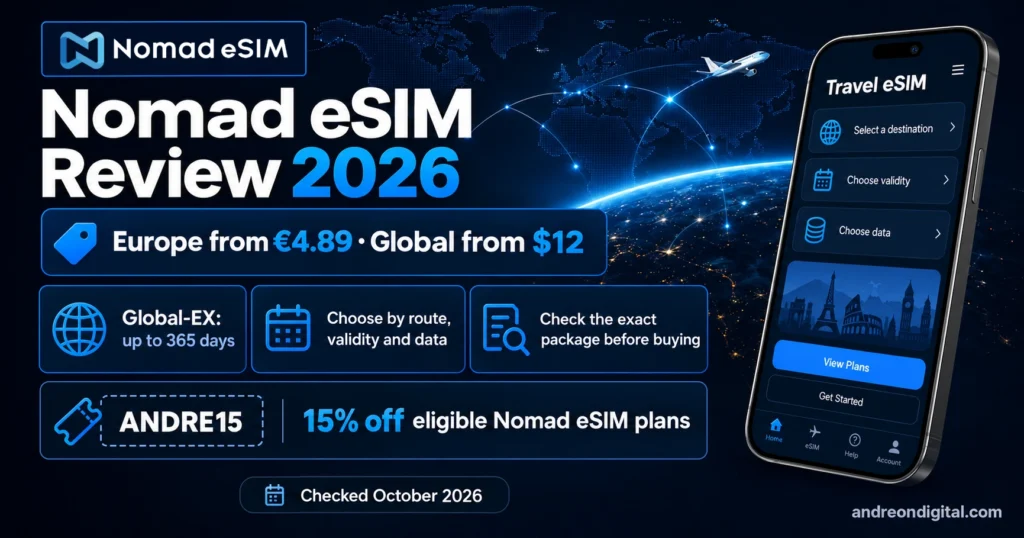
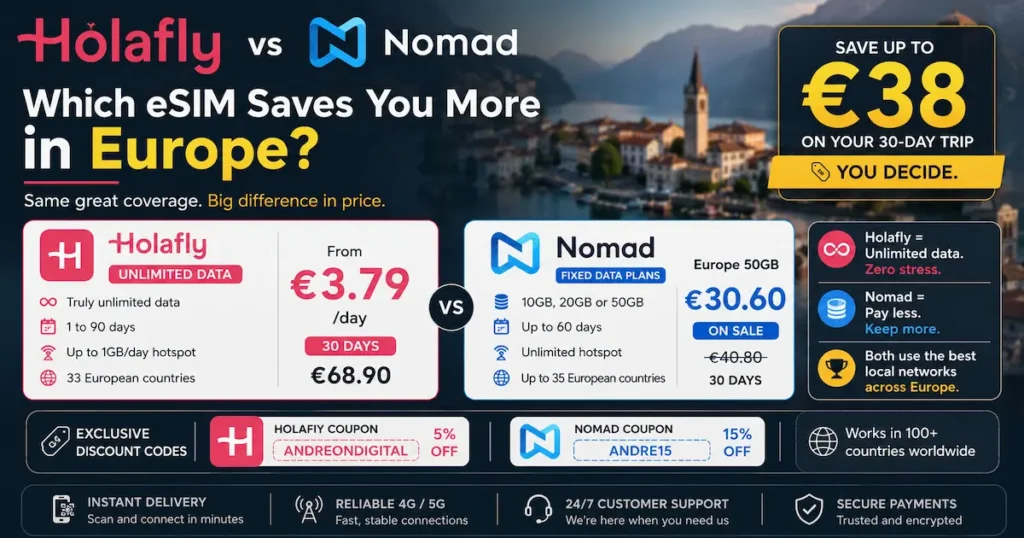
Nomad
Its blog explicitly mentions main-line calls over eSIM data, conditional on your carrier
Data only on the plans sampled
$17.50 / $23 · 35 destinations
Roamless
✅ States plainly that it does not provide carrier-level Wi-Fi Calling
Numbers: $6.95/month or $59.95/year
$17.95 / $30.95 · 40 destinations
Airalo
Its guide requires a compatible device and carrier and directs you to a real Wi-Fi connection
Documents the main line coexisting, and warns that calls on it can trigger carrier charges
Saily Phone Number, an optional US number
$19.49 / $35.99 · 35 destinations
aloSIM
No guarantee of native Wi-Fi Calling over its data found
Hushed, a separate VoIP app
$19.50 / $36 · 35 destinations
🏅 Credit where it is due: Roamless is the only one that says the quiet part out loud. Its own blog states plainly that it does not provide Wi-Fi Calling at the carrier level and distinguishes its in-app calling from the carrier feature. That is a disclosure against interest, and it is more useful to a reader than three competitors asserting the opposite without a carrier to back it. One related thing worth separating, because it is widely misread: Roamless lets you verify your own number as caller ID, so outgoing app calls display it. It does not deliver incoming calls to that number. Full detail in our Roamless review.
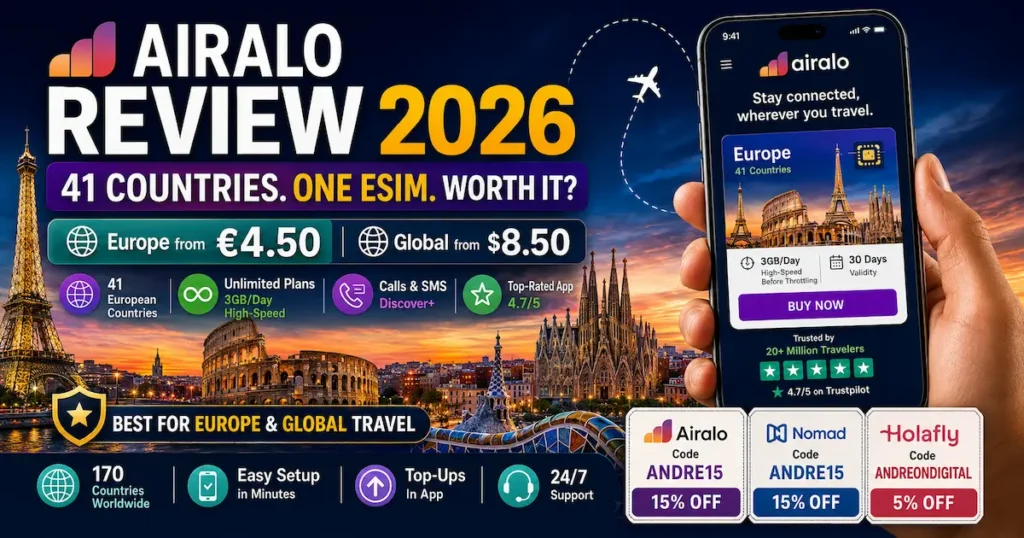
💶 On price, the eSIM you pick does not change whether Wi-Fi Calling works, so buy on data value. For Europe in October 2026 Jetpac is cheapest at $16 for 5GB and $22 for 10GB, though across 32 destinations rather than Airalo’s 41, which is the trade our Jetpac vs Airalo comparison looks at in full. If what you actually want is a number that rings rather than your existing one, Airalo’s Discover+ at $79 bundles a +1 number with 100 minutes and 100 texts alongside 10GB over 180 days, which removes the carrier question entirely. Note that its 100 minutes are rounded to whole minutes and that without minutes left you cannot receive calls.
Jetpac: Using the eSIM as Your Travel Data Line
In Wi-Fi Calling With a Travel eSIM 2026, Jetpac fits this setup as the travel data line. The eSIM provides the mobile internet connection, while Wi-Fi Calling for your home number still depends on your home carrier, your phone and whether the required dual-SIM capability is supported. That distinction matters because buying a Jetpac plan does not itself enable carrier-level Wi-Fi Calling on your primary line.
The practical reason to consider Jetpac here is data value rather than a promise about your home number. Use the travel eSIM for data, keep the home line active for calls and texts, and verify Wi-Fi Calling or Cross-SIM support with the carrier before relying on it abroad.
Airalo: Travel Data and the Discover+ Number Option
For Wi-Fi Calling With a Travel eSIM 2026, Airalo can also provide the travel data line, but this article separates that role from the calling feature on your home carrier. Airalo’s Discover+ is different because it includes its own +1 number with minutes and texts, giving travellers another option when keeping the original carrier number reachable is not the only priority.
For this setup, decide first whether you simply need affordable data or whether you also need a separate callable number. That keeps the Airalo data plan, Discover+ voice features and your home carrier’s Wi-Fi Calling support from being treated as the same thing.
Roamless: Data, In-App Calling and Your Existing Number
Within Wi-Fi Calling With a Travel eSIM 2026, Roamless is especially useful for understanding the distinction because it states that it does not provide carrier-level Wi-Fi Calling. Its data service, in-app calling features and number products should therefore be evaluated separately from the Wi-Fi Calling capability controlled by your home carrier.
Roamless can still be part of the same dual-SIM travel setup as the data connection. The key point is that its own calling tools do not turn the travel eSIM into your home carrier line, so incoming calls, caller ID and carrier Wi-Fi Calling should not be treated as interchangeable features.
Wi-Fi Calling and Cross-SIM are separate capabilities. Wi-Fi Calling uses a real Wi-Fi network, while Cross-SIM can route your home line through another SIM’s mobile data when both the device and carrier support it. Verified October 2026.
The Setup, and How to Check It Before You Fly
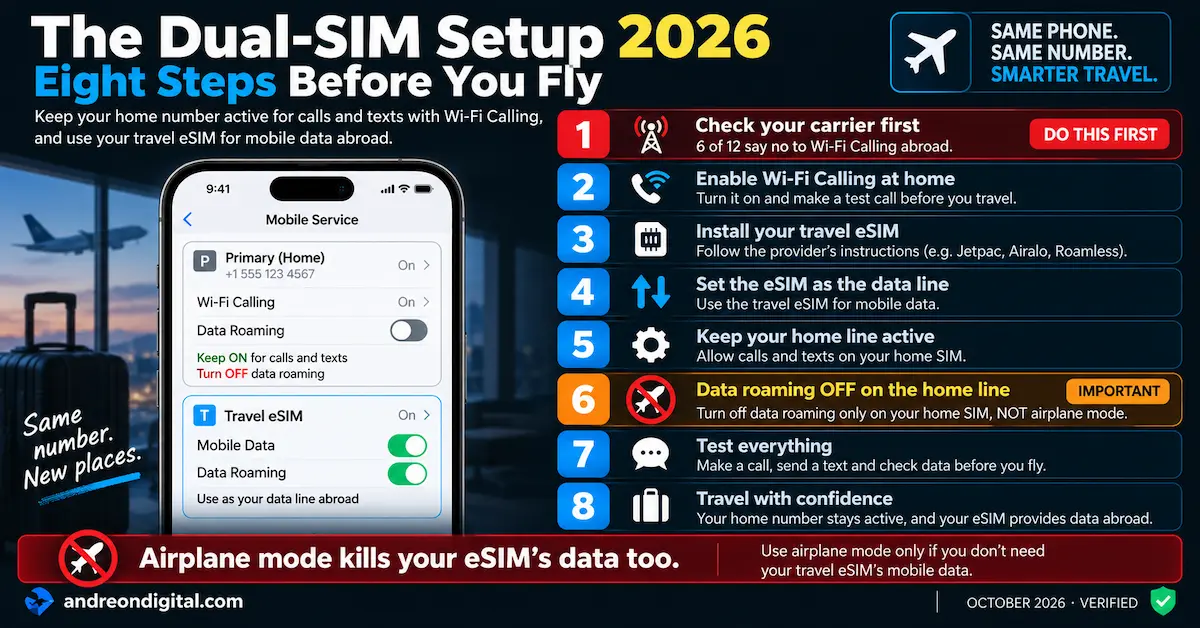
The practical setup for Wi-Fi Calling With a Travel eSIM 2026 is simple once the carrier check is done: keep the home line active for calls and texts, choose the travel eSIM for data, and control roaming on each line separately.
Step
What to do
Why it matters
1. Check your carrier first
Find your carrier in the table above
⚠️ Six of twelve do not allow it abroad at all. Nothing else matters if yours is one
2. Enable it before you leave
Turn Wi-Fi Calling on while connected to your home network
⚠️ Verizon requires this on iPhone. Google Fi asks you to use the service for a day first
3. Register your emergency address
Add the E911 or equivalent address your carrier asks for
Required by AT&T and T-Mobile before the feature activates
4. Install the travel eSIM at home
Over Wi-Fi, before departure
Validity usually starts on first connection abroad, not on install
5. Set the data line, not the voice line
Travel eSIM as mobile data · home line kept active for calls and texts
iPhone Control Centre shows the carrier state when Wi-Fi Calling is active
⚠️ The plain Wi-Fi icon alone does not prove the line is registered
8. Test a code before it matters
Trigger a verification SMS you can afford to miss
⚠️ No carrier or provider guarantees short-code delivery
🔐 On bank codes, the honest answer is that it usually works and nobody promises it. Several carriers document SMS over Wi-Fi on eligible devices and plans, and AT&T confirms separately that receiving a text does not trigger its daily roaming charge, which is genuinely good news for this setup. What none of them promise, and what the audit behind this guide marks as unconfirmed across every carrier and every paid number product, is delivery of any particular authentication code. Short codes and bank systems route by their own rules. Keep the home line registered rather than removing it, test a code before you fly if the account matters, and keep a second authentication method that does not depend on SMS.
Dual-SIM travel setup for 2026: check your carrier first, enable Wi-Fi Calling before departure, use the travel eSIM as the data line and turn data roaming off on the home line rather than using airplane mode. Verified October 2026.
FAQ, Wi-Fi Calling With a Travel eSIM 2026
Does Wi-Fi Calling work with a travel eSIM?
Over real Wi-Fi it usually works, provided your home carrier allows it abroad. Over the travel eSIM’s own mobile data it is a different feature, and no carrier we audited confirms it officially. Reading the published policies of twelve carriers across the US, UK, Canada and Australia on 3 October 2026, every single one returned no confirmation that Wi-Fi Calling runs over a second SIM’s data, with AT&T the only partial case through an iPhone tutorial describing receiving calls that way. Several travel eSIM sellers state it as settled fact. Apple illustrates the scenario and says it depends on the carriers and device, and Android’s own developer reference treats Wi-Fi Calling and Cross-SIM as two separate capability flags. Verified October 2026.
Which carriers do not support Wi-Fi Calling abroad at all?
Six of the twelve we audited. In the United Kingdom, EE’s consumer travel guide says Wi-Fi Calling is available in the UK only, O2 states it is not supported outside the UK, Vodafone’s business FAQ says Wi-Fi Calling and SMS over Wi-Fi are not available abroad, and Three’s terms define the feature as calls and texts over Wi-Fi within the UK. In Canada, Bell says it is available only within Canada and TELUS’s official terms say it cannot be used outside Canada. So for a British or Canadian traveller on most major carriers, the setup every guide recommends does not exist. Rogers is the Canadian exception and supports it abroad with specific billing rules. Verified October 2026.
Is Wi-Fi Calling free when I am abroad?
Only for calls to your own country, and even then the conditions vary. AT&T charges nothing extra for Wi-Fi calls to US numbers, and calls to non-US numbers follow its roaming add-on rules rather than being included. Verizon is the same for calls back to the US, while a local or third-country number is billed at long distance rates. Google Fi charges by the destination of the number you call, exactly as it would on cellular. Rogers includes calls received from any country and calls to Canadian numbers, while non-Canadian numbers trigger Roam Like Home. Telstra includes calls to Australia and received calls, and does not enable calls to other countries while you are abroad. Verified October 2026.
Are there countries where Wi-Fi Calling is blocked?
Yes, and AT&T publishes the list by name: China, Cuba, North Korea, India, Iran, Israel, Pakistan, Saudi Arabia, Sudan, Syria, Turkey, the United Arab Emirates and Vietnam. That is thirteen destinations where the feature is excluded regardless of your device or plan, and it includes two heavily visited ones in Turkey and the UAE. T-Mobile also states the service is not available where it is prohibited. Verizon maintains its own current list of blocked countries. If your trip includes any of these, plan on app-based calling over your travel eSIM’s data rather than expecting your home number to ring. Verified October 2026.
Does airplane mode plus Wi-Fi solve it?
For a hotel Wi-Fi connection yes, and it is the standard advice for a reason. For a travel eSIM it does the opposite of what people expect, because airplane mode switches off the cellular radio and that includes the travel eSIM’s own data connection. So you cannot use airplane mode to suppress roaming while keeping eSIM data running on the same phone. There is a second catch worth knowing: Rogers states in its billing FAQ that airplane mode does not eliminate the charge, so switching it on after a session has already started does not undo it. Use data roaming controls on the specific line instead of airplane mode. Verified October 2026.
What is Cross-SIM and why does it matter?
It is the technical name for the thing most guides describe without naming, and Android’s own developer documentation treats it as separate from Wi-Fi Calling. The platform defines distinct configuration flags for Wi-Fi Calling over IMS and for Cross-SIM over IMS, with the Cross-SIM flag and its branding options added at a later API level. The practical consequence is that a phone having a Wi-Fi Calling menu proves nothing about whether it can route your home line’s calls over a second SIM’s data. Both the device and the carrier have to provision the Cross-SIM capability specifically, which is why the answer differs between two people with the same handset on different networks. Verified October 2026.
What does Apple actually say about calls over the other SIM’s data?
It illustrates the scenario rather than guaranteeing it. Apple’s dual-SIM documentation shows a second carrier using the other line’s cellular data when Wi-Fi Calling is on for that line and Allow Cellular Data Switching is enabled, and it states that this depends on your carriers and device. Two conditions sit alongside it: data switching during a call does not work if you are already using the other line’s data, and if the line in use is not your default data line the automatic switch behaves differently. From iOS 26 the travel setup assistant can install a travel eSIM alongside your main line, keeping the main line for voice while the eSIM carries data. Apple also notes that FaceTime and iMessage continuing on a travel eSIM is not evidence that carrier voice and SMS will. Verified October 2026.
Will I still receive bank verification codes?
Often yes, and no carrier or provider guarantees it. Several carriers document SMS over Wi-Fi on eligible devices and plans, and AT&T confirms separately that receiving a text does not trigger its daily roaming charge. What none of them promise is delivery of any particular authentication code, because short codes and bank systems follow their own routing rules. The audit behind this guide treats universal OTP delivery as unconfirmed on every provider checked, including the paid number products. The practical approach is to keep your home line registered rather than removing it, test a code before you fly if the account matters, and have a backup authentication method that does not depend on SMS. Verified October 2026.
Which travel eSIM should I buy for this setup?
Any data plan works, since the eSIM supplies internet rather than the calling feature. On price for Europe in October 2026, Jetpac is cheapest at $16 for 5GB and $22 for 10GB over 30 days across 32 destinations, with Nomad at $17.50 and $23 across 35, Roamless at $17.95 and $30.95 across 40, Airalo at $19.50 and $31 across 41, and Saily at $19.49 and $35.99 across 35. Worth knowing that Roamless is the only provider that states plainly it does not offer carrier-level Wi-Fi Calling, which is an honest disclosure rather than a limitation unique to it. If you want a callable number inside the plan instead, Airalo’s Discover+ includes a +1 number with 100 minutes and 100 texts alongside 10GB over 180 days at $79. Verified October 2026.
What if my carrier does not support Wi-Fi Calling abroad?
You have three workable options and one that is often misunderstood. The first is app calling over your travel eSIM’s data, using WhatsApp, FaceTime or Signal, which works regardless of carrier policy and is what most travellers end up using. The second is a separate number product: Airalo’s Discover+ bundles a +1 number with minutes and texts, Saily sells an optional US number, Roamless sells Numbers at $6.95 a month or $59.95 a year, and aloSIM pairs with Hushed. The third is your carrier’s own roaming pass if your number genuinely must ring. The misunderstood option is caller ID verification, which Roamless offers: it makes your outgoing app calls display your real number, and it does not deliver incoming calls to that number. Verified October 2026.
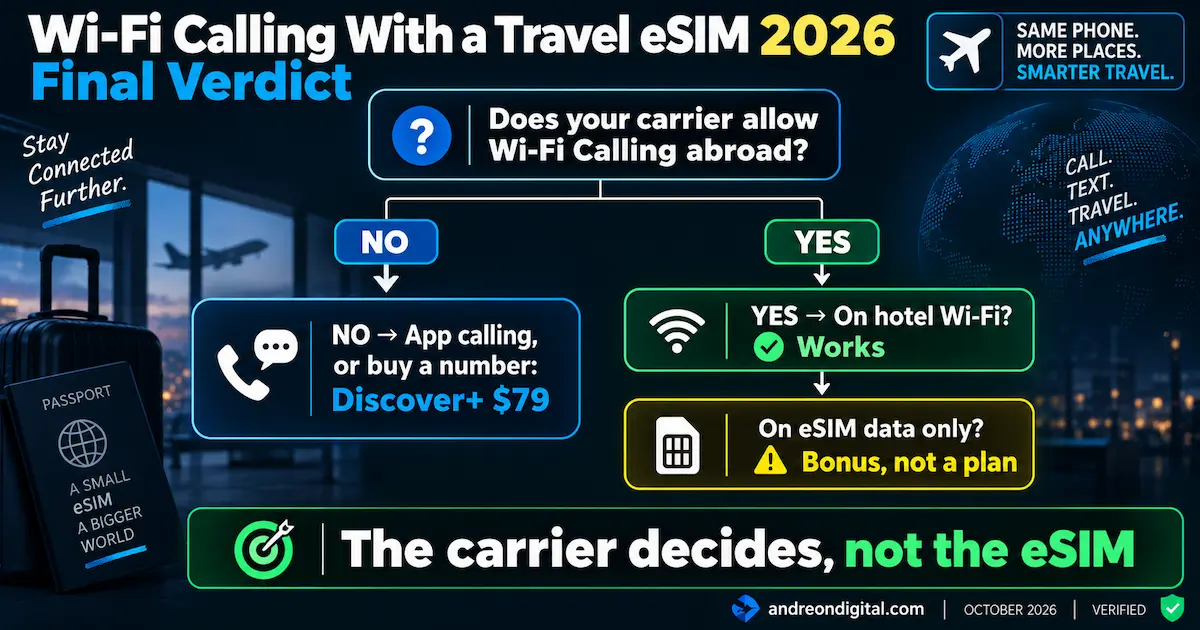
Wi-Fi Calling With a Travel eSIM 2026 final verdict: check your carrier first. Over hotel Wi-Fi it usually works, while over travel eSIM data it should be treated as a bonus rather than a guaranteed setup. Airalo Discover+ at $79 is an alternative when you need a separate number. Verified October 2026.
Final Verdict: Can Your Home Number Still Work?
Often, yes. The dual-SIM setup is genuinely the right answer for most travellers, and keeping your number reachable while a cheap eSIM carries your data is worth the five minutes it takes. What the guides selling eSIMs leave out is that the carrier decides, not the eSIM, and that six of the twelve we read say no before the conversation even starts.
1️⃣ Check your carrier first.EE consumer, O2, Vodafone, Three, Bell and TELUS do not support it abroad
✅ Over hotel or café Wi-Fi: works on most US and Australian carriers, and on Rogers
⚠️ Over your travel eSIM’s data:no carrier confirms it. Treat it as a bonus, not a plan
❌ Thirteen countries are blocked outright on AT&T, including Turkey and the UAE
💶 Buy the data on value:Jetpac at $16 for 5GB in Europe, or Airalo for 41 destinations
📞 Want a number that definitely rings?Airalo Discover+ at $79 with a +1 number, or Roamless Numbers at $6.95 a month
📱 The fallback that always works: WhatsApp or FaceTime over the eSIM’s data
Three things to carry away. Wi-Fi Calling and Cross-SIM are two different features, and Android’s developer reference treats them separately. A Wi-Fi Calling menu on your phone therefore does not prove the second capability is provisioned.
Airplane mode is not a safety switch here. It kills the travel eSIM’s data along with the roaming, and on Rogers it does not remove a charge already incurred.
It is free to call home and rarely free to call anywhere else. Carriers bill by the destination of the number you dial. We are affiliates of several eSIM providers mentioned here, which is worth stating plainly on a question where many competing pages are published by providers.
This article contains affiliate links for several of the eSIM providers compared. We may earn a commission at no extra cost to you, and we have no relationship with any of the carriers discussed.
This is a documentary audit of official sources rather than a field test, and is presented as such. We tested no calls, messages or verification codes and measured no speeds. Every carrier policy, device capability, provider condition and price was read from published sources on 3 October 2026, covering twelve carriers across the United States, United Kingdom, Canada and Australia, 41 device findings, 36 plan prices across six eSIM providers and 25 provider conditions.
Where a source is silent, this guide records the point as unconfirmed rather than inferring an answer. No carrier audited publishes confirmation that Wi-Fi Calling operates over a second SIM’s mobile data, with AT&T recorded as partial on the strength of an iPhone tutorial describing received calls. Apple illustrates the scenario and says it depends on carriers and device. Android’s developer reference defines Wi-Fi Calling over IMS and Cross-SIM over IMS as separate configuration flags.
Carrier positions are segment-specific and divergences are preserved rather than reconciled. EE’s consumer guidance says UK only while its business FAQ cites the UK and the US. AT&T’s general international long-distance article and its specific Wi-Fi Calling FAQ are not aligned on how charges apply. AT&T Prepaid is billed differently from postpaid, and Telstra’s terms revised in July 2025 add their own conditions.
The thirteen excluded destinations listed are those AT&T names on its own page. No carrier or provider guarantees delivery of bank verification codes, short codes or any specific authentication message. Prices, policies and device behaviour change without notice, so confirm with your own carrier and at each provider’s checkout before relying on any of this.
We use cookies to improve your experience. Accept or manage preferences.
Functional
Always active
The technical storage or access is strictly necessary for the legitimate purpose of enabling the use of a specific service explicitly requested by the subscriber or user, or for the sole purpose of carrying out the transmission of a communication over an electronic communications network.
Preferences
The technical storage or access is necessary for the legitimate purpose of storing preferences that are not requested by the subscriber or user.
Statistics
The technical storage or access that is used exclusively for statistical purposes.The technical storage or access that is used exclusively for anonymous statistical purposes. Without a subpoena, voluntary compliance on the part of your Internet Service Provider, or additional records from a third party, information stored or retrieved for this purpose alone cannot usually be used to identify you.
Marketing
The technical storage or access is required to create user profiles to send advertising, or to track the user on a website or across several websites for similar marketing purposes.